On this page (20 sections)
- Quick verdict
- The walls you hit
- When staying is right
- Pick by your wall
- Six alternatives at a glance
- Beehiiv: the growth machinery
- Substack: $0 until you earn
- Kit: automation, free to 10K
- MailerLite: the price floor
- Buttondown: honest billing
- WordPress: when Ghost is too minimal
- Who controls your audience
- The switch math
- What survives the move
- Which fits you?
- Feature matrix
- What users say
- FAQ
- Methodology
- Bottom line
Ghost Alternatives 2026: Six Platforms, Matched to the Wall You Hit

By Arthur Brulard, Founder of OwnLetter. Cross-vendor analyst review across 11 newsletter platforms, aggregating user signals from Reddit, G2, Capterra, Trustpilot, and Hacker News. LinkedIn
Published June 12, 2026 · Updated June 12, 2026 · 20 min read
Quick verdict
Ghost is one of the best tools on the market at a single job: running a serious, self-owned publication. If that is your job, stay. You leave Ghost when your job is a different one. There is no free plan, only a trial; the entry Starter plan gives you a site with nothing to sell, since paid subscriptions first appear at Publisher. Growth is on you, with no native referral or recommendation engine. And the editor's design freedom assumes you can write Handlebars and CSS. If you want a free or low-setup start, growth machinery built in, or behavioral automation, the honest destinations are Beehiiv, Kit, MailerLite, Substack, Buttondown and WordPress, routed below by the exact wall you hit. Read the stay-case first: ownership through self-hosting that no rival here can match.
 Ghost
Ghost beehiiv
 Substack
 Kit
Kit MailerLite
 Buttondown
How we testedVerified June 2026 · 4915 reviews aggregated · Beehiiv + MailerLite + Substack + Kit tested · 31 sourced claims · 7 proprietary data layers · methodology public
What we did: Read the full review corpus behind the seven platforms on this page (4,915 reviews re-themed across Capterra, G2, Reddit and Trustpilot, including 415 for Ghost alone). Crossed it with our seven data layers: weekly-scraped pricing, the 53-feature matrix, trust and termination clauses, and capability docs. Re-grounded Ghost's pricing and terms against its own live pages in June 2026.
What we did NOT do: We did not test Ghost from a paid account first-hand (our Ghost screenshots are public pages, never marked as our own), we ran no seed-list deliverability tests, and we publish no inbox-placement percentages. We emit no combined star rating across platforms: review populations differ too much to average.
Refresh cadence: Pricing re-verified weekly by automated tracker; trust clauses quarterly; this page's claims manifest (31 entries with source URLs) is archived and auditable. (pricing verified June 12, 2026). Full methodology →
The Walls People Actually Hit
We read all 415 Ghost reviews in our corpus (Reddit 325, Capterra 52, G2 24, Trustpilot 14), in full. The headline finding is not that Ghost is disliked. The opposite. Its two biggest themes by volume are positive: the editor and ease of use lead with 38 mentions, native monetization at 0% follows. People who leave Ghost are not escaping a bad product. They are hitting a specific wall, and the wall decides where they should go next. Across 325 Ghost community posts on Reddit alone, the same split recurs: the editor draws the praise, while growth and setup draw the complaints.
Wall 1: no free start, and the entry plan cannot monetize
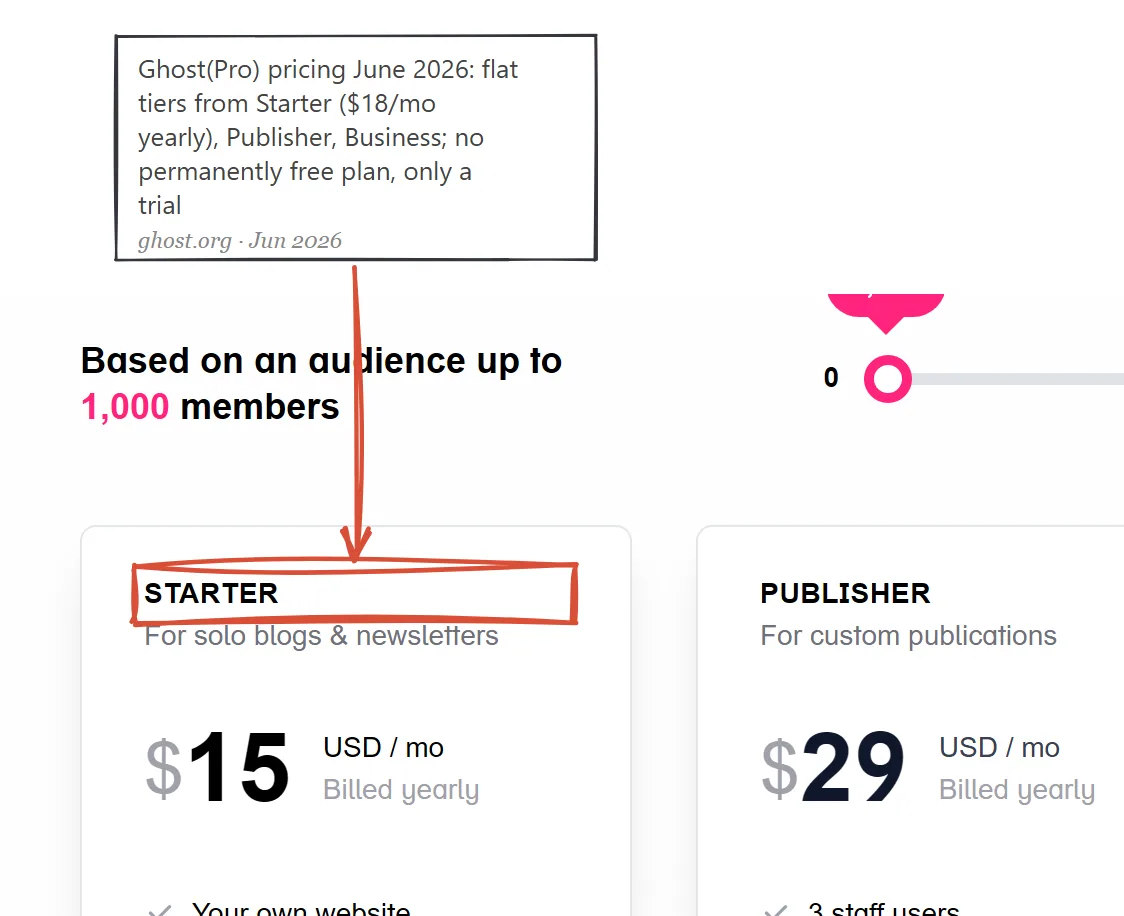
Ghost has no permanently free plan. There is a trial, and then the site goes dark. The entry Starter tier carries a real monthly fee, and it gives you a site and a list but nothing to sell: paid subscriptions, tips and premium tiers all stay locked until you upgrade to Publisher. Ghost's own pricing table is plain about it.
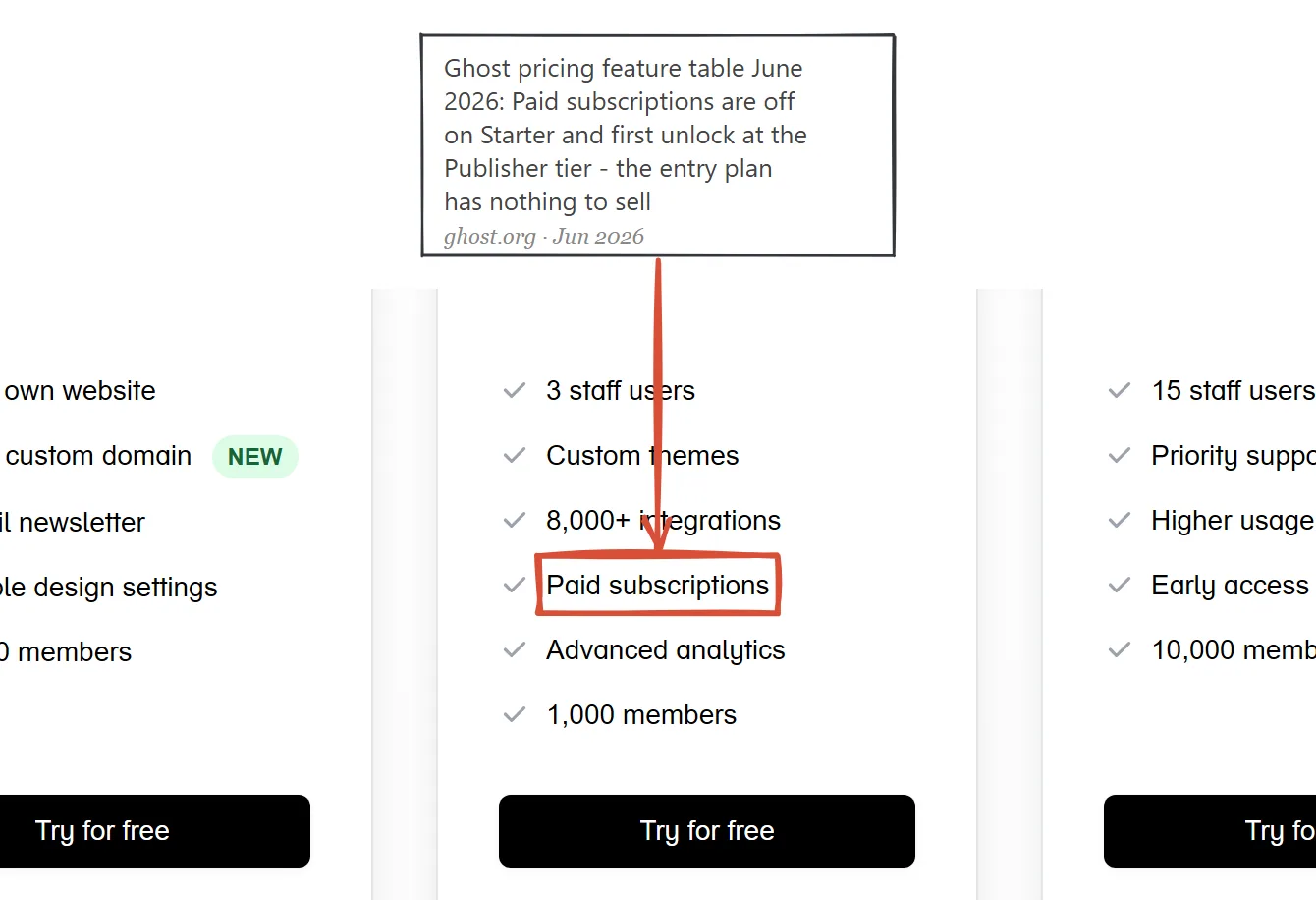
Premium pricing is the most-cited cost theme (18 mentions), and users who stay accept it. One Capterra reviewer caught the whole tension: "The only issue is the cost, which is way higher than competitors. But because it's the best, I decided that for me it worth it." If the wall is the price of starting, the exits are real free tiers: Beehiiv (free to 2,500), Kit (free to 10,000) or Substack ($0 until you earn).
Wall 2: the setup wall (11 mentions)
Ghost is easy in one direction and hard in another. Writing and publishing are frictionless; the moment you want a theme that does not ship in the box, you meet Handlebars and CSS. A paying user wrote in July 2025: "The themes are too simple and don't work, the one I paid for didn't work properly." A lively third-party theme ecosystem exists, but it is so hard to discover that a community member built a tool just to index it. On self-hosting, the setup adds Stripe wiring and a Mailgun account before you can send. If zero setup is the point, Substack publishes in minutes; Beehiiv's editor is no-code and modern.
Wall 3: growth is your job, not the platform's (6 mentions)
Ghost ships no referral program, no recommendation network and no ad network. That is a product fact, and it is the gap Ghost users name most concretely. One put it as a direct question in February 2026:
"I currently use Ghost. I'm happy with it, but newsletter signup growth has been slow. I'm curious if Beehiiv's growth tools (like the referral tool) are effective." Reddit user, February 10, 2026
That sentence is the whole routing argument for this wall. Beehiiv includes its cross-newsletter recommendation network free on every plan and adds referrals and an ad network above; Substack brings Notes and the deepest discovery network in our panel.
Wall 4: the self-host tax
Self-hosting Ghost is free in licensing and not in operations. Bulk email requires Mailgun, whose free tier of 600 a month is unusable for a real list. One creator migrating 600,000 emails a month calculated that routing through Mailgun would run roughly ten times the cost of Amazon SES. A February 2026 security vulnerability forced an emergency patch on every self-hosted instance. And the maintenance compounds: one two-year Ghost user migrated to a static Hugo site because, in their words, the upkeep outweighed the benefit of the membership tools they never used. If you wanted free and got a server to babysit, the managed exits are Beehiiv, Substack and Kit.
Wall 5: shallow analytics, no behavioral automation (5 + 2 mentions)
Ghost's native analytics are thin. The dashboard shows the last 90 days, and full web analytics is reserved for Publisher and up. One paying user wrote in December 2025: "im on the pro plan in Ghost but i dont see any way to check my blog views except Web analytics which is publisher+ plan." Behavioral automation, drip sequences and conditional branching, is absent entirely. If analytics depth or automation is your wall, Beehiiv has native open, click and revenue reporting, and Kit is built around creator workflows.
Wall 6: billing friction (5 mentions)
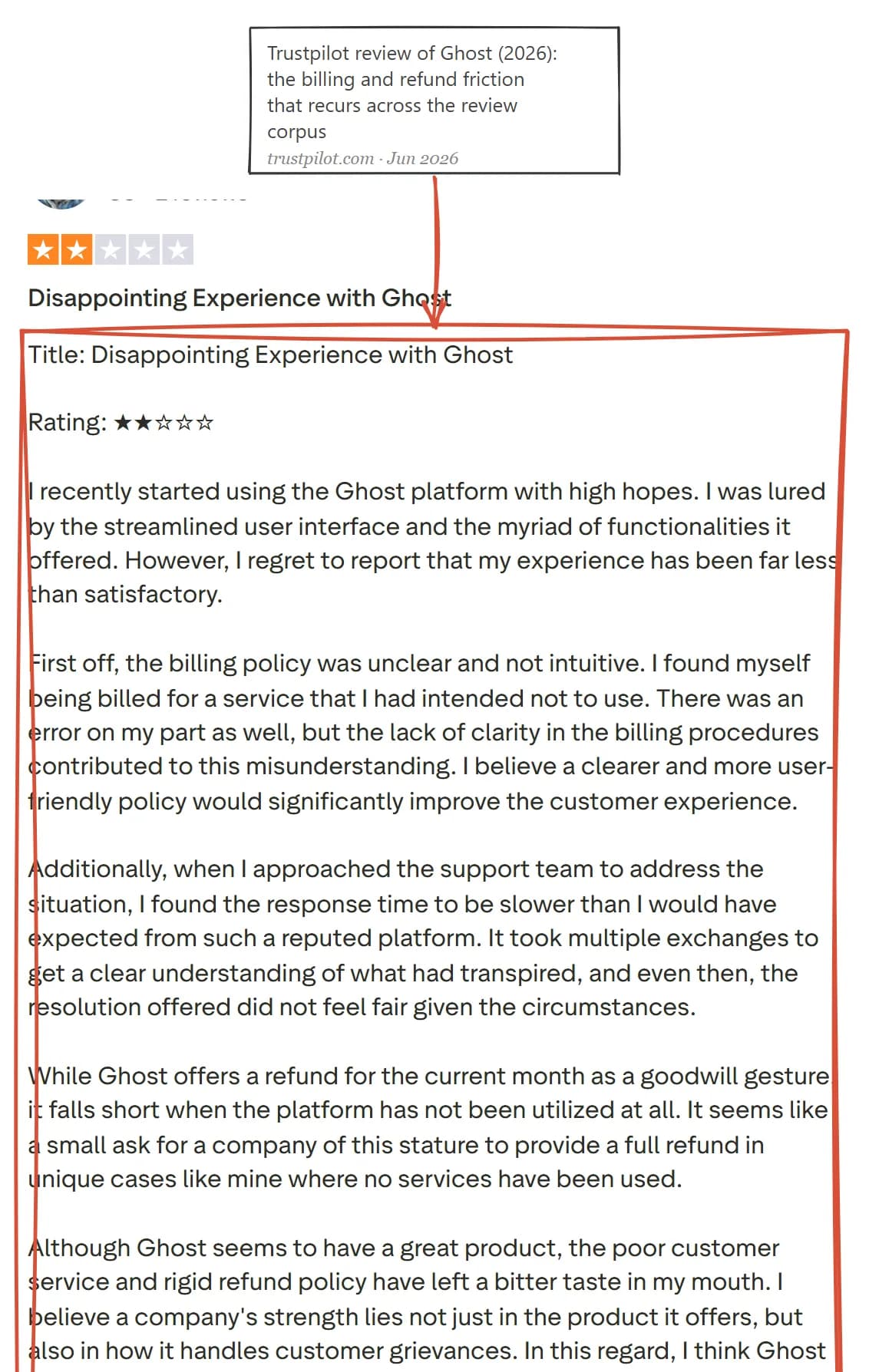
A smaller but stubborn theme, present in reviews in 2020 and still in 2026: unrequested plan changes, double charges, partial refunds and an unclear policy. One Capterra reviewer in 2020: "They changed my account plan without even asking. We realised past 3 months we have paid double the amount of what we were paying without even knowing." A Trustpilot reviewer in January 2026 documented a partial refund after weeks of unresolved problems. Low in volume, high in its effect on trust.
Our take
Where Ghost Falls Short
- The entry plan gives you a site with nothing to sellGhost(Pro) has no permanently free plan, only a trial, after which an unpaid site goes dark. The Starter tier carries a real monthly fee, and paid subscriptions, tips and premium tiers all stay locked until you upgrade. Ghost's own pricing page is plain about it: the Publisher tier is the first to allow paid subscriptions. For a creator who wants to charge readers from day one, that is an upsell, not a feature.
- Ownership is real, but read the Ghost(Pro) termsGhost sells ownership as its headline, and via the open-source self-hosted core it is genuinely the only platform here that no service can deplatform. On Ghost(Pro), the managed product, the terms are softer than the marketing: you grant the Foundation a 'perpetual, irrevocable' licence to your content, and recourse for a data or security incident is capped at $100 regardless of harm. One self-hoster put the underlying anxiety plainly in February 2026: 'I can't find language on Ghost's site regarding ownership of content.'
- Growth is your job, not the platform'sGhost ships no referral program, no recommendation network and no ad network. Audience growth depends on channels you build yourself, which is exactly the gap Ghost users name most concretely. One wrote in February 2026: 'I currently use Ghost. I'm happy with it, but newsletter signup growth has been slow. I'm curious if Beehiiv's growth tools (like the referral tool) are effective.' That sentence is the whole routing argument for the growth wall.
- Self-hosting trades a bill for a maintenance burdenThe free self-hosted core is free in licensing only. Bulk email requires Mailgun, whose free tier (600 a month) is unusable for a real list; one creator migrating 600,000 emails a month calculated roughly ten times the cost of Amazon SES. A February 2026 security vulnerability required an emergency patch on every self-hosted instance. One two-year Ghost user migrated to a static Hugo site because, in their words, the maintenance outweighed the benefit.
- Customization assumes you can codeThe Koenig editor is the most-praised element in the corpus, but the design freedom it promises runs into Handlebars and CSS for anything beyond a stock theme. A paying user wrote in July 2025: 'The themes are too simple and don't work, the one I paid for didn't work properly.' A healthy third-party theme ecosystem exists, but it is hard to discover, enough that a community member built a tool just to index it. The friction is partly discoverability, not only quality.
When Staying on Ghost Is Right
An alternatives guide that cannot argue for staying is a sales page. Here is the case for not moving, and it is stronger than any of the pages ranking for this query admit. Ghost itself pays us nothing, so we have no reason to soften it.
You can actually own it
This is the structural reason, and it is unique in this panel. The Ghost core is open source under the MIT licence, so you can self-host it on your own server and no service can ever deplatform you. None of Beehiiv, Kit, Substack or MailerLite offers that. When we cross our suspension data with our terms-of-service layer, self-hosted Ghost is the only structural exit from platform risk on the entire market. If your work is the kind that gets people deplatformed, or you simply refuse to rent your home, Ghost is the answer and the alternatives are a step down.
0% on what you charge, on a real website
From the Publisher tier, Ghost takes 0% of your subscription revenue (you pay Stripe's processing fee and nothing to Ghost). Against Substack's 10%, that gap widens with every paying subscriber. One creator weighing the move to Ghost framed it exactly: with 1,100 paying subscribers, Substack's cut was over $1,000 a month, a figure they described as starting to seem unreasonable. And you get a genuine website and CMS in the bargain, not a newsletter with a homepage. The editor is the most-praised element in 415 reviews, a sentiment one G2 reviewer put plainly in 2022: "Beautiful editor, so much better than WordPress."
A non-profit that cannot be sold
Ghost is run by a non-profit foundation whose constitution means it can never be bought or sold. It has roughly $10.6M in annual revenue, more than a decade of operation, zero outside venture capital, and recognition as a Digital Public Good in April 2026. In a market where the suspension and acquisition risks of venture-backed platforms are real, that governance is a moat of its own. It is the answer to a worry the alternatives cannot fully settle.
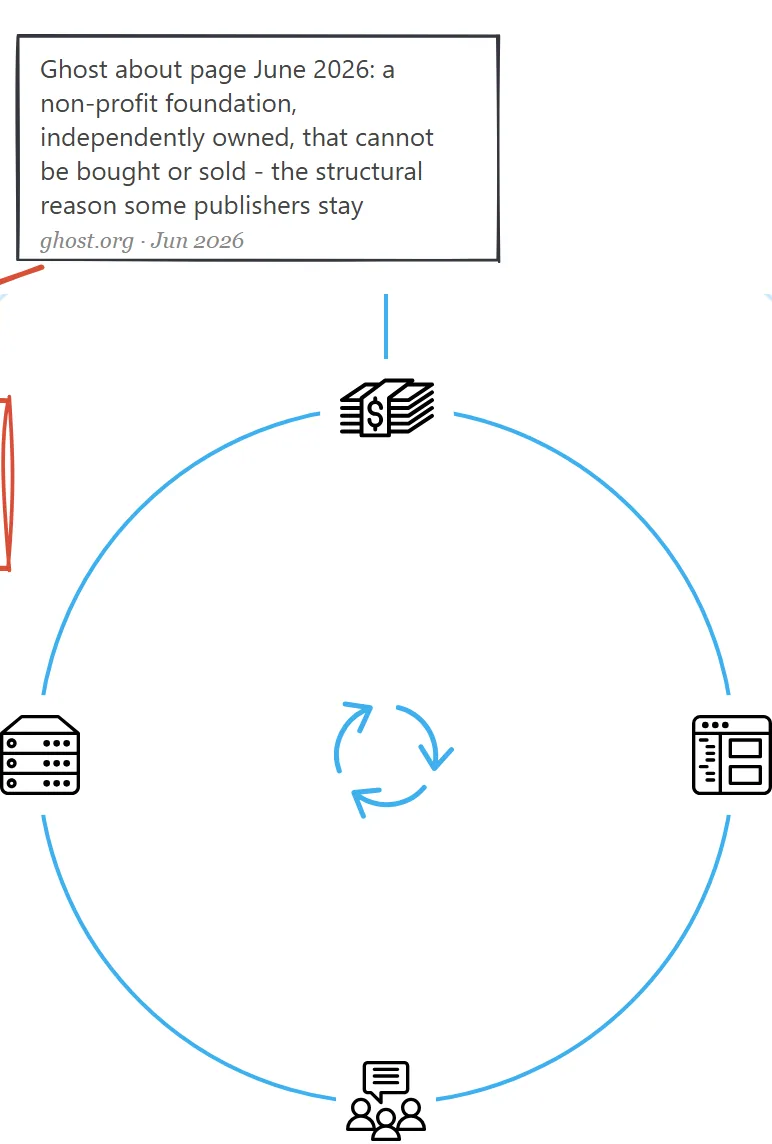
The honest caveat belongs here too. The ownership is real via self-host; on Ghost(Pro), the managed product, the terms grant the Foundation a perpetual licence to your content and cap recourse for a data or security incident at $100. Both facts are true, and both belong on this page. We cover the trade in the audience-control section below.
Stay on Ghost (ghost.org) →Pick by Your Wall, Not by a Ranking
Match your wall to the destination the data supports. Signals are from our 415-review Ghost corpus crossed with the feature and pricing layers; every row links to a section below. Four of the six destinations (Substack, Kit, MailerLite, WordPress) pay us nothing, and Ghost pays us nothing either; the routing follows the corpus.
Routing by your leave-trigger (June 2026).
Your wall ranked by review signal | First stop where the data points | Also consider the credible runner-up |
|---|---|---|
| No free plan, Starter cannot monetize, premium pricing (18 mentions) | Beehiiv (free to 2,500, 0% on Scale) | Kit (free to 10,000) or Substack ($0 until you earn) |
| Themes need Handlebars and CSS; self-host needs Stripe and Mailgun (11 mentions) | Substack (zero setup, publish in minutes) | Beehiiv (a modern no-code editor) |
| No referral, no recommendation network, no ad network (6 mentions, plus the Beehiiv question) | Beehiiv (recommendation network free on every plan) | Substack (Notes plus the deepest discovery network) |
| Mailgun mandatory, a February 2026 security patch, server upkeep | Beehiiv or Substack (managed, no server) | Kit (managed, free to 10,000) |
| 90-day dashboard, web analytics Publisher only, no drips or branching (5 + 2 mentions) | Beehiiv (native open, click and revenue analytics) | Kit (creator behavioral automation) |
| Unrequested plan changes, partial refunds, unclear policy (5 mentions) | Buttondown (active-only billing, a human founder) | MailerLite (the panel price floor) |
| No complex pages, no real store, theme limits by design | WordPress (the plugin-rich CMS Ghost is not) | MailerLite (a site and email in one, for less) |
No free plan, Starter cannot monetize, premium pricing (18 mentions)
- First stop
- Beehiiv (free to 2,500, 0% on Scale)
- Also consider
- Kit (free to 10,000) or Substack ($0 until you earn)
Themes need Handlebars and CSS; self-host needs Stripe and Mailgun (11 mentions)
- First stop
- Substack (zero setup, publish in minutes)
- Also consider
- Beehiiv (a modern no-code editor)
No referral, no recommendation network, no ad network (6 mentions, plus the Beehiiv question)
- First stop
- Beehiiv (recommendation network free on every plan)
- Also consider
- Substack (Notes plus the deepest discovery network)
Mailgun mandatory, a February 2026 security patch, server upkeep
- First stop
- Beehiiv or Substack (managed, no server)
- Also consider
- Kit (managed, free to 10,000)
90-day dashboard, web analytics Publisher only, no drips or branching (5 + 2 mentions)
- First stop
- Beehiiv (native open, click and revenue analytics)
- Also consider
- Kit (creator behavioral automation)
Unrequested plan changes, partial refunds, unclear policy (5 mentions)
- First stop
- Buttondown (active-only billing, a human founder)
- Also consider
- MailerLite (the panel price floor)
No complex pages, no real store, theme limits by design
- First stop
- WordPress (the plugin-rich CMS Ghost is not)
- Also consider
- MailerLite (a site and email in one, for less)
Six Alternatives at a Glance
Free ceilings and fee models below are feature facts from our source-verified data layer; every plan price in the sections that follow renders live from our weekly pricing tracker, with its verification date.
Six Ghost alternatives at a glance (June 2026).
Platform | Free tier real ceiling, June 2026 | Paid newsletters platform fee model | Beats Ghost at from the review corpus | Walk away if the honest dealbreaker |
|---|---|---|---|---|
| Beehiiv | 2,500 subs | 0% (on paid Scale plan) | Growth: recommendations, referrals, ad network | You want a real website and CMS, not a newsletter |
| Substack | Unlimited | 10% of paid revenue | Zero setup and a discovery network | You will resent the 10% once you scale |
| Kit | 10,000 subs | 0.6% (from the free tier) | Behavioral automation, selling digital products | You want a full publishing site, not an email tool |
| MailerLite | 500 subs / 12,000 emails | 0% (from Growing Business) | Price floor, a modern editor, a site builder | Open-source ownership is your dealbreaker |
| Buttondown | 100 subs | 0% (paid add-on) | Active-only billing, friendliest hosted terms | You want rich design or a big team |
| WordPress.com | Free ($0) | Varies by plan and plugin | Plugin breadth and full CMS control | You chose Ghost precisely to escape plugin sprawl |
Beehiiv
- Free tier
- 2,500 subs
- Paid newsletters
- 0% (on paid Scale plan)
- Beats Ghost at
- Growth: recommendations, referrals, ad network
- Walk away if
- You want a real website and CMS, not a newsletter
Substack
- Free tier
- Unlimited
- Paid newsletters
- 10% of paid revenue
- Beats Ghost at
- Zero setup and a discovery network
- Walk away if
- You will resent the 10% once you scale
Kit
- Free tier
- 10,000 subs
- Paid newsletters
- 0.6% (from the free tier)
- Beats Ghost at
- Behavioral automation, selling digital products
- Walk away if
- You want a full publishing site, not an email tool
MailerLite
- Free tier
- 500 subs / 12,000 emails
- Paid newsletters
- 0% (from Growing Business)
- Beats Ghost at
- Price floor, a modern editor, a site builder
- Walk away if
- Open-source ownership is your dealbreaker
Buttondown
- Free tier
- 100 subs
- Paid newsletters
- 0% (paid add-on)
- Beats Ghost at
- Active-only billing, friendliest hosted terms
- Walk away if
- You want rich design or a big team
WordPress.com
- Free tier
- Free ($0)
- Paid newsletters
- Varies by plan and plugin
- Beats Ghost at
- Plugin breadth and full CMS control
- Walk away if
- You chose Ghost precisely to escape plugin sprawl
Beehiiv: the Growth Machinery Ghost Never Built
Ghost ships no referral program, no recommendation network and no ad network. Beehiiv ships all three, with the cross-newsletter recommendation network included free from the first subscriber. The free Launch plan reaches 2,500 subscribers with unlimited sends, and paid newsletters carry a 0% platform fee on the paid Scale plan ( $43/mo (Scale, 1K subs) · verified June 12, 2026 at 1,000 subscribers). For the Ghost user who wrote that signup growth had been slow and wondered about Beehiiv's referral tool, this is the answer to that exact question. The editor is no-code and among the most recently rebuilt in the panel, which also answers Wall 2.
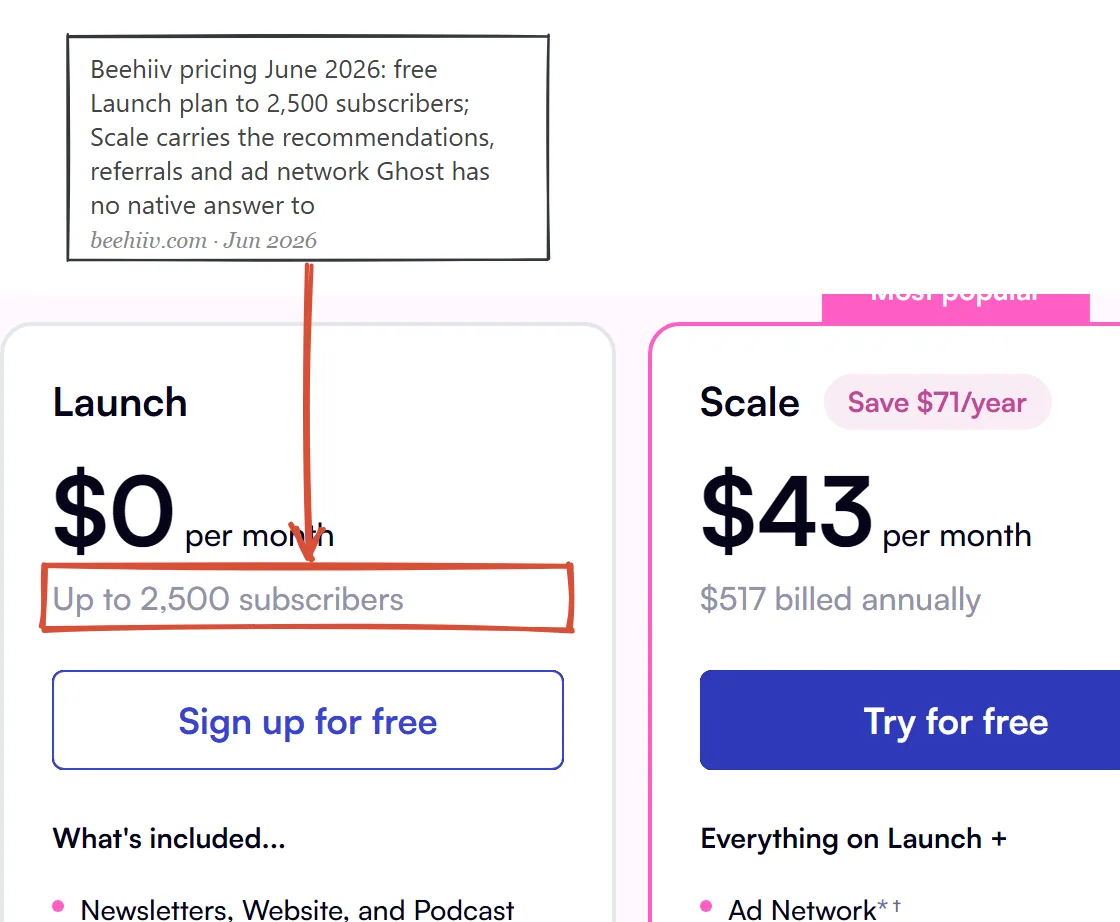
The honest ledger: Beehiiv is a newsletter business platform, not a full website and CMS. If you came to Ghost for a real publication site, Beehiiv is a narrower tool. Its own corpus also documents 15 opaque account suspensions, so it does not give you Ghost's ownership; only self-hosting does. Support on the free plan is thin.
Full first-hand walkthrough: our Beehiiv review (7.4/10).
Try Beehiiv free (to 2,500 subs) →Substack: $0 Until You Earn, Setup in Minutes
If Wall 1 or Wall 2 sent you here, Substack answers both: there is no monthly bill at any list size, and you publish in minutes with no themes to wire and no server to run. It takes 10% of your paid-subscription revenue (plus Stripe fees) only once you charge, and it brings Notes and the deepest discovery network in our panel, which also softens Wall 3. For a writer who wanted Ghost's ownership but found the setup and the premium price too much, this is the simplest landing.
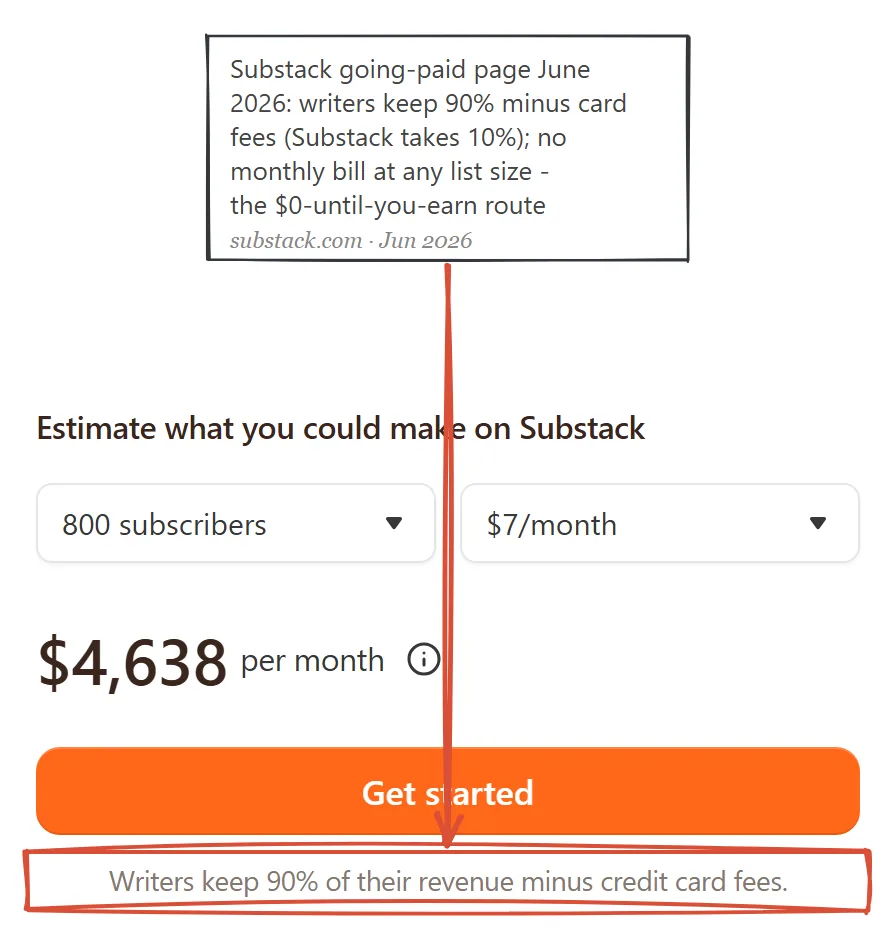
The honest ledger: the 10% is the inverse of Ghost's pitch. Once you earn real revenue, that cut can dwarf Ghost's flat fee, which is exactly why some creators move toward Ghost, not away from it. You also rent your home: Substack hosts you, you cannot self-host, and your design freedom is limited. It is the most replaceable choice if your ambitions grow.
Full picture: Substack review (5.4/10) and the head-to-head Substack vs Ghost.
Start on Substack ($0) →Kit: the Automation and Commerce Ghost Does Not Build
Ghost has no behavioral automation: no drip sequences, no branching. Kit is built around exactly that, with visual workflows, tag-based triggers and conditional paths on a builder reviewers praise. Its free Newsletter plan reaches 10,000 subscribers, four times Beehiiv's ceiling, and selling digital products is native at a 0.6% fee, which answers both Wall 5 and the monetization side of Wall 1. The paid Creator plan runs $33/mo (Creator, 1K subs) · verified June 12, 2026 at 1,000 subscribers on annual billing.
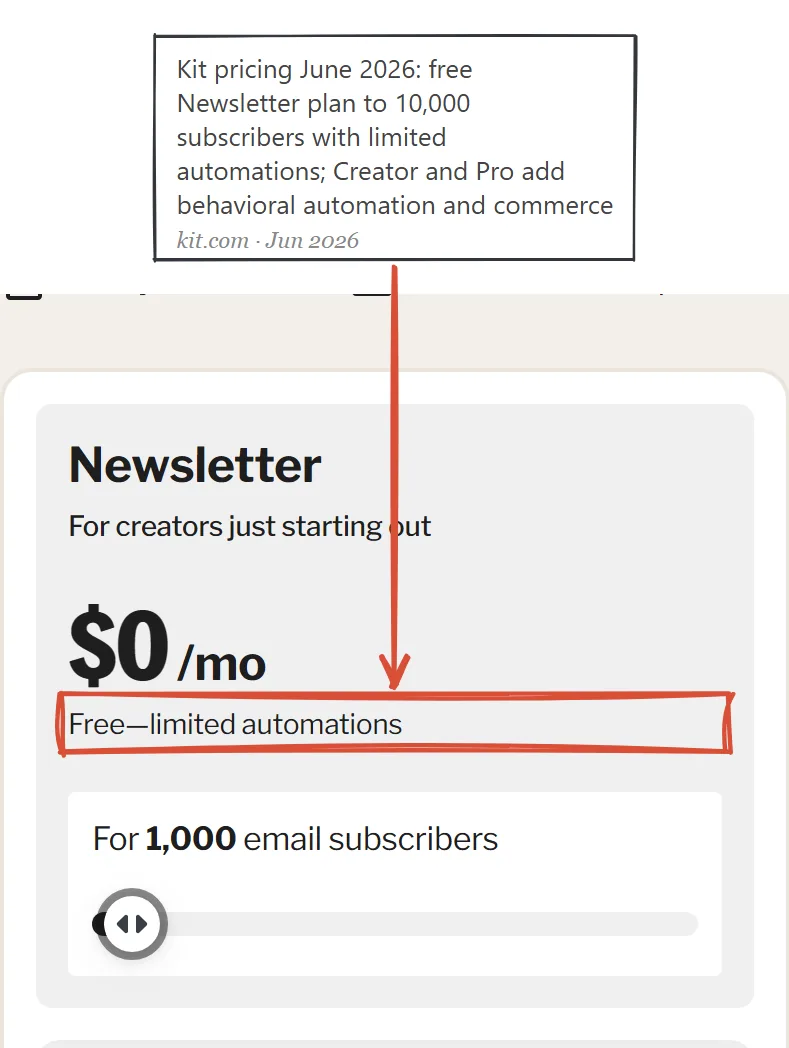
The honest ledger: Kit is an email tool, not a publishing CMS, so if you came to Ghost for a real website it is a narrower fit. The free tier's automations are limited (one sequence, one automation, until you pay), and affiliate-heavy creators should note that Kit's own corpus carries suspension reports tied to affiliate links.
Full first-hand walkthrough: our Kit review (8.1/10).
Try Kit free (to 10,000 subs) →MailerLite: the Price Floor With a Site Builder
If the premium price (Wall 1) is what is moving you, MailerLite holds the cheapest serious paid ladder of our panel at most list sizes ( $19/mo (Growing Business, 1K subs) · verified June 12, 2026 at 1,000 subscribers, well below Ghost Publisher at the same size), and it still gives you a website builder, landing pages and the highest editor depth score we track. The free plan covers 500 subscribers and 12,000 emails a month, and paid newsletters carry a 0% commission from the Growing Business tier.
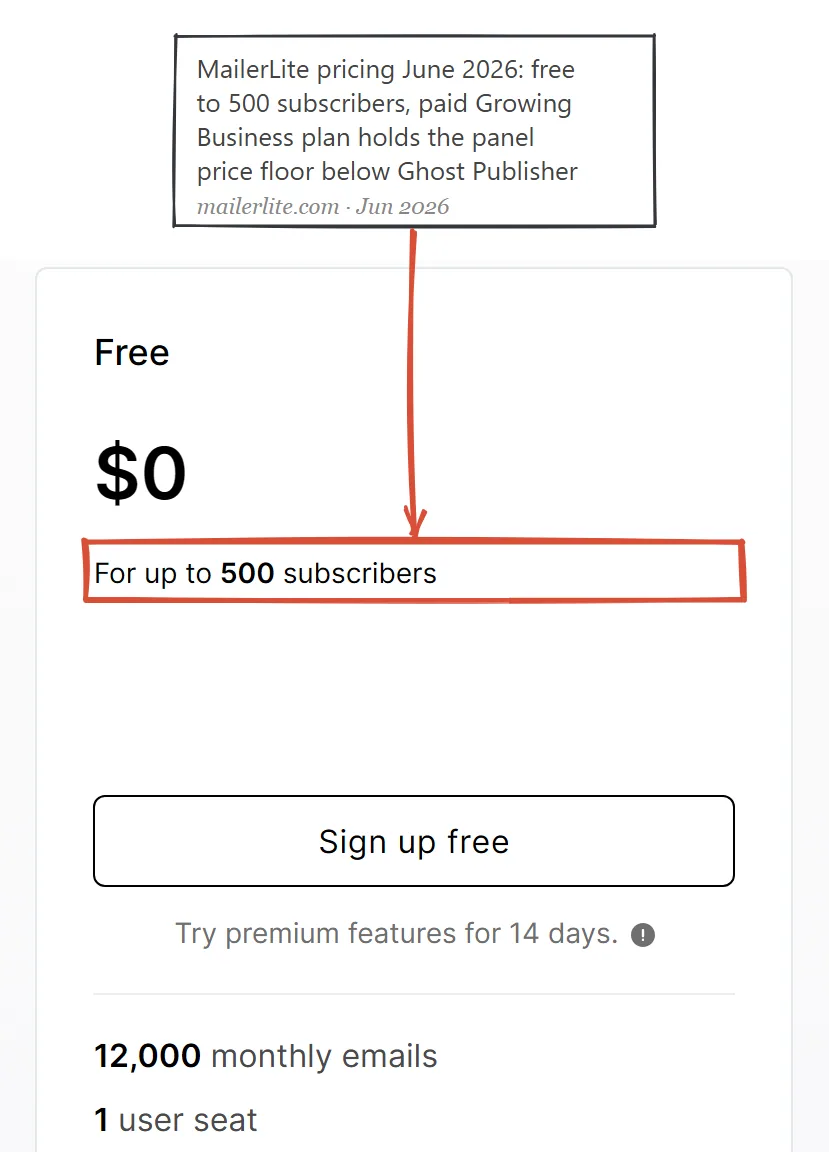
The honest ledger: MailerLite is hosted, so it is no escape from the ownership question. Its own corpus documents 87 suspension mentions, algorithmic and described as hard to reverse. Walk away if open-source self-hosting is your dealbreaker; on that one axis, only Ghost answers.
Full picture: MailerLite review (7.3/10).
Try MailerLite free (to 500 subs) →Buttondown: Honest Billing and Indie-Friendly Terms
If Wall 6 sent you here, Buttondown is the cleanest answer. It bills on active subscribers only, it is founder-run rather than a support queue, and its terms are the friendliest hosted account-control contract in our panel. It is free for the first 100 subscribers, then $9/mo (Paid, 1K subs) · verified June 12, 2026 at 1,000, with paid subscriptions at a 0% platform fee. For a writer who valued Ghost's minimalism but not its setup, Buttondown keeps the calm and removes the server.
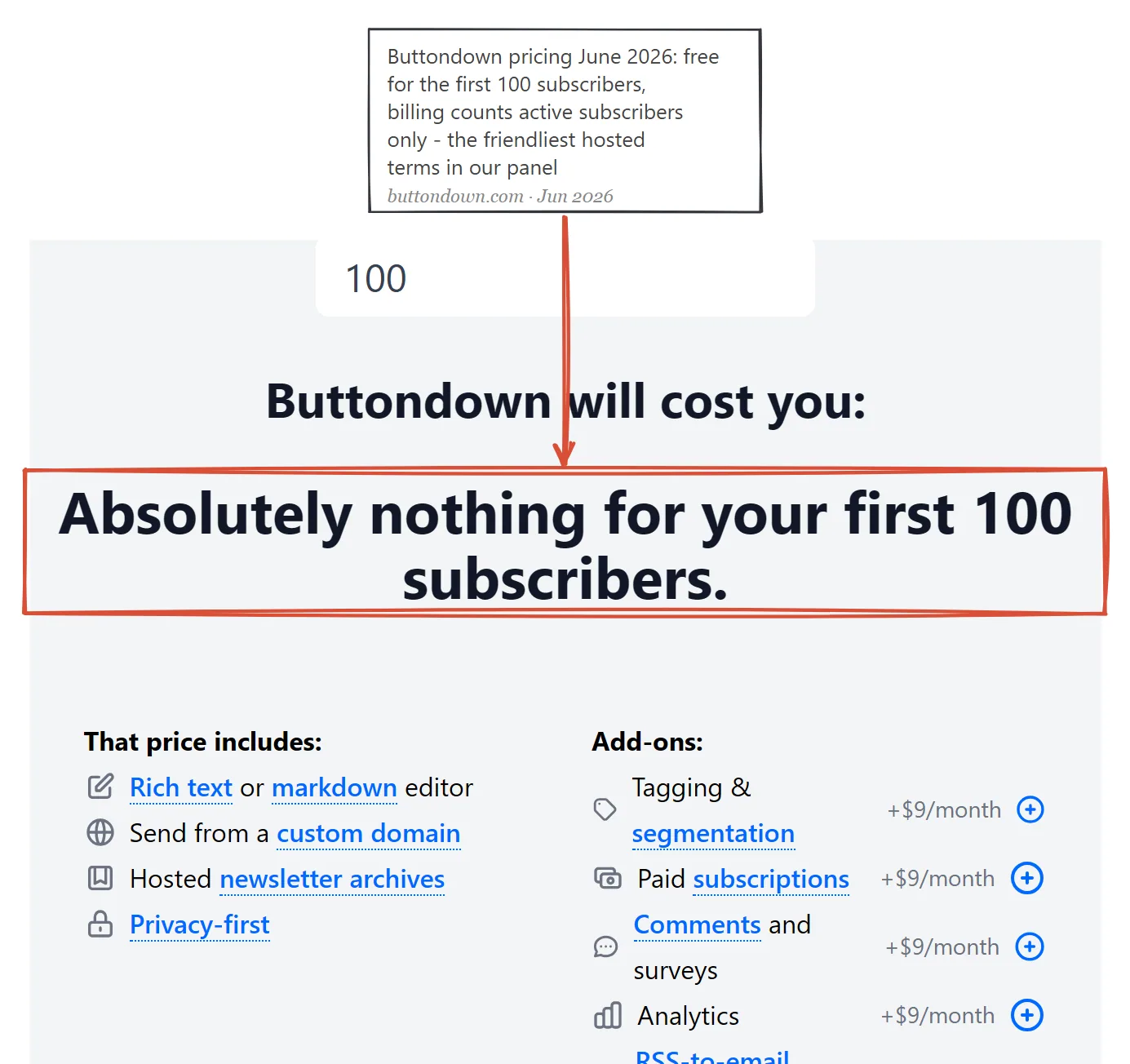
The honest ledger: Buttondown is deliberately minimal, more so than Ghost. There are no rich design tools, no visual automation builder and no team features at scale. If you found Ghost too minimal rather than too complex, this is the wrong direction.
Try Buttondown free (to 100 subs) →WordPress: When Ghost Is Too Minimal, Not Too Complex
This route runs against the grain, and that is the point. Most people move from WordPress to Ghost to escape plugin chaos; the minority who find Ghost too minimal want that flexibility back. WordPress.com gives you a plugin-rich CMS with real e-commerce, complex pages and a vast theme market, on a free $0 tier (paid plans run from $8/mo (Premium) · verified June 12, 2026). If Ghost's deliberate simplicity is the wall, this is where the flexibility lives.
The honest ledger: everything Ghost users escaped comes back. The plugin sprawl, the maintenance surface and the security upkeep are the price of that flexibility, and Ghost's clean writing-first experience is exactly what you trade away. Choose this only if breadth genuinely beats focus for your project. We run WordPress.com's newsletter stack through the full data layers in Substack vs WordPress, worth a read before committing to the switch.
See WordPress.com (free tier) →Who Controls Your Audience
Here is the uncomfortable twist of this whole page. On the one axis that decides if you truly own your audience, leaving Ghost for a hosted platform is a downgrade. Self-hosted Ghost is the only option in this panel where no company can suspend you, because there is no company in the loop. Beehiiv, Kit, MailerLite and Substack all host you, and all carry documented suspension patterns in their own review corpora.
The credit cuts the other way too, and it belongs here: on Ghost(Pro), the managed product, the terms grant the Foundation a perpetual licence to your content and cap recourse for a data incident at $100. So the full picture is precise. Self-hosted Ghost gives you maximum control; Ghost(Pro) is strong but not absolute; the hosted alternatives are a further step away. Read the matrix with that order in mind.
- GhostFavorable
Self-hosted = zero deplatforming risk by design.
Read the clause
Ghost Pro can terminate "with or without cause, with or without notice." But Ghost is open source, so you can always move to self-hosting and keep everything.source
- ButtondownFavorable
Least aggressive policy; full CSV export.
Read the clause
The license "automatically terminates" on violation, but the prohibited list is short and a full CSV export (email, tags, UTM, IP) is available.source
- beehiivMixed
Clear AUP, but post-ban list portability is not documented.
Read the clause
Can "temporarily or permanently suspend" access (§3). CSV export works in active accounts; behaviour after a ban is not spelled out in the terms.source
- MailerLiteMixed
Dashboard access preserved during review (§16.4), a rare positive.
Read the clause
Can terminate "with or without cause" (§16.2), but §16.4 guarantees you keep dashboard access during a review. Abrupt terminations are documented (BBB complaints, late 2024 to early 2025).source
 WordPress.comMixed
Terminable at any time without cause; posts export as XML but subscriber/email list export is not documented in standard tools.
Read the clause
"We may terminate your access to all or any part of our Services at any time, with or without cause or notice, effective immediately." The standard export (Tools → Export) produces a WXR XML file of posts, pages, comments, and media links — but subscriber and email-list data are not included. The support documentation notes a "Subscriber Migration Tool" via Jetpack plugin as the path for moving subscribers, which adds friction post-termination. No obligation to provide refund on termination: "We will have no obligation to provide a refund of any fees previously paid."source
- SubstackUnfavorable
Export blocked the moment your account is locked.
Read the clause
Verbatim: "Substack is free to terminate (or suspend access to) your use of Substack, or your account, for any reason at our discretion." Confirmed case (March 2025): a locked account's subscriber list became "not available to view and export."source
- KitUnfavorable
Post-ban export "at Kit's discretion"; bans affiliate sites.
Read the clause
Can terminate "in our sole determination" (§12b). AUP: an account can be "closed immediately and without prior notice", export is "at Kit's discretion", and no new account is allowed afterwards.source
✓ favorable to the creator · ◐ mixed · ✗ unfavorable. Open a row for the verbatim clause and source. Compiled June 2026 from public terms, status pages and the pricing data layer. Re-verified quarterly.
The full eleven-criteria matrix lives in who controls your audience.
The Switch Math: Run Your Own Numbers
Sticker prices mislead in both directions here. Ghost looks expensive next to a free tier, yet its 0% subscription fee can beat Substack's 10% the moment you earn real money. Substack's $0 becomes the most expensive option at scale. Buttondown's active-only billing can undercut everyone for low-frequency senders. The only honest way to choose on cost is to price your own list.
So we built the calculator instead of hand-waving: your list size, your destination, year-one math from our weekly-scraped pricing data. When staying on Ghost is cheaper, it says so, with no affiliate push on that verdict.
Migration: What Survives the Move Out
Your content and list export, but not always cleanly. Ghost exports content as JSON and members as CSV. Moving to WordPress means converting that JSON to the XML WordPress expects; one reviewer noted exactly that mismatch. Members transfer, but paid subscriptions are tied to your Stripe account and usually need to be reconnected at the destination rather than carried over silently.
Plan for the confirmation toll. Several destinations enforce double opt-in on imported lists, so budget a re-confirmation campaign and accept some shrinkage. The move is not free in attention even when it is free in dollars.
Your design and plumbing do not port. Themes, routes and any custom Handlebars work are rebuilt at the destination, and a Squarespace-to-Ghost migration in our corpus generated a flood of trailing-slash 404s, a reminder that URL structure breaks easily in either direction. Cancel in writing, keep a backup, and watch your card for two cycles given the billing theme above.
Pressure-test the cost side first in the switch calculator.
Two minutes to your shortlist
The quiz scores all platforms, Ghost included, on what you actually need (ownership, growth, automation, monetization) and names your best fit. It is blind to commission; the engine cannot see who pays us.
Take the platform quiz →Feature Matrix: Ghost and the Field, Side by Side
The full 53-feature data layer behind this page, source-verified against vendor documentation, with Ghost in view so every comparison answers the question you came with. Counting checkmarks is not the goal; finding where your dealbreaker sits is.
Compare 4 / 5 platforms
Pick a plan from the ▾ menu under a platform to see what that plan unlocks and its price at your subs count.
| Feature | Ghost | Beehiiv | Substack | Kit (ex-ConvertKit) |
|---|---|---|---|---|
| Monthly priceat 2.5K subs · monthly | $55/mo · Publisher · 2.5K subs | $0/mo · Free ≤2.5K subs | 10% of revenue | $0/mo · Free ≤10K subs |
| 5/6 | 6/6 | 5/6 | 6/6 | |
| 4/5 | 4/5 | 2/5 | 4/5 | |
| 8/9 | 9/9 | 6/9 | 9/9 | |
| 7/9 | 9/9 | 7/9 | 9/9 | |
| 1/4 | 2/4 | 2/4 | 2/4 | |
| 2/5 | 4/5 | 3/5 | 5/5 | |
| 5/10 | 10/10 | 8/10 | 7/10 | |
| 5/5 | 5/5 | 5/5 | 4/5 | |
| Get started | Visit → | Try free → | Try free → | Try free → |
✓ Yes · Partial · — No · dotted = unverified · a plan tag (e.g. Scale) = the cheapest plan that unlocks it; pick a plan above each column and ↑ marks features above it. Verified against vendor sources, September 2026. Some links are paid — OwnLetter may earn a commission at no extra cost to you. It never affects the data.
What Users Say, Theme by Theme
Average ratings first, read knowing review populations differ (frustrated users cluster on Trustpilot; established customers cluster on Capterra and G2), then the themes users actually raise, side by side. Every verbatim is an exact quote.
Straight from the reviews
What real users say
Each site’s average below comes from its own user reviews across Reddit, Trustpilot, Capterra and G2 — the count per site is on each bar. We never invent a quote.
Average score on each review site
GhostbeehiivSubstackKitWordPress.comPraised · Complaint · Split opinion
Average scores pulled from each site on May 31, 2026. Trustpilot scores are a recent sample, not the lifetime average; Reddit has no star ratings. Substack isn't listed on Capterra, and on Substack Trustpilot skews toward readers and Reddit toward creators. See our methodology.
Where the review themes agree and split
Compare 4 / 5 platforms
| What users say about… | Ghost415 reviews read | beehiiv669 reviews read | Substack480 reviews read | Kit885 reviews read |
|---|---|---|---|---|
| ▲ | ▼ | ▼ | ▲ | |
| ▼ | ▼ | ▼ | ▼ | |
| ◆ | ▼ | ▼ | ▼ | |
| ▲ | ◆ | ◆ | ▲ | |
| ▼ | ◆ | ◆ | ▲ | |
| ▼ | ▲ | ◆ | ▲ | |
| See for yourself | Visit → | Try free → | Try free → | Try free → |
▲ Praised · ▼ Complaint · ◆ Mixed · top theme / common / minor = how often readers bring it up · ❝ hover any cell for the exact count and a real, sourced quote · · = too few reviews to score. Read in full from Reddit, Trustpilot, G2 and Capterra, June 2026. We never invent a quote. Some links are paid — OwnLetter may earn a commission at no extra cost to you. It never affects the data.
Review sources:RedditTrustpilotG2Capterra
Frequently asked
Ghost alternatives, the questions that matter
Does Ghost have a free plan?
No. Ghost(Pro) offers a trial, not a permanent free tier, and an unpaid site goes dark when the trial ends, as confirmed on ghost.org/pricing in June 2026. If a free start is what you need, the permanent free tiers are Beehiiv (2,500 subscribers), Kit (10,000), MailerLite (500 subscribers and 12,000 emails a month), Buttondown (100) and Substack (unlimited, with a 10% cut only once you charge).
Can I make money on Ghost's cheapest plan?
No. The entry Starter plan gives you a site and an email list but no way to charge: paid subscriptions, tips and premium tiers first appear at the Publisher tier (verified on ghost.org/pricing, June 2026). If charging readers early is the point, Substack does it from $0 for a 10% cut, Beehiiv from a free tier at 0% on its paid Scale plan, and Kit from its free plan at a 0.6% fee.
Is Ghost really 'own your content'?
Via self-hosting, yes: the core is open source under the MIT licence, so no platform can deplatform you, and that is the single strongest reason to stay. On Ghost(Pro), the managed product, the terms grant the Foundation a perpetual, irrevocable licence to your content and cap recourse for a data or security incident at $100. The genuine ownership exit is the self-hosted core, not the hosted plan.
What is the best free Ghost alternative?
By ceiling alone, Kit: free to 10,000 subscribers, against Beehiiv's 2,500, MailerLite's 500 (with 12,000 emails a month), Buttondown's 100 and Substack's unlimited (which takes 10% only when you charge). Free tiers differ in what they include as much as in size; the at-a-glance table on this page lists the honest dealbreaker for each.
I left Ghost because growth was slow. Where do I go?
Beehiiv is where the corpus points: its recommendation network is free on every plan, and it adds a referral program and an ad network, none of which Ghost ships natively. Substack is the runner-up, with Notes and the deepest discovery network in our panel. We route here because the feature gap and a Ghost user's own words point here, not because Beehiiv pays us.
Should I switch off Ghost just to save money?
Run the numbers first. Ghost is a premium product, but its 0% platform fee on subscriptions (from Publisher) can beat Substack's 10% once you earn real revenue. The switch calculator on this page prices your exit from your list size and destination; when staying on Ghost is cheaper, it says so, with no affiliate push on that verdict.
How We Built This Page
OwnLetter works as a lab-style analyst, not a power-user reviewer. This page crosses seven proprietary data layers. Pricing is scraped weekly for 17 vendors. The 53-feature matrix is source-verified against vendor docs. The 4,915reviews behind these seven platforms were re-themed from Capterra, G2, Reddit and Trustpilot, 415 for Ghost alone. We re-grounded Ghost's pricing and terms against its own live pages in June 2026.
On independence: Ghost pays us nothing, and four of the six alternatives (Kit, MailerLite, Substack, WordPress) pay us nothing either. Only Beehiiv and Buttondown are affiliate partners. We earn the same if you stay or if you leave, and the routing and the quiz follow the review data, not the commission. Our public method is at how we test.
Bottom Line
Stay on Ghost to own a publication. Its self-hosted core is the only true ownership on this market, its 0% fee beats Substack once you earn, and a non-profit that cannot be sold is a moat the alternatives cannot match. Leave Ghost when your job is a different one. For a newsletter scaler chasing growth, a paid writer who wants to charge from day one, or a freelancer who needs the cheapest start, the data routes you to Beehiiv first, with Substack, Kit, MailerLite, Buttondown and WordPress each answering a specific wall. Match the destination to the wall, not to a ranking, and price your own list before you move. If writing is the job itself, the whole field is ranked writer-first in best newsletter platforms for writers.
Last verified June 2026. Pricing re-checked weekly; trust clauses quarterly.