On this page (16 sections)
- Quick verdict
- Two free-until-you-earn models
- Feature comparison
- What users say
- Deep dive: Substack
- Where Substack falls short
- Deep dive: WordPress.com
- Where WordPress falls short
- Who controls your audience?
- Pricing scenarios
- Migration friction
- Who switches, who stays
- .com vs .org, untangled
- FAQ
- Methodology
- Final verdict
Substack vs WordPress 2026: The Network vs the Website You Own

By Arthur Brulard, Founder of OwnLetter. Cross-vendor analyst review across 11 newsletter platforms, aggregating user signals from Reddit, G2, Capterra, Trustpilot, and Hacker News. LinkedIn
Published June 12, 2026 · Updated June 12, 2026 · 20 min read
Quick verdict
These are the only two platforms in our panel that cost $0 at any list size, so the decision is what happens once readers pay. Substack is the focused publishing machine: native paywall, a discovery network it credits with 30 percent or more of paid subscriptions (its own figure), zero setup, and a flat 10 percent of revenue forever. WordPress.com is the website that also sends a newsletter: unlimited subscribers free on every plan, a fee that slides from 10 percent to 0 as the plan grows, a site you can move to self-hosted WordPress, and honestly thin newsletter tooling: no segmentation, no A/B tests, one welcome email. Pick Substack to be found and to charge readers this week. Pick WordPress for a permanent web presence whose fee math improves as you earn. We make $0 from either.
Both are free to start with unlimited newsletter subscribers. Neither link pays us.
Not sure which fits you?
Substack or WordPress: answer a few questions
Which fits you?
Loading the quiz…
How we testedVerified June 2026 · 880 reviews aggregated · Substack tested · 48 sourced claims · 7 proprietary data layers · methodology public
What we did: Read 880 user signals in full: 400 WordPress items (200 Trustpilot reviews of the hosted wordpress.com service + 200 Reddit items, mapped June 12, 2026 with the .com/.org conflation separated explicitly) and 480 Substack reviews (aggregated June 2026). Pulled WordPress.com's plan prices from its official public API into our weekly tracker (June 12, 2026) and verified the fee schedules on both vendors' support pages the same day. Read both terms of service clause by clause. Captured 10 dated screenshots fresh for this page. First-hand: we operate a test Substack publication (hands-on log, June 10, 2026); we have not run a paid WordPress.com site.
What we did NOT do: We did not run deliverability seed-list tests (they violate both vendors' terms). We did not test WordPress.com's paid plans hands-on, so no WordPress claim here is presented as first-hand product testing. We quote no invented rating and no invented clause; WordPress trust cells were AI-collected this week and each clause quoted on this page was re-verified against the primary text.
Refresh cadence: Pricing re-verified weekly by automation; claims manifest (48 entries with source URLs) archived and auditable. Next full refresh September 2026. (pricing verified June 12, 2026). Full methodology →
 SubstackSubstack
 WordPress.comWordPress.com
Two Free-Until-You-Earn Models, One Sliding Scale
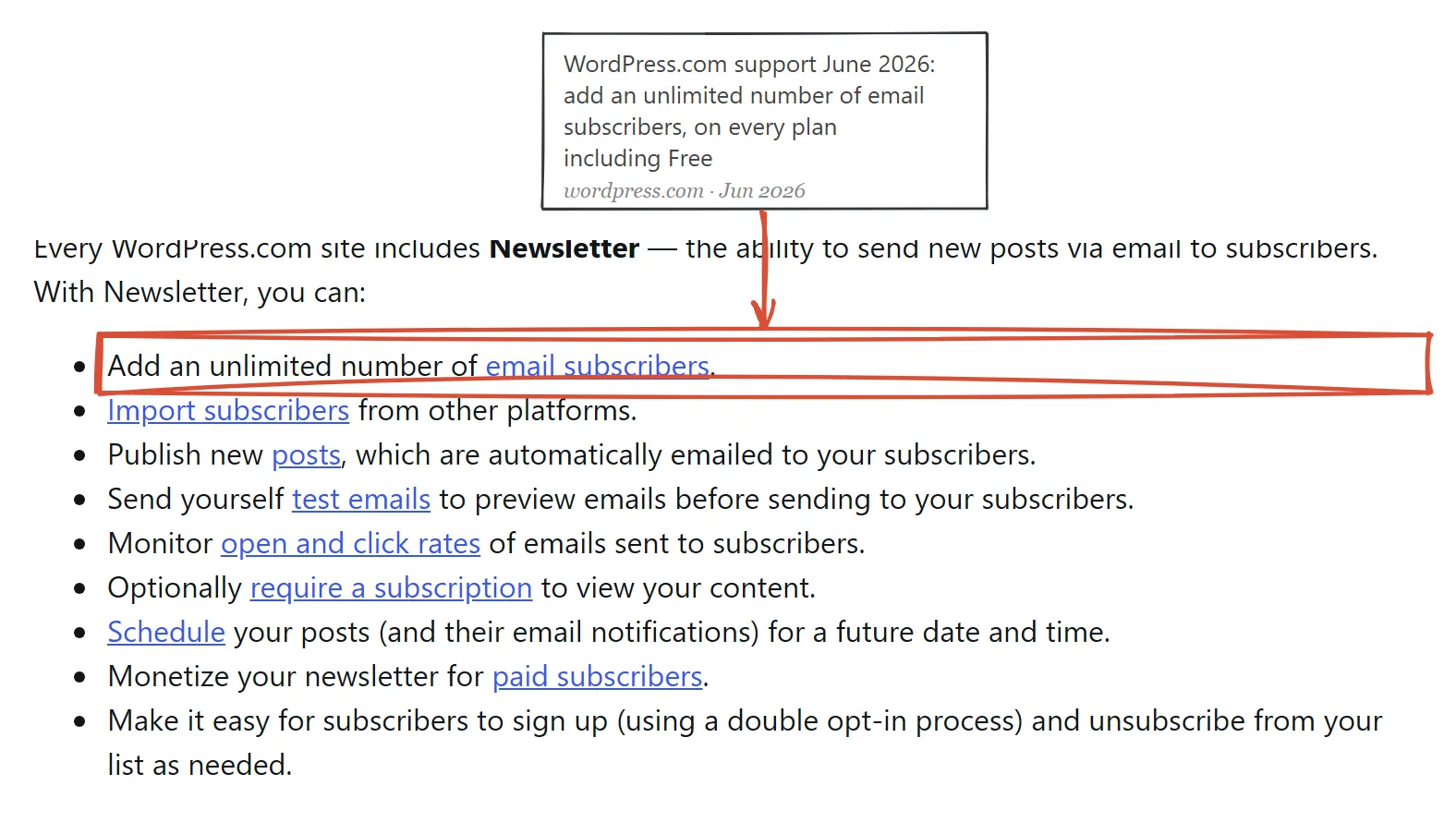
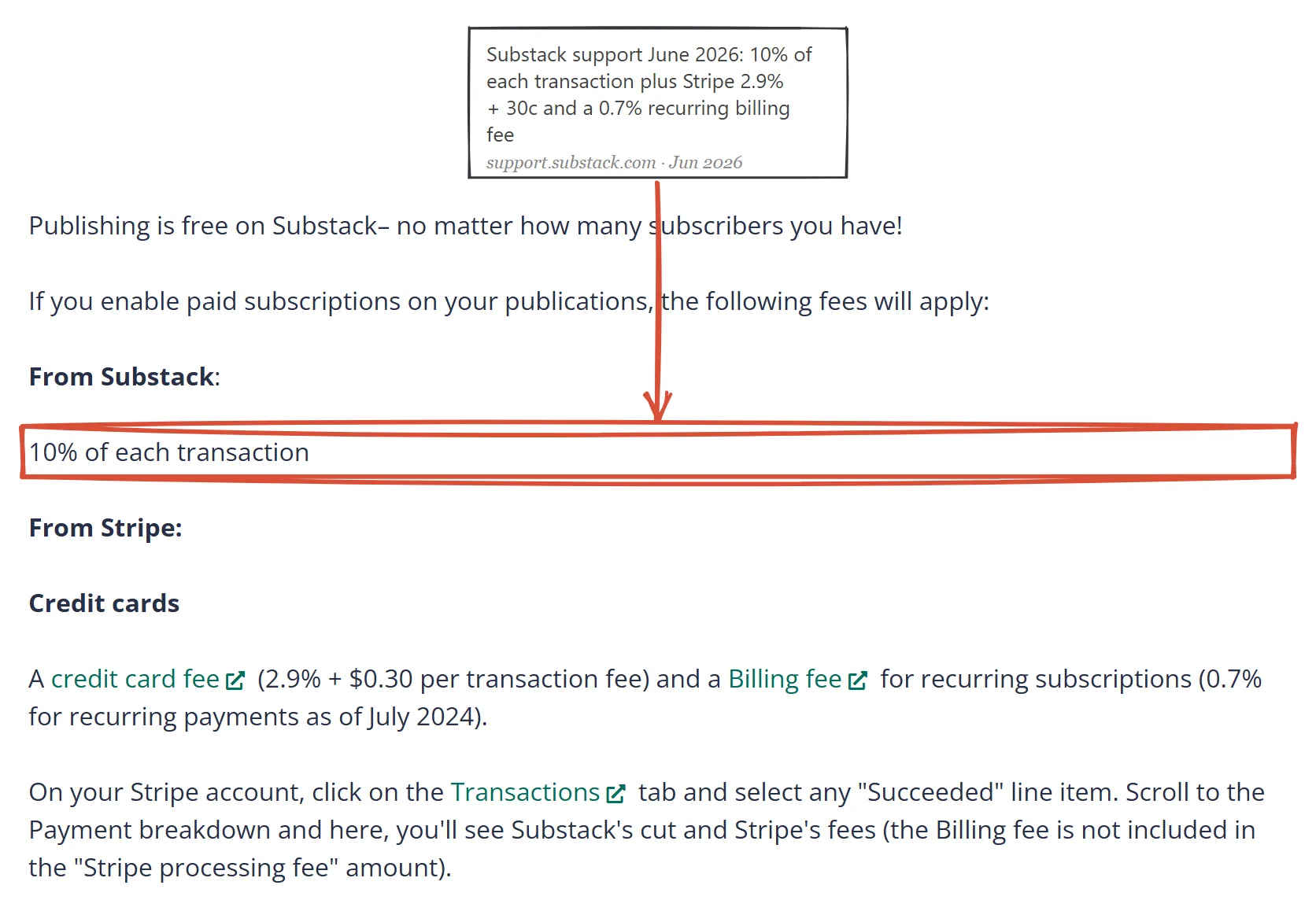
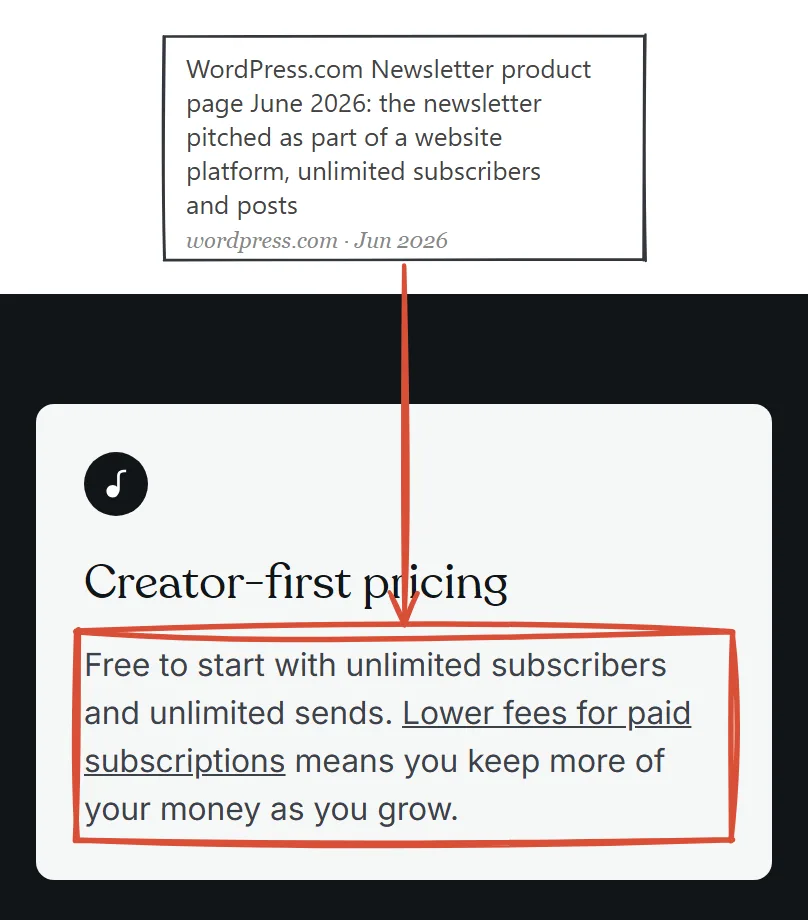
Start with what makes this matchup unusual: neither platform charges you a cent for a free newsletter, at any list size. Substack's support center states its cut plainly, "10% of each transaction," plus Stripe's 2.9 percent + $0.30 and a 0.7 percent recurring billing fee; until a reader pays, the bill is zero. WordPress.com's Newsletter feature ships on every plan, including Free, with what its support page calls "an unlimited number of email subscribers." No other pair in our 11-platform panel can say that; everyone else bills by subscriber tier.
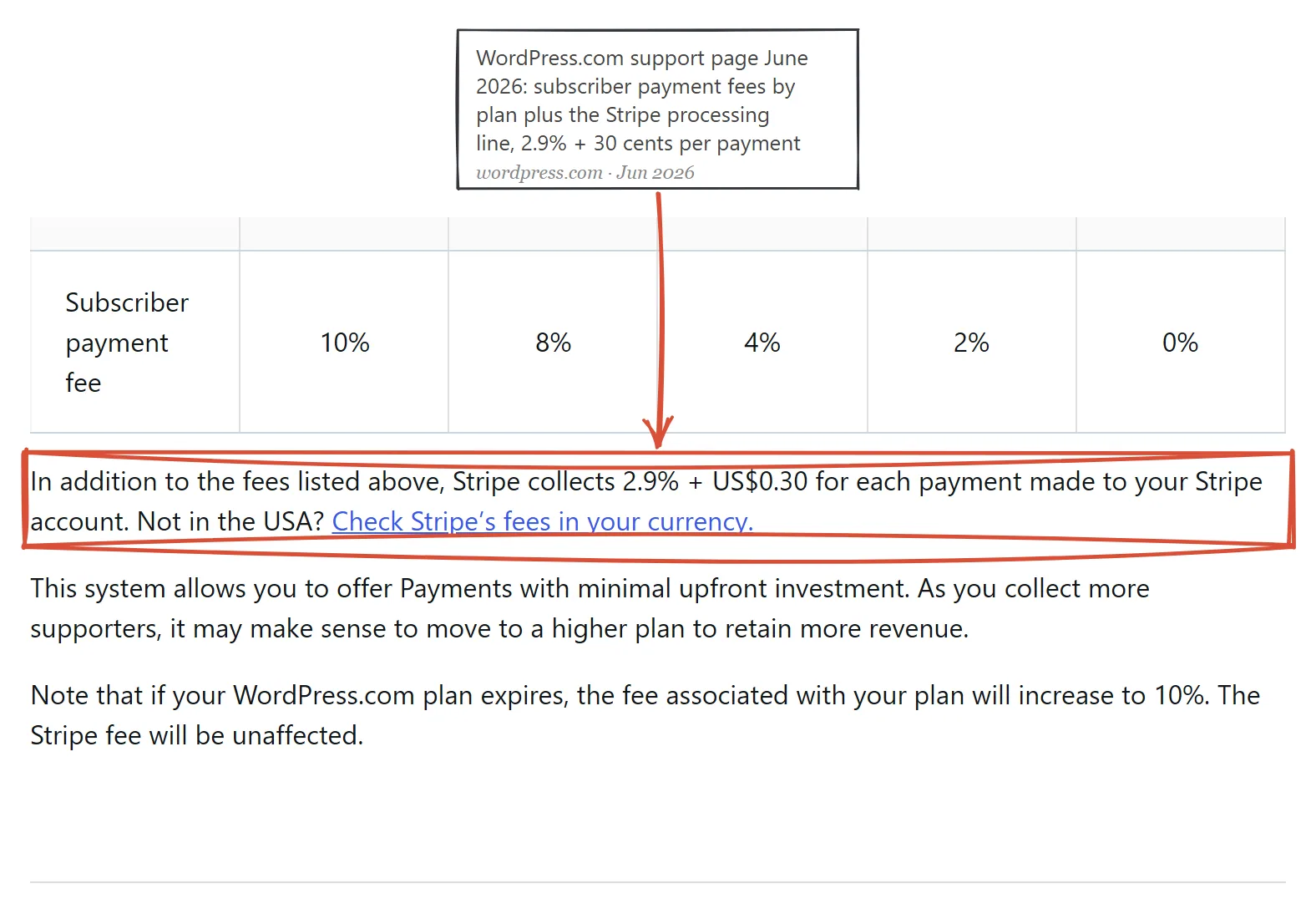
The fork opens the moment money arrives. Substack's 10 percent never changes: it is the same on your first paid reader and your five-thousandth. WordPress.com charges a flat plan price and a fee that shrinks as the plan grows: 10 percent on Free, 8 on Personal, 4 on Premium, 2 on Business, 0 on Commerce, with one trap worth knowing: if the plan expires, the fee snaps back to 10 percent. So Substack taxes your success at a constant rate, while WordPress lets you buy the tax down. The scenarios table below runs the crossover; it arrives faster than most writers expect.
Feature Comparison: Publishing, Monetization, Growth, Ownership
The split is unusually clean. Substack brings the newsletter craft: native paywall, podcast and video hosting, the discovery network, an editor writers praise. WordPress.com brings the web: a real CMS, themes, full pages, SEO control, WordAds, and the open-source escape hatch. Where they overlap, both are thin: neither has real automation, segmentation, or A/B testing natively. The matrix below is data-driven from the OwnLetter feature layer, source-verified against vendor documentation, with WordPress.com newly added to that layer this week.
Pick a plan from the ▾ menu under a platform to see what that plan unlocks and its price at your subs count.
| Feature | Substack | WordPress.com |
|---|---|---|
| Monthly priceat 2.5K subs · monthly | 10% of revenue | $9/mo · Personal |
| 5/6 | 5/6 | |
| 2/5 | 4/5 | |
| 6/9 | 9/9 | |
| 7/9 | 6/9 | |
| 2/4 | 3/4 | |
| 3/5 | 3/5 | |
| 8/10 | 10/10 | |
| 5/5 | 5/5 | |
| Get started | Try free → | Try free → |
✓ Yes · Partial · — No · dotted = unverified · a plan tag (e.g. Scale) = the cheapest plan that unlocks it; pick a plan above each column and ↑ marks features above it. Verified against vendor sources, September 2026.
Straight from the reviews
What real users say
Each site’s average below comes from its own user reviews across Reddit, Trustpilot, Capterra and G2 — the count per site is on each bar. We never invent a quote.
Average score on each review site
SubstackWordPress.comPraised · Complaint · Split opinion
Average scores pulled from each site on May 31, 2026. Trustpilot scores are a recent sample, not the lifetime average; Reddit has no star ratings. Substack isn't listed on Capterra, and on Substack Trustpilot skews toward readers and Reddit toward creators. See our methodology.
Read the split carefully on both sides: WordPress.com scores 4.4/5 on G2 (business users praising ease) against 3.6/5 on Trustpilot (billing and suspension crises); Substack's 1.3/5 Trustpilot population is dominated by reader billing complaints, not publisher verdicts. One number alone misleads, which is why we show them all.
Theme by theme: where they agree and differ
| What users say about… | Substack480 reviews read | WordPress400 reviews read |
|---|---|---|
| WordPress leads | ||
| WordPress leads | ||
| Substack leads | ||
| Substack leads | ||
| Even | ||
| Substack leads | ||
| See for yourself | Try free → | Try free → |
▲ Praised · ▼ Complaint · ◆ Mixed · top theme / common / minor = how often readers bring it up · ❝ hover any cell for the exact count and a real, sourced quote · · = too few reviews to score. Read in full from Reddit, Trustpilot, G2 and Capterra, June 2026. We never invent a quote.
Review sources:RedditTrustpilotG2Capterra
Deep Dive: Substack
Across 480 Substack community posts and reviews read in full, the pattern is stable: the paywall and the network genuinely work, the toolset stops at publishing, and the costs are the 10 percent plus everything you cannot control.
The network is the product WordPress cannot copy
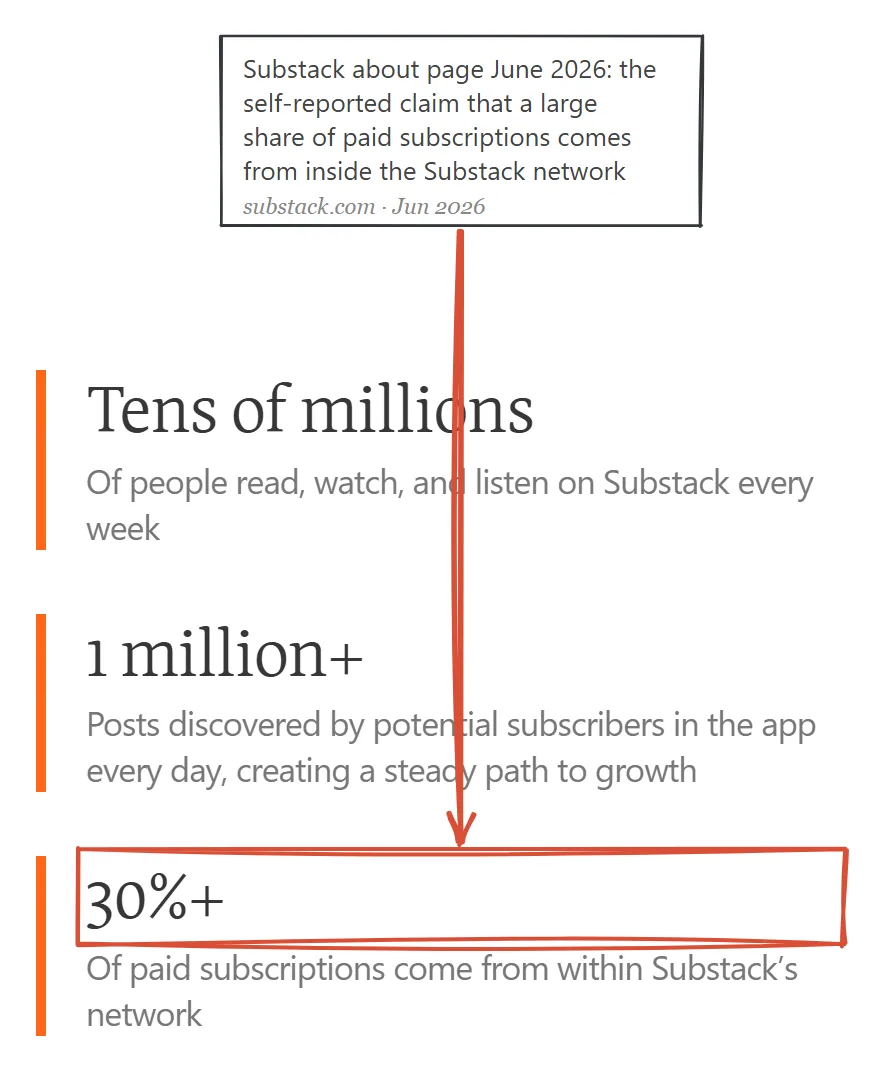
Substack's about page makes the claim itself: a large share of paid subscriptions, 30 percent or more by its own figure, comes from inside the network (self-reported, no third-party audit). Whatever the exact number, Notes, recommendations and leaderboards push your writing to readers who never searched for you, and discovery is the second most-mentioned theme in the Substack corpus. For a writer starting from zero, this is the argument everything else on this page has to beat.
The same corpus prices the network honestly. It is real, and it has a saturation curve:
"The hard truth is most of your early readers will be other writers, not general readers, and breaking out of that circle is genuinely difficult."Reddit user (r/Substack source), June 2026 (svw-047)
The corpus also names the ceiling, and it matters in this matchup precisely because WordPress shares it:
"As a newsletter platform it falls short on the fundamentals: segmentation is basic, automation is almost non-existent, analytics are surface-level."Trustpilot reviewer, March 2026 (svw-004)
When we ran our own test publication (hands-on, June 10, 2026), there was no sequence builder to find and no behavioral trigger; the automation surface is the welcome email. On most pages of this site that sentence sets up a rival's pitch. Here it does not: WordPress.com's native newsletter automation is the same single welcome email. Nobody wins this axis natively; WordPress merely has a plugin route up (Business plan) where Substack has none.
Our take
Where Substack Falls Short
- The 10 percent never slides downSubstack's cut is 10 percent of every paid transaction, forever, plus Stripe's 2.9 percent + $0.30 and a 0.7 percent recurring billing fee (support.substack.com, verified June 2026). WordPress.com's fee starts at the same 10 percent on a free site and slides to 8, 4, 2, then 0 percent as the plan grows. At $5,000 a month of paid revenue the difference is $6,000 a year against roughly $1,500 all-in. Substack's fee buys real things (the paywall, the network, zero setup), but it is the only number on this page that never improves as you succeed.
- Automation and segmentation barely existA Trustpilot reviewer summed it up in March 2026: "segmentation is basic, automation is almost non-existent, analytics are surface-level." There is no sequence builder, no behavioral trigger, and drip campaigns sit in a restricted beta. The fair caveat in this particular matchup: WordPress.com's native newsletter tooling is just as thin. Neither platform here serves a funnel-builder; the difference is that WordPress can bolt on real automation through Business-plan plugins, while Substack has no route up at all.
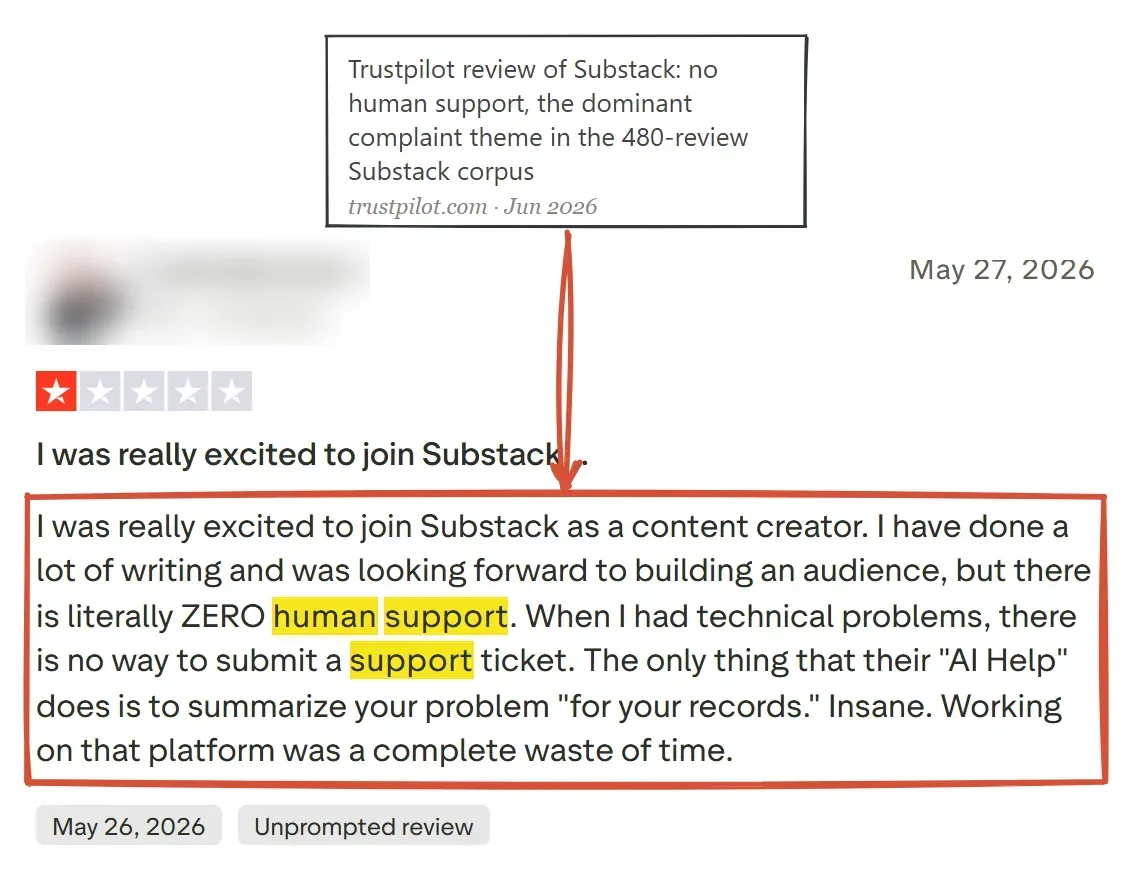
- Support is an AI chatbot, by designSupport is the dominant complaint theme in our 480-review Substack corpus (58 mentions): no ticket system, no human escalation. A May 2026 Trustpilot reviewer: "There is literally ZERO human support." WordPress.com's support is plan-gated and polarized, but its Happiness Engineers on paid plans earn named, repeated praise; Substack has no human tier to upgrade to at any price.
- A breach, a license, and a blocked exportIn October 2025 Substack suffered a data breach exposing roughly 663,000 account records. Its terms keep a perpetual license on what you publish, and a confirmed March 2025 case documented a locked account whose list export was blocked. The discovery network that makes Substack attractive is also borrowed reach: an algorithm Substack tunes, not a channel you own.
Deep Dive: WordPress.com
Across 400 WordPress items read in full (200 Trustpilot reviews of the hosted service, 200 Reddit items with the .com/.org conflation separated), the picture is a website platform first: the site builder is the most-praised capability, the economics anger people more than the product does, and the newsletter is a convenience riding on the side.
What you actually get: a real website with email attached
The strongest positive signal in the corpus (95 mentions) is people who built the site they wanted: portfolios, business sites, blogs with newsletters attached, often with the help of the Happiness Engineers on paid plans. The newsletter inherits everything the website has that Substack lacks: your archive lives on a real CMS with themes and full SEO control, pages exist, WordAds can monetize traffic from the Premium plan up, and the whole thing runs under a brand that does not look like everyone else's publication.
The ease verdict is genuinely split
Ease of use is the most-mentioned theme in the WordPress corpus (142 mentions) and the most divided we have mapped on any platform: real non-technical successes, including a reviewer in her eighties still building, against users who walked away from the stacked interfaces (classic wp-admin, Gutenberg, the Site Editor, the dashboard). Two verbatims, same product:
"Wordpress is amazing. My website is easy to edit as needed to keep it updated and I can do it all myself"Trustpilot reviewer (svw-036)
"Incomprehensible interface. And I have a PhD"Trustpilot reviewer (svw-036)
The like-for-like number sits between the poles: G2 scores WordPress.com's ease of use 8.4/10 across its 2,687-review population. Against Substack, the honest summary is that Substack asks you zero decisions on day one and WordPress asks you fifty; what you get back for those decisions is a website Substack will never be.
Where the money complaints actually point
Pricing is the corpus's loudest negative (67 mentions), and it is important to read it precisely, because it is NOT about the newsletter fee. The anger is the website upsell ladder: a free plan that cannot connect an owned domain, plugins gated behind Business, e-commerce priced by the year. The newsletter economics, unlimited subscribers and a fee that slides to zero, are the best-kept secret in their own corpus. Both things are true, and this page needs both: WordPress the website can get expensive; WordPress the newsletter pipe is the cheapest serious option we track once revenue is real.
The plugin gate shows up at newsletter level too. A r/Wordpress poster, writing in 2024 (June), hit it trying to wire an external email tool into a free site:
"I've been trying to embed a sign-up form for my MailerLite newsletter on my free Wordpress.com site using HTML. It shows up fine in previews, but on my actual site it just shows up as a block of code." Reddit user (r/Wordpress source), posted in 2024, June (svw-048)
Our take
Where WordPress.com Falls Short
- The newsletter is an attachment, not the productWordPress.com sends your posts as email, and that is roughly where the newsletter product stops. There is no subscriber tagging or segmentation, no A/B testing, no engagement scoring, and automation is the single welcome email. The corpus is blunt about the output quality too: one reviewer describes the generated email as "totally glitchy and a messed-up version of the template." If the newsletter is your whole business, you would be running it on the side-feature of a website platform.
- Nobody will discover you hereOur 400-item WordPress corpus contains zero growth-attribution stories: no reviewer credits WordPress.com with bringing them readers. There is no recommendations network, no Boost equivalent, no leaderboard, and the Reader feed scores 0.4 in our depth layer against Substack's 1.0. You arrive with an audience or you build one elsewhere; the platform will not help.
- The free plan is a teaser, and the corpus calls it thatThe Free plan runs on a wordpress.com subdomain, shows WordPress.com's ads to your visitors, and cannot use a custom domain or any plugin. Eighteen corpus mentions read the 'free' promise as bait-and-switch: "Claims free. Charges 6X as much as competition. After putting in 11 hours building my site they popped up a plan starting at 18.99." The newsletter's unlimited subscribers are genuinely free; a credible web presence is not.
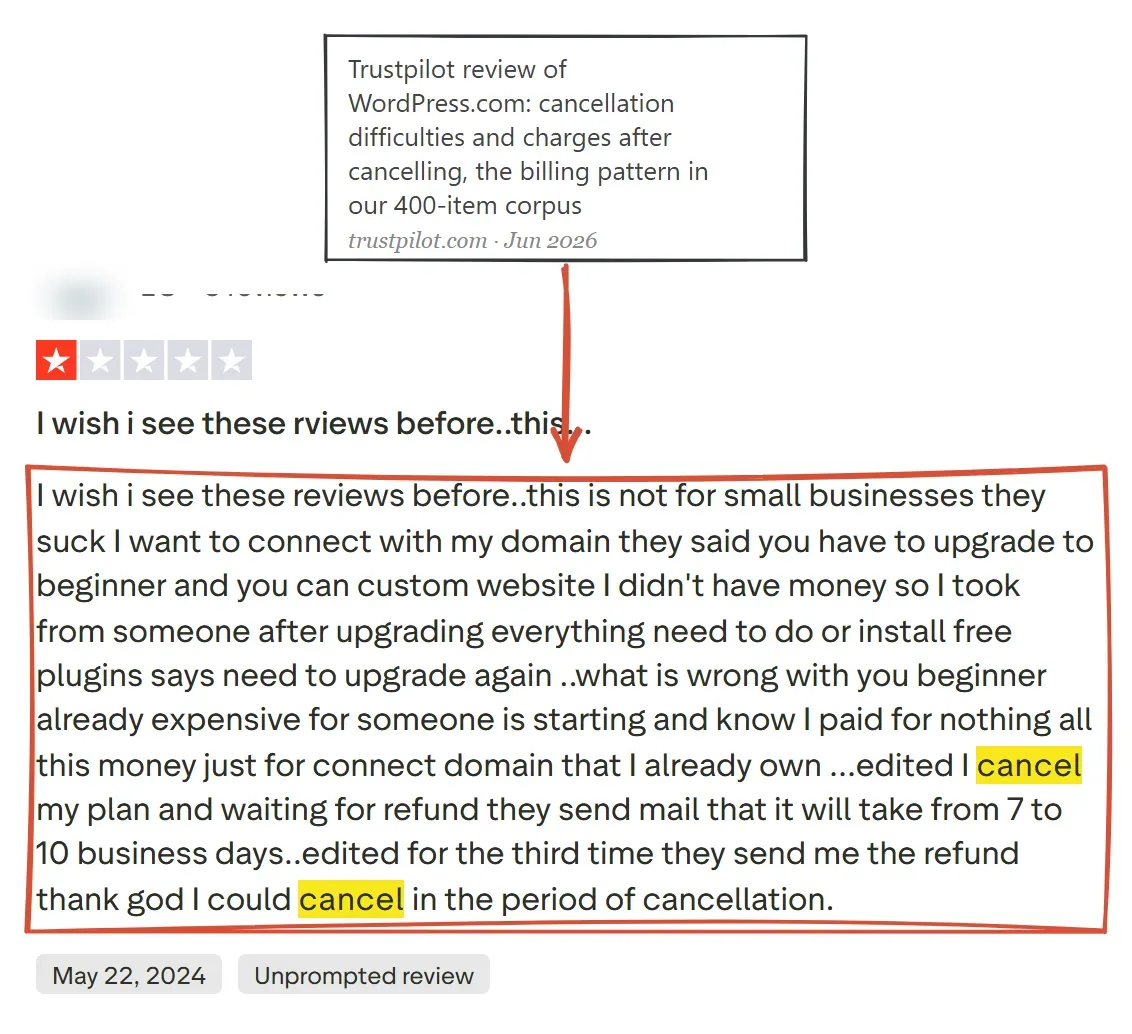
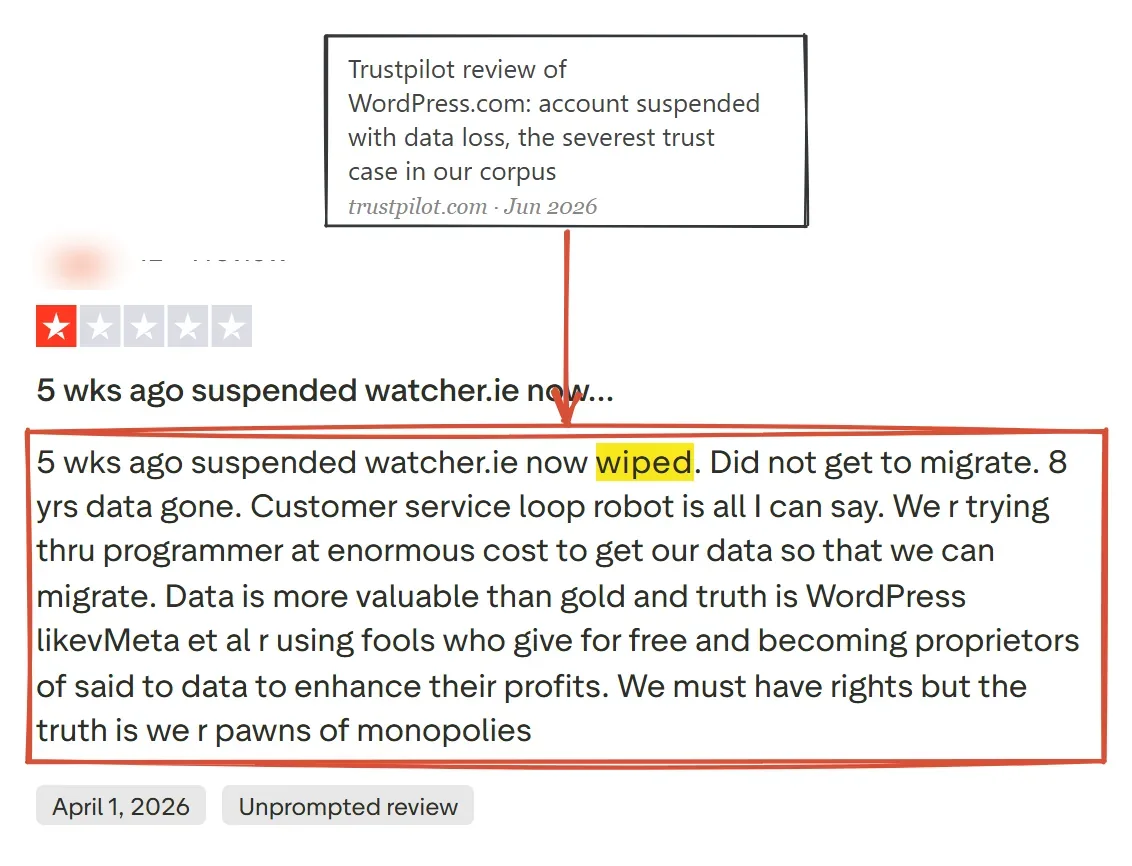
- Billing complaints, opaque suspensions, and one wiped siteCancellation and billing problems are a clear pattern (24 mentions, negative): charges after cancelling, renewals billed a month early, refunds gated behind paid-tier support. Account suspensions are rarer (16 mentions) but the worst case is the worst in any of our corpora: "5 wks ago suspended watcher.ie now wiped. Did not get to migrate. 8 yrs data gone." The terms make that legal: termination 'at any time, with or without cause or notice, effective immediately.'
- The broadest content license we have read, with an AI historyWordPress.com's terms grant Automattic a worldwide, transferable, SUB-licensable license on your content, including making publicly-posted content available to third parties through its Firehose. Press reports in 2024 (February) documented Automattic preparing to sell public WordPress.com and Tumblr content to OpenAI and Midjourney for AI training, with an opt-out toggle; the opt-out is a setting, not a clause. Dated history, not a current accusation, but the license that made it possible is still the license.
Who Controls Your Audience? Two Different Papers
We read both terms of service clause by clause, and the asymmetry is instructive. WordPress.com wins the exits: subscriber CSV export is a documented button, posts leave as standard WordPress XML, disputes go to California courts with no forced arbitration, and the liability cap has an actual floor (the greater of $50 or a year's fees). Substack wins nothing comparable on paper: perpetual content license, a confirmed export-block case in March 2025, and the October 2025 breach. But WordPress's paper has its own teeth: termination "at any time, with or without cause or notice, effective immediately," the broadest content license in our panel (transferable, sub-licensable, with third-party Firehose distribution), and the AI-training data episode reported in 2024 that the license made possible.
Trust and risk: Substack vs WordPress.com
| Platform | Account control | Content license | Legal recourse | Cost at scale | Billing model | Allowed niches |
|---|---|---|---|---|---|---|
| Substack | ||||||
| WordPress.com |
✓ favorable to the creator · ◐ mixed · ✗ unfavorable. Hover or tap a cell for the detail. Compiled June 2026 from public terms, status pages and the pricing data layer. Re-verified quarterly.
Pricing Scenarios: When the Sliding Fee Beats the Flat Ten
The rule of this matchup: pre-revenue, the platforms tie at $0; post-revenue, WordPress wins the math and Substack has to win on everything else. The crossover arrives at the first real dollar, because even Personal's 8 percent plus its plan price undercuts 10 percent almost immediately. Automattic's own comparison page advertises $11,460a year saved at $10,000 a month of paid revenue; we checked the arithmetic and it holds, but only on its best case, the annual Commerce plan at 0 percent. The table below shows the honest ladder, with every figure derived from our weekly tracker and the two vendors' published fee schedules (Stripe applies on both sides and washes out).
WordPress.com plans (verified June 12, 2026)
- · Free: Free up to . Unlimited newsletter subscribers, wordpress.com subdomain, WordPress ads shown, 10% fee on paid subscriptions.
- · Personal: $4/mo (Personal) · verified June 12, 2026 billed annually. Custom domain, ads removed, fee drops to 8%.
- · Premium: $8/mo (Premium) · verified June 12, 2026 billed annually. WordAds eligibility, more design control, fee 4%.
- · Business: $25/mo (Business) · verified June 12, 2026 billed annually. Plugins unlock (the email-tool route), fee 2%.
- · Commerce: $45/mo (Commerce) · verified June 12, 2026 billed annually. Full WooCommerce, fee 0%.
- · Substack (no tiers): free at any size; 10% of paid revenue plus Stripe and the 0.7% recurring fee, with the paywall and network built in.
Annual platform cost by paid-revenue level (Substack 10% vs WordPress plan + sliding fee)
Scenario Paid revenue per month | Substack (flat 10%) $0 plan fee, always | WordPress.com (plan + sliding fee) Cheapest sensible plan | Annual delta Positive = WordPress saves |
|---|---|---|---|
| $0/mo paid, any list size | $0/yr | $0/yr (Free plan, unlimited subscribers) | Even. The only matchup in our panel where both sides are $0 at any size |
| $250/mo paid | $300/yr | Personal: $288/yr ($48 plan + 8%) | +$12/yr (WordPress edges ahead already) |
| $1,000/mo paid | $1,200/yr | Premium: $576/yr ($96 plan + 4%) | +$624/yr (WordPress saves half) |
| $5,000/mo paid | $6,000/yr | Business: $1,500/yr ($300 plan + 2%) | +$4,500/yr (the 10% is now the story) |
$0/mo paid, any list size
- Substack (flat 10%)
- $0/yr
- WordPress.com (plan + sliding fee)
- $0/yr (Free plan, unlimited subscribers)
- Annual delta
- Even. The only matchup in our panel where both sides are $0 at any size
$250/mo paid
- Substack (flat 10%)
- $300/yr
- WordPress.com (plan + sliding fee)
- Personal: $288/yr ($48 plan + 8%)
- Annual delta
- +$12/yr (WordPress edges ahead already)
$1,000/mo paid
- Substack (flat 10%)
- $1,200/yr
- WordPress.com (plan + sliding fee)
- Premium: $576/yr ($96 plan + 4%)
- Annual delta
- +$624/yr (WordPress saves half)
$5,000/mo paid
- Substack (flat 10%)
- $6,000/yr
- WordPress.com (plan + sliding fee)
- Business: $1,500/yr ($300 plan + 2%)
- Annual delta
- +$4,500/yr (the 10% is now the story)
WordPress figures use annual billing from our tracker plus the support-page fee schedule; monthly billing costs more. The unusual row is the first one: this is the only comparison on this site where the "big free list, no revenue" scenario is a tie instead of a trap.
Migration: the Importer Is Real, the Network Stays Behind
The mechanics are friendlier than most exits on this site. WordPress.com documents a Substack importer that moves both your posts and your subscriber CSV, and the reverse direction exists too (Substack imports from WordPress). A custom domain carries your SEO equity if you owned one on Substack ($50 one-time there; any paid plan on WordPress). Paid subscriptions are the familiar exception: billing does not transfer in either direction, so paying readers re-subscribe at the destination; time the move to your renewal cycle.
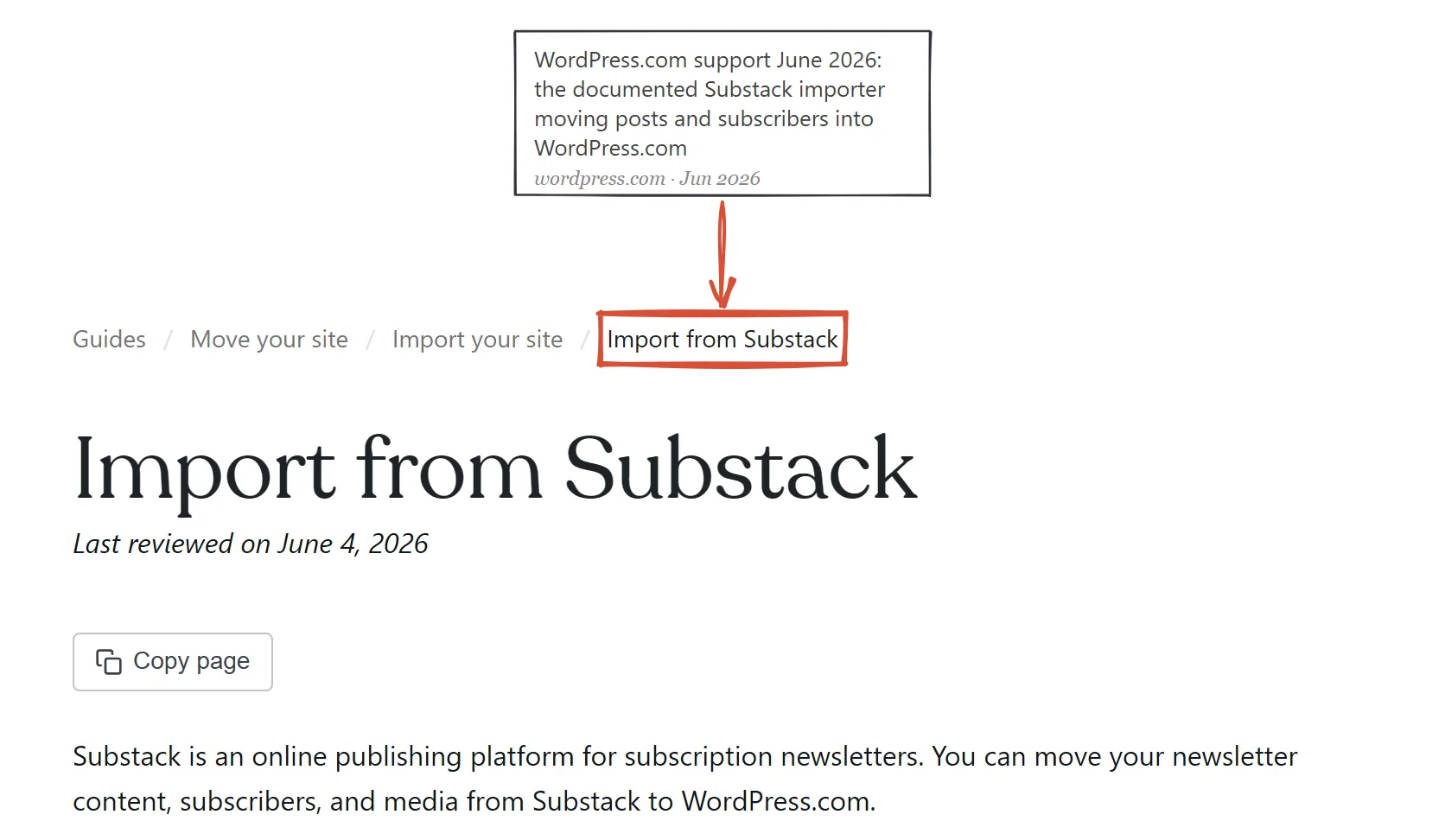
What does not migrate is the thing that made Substack work: the network. Every recommendation, every Notes reader, every leaderboard position stays behind, and our WordPress corpus shows nothing on the other side will replace it. The honest sequencing for a network-grown publication: build the replacement channels first, move second. And in both directions, the paid-subscriber re-subscribe ask will cost you a slice of revenue; budget for it rather than hoping.
Who Switches, and Who Should Stay
Who the move to WordPress pays off for
The profile is specific: you already have an audience (the network is not doing your acquisition), your paid revenue is real (the sliding fee is now meaningful money), and you want a permanent web presence: an archive with SEO, pages, a brand that is not a Substack template. For that writer, the math in the scenarios table is decisive and the website is a bonus Substack cannot offer at any price. The corpus even carries the inverse refugee: a writer locked out of Substack after a shadow-ban, with 5,581 subscribers, who calls WordPress "simply the best blogging platform I have found."
Who should stay on Substack, and why that is rational
If the network is feeding you, stay. Thirty percent of paid subscriptions (Substack's own figure) is acquisition you would have to rebuild from nothing on WordPress, where our corpus records zero discovery stories. Stay too if you want zero operations: Substack asks no decisions, WordPress asks many, and the 142-mention ease theme shows real people bouncing off those decisions. The 10 percent is the price of those two things; for a growing publication it is often worth paying, and unlike WordPress's upsell ladder, it never surprises you.
Account risk exists on both, with different shapes
Substack's risks are the license, the export-block precedent, and a breach already on the record. WordPress's are discretionary termination, billing friction (24 mentions), and the watcher.ie worst case. Neither side of this page is the safe house; the monthly CSV export is.
.com vs .org, Untangled (Because the SERP Won't Do It)
Almost every page ranking for this comparison blurs two different products, usually because the author sells hosting for one of them. WordPress.com is Automattic's hosted service: this page's subject, with the plans, fees and terms above. WordPress.org is the same software, self-hosted: no platform above you, no user guidelines, no fee on anything, and in exchange you run updates, security and an email-sending stack yourself. Our Reddit corpus mixes the two constantly (only 30 to 40 percent of WordPress threads were clearly about .com), and so do the comparison sites.
For this decision, the distinction cuts one way that matters: the escape hatch. A WordPress.com site can move to self-hosted WordPress with the same software, the same posts in standard XML, the same theme family, and the subscriber CSV. No other hosted platform in our panel offers a same-software exit that leaves the vendor entirely; Ghost comes closest, and its self-host path stays inside the same product family. If long-term sovereignty ranks high for you, this is WordPress's deepest structural argument, with the watcher.ie caveat attached: the hatch only works if you export before the door closes.
Frequently asked
Frequently Asked Questions
Is WordPress cheaper than Substack for a paid newsletter?
Once you earn real money, yes, and the gap grows with revenue. Both platforms cost $0 on a free list of any size, the only pair in our panel that can say that. The difference is the cut once readers pay. Substack takes a flat 10 percent forever. WordPress.com charges a flat plan price and a fee that shrinks as the plan grows: 10 percent on Free, 8 on Personal, 4 on Premium, 2 on Business, 0 on Commerce (verified on its support pages, June 2026). At $1,000 a month of paid revenue, Substack costs $1,200 a year while WordPress Premium costs about $576 all-in. At $5,000 a month it is $6,000 versus about $1,500 on Business. Stripe processing applies on both sides. What the math does not buy you on WordPress is Substack's paywall polish and discovery network, which is the rest of this page.
Can WordPress.com really run a newsletter like Substack?
Mechanically yes, and more cheaply at scale, but the tooling is a feature, not the product. Every WordPress.com plan, including Free, ships the Newsletter feature with, in the support page's own words, 'an unlimited number of email subscribers': your posts go out by email, readers subscribe free or paid, Stripe handles billing. What you do not get is what a newsletter-first platform builds around that pipe: there is no subscriber segmentation or tagging, no A/B testing, no engagement scoring, automation is the single welcome email, and one corpus reviewer describes the generated email as 'totally glitchy and a messed-up version of the template.' WordPress is the right answer when the newsletter is one part of a real website; it is the wrong answer when the newsletter IS the business and you need the craft tools.
What about self-hosted WordPress (.org) instead?
It is a different product with the same name, and most comparisons blur the two on purpose. WordPress.com is Automattic's hosted service: it runs your site, sends the newsletter emails, and enforces its terms. WordPress.org is the open-source software you host anywhere: total control, no platform rules, but you assemble email sending yourself (a plugin like MailPoet plus an SMTP service) and you maintain everything. The honest framing for a writer: .com competes with Substack on convenience and adds the fee advantage; .org competes on sovereignty and adds an operations job. The unique part is the path between them: a WordPress.com site exports to self-hosted WordPress with the same software, posts, theme and subscriber CSV, an escape hatch no other hosted platform in our panel offers, Substack included.
Does WordPress have anything like Substack's discovery network?
No, and this is Substack's strongest card. Substack states that 30 percent or more of paid subscriptions come from inside its network (its own figure, self-reported, no third-party audit), and discovery is the second most-mentioned theme in our 480-review Substack corpus (35 mentions, mixed). WordPress.com has a Reader feed, but our 400-item WordPress corpus contains zero growth-attribution stories: nobody credits WordPress with finding them an audience. If you are starting from zero readers and want the platform to bring you some, that is a structural argument for Substack that no fee math offsets.
Which platform is safer for owning my audience?
Each fails differently; read both failure modes before choosing. Substack's paper is harsh: a perpetual license on your content, and a confirmed March 2025 case where a locked account's list export was blocked; it also suffered a breach of roughly 663,000 account records in October 2025. WordPress.com gives you the structural exits (subscriber CSV export, standard XML, the .org escape hatch) and cleaner dispute terms (California courts, no forced arbitration), but its terms allow termination 'at any time, with or without cause or notice,' its content license is the broadest we have read (transferable, sub-licensable, with third-party Firehose distribution), and the severest case in our corpus is a site suspended then wiped with eight years of data gone. The defense is identical on both: export your subscriber CSV monthly, while the account is healthy.
Can I use affiliate links in a WordPress.com newsletter?
Within limits, and the clause is worth reading before you build. WordPress.com's user guidelines prohibit sites 'primarily dedicated to... promote affiliate marketing' and restrict advertising to the WordAds program or plans that allow ad networks. Like Kit's similar rule, the scope is sites that exist mainly to push affiliate links, not a newsletter that occasionally recommends products. But enforcement discretion sits with Automattic, and our corpus documents suspensions that arrive without explanation. An affiliate-first monetizer should treat both platforms in this comparison as risky and look at platforms that tolerate the model explicitly; for everyone else it is fine print, not a blocker.
How We Built This Comparison
OwnLetter operates as a lab-style analyst, not a power-user reviewer. We read 880 user signals in full: 400 WordPress items (200 Trustpilot reviews of the hosted wordpress.com service plus 200 Reddit items, mapped June 12, 2026, with the .com/.org conflation separated in its own section of our theme map) and 480 Substack reviews (June 2026). WordPress.com's plan prices come from its official public API into our weekly tracker, and both fee schedules were verified on the vendors' support pages on June 12, 2026. We read both terms of service clause by clause; WordPress trust cells were AI-collected this week, flagged as such in our data layer, and every clause quoted on this page was re-verified against the primary text before publication.
All 48 claims in our manifest carry a source URL and verification status. First-hand status, stated plainly: we operate a test Substack publication (hands-on log, June 10, 2026); we have not run a paid WordPress.com site, so nothing here presents WordPress's product as "tested by us." Full methodology →
Affiliate status:we are in neither Substack's nor WordPress.com's program, so this page earns us nothing, which is exactly why the verdict can follow the data in both directions.
Sources
- · WordPress.com support: launch a newsletter (unlimited subscribers) (captured June 12, 2026)
- · WordPress.com support: payments and the per-plan fee schedule (captured June 12, 2026)
- · WordPress.com pricing (plans verified via the official public API, June 12, 2026)
- · WordPress.com Terms of Service (termination, content license, disputes, liability; read June 12, 2026)
- · WordPress.com user guidelines (affiliate-marketing clause) (read June 12, 2026)
- · WordPress.com support: subscribers (CSV export) + the Substack importer (verified June 12, 2026)
- · Substack support: How much does Substack cost? (captured June 12, 2026)
- · Substack going-paid page + about page (network claim) (captured June 12, 2026)
- · The Verge: Automattic AI-training data deals, reported in 2024 (February)
- · Trustpilot WordPress.com reviews (3.6/5 across 4,059, read live June 12, 2026) + Trustpilot Substack reviews (1.3/5, read live June 11, 2026)
- · OwnLetter review corpus: 880 items read in full (400 WordPress, 480 Substack), re-themed June 2026; per-claim source URLs in our public claims manifest.
Who Should Pick Which
If you are starting from zero readers:
Substack, and it is not close. The network is the only acquisition engine in this matchup, the setup asks nothing of you, and the 10 percent costs nothing until readers pay. Revisit this page when the fee is real money.
Start free on Substack →If you bring your own audience and earn real revenue:
WordPress.com earns its place. At $1,000 a month of paid revenue the sliding fee saves roughly half of Substack's cut; at $5,000 it saves three-quarters, and you get a real website, SEO, and the .org escape hatch in the same purchase. Accept the thinner newsletter tooling, pick the plan whose fee tier fits your revenue, and export your CSV monthly.
Try WordPress.com →If the newsletter craft is the point (segmentation, automation, growth tools):
Neither. Both sides of this page are automation deserts natively. A newsletter-first platform with real tooling fits better; start with our Substack vs Kit comparison or the full Substack alternatives guide.
If sovereignty is the deciding value:
WordPress, used deliberately: start on .com for convenience, keep monthly exports, and know the self-hosted exit is real. No other hosted platform we cover can make that promise; just remember the exit only works while the account is healthy.
Join the Discussion
Using Substack or WordPress for a newsletter? Share your experience or correct an inaccuracy. No account required: email and name only. Comments are moderated.