On this page (16 sections)
Beehiiv vs Kit (2026): Which One Fits How You Make Money?

By Arthur Brulard, Founder of OwnLetter. Cross-vendor analyst review across 11 newsletter platforms, aggregating user signals from Reddit, G2, Capterra, Trustpilot, and Hacker News. LinkedIn
Published June 3, 2026 · Updated June 3, 2026 · 21 min read
Quick verdict
Choose beehiiv if you want to grow a newsletter and monetize with sponsors: its native ad network is what Kit cannot match (Kit's own ad product takes about 23.5% of ad revenue), it takes 0% on paid subscriptions, and it has the simplest UX with the best analytics. The cost: a paid plan from 2,500 subscribers and shallower automation. Choose Kit if you sell products or courses to your audience: behavioral automation and subscriber-tag segmentation are its genuine edge, digital commerce is open from the free plan at 0.6%, and you can stay free up to 10,000 subscribers. Both platforms suspend accounts, on different triggers: beehiiv especially when ad revenue is at stake, Kit especially on affiliate links.
Beehiiv link = affiliate (we may earn a commission). Kit link = no commission.
Not sure which fits you?
Beehiiv or Kit — answer a few questions
Which fits you?
Loading the quiz…
How we testedVerified June 2026 · 1554 reviews aggregated · Beehiiv + Kit tested · 8 triangulated claims · 1,554 reviews read in full · pricing cross-validated · methodology public
What we did: Read 1,554 user signals in full: 669 beehiiv signals (Trustpilot, Reddit, G2, Capterra, Hacker News) and 885 Kit signals (Trustpilot, Reddit, G2), collected through June 2026. Pricing cross-validated against beehiiv.com/pricing and kit.com/pricing June 3, 2026. Captured both platforms' UIs (ad network, automations, commerce, pricing, dashboard) in June 2026.
What we did NOT do: We did not run live deliverability tests (seed-list tests violate vendor ToS for both platforms). We aggregate documented user signals rather than producing metrics from a single account.
Refresh cadence: Pricing verified quarterly minimum (next refresh September 3, 2026). 8 triangulated claims with source attribution publicly available. (pricing verified June 3, 2026). Full methodology →
 beehiivbeehiiv
 KitKit
How You Make Money: Two Different Models
This is not a comparison where one platform is objectively better. The decision turns on how you plan to generate revenue from your newsletter audience. Beehiiv is built for the media model: grow your list, run sponsored placements through the native ad network, and collect subscriptions at 0% platform fee. Kit is built for the creator-commerce model: sell products and courses through behavioral automation, with digital commerce accessible from the free tier.
The fees, clearly stated
Most comparison articles still cite Kit's fee as 3.5 percent. That figure adds Kit's platform cut and Stripe processing together. Kit's own platform fee on paid newsletter revenue is 0.6 percent. Stripe's standard processing (roughly 2.9 percent plus $0.30 per transaction) applies to both platforms and does not factor into the platform comparison. Beehiiv's platform fee on paid subscriptions is 0 percent. The gap that matters is 0% versus 0.6%, not 0% versus 3.5%.
| Revenue source | Beehiiv | Kit |
|---|---|---|
| % on paid subscriptions | 0% (Stripe only) | 0.6% + Stripe |
| Ad network | Native CPM/CPC, Scale+ — 0% cut | Kit Ads — ~23.5% commission on ad revenue |
| Digital products | 0% commission (Scale+) | 0.6% — available on the free tier |
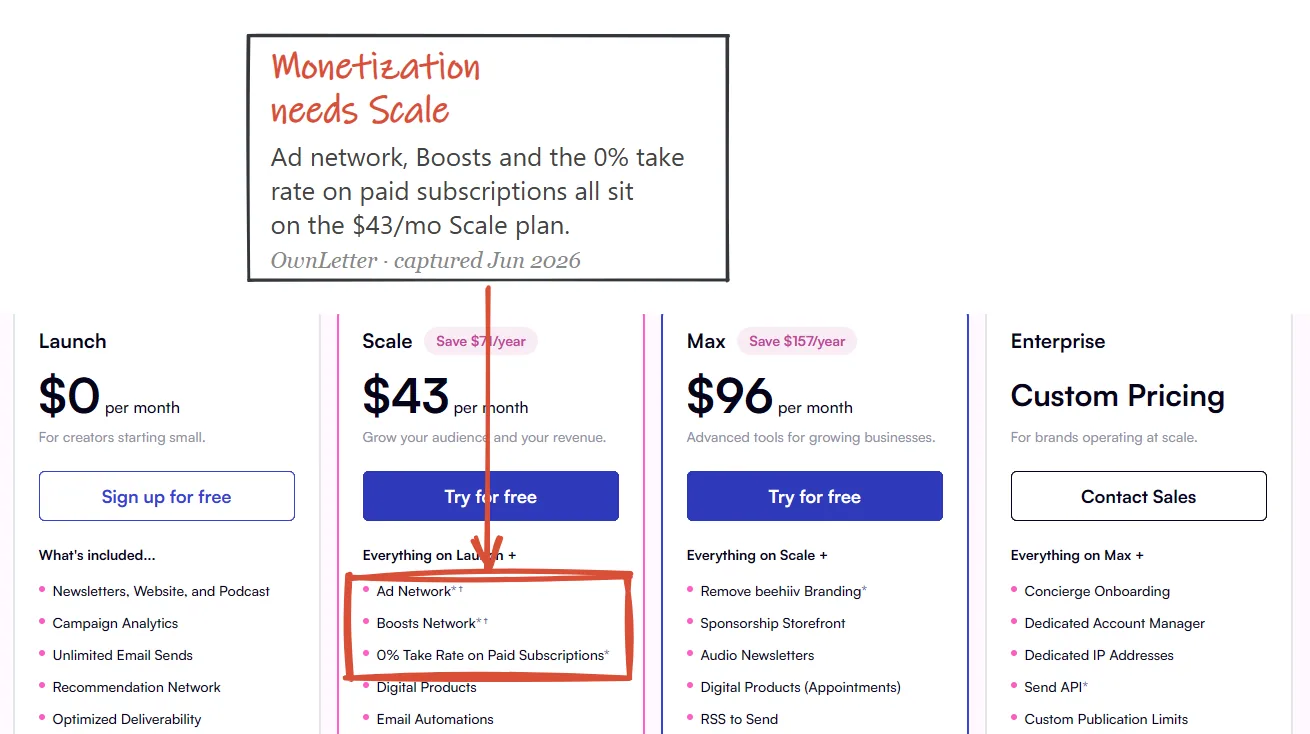
| Monetization access | Requires paid Scale plan ($43/mo annual) | From the free Newsletter plan |
The ad network gap
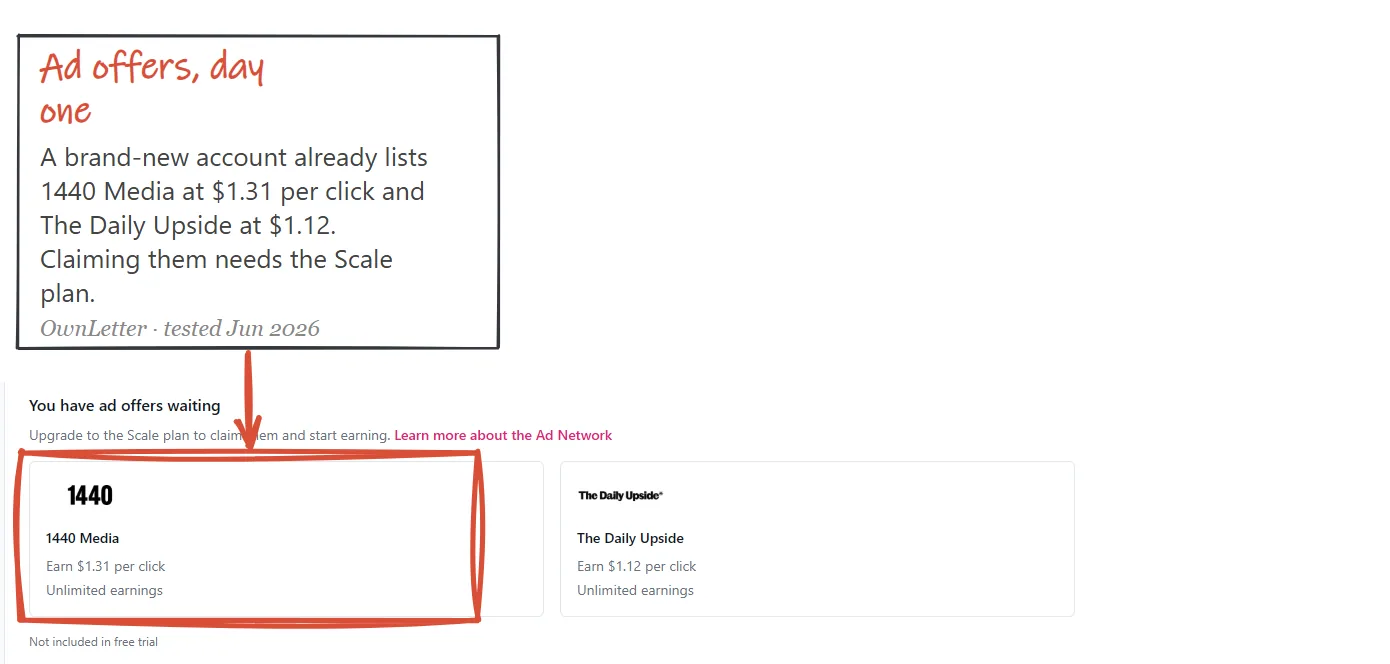
Beehiiv's native ad network is the feature Kit does not match. Reviewers describe concrete earnings: one creator reported "$27 straight to my PayPal" from a single campaign and "you do not need huge numbers to monetize" (Reddit, February 2026). At 80,000 subscribers, another creator described $3,000 to $4,000 per month in ad revenue (Trustpilot, March 2025; note: over 12 months old, reconfirm before modeling). Kit Ads exists, but it takes approximately 23.5% of the ad revenue generated through its network (per kit.com/ads), and Kit's programmatic ad network is not accepting new creators as of 2026 (per Kit's help center). For creators whose primary revenue is sponsors, the structural difference is significant: beehiiv's open ad network is effectively the only one of the two a new creator can actually use.
The claim that "The ad network is by far the most compelling and unique thing Beehiiv has to offer" (Trustpilot, January 2026) is corroborated by approximately 42 positive signals naming the ad network specifically in the OwnLetter aggregation.
Feature Comparison: Two Complete Platforms
Beehiiv scores 48 "yes" / 1 partial / 2 "no" / 2 pending across our 53-feature set; Kit scores 43 "yes" / 3 partial / 6 "no" / 1 pending. Both are complete newsletter platforms. The difference is not who can do what; it is which model each optimizes for. The feature table below is data-driven from the OwnLetter feature SSoT, 652 of 689 cells source-verified against primary documentation (June 2026).
Pick a plan from the ▾ menu under a platform to see what that plan unlocks and its price at your subs count.
| Feature | Beehiiv | Kit (ex-ConvertKit) |
|---|---|---|
| Monthly priceat 2.5K subs · monthly | $0/mo · Free ≤2.5K subs | $0/mo · Free ≤10K subs |
| 6/6 | 6/6 | |
| 4/5 | 4/5 | |
| 9/9 | 9/9 | |
| 9/9 | 9/9 | |
| 2/4 | 2/4 | |
| 4/5 | 5/5 | |
| 10/10 | 7/10 | |
| 5/5 | 4/5 | |
| Get started | Try free → | Try free → |
✓ Yes · Partial · — No · dotted = unverified · a plan tag (e.g. Scale) = the cheapest plan that unlocks it; pick a plan above each column and ↑ marks features above it. Verified against vendor sources, September 2026. Some links are paid — OwnLetter may earn a commission at no extra cost to you. It never affects the data.
Straight from the reviews
What real users say
Each site’s average below comes from its own user reviews across Reddit, Trustpilot, Capterra and G2 — the count per site is on each bar. We never invent a quote.
Average score on each review site
beehiivKitPraised · Complaint · Split opinion
Average scores pulled from each site on May 31, 2026. Trustpilot scores are a recent sample, not the lifetime average; Reddit has no star ratings. See our methodology.
Theme by theme: where they agree and differ
| What users say about… | beehiiv669 reviews read | Kit885 reviews read |
|---|---|---|
| Kit leads | ||
| beehiiv leads | ||
| beehiiv leads | ||
| Kit leads | ||
| Kit leads | ||
| beehiiv leads | ||
| See for yourself | Try free → | Try free → |
▲ Praised · ▼ Complaint · ◆ Mixed · top theme / common / minor = how often readers bring it up · ❝ hover any cell for the exact count and a real, sourced quote · · = too few reviews to score. Read in full from Reddit, Trustpilot, G2 and Capterra, June 2026. We never invent a quote. Some links are paid — OwnLetter may earn a commission at no extra cost to you. It never affects the data.
Review sources:RedditTrustpilotG2Capterra
Deep Dive: beehiiv
Across 322 beehiiv signals collected through June 2026 from Trustpilot, Reddit, G2, Capterra, and Hacker News, three patterns dominate the positive reviews: the ad network earns real money at modest list sizes, UX simplicity is praised by near-beginners, and the analytics are cited as a migration driver from Kit. Support is strong on paid plans. The account-suspension concern is real and specific, covered in the limitations section below.
Ad network: beehiiv's signature feature
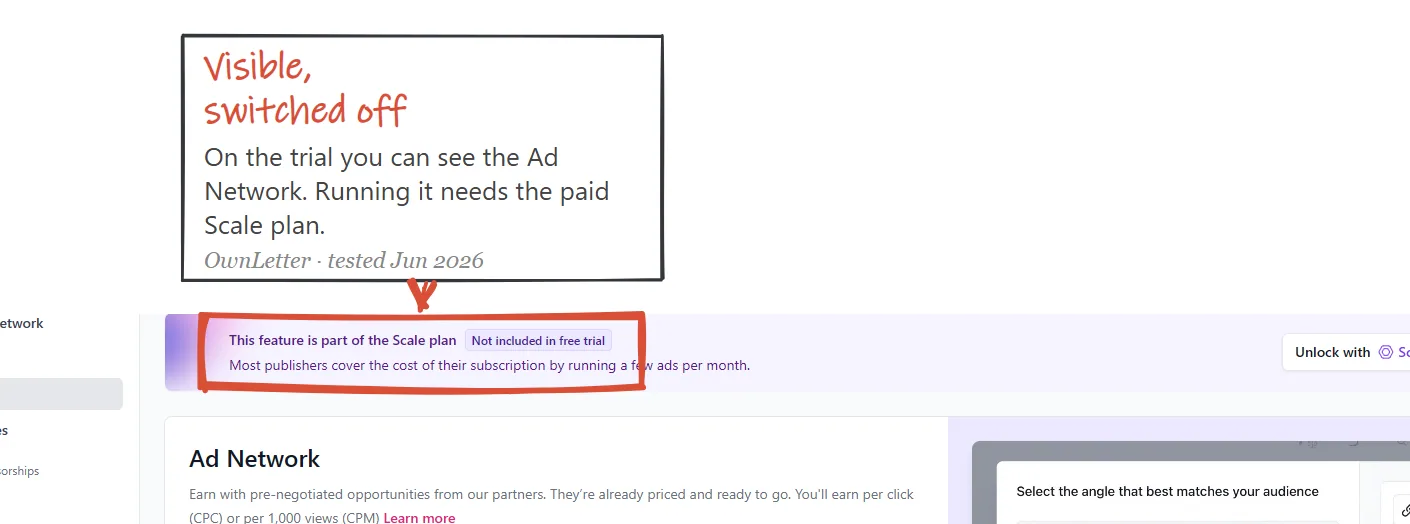
The native ad network is what approximately 42 reviews name as the main reason to choose beehiiv over alternatives. The mechanics: brands bid for placements in your newsletter via a CPM (cost per thousand) and CPC (cost per click) system, available on Scale and Max plans. Beehiiv takes 0% on the subscription side; you receive the full ad payment. For a creator whose primary growth strategy is publishing quality content and monetizing reach, this removes the intermediary margin that platforms like Kit Ads retain.
Simplicity: the most praised theme
UX simplicity is beehiiv's most cited positive theme, with approximately 45 signals using language like "super clean and easy to use for all levels" (Trustpilot, May 2026). This is the relevant contrast against Kit, where approximately 12 reviewers describe the onboarding as intrusive and the editor as "bare bones." For a creator who wants to start fast without investing time in an automation system, beehiiv's interface is a genuine advantage. The caveat: beehiiv's feature density can be initially overwhelming despite the clean UI; the simplicity is in the authoring and publishing flow, not the settings depth.
Analytics: the migration argument
Superior analytics is the most frequently cited reason in the OwnLetter aggregation for migrating from Kit to beehiiv. One Trustpilot reviewer in February 2026 wrote the clearest version: "We left Kit because we have had better analytics dashboard that helped us scale faster." Kit's analytics are functional but not cited as a strength in any review. Beehiiv's subscriber growth breakdown, post-level performance, and revenue-per-subscriber metrics are the specific dimensions reviewers name.
Support: CEO-accessible on paid plans
Support is beehiiv's top theme in the aggregation (~45 signals), and the dominance is positive. Multiple reviewers describe direct responses from CEO Tyler Denk. The contrast with Kit's polarized support is real: beehiiv is described as consistently accessible on paid plans. The catch: the free Launch plan routes to a help center that requires a paid plan for live support, per a June 2025 reviewer ("when I click Help it says I need to be on a paid plan"). If you are on the free tier, support access is limited.
Developer access and AI tooling
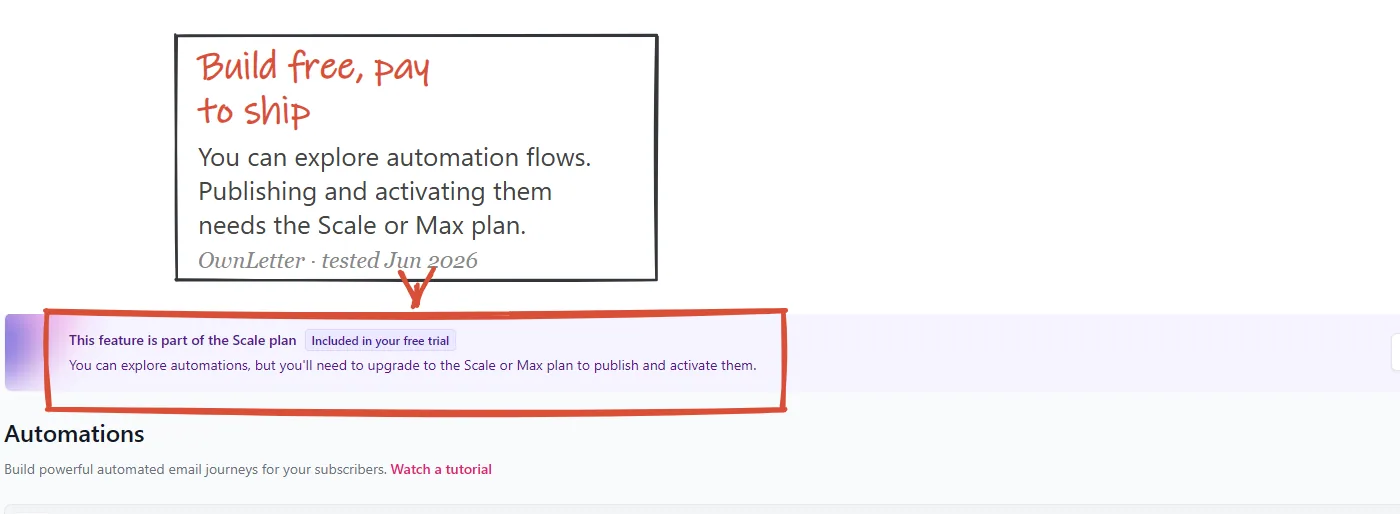
Two capability details that rarely surface in comparisons. First, beehiiv added a native MCP server in 2026 (free on all plans), which lets you query your publication's posts, stats, and subscribers from AI tools like Claude in plain language. It is read-focused for now (it can create segments but not send campaigns), and it is mainly useful if you run AI tools against your newsletter data. Second, the limits: beehiiv's REST API is free from the Launch plan, but webhooks and the full automation system require the paid Scale plan, and A/B testing is restricted to subject lines and send times, not email content (verified developers.beehiiv.com and the beehiiv help center, June 2026). For creators who want to script their stack or A/B test the body of an email, those are real constraints, and they are part of why some automation-first builders move to Kit.
Our take
Where beehiiv Falls Short
- Paid plan required from 2,500 subscribersThe beehiiv Launch plan is free up to 2,500 subscribers, but automations, the ad network, growth tools, and paid subscriptions are locked behind the Scale plan. Reviewers on Trustpilot and Reddit name this threshold explicitly: 'I'm getting close to the 2,500-subscriber mark, and that's when the monthly cost jumps quite a bit' (Reddit, May 2025). 'How is paying $49 reasonable?' for a small creator (Trustpilot, March 2026). If you are building toward the ad network or paid subscriptions and plan to stay free, the free tier will hit a ceiling faster than Kit's.
- Account suspensions with withheld revenue (REVIEW_SOURCED)Approximately 15 signals in the OwnLetter aggregation describe beehiiv account suspensions. Several of these specifically involve ad revenue being held during the review. One reviewer wrote: 'When I had generated about $8K in ad revenue, they locked my account for violation of terms and no explanation' (Trustpilot, May 2025). Another: 'blocked my account before I even sent a single email' (Trustpilot, November 2025). Beehiiv replies to these reviews and states accounts are reviewed per terms of service. The practical mitigation: keep CSV exports monthly and document your ad creative history. Attributed to review corpus, not confirmed as a blanket policy.
- Website builder limited and reported as buggyBeehiiv includes an integrated website and landing-page builder, but reviewers describe it as limited in customization and occasionally buggy. The contrast with dedicated landing-page tools or Kit's landing pages is cited in approximately 8 signals. If your use case is a polished standalone site rather than a newsletter-first setup, beehiiv's website builder is not a substitute for a purpose-built CMS. Kit does not offer a full site builder but its landing pages get better reviews.
- CPM rates reported declining in early 2025 — date-flag requiredSeveral reviewers described declining CPM rates on the beehiiv ad network in early 2025 (Trustpilot and Reddit, January through April 2025). This data point is over 12 months old as of this writing (June 2026) and should not be presented as current. If you are modeling ad revenue, confirm current CPM rates with beehiiv directly before publishing projections. The '$27 to PayPal' and '$3K to $4K monthly at 80K subs' examples cited elsewhere in this page are attributed with their original dates.
Deep Dive: Kit
Across 227 Kit signals from Reddit, G2, and Trustpilot (through June 2026), automations are the defining strength and the primary reason creators choose Kit over beehiiv. Support quality and the affiliate-link suspension risk are the specific warnings this audience needs. The September 2025 price hike is a material cost factor.
Automations: Kit's crown jewel
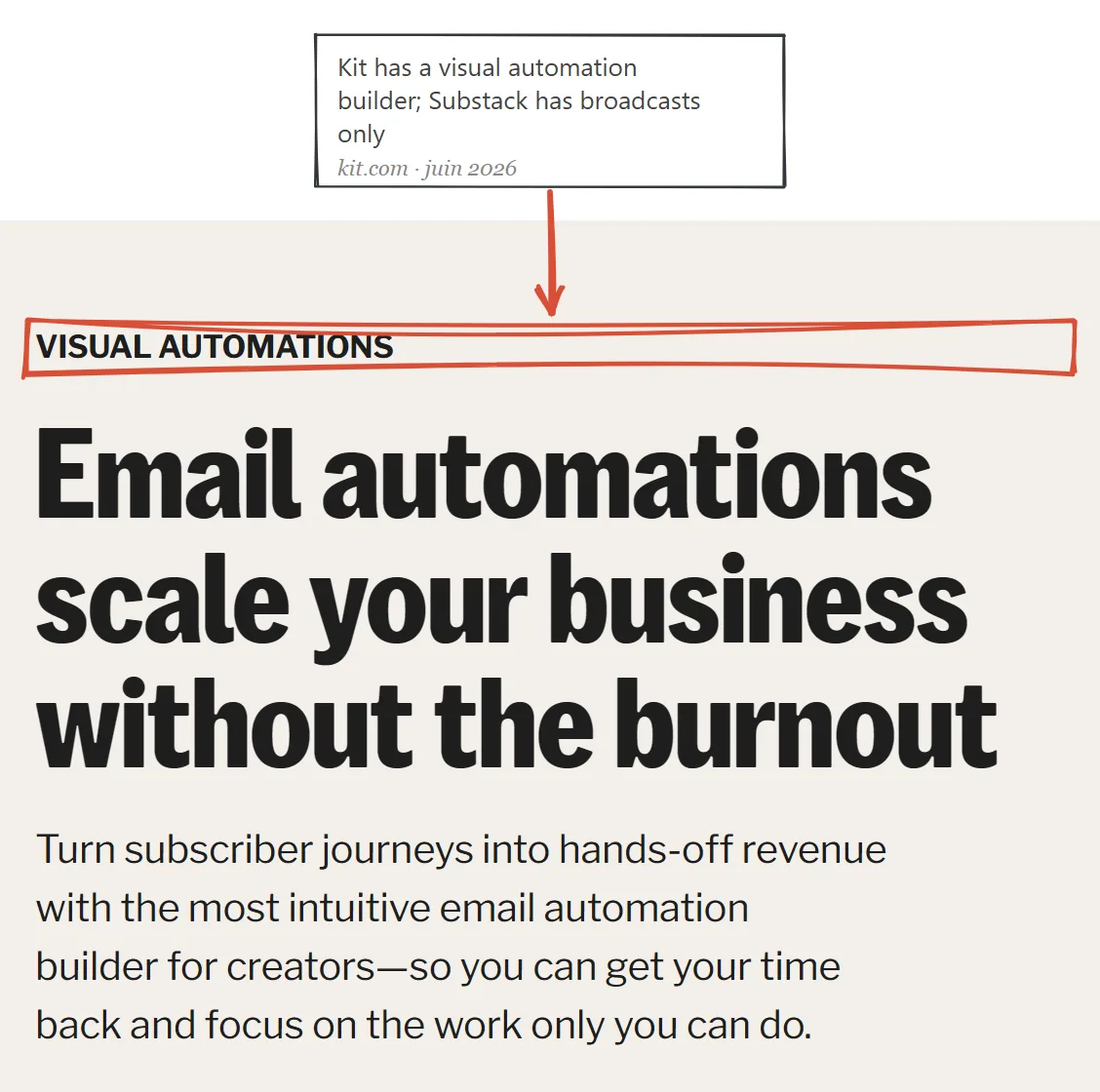
Approximately 20 reviews in the Kit aggregation name automations as the primary purchase driver. One G2 reviewer in May 2026: "the automations help turn subscribers into a real relationship and sales." The Creator plan includes unlimited visual automations with conditional logic, behavioral triggers, subscriber tagging, and 70-plus third-party integrations (verified kit.com/features/automations, June 2026). For course creators running onboarding-to-purchase sequences, this is a meaningful operational advantage. Beehiiv has automations too, but they are behind the Scale paywall and shallower; Kit's conditional logic and trigger depth go further.
Digital commerce: sell from the free tier
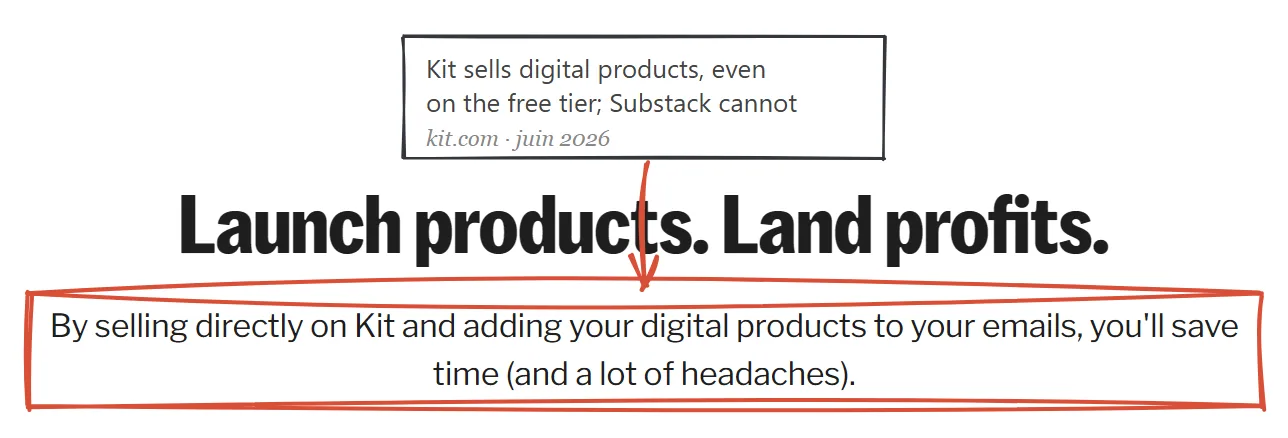
Kit supports selling digital products (ebooks, courses, templates) directly from the newsletter platform, including on the free Newsletter tier at a 0.6 percent platform fee (verified vendor-features.json, kit.com/commerce). Beehiiv offers 0% commission on digital products on Scale, but that requires the paid plan. For a creator with a small list who wants to sell a course before they can justify a beehiiv Scale subscription, Kit's free-tier commerce is a concrete advantage. The automation-plus-commerce combination is also more integrated on Kit: a subscriber who buys a product gets tagged and enters a post-purchase nurture sequence, all within one platform.
The affiliate-link suspension warning
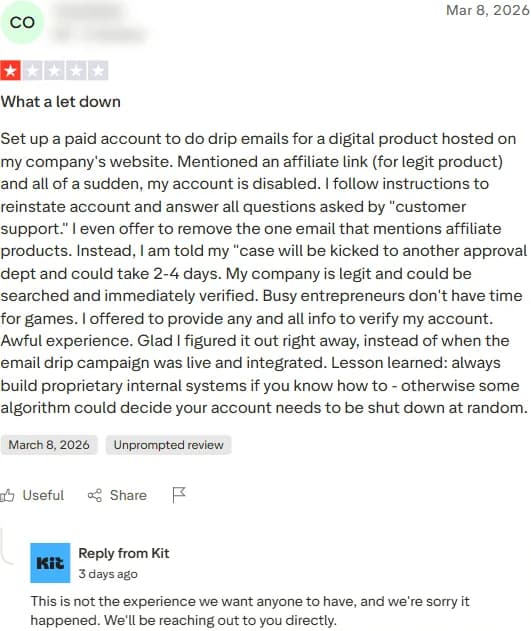
This matters specifically for OwnLetter's audience. Approximately 3-4 Trustpilot reviewers (March 2026) report Kit disabling accounts after including affiliate links in newsletters, including links the reviewers describe as legitimate. One wrote: "Mentioned an affiliate link (for legit product) and all of a sudden, my account is disabled." Kit's spam filter appears to flag outbound commercial links aggressively. This is a documented pattern from the review corpus, not a confirmed Kit policy. If you run affiliate content, consult Kit's support documentation on commercial email before sending at volume.
Our take
Where Kit Falls Short
- Account suspension risk on affiliate linksReviewers on Trustpilot (March 2026, approximately 3-4 reports in the OwnLetter aggregation) describe Kit disabling accounts after including affiliate links in newsletters, including links the reviewers describe as legitimate. One reviewer wrote: 'Mentioned an affiliate link (for legit product) and all of a sudden, my account is disabled' (Trustpilot, March 2026). This is a specific, documented risk for OwnLetter-style affiliate creators. Kit's spam filter appears to flag outbound commercial links aggressively. Attributed reviewer reports, not Kit policy; use link cloaking or direct links if you run affiliate content.
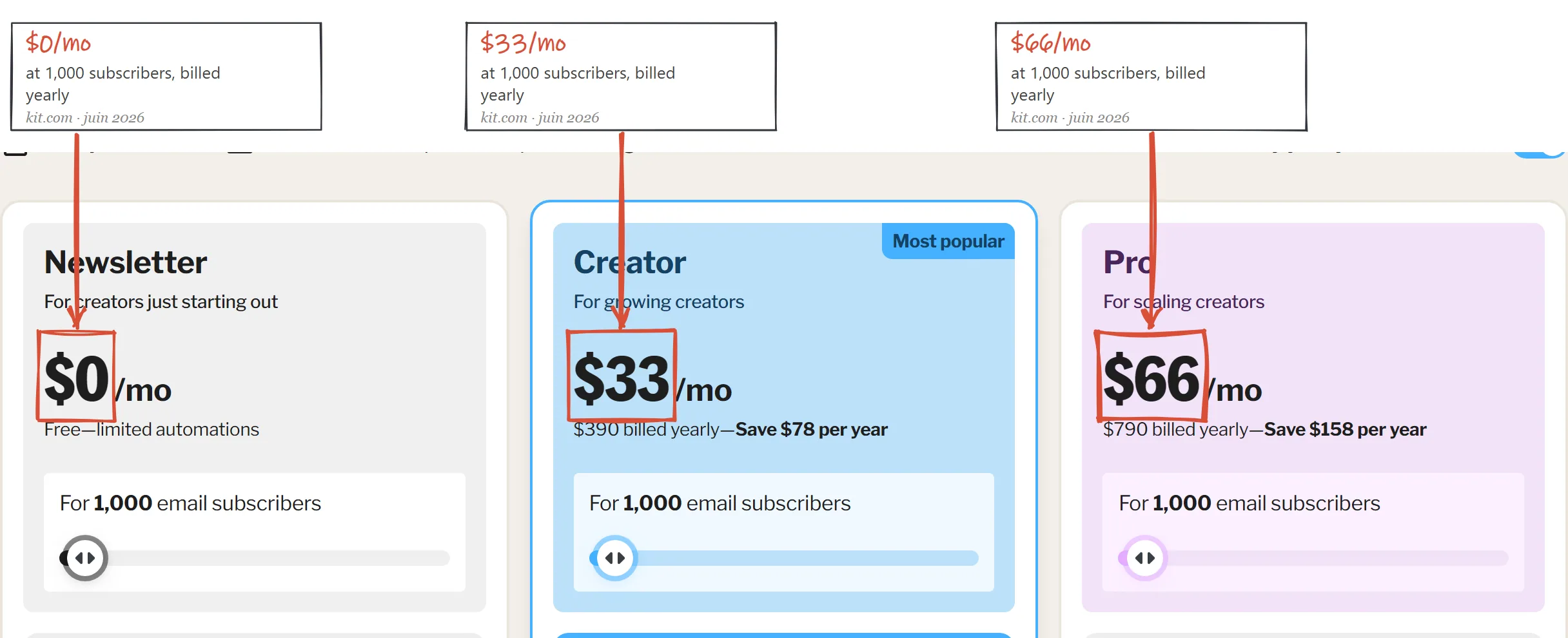
- September 2025 price hike (~56%)Kit raised Creator plan pricing approximately 56 percent in September 2025. The 1K-subscriber annual rate went from roughly $25 to $33 per month; monthly billing went from $29 to $39. Existing subscribers transitioned after a grace period. Several G2 and Trustpilot reviewers mention the hike as a pain point. There is no guarantee this was the last increase. Kit's pricing history is a relevant factor for newsletters modeling 3-5 year cost projections.
- Support experience is polarizedAcross approximately 35 Kit review signals (G2 and Trustpilot, May 2026), Kit support quality splits sharply. Some users report replies within minutes from named agents (G2, May 2026). Others describe Kit support as the most frustrating part of the platform, with unresolved issues dragging for weeks (Trustpilot, 2025-2026). Neither outcome is consistent. If responsive support is a hard requirement for your business, treat Kit's support as variable rather than reliable.
- Onboarding described as intrusive, editor described as bare-bonesApproximately 12 signals in the Kit aggregation describe the onboarding process as unusually intrusive or 'like a mortgage application.' The email editor is described as 'bare bones' by reviewers who came from more visual tools. These are UX friction points rather than functional limitations, but they matter for teams that need to onboard non-technical senders quickly. Beehiiv's UX simplicity is its most praised theme (~45 signals); Kit's editor rewards power users who invest in learning the automation system.
Email Deliverability: What Neither Platform Publishes
Neither beehiiv nor Kit publishes an audited inbox-placement rate, and any single-account deliverability test is too small a sample to rank one platform over the other. Across 1,554 signals, deliverability is not a dominant complaint on either platform. Beehiiv has occasional delivery swing reports from individual senders; Kit has approximately 8 signals mentioning shared-IP blacklist events. Neither pattern dominates the corpus.
What we did not do: we did not run seed-list deliverability tests. They violate both platforms' terms of service, and one sending account is not representative of platform-wide performance. If deliverability is your decisive factor, test your own content with a small real list before you commit, rather than trusting any published number including ours.
One signal to note: beehiiv's Trustpilot aggregate includes approximately 15 one-star reviews from readers who received spam or scam emails sent via beehiiv. This is a reader perspective on platform trust, not a creator deliverability failure. It affects the aggregate rating but does not reflect on your outbox performance.
Who Controls Your Audience: Data, Terms, and Company Risk
Suspension stories (covered above) are the visible risk. The structural picture matters just as much, and on this layer the two platforms diverge in ways most comparisons skip. We read both companies' published terms and funding history. The verified points are below, with sources.
Company stability: the counterintuitive part
beehiiv is venture-backed (Series B, $33M raised, April 2024) and growing fast. That funds rapid feature development, but venture ownership carries an exit horizon: investors eventually need a sale or IPO, which can change pricing, terms, or direction. Kit runs the opposite model: bootstrapped, profitable, roughly $43M in annual revenue with about 99.5% net revenue retention, and a founder who is openly anti-venture-capital. If your priority is a platform unlikely to be sold or repriced under investor pressure over the next few years, Kit's independence is the safer bet. If you want the platform shipping new monetization features fastest, beehiiv's funding is the advantage. (Sources: Sacra on beehiiv, GetLatka on Kit, June 2026.)
If your account is closed
Both platforms let you export a CSV of your list while your account is active, and both reserve the right to suspend. The difference is what their terms say about a closure. beehiiv's terms allow suspension but do not spell out list portability after a ban. Kit's terms are more explicit and more restrictive: an account can be closed "in our sole determination," export after closure is "at Kit's discretion," and a new account is not permitted afterward (kit.com/terms, read June 2026). The practical takeaway is the same for both platforms: keep your own monthly CSV backup so no platform decision ever holds your list hostage.
The fine print: both are creator-adverse, on different axes
We read both companies' terms of service in full (beehiiv.com/tou and kit.com/terms, June 2026). Neither is clean, and they are harsh on different points. Read this as "what we confirmed," not legal advice.
| Fine print | beehiiv | Kit |
|---|---|---|
| Content license | Sublicensable; covers your name, voice, and likeness (ad partners could use your identity) | Perpetual, but only on anonymized, aggregated derivatives, not your raw content |
| Legal disputes | Court-based (no forced arbitration); class action and jury waived; 1-year window | Forced arbitration in Idaho; class action and jury waived; 2-year window |
| Liability cap | Greater of 12 months' fees or $100 | Greater of 12 months' fees or $5 |
| Selling your account | Non-transferable | Non-transferable (needs a separate written agreement) |
The honest read: beehiiv's content license is the more creator-adverse on paper, because it can sublicense your name, voice, and likeness. Kit's terms are harsher on legal recourse, with forced arbitration and a $5 liability floor for free-plan users. Both block class actions and make your account non-transferable. This is common SaaS boilerplate, but the likeness clause on beehiiv and the arbitration plus $5 cap on Kit are the parts worth knowing before you build a business on either.
For affiliate-driven creators
This is the most actionable point for an audience that runs affiliate content. Kit's Acceptable Use Policy explicitly prohibits "CPA affiliate-type sites" and purchased or scraped lists (help.kit.com, verified June 2026). That language targets thin affiliate-spam operations rather than a genuine newsletter that happens to include affiliate links, but combined with the reported link-flagging suspensions covered above, affiliate-first creators should read Kit's AUP carefully before committing. beehiiv's AUP is category-based (it bans ICOs, MLM, unlicensed gambling, and payday lending, while allowing educational crypto content) and does not single out affiliate sites. Neither platform is a free pass for aggressive affiliate sending.
Data location and security
beehiiv stores all publisher and subscriber data in the United States (AWS US regions, per security.beehiiv.com) and holds a SOC2 Type I certification (October 2025). The US-only hosting is worth noting if you have a European audience and GDPR data-residency obligations, because there is no EU hosting option. Kit's data-residency region is not documented in our current data and should be verified directly if it is decisive for you. Neither platform has a publicly documented data breach as of June 2026.
Note on method: every point in this section is verified against primary sources (company funding records via Sacra and GetLatka, beehiiv.com/tou, kit.com/terms, and each platform's AUP, read June 2026). We would rather omit a claim than publish an unverified one.
Pricing Scenarios: The Cost Inversion by Size
The price advantage switches platforms as your list grows. Kit's Newsletter plan is free to 10,000 subscribers; beehiiv charges from 2,500. Once both platforms are paid, beehiiv Scale becomes cheaper at 10,000 subscribers and stays cheaper above that. At 10,000 subscribers: beehiiv $109/mo monthly versus Kit Creator $139/mo monthly. At 25,000 subscribers: beehiiv $169/mo versus Kit $199/mo (monthly billing, verified June 2026). On annual billing: beehiiv $149/mo versus Kit $166/mo at 25K subs.
beehiiv Scale pricing (verified June 2026)
- · Launch (free): Free up to 3K subs. Up to 2,500 subscribers. No ad network, no paid subs, no automations.
- · Scale (annual): $43/mo (Scale, 1K subs) · verified June 3, 2026 at 1K subs. 0% platform fee on paid subs, ad network, automations, growth tools.
- · Scale (monthly): $49/mo (Scale, 1K subs) · verified June 3, 2026 at 1K subs. Same features as annual, no long-term lock-in.
Kit Creator pricing (verified June 2026, September 2025 hike applied)
- · Newsletter (free): Free up to 10K subs. Up to 10,000 subscribers. Paid subscriptions and digital products at 0.6% platform fee.
- · Creator (annual): $33/mo (Creator, 1K subs) · verified June 3, 2026 at 1K subs. Unlimited automations, sequences, 2 team members. September 2025 hike applied.
- · Creator (monthly): $39/mo (Creator, 1K subs) · verified June 3, 2026 at 1K subs. Same features as annual, no long-term lock-in.
Monthly cost by subscriber count
beehiiv Scale vs Kit Creator by subscriber count (monthly billing). Beehiiv is cheaper from 10K subscribers. Kit is free to 10K; beehiiv charges from 2,500. Verified pricing June 2026.
Subscriber count Total list size | beehiiv Scale (monthly billing) 0% on paid subs | Kit Creator (monthly billing) 0.6% on paid subs | Who is cheaper Monthly billing comparison |
|---|---|---|---|
| 1,000 subscribers | $49/mo (Launch free if ≤2,500) | $39/mo (Newsletter free if no paid subs) | Kit (free tier available) |
| 5,000 subscribers | $89/mo | $89/mo (Newsletter free if <10K) | Kit (free tier or equal cost) |
| 10,000 subscribers | $109/mo | $139/mo | beehiiv ($30/mo cheaper) |
| 25,000 subscribers | $169/mo | $199/mo | beehiiv ($30/mo cheaper) |
1,000 subscribers
- beehiiv Scale (monthly billing)
- $49/mo (Launch free if ≤2,500)
- Kit Creator (monthly billing)
- $39/mo (Newsletter free if no paid subs)
- Who is cheaper
- Kit (free tier available)
5,000 subscribers
- beehiiv Scale (monthly billing)
- $89/mo
- Kit Creator (monthly billing)
- $89/mo (Newsletter free if <10K)
- Who is cheaper
- Kit (free tier or equal cost)
10,000 subscribers
- beehiiv Scale (monthly billing)
- $109/mo
- Kit Creator (monthly billing)
- $139/mo
- Who is cheaper
- beehiiv ($30/mo cheaper)
25,000 subscribers
- beehiiv Scale (monthly billing)
- $169/mo
- Kit Creator (monthly billing)
- $199/mo
- Who is cheaper
- beehiiv ($30/mo cheaper)
Coming from Substack: beehiiv vs Kit as a Destination
Both beehiiv and Kit are common Substack migration destinations, and the friction differs substantially.
Beehiiv has a 1-click Substack importer that carries Stripe payment data for paid subscribers. Free subscribers and paid subscribers move together in one step, with payment continuity. The re-subscription ask that applies when migrating to Kit is not required. For newsletters with significant paid subscriber revenue, this is a concrete lower-friction path.
Kit requires paid subscribers to re-subscribe.Per Kit's official migration documentation (help.kit.com, verified February 2026), paid subscribers must cancel their Substack subscription and re-subscribe through your new Kit checkout. Payment data does not transfer. The re-subscription event typically produces some drop in paid count; practitioners estimate 5-15% (no Kit-specific verified data). If paid-subscriber continuity is your primary concern, beehiiv reduces this friction materially.
Apple in-app subscriptions are non-portable on any migration path, including both beehiiv and Kit. Free subscribers move cleanly via CSV to either platform.
Cross-reference: the Substack vs beehiiv comparison covers the paid-sub importer in detail. The Substack vs Kit comparison covers the re-subscription process and the 10% vs 0.6% fee math.
Real-World Cases: Bidirectional Migration and the Dual-Stack
Migrations go in both directions, and each direction is motivated by the features that matter most to that creator's model.
From Kit to beehiiv: analytics and ad monetization
The Trustpilot reviewer in February 2026 who wrote "We left Kit because we have had better analytics dashboard that helped us scale faster" is representative of approximately 10 signals in the beehiiv corpus describing Kit-to-beehiiv migrations. The pattern: creators who are primarily publishing a newsletter and want to monetize it through sponsors find beehiiv's ad network and analytics more useful than Kit's automation depth.
From beehiiv to Kit: automation and API depth
Developers and creators building product funnels cite beehiiv's API limitations (locked behind Scale) and shallower automation as reasons to move to Kit. Kit's behavioral triggers, deeper integrations, and more mature API are the pull factors. The trade-off: losing beehiiv's ad network and moving to a platform that takes 0.6% on subscription revenue and 23.5% if you use Kit Ads.
Account ownership risk: different triggers on both platforms
Both platforms carry documented account-suspension risk. Beehiiv suspensions cluster around the moment revenue is at stake: approximately 15 signals describe suspensions, several involving ad revenue being withheld during the review. Kit suspensions cluster around affiliate-link detection: approximately 3-4 Trustpilot signals describe accounts disabled after including a legitimate affiliate link. For OwnLetter's audience, the Kit affiliate-link trigger is a specific, documented operational risk. For high-revenue beehiiv users, the ad-revenue-retention risk is the specific concern. Keep monthly CSV exports of your subscriber list on both platforms regardless of which you use.
Frequently asked
Frequently Asked Questions
Is beehiiv or Kit cheaper?
It depends on your subscriber count. Kit is free up to 10,000 subscribers (Newsletter plan), while beehiiv charges from 2,500 subscribers ($49/mo monthly, $43/mo annual on the Scale plan). Once both platforms are paid, beehiiv becomes cheaper at scale: at 10,000 subscribers, beehiiv Scale runs $109/mo monthly versus Kit Creator at $139/mo monthly. At 25,000 subscribers, beehiiv charges $169/mo versus Kit's $199/mo (monthly billing). The advantage flips: Kit is free early, beehiiv is cheaper later. Pricing verified on beehiiv.com/pricing and kit.com/pricing (June 2026).
Does Kit really charge 3.5% on paid newsletter revenue?
No. The 3.5% figure that circulates in most comparison articles conflates Kit's platform fee with Stripe processing. Kit's platform fee on paid subscriptions is 0.6 percent. Stripe adds roughly 2.9 percent plus $0.30 per transaction (the same Stripe rate that applies to beehiiv and every other platform using Stripe). The correct all-in figure is approximately 3.5 percent total, but Kit's own cut is 0.6 percent. Beehiiv takes 0 percent on paid subscriptions (Stripe fees still apply). This distinction matters if you're comparing platform economics: beehiiv's 0% platform fee versus Kit's 0.6% is the accurate gap to model. Verified kit.com/pricing, June 2026.
Can I monetize with ads on both beehiiv and Kit?
Both have ad products, but the economics differ substantially. Beehiiv runs a native ad network (CPM and CPC deals) available on the Scale plan, and beehiiv takes 0 percent from your ad revenue on the subscription side. Kit has its own ad product (Kit Ads), but Kit takes approximately 23.5 percent of the ad revenue generated through its network. That makes beehiiv's ad network structurally more favorable for creators who want to monetize primarily through sponsorships. Beehiiv reviewers describe earnings like '$27 straight to my PayPal' and '$3,000 to $4,000 per month at 80,000 subscribers' (Trustpilot, February 2026 and March 2025). Verify the Kit Ads commission rate on kit.com/ads before building a revenue model around it.
Will beehiiv withhold my ad revenue if my account is flagged?
Reviewers on Trustpilot and Reddit document this risk specifically. Approximately 15 signals in the OwnLetter aggregation describe beehiiv account suspensions, and several involve ad revenue being withheld during an account review. One reviewer wrote: 'When I had generated about $8K in ad revenue, they locked my account for violation of terms and no explanation' (Trustpilot, May 2025). Beehiiv does respond to these reviews and states accounts are reviewed per terms of service. The practical mitigation: keep monthly CSV exports of your subscriber list and document your ad content before disputes arise. This is a documented risk, not a confirmed blanket policy, but it's specific and attributed.
Can I use both beehiiv and Kit at the same time?
Yes, and there are documented cases of both directions. Grow and monetize with sponsors on beehiiv (ad network, simple UX, strong analytics), while running automation-heavy product funnels or digital commerce on Kit (behavioral workflows, 0.6% digital product fee from the free tier). The dual-stack costs more operationally and requires managing two subscriber lists, but it's a defensible strategy if your revenue has two distinct legs. Creators have also migrated in both directions: from Kit to beehiiv for analytics and ad monetization, and from beehiiv to Kit for API depth and automation. The practical limit is subscriber-list overlap and keeping FTC disclosures accurate on both platforms.
How We Tested This Comparison
OwnLetter operates as a lab-style analyst. We read 1,554 unique user signals: 669 beehiiv signals (Trustpilot, Reddit, G2, Capterra, Hacker News) and 885 Kit signals (Trustpilot, Reddit, G2), all collected through June 2026. Every signal was read in full, not sampled by keyword. Both feature data sets (53 features, 652 source-verified cells) and pricing data were cross-validated against vendor primary pages on June 3, 2026.
All 8 triangulated claims include attribution. Negative claims about either vendor are REVIEW_SOURCED with platform and date. Zero claims are invented or padded. The Kit Ads 23.5% commission figure is source-verified at 0.9 confidence (one primary source, kit.com/ads); we have phrased it as "approximately 23.5%" with a note to verify before modeling.
What we did not do: we did not run live deliverability tests (seed-list tests violate vendor ToS for both platforms). We aggregate documented signals rather than producing metrics from a single account. Full methodology →
Affiliate status:OwnLetter is enrolled in beehiiv's affiliate program (Bronze tier, 50% commission for 12 months, 60-day cookie). If you start beehiiv through our link, we may earn a commission. We are not enrolled in Kit's affiliate program, so our Kit analysis earns us nothing. We flag this asymmetry as a trust signal: our Kit coverage has no commission incentive. The editorial positions on both platforms reflect the review data, not the commission structure.
Sources
- · beehiiv pricing page (verified June 3, 2026)
- · Kit pricing page (verified June 3, 2026)
- · Kit Visual Automations feature page (verified June 2026)
- · Kit commerce page (verified June 2026)
- · Trustpilot beehiiv reviews (4.12/5, ~354 reviews, captured June 2026)
- · Trustpilot Kit reviews (3.41/5, 194 reviews, captured June 2026)
- · Kit official Substack migration documentation (verified February 4, 2026)
- · FTC Consumer Review Rule (October 2024)
Who Should Pick Which
If you monetize with sponsors or want to grow a newsletter:
Beehiiv. The native ad network is what Kit cannot match at competitive economics; 0% on paid subscriptions; best analytics for tracking growth. The cost: a paid plan from 2,500 subscribers and shallower automation than Kit.
Start beehiiv free →If you sell courses or digital products:
Kit. Behavioral automation is its genuine edge; commerce is open from the free tier at 0.6%; you can stay free to 10,000 subscribers. The trade-off: a bare-bones editor, intrusive onboarding, polarized support, and a 23.5% cut if you use Kit Ads.
Try Kit free (up to 10K subs) →If you run affiliate content:
Caution on both. Beehiiv suspends accounts when ad revenue is at stake (approximately 15 signals). Kit suspends accounts when affiliate links are detected (approximately 3-4 Trustpilot signals, March 2026). Neither platform has a clean record for affiliate-driven creators. Keep monthly CSV exports, document your content, and read both platforms' commercial email policies before sending at scale.
If you want the simplest start:
Beehiiv. UX simplicity is its most praised theme (~45 signals). Kit rewards power users who invest in the automation system; its onboarding is described as intrusive by approximately 12 reviewers. If you want to start publishing fast and grow before optimizing your monetization model, beehiiv's launch friction is lower.
Looking at alternatives beyond these two? See our full beehiiv alternatives guide or the Kit alternatives guide.
Join the Discussion
Using beehiiv or Kit? Share your experience or correct an inaccuracy. No account required: email and name only. Comments are moderated.