On this page (15 sections)

By Arthur Brulard, Founder of OwnLetter. Cross-vendor analyst review across 11 newsletter platforms, aggregating user signals from Reddit, G2, Capterra, Trustpilot, and Hacker News. LinkedIn
Published June 9, 2026 · Updated June 9, 2026 · 18 min read
For paid-first writers · Updated June 9, 2026
Best newsletter platforms for writers
You write prose, you want readers to pay for it, and Substack's 10% cut has started to sting. Here is where writers actually land when they leave, ranked by what you need most.
The 30-second verdict
- Ghostif you want the best writing editor and to fully own your site (0% fee).visit ↗
- Beehiivif growth and ad revenue matter as much as subscriptions.visit ↗
- Substackif you are starting from zero and need its discovery network.visit ↗
- Buttondownif you want to keep 100% and write in Markdown.visit ↗
- Kitif you also sell products or courses to your list.visit ↗
One honest caveat up front: our top pick, Ghost, makes you pay for its Publisher tier before you can charge readers, and it leans technical. If that is a dealbreaker, start with Beehiiv or Substack.
Who this is for
Writers who publish prose and want readers to pay for it
This is for the writer leaving Substack: you care about the writing experience, about keeping more of your subscription revenue, and about owning your audience rather than renting it. If you run an e-commerce store or a B2B sales team, a marketing tool will fit you better than anything here.
- Publishing words, not just broadcasting offers
- Building or already earning from paid subscriptions
- Tired of giving up 10% and flying blind on support
The shortlist
Three picks for most writers
The other two (Buttondown and Kit) win narrower, specific cases covered below.
Ghost
Best for writers
The most-praised writing editor in the panel, a 0% fee on paid subscriptions, and the only platform you can fully own. The trade-off: you pay for the Publisher tier before you can monetize.
0% fee · paid plans open monetization
Explore GhostEditorial pick · not an affiliate link
Beehiiv
Best for growth
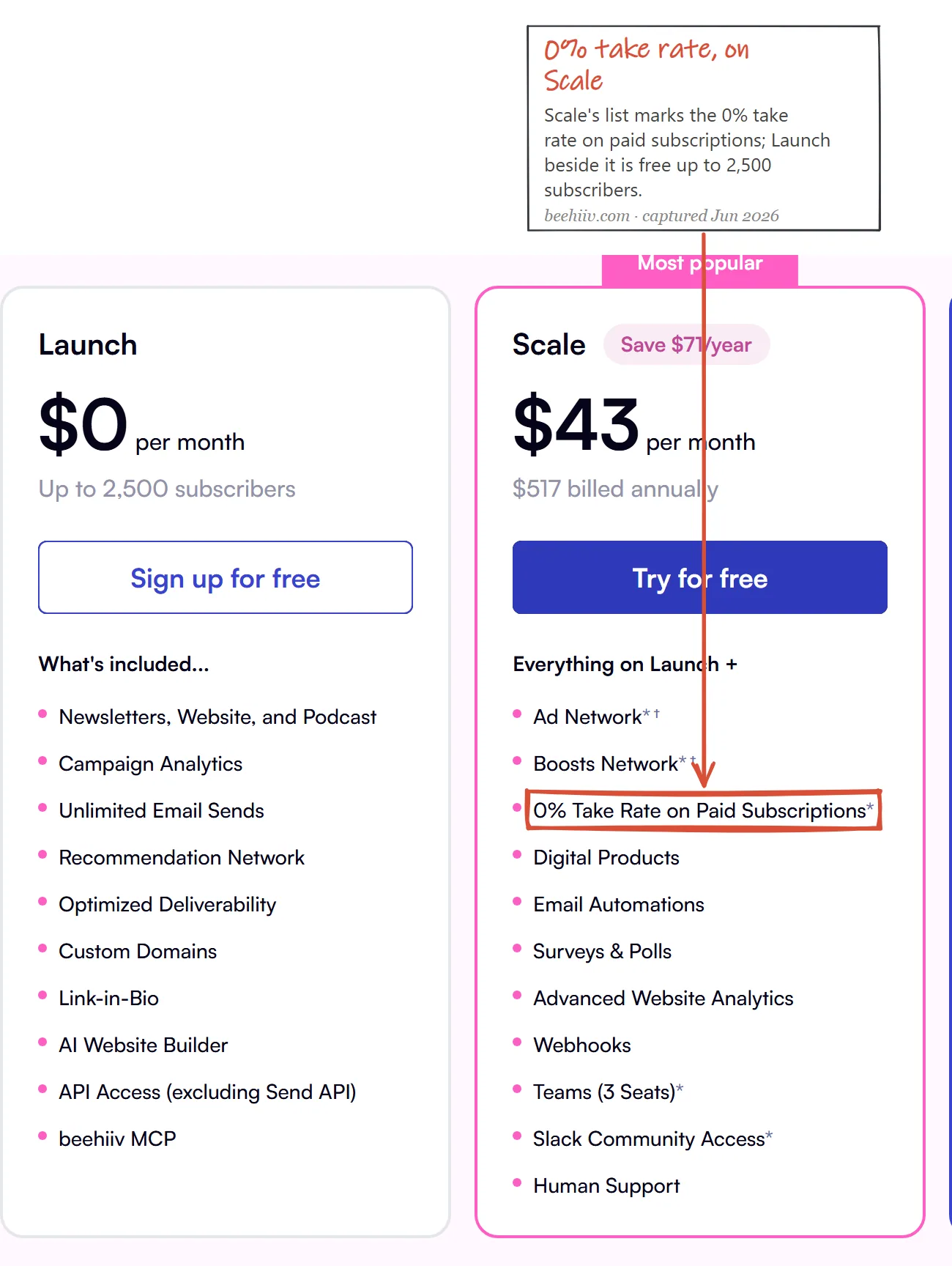
Keeps 0% of your subscription revenue and adds the growth and ad-revenue tools Substack will not: Boosts, a referral program, a sponsor network, and the best analytics in the panel.
Free to start · 0% on paid subs
Start Beehiiv freePaid link — at no extra cost to you
Substack
Best to start from zero
Its recommendation network is the only real reader-discovery engine in the panel. If you have no audience yet, that network is worth the 10% cut. Once you earn, the cut starts to hurt.
Free to start · 10% of paid revenue
See SubstackEditorial pick · not an affiliate link
Five platforms at a glance
The four things that decide it for a writer: what the platform takes, how it feels to write in, how it finds you readers, and how much of your audience you keep when you leave.
Platform | Platform fee on paid subscriptions | Prose editor writing experience | Built-in discovery does it find readers? | You own the audience export & control |
|---|---|---|---|---|
| Ghost | 0% (Stripe only) | Best in class (Koenig) | None built in | Yes (even self-host) |
| Beehiiv | 0% (paid plan) | Good, no live preview | Boosts + referral | Export; US-only data |
| Substack | 10% of revenue | Good, some bugs | Best (native network) | List export only |
| Buttondown | 0% (add-on) | Good (Markdown) | None | Full export, portable |
| Kit | 0.6% | Weak (text only) | Creator Network | At Kit's discretion |
Ghost
- Platform fee
- 0% (Stripe only)
- Prose editor
- Best in class (Koenig)
- Built-in discovery
- None built in
- You own the audience
- Yes (even self-host)
Beehiiv
- Platform fee
- 0% (paid plan)
- Prose editor
- Good, no live preview
- Built-in discovery
- Boosts + referral
- You own the audience
- Export; US-only data
Substack
- Platform fee
- 10% of revenue
- Prose editor
- Good, some bugs
- Built-in discovery
- Best (native network)
- You own the audience
- List export only
Buttondown
- Platform fee
- 0% (add-on)
- Prose editor
- Good (Markdown)
- Built-in discovery
- None
- You own the audience
- Full export, portable
Kit
- Platform fee
- 0.6%
- Prose editor
- Weak (text only)
- Built-in discovery
- Creator Network
- You own the audience
- At Kit's discretion
Platform fees are structural; subscriber-tier prices are pulled live from our pricing tracker.
 Ghost
GhostGhost: the writer's platform you can own
Ghost is the closest thing to a writer-first platform in this group, and it wins on the two things writers feel every day: the editor and ownership. Its Koenig editor is the single most-praised feature across 415 reviews:
“A clean, fast, distraction-free editor focused purely on writing and publishing.” — Trustpilot reviewer, 2026-01-20
It takes 0% of your subscription revenue, and because it is open-source and self-hostable, no company can deplatform a site you run yourself.
The catch is the on-ramp. You cannot charge readers on the cheapest plan; monetization lives on the Publisher tier. And Ghost will not find readers for you. There is no recommendation network, so growth comes from your own SEO and social. For a writer who already has an audience and wants to stop renting it, that is a fair trade.
Our take
Where Ghost Falls Short
- The cheapest tier cannot monetizeGhost's Starter plan gives you a site and an email list but no paid subscriptions and no tips. You need the Publisher tier to charge readers, so there is no free on-ramp to revenue.
- Design customization hits a developer wallBeyond the default theme, meaningful customization needs Handlebars and CSS. One reviewer: "There's no ability to design a website that looks even half decent" (Trustpilot, 2025-07-13).
- No automation, no native discovery, no writing appGhost has no behavioral email automation, no built-in referral or recommendation network, and no mobile app for writing on the go. Growth is on you, through SEO and social.
Pick Ghost if you have a list, value the writing experience, and want to own your full site. Skip it if you need to monetize on day one, are non-technical, or expect the platform to grow your audience.
 beehiiv
Beehiiv: keep 0% and add the growth tools Substack will not
Beehiiv is the upgrade path for a writer who thinks like an operator. It takes 0% of your subscription revenue and layers on what Substack structurally cannot: a referral program, paid cross-promotion (Boosts), a sponsor network, and the best analytics in the panel. Writers migrate for exactly that:
“I switched over from Kit a few years ago… better analytics dashboard that helped us scale faster.” — Trustpilot reviewer, 2026-02-09
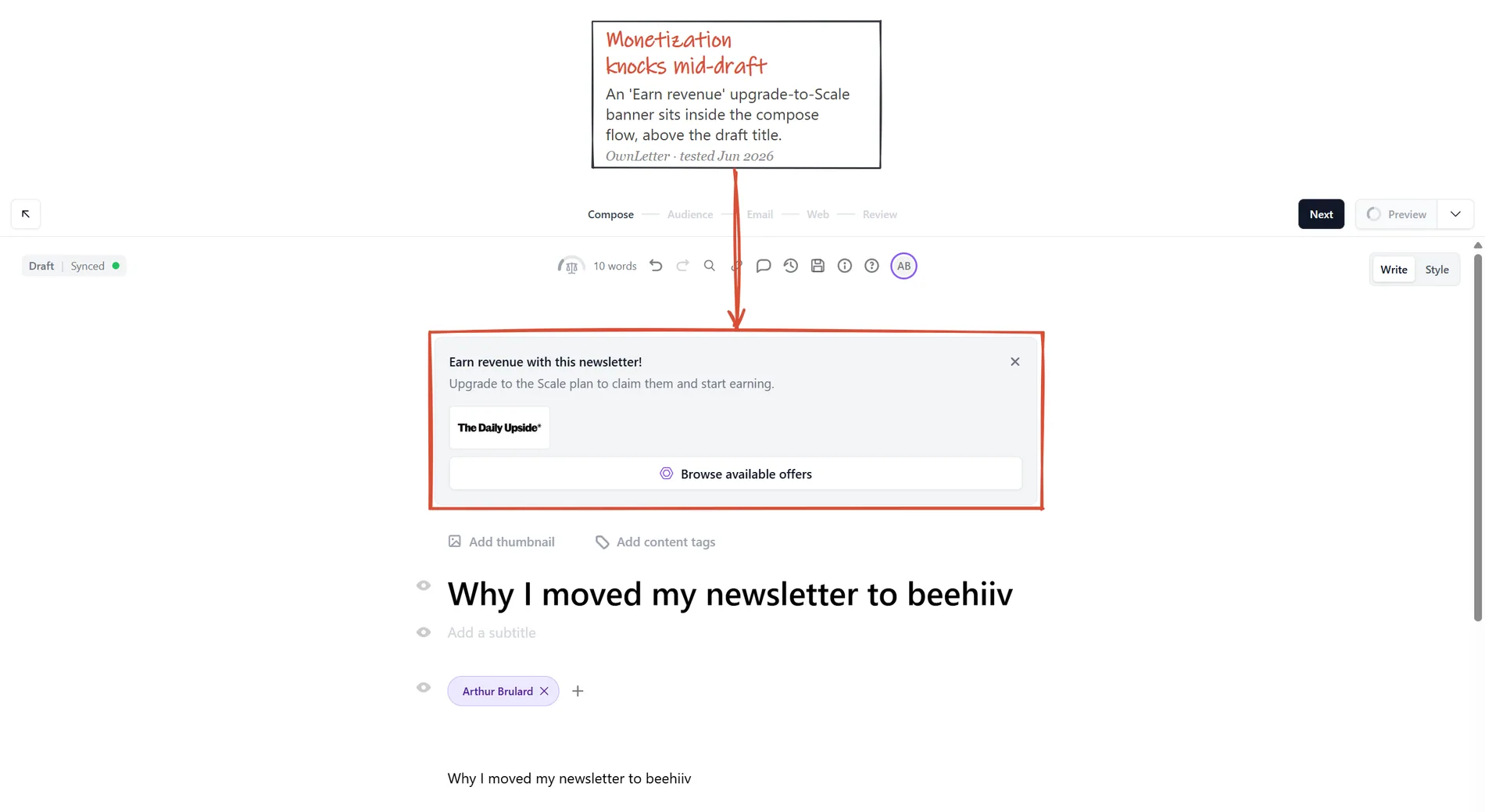
The friction is the writing surface and the gate. There is no live preview, and the editor has been reported to lag on long posts in 2026. Paid subscriptions and the ad network sit behind the Scale plan, not the free tier, so the model rewards writers who are already past their first few hundred readers.
Our take
Where Beehiiv Falls Short
- Monetization is gated to a paid planPaid subscriptions, the ad network, and the referral program are gated to the Scale plan, not the free tier. Below a few hundred subscribers with no near-term revenue, the jump can feel steep.
- The editor lags on long proseThere is no live preview, and reviewers report keystroke lag on long posts: "The editor was basically unusable today — I had to write my daily newsletter in Evernote and then cut and paste over" (Reddit, 2026-01-13).
- Suspension risk and US-only dataAccounts have been closed without warning ("I have lost over $4,000 in revenue," Trustpilot, 2026-04-06), post-ban export is not spelled out in the terms, and data is hosted in the US with no EU option.
Pick Beehiiv if you want growth and ad revenue on top of subscriptions and have an engaged list. Skip it if you write long-form daily and need a rock-solid editor, or your audience is mostly in the EU.
 Substack
Substack: the network is the reason to stay, and to leave
We are not affiliated with Substack and have no reason to flatter it, so here is the honest read: its recommendation network is the only real reader-discovery engine in this group, and for a writer with no audience that is genuinely valuable. As one creator put it, "it's one of the best newsletter platforms out there for discovery if you have no audience" (Reddit, 2026-05-03).
Across 319 Substack community posts in our full read, audience growth and discovery is one of the themes writers raise most, and the tone splits both ways: the network does find you readers, but at first they are mostly other writers.
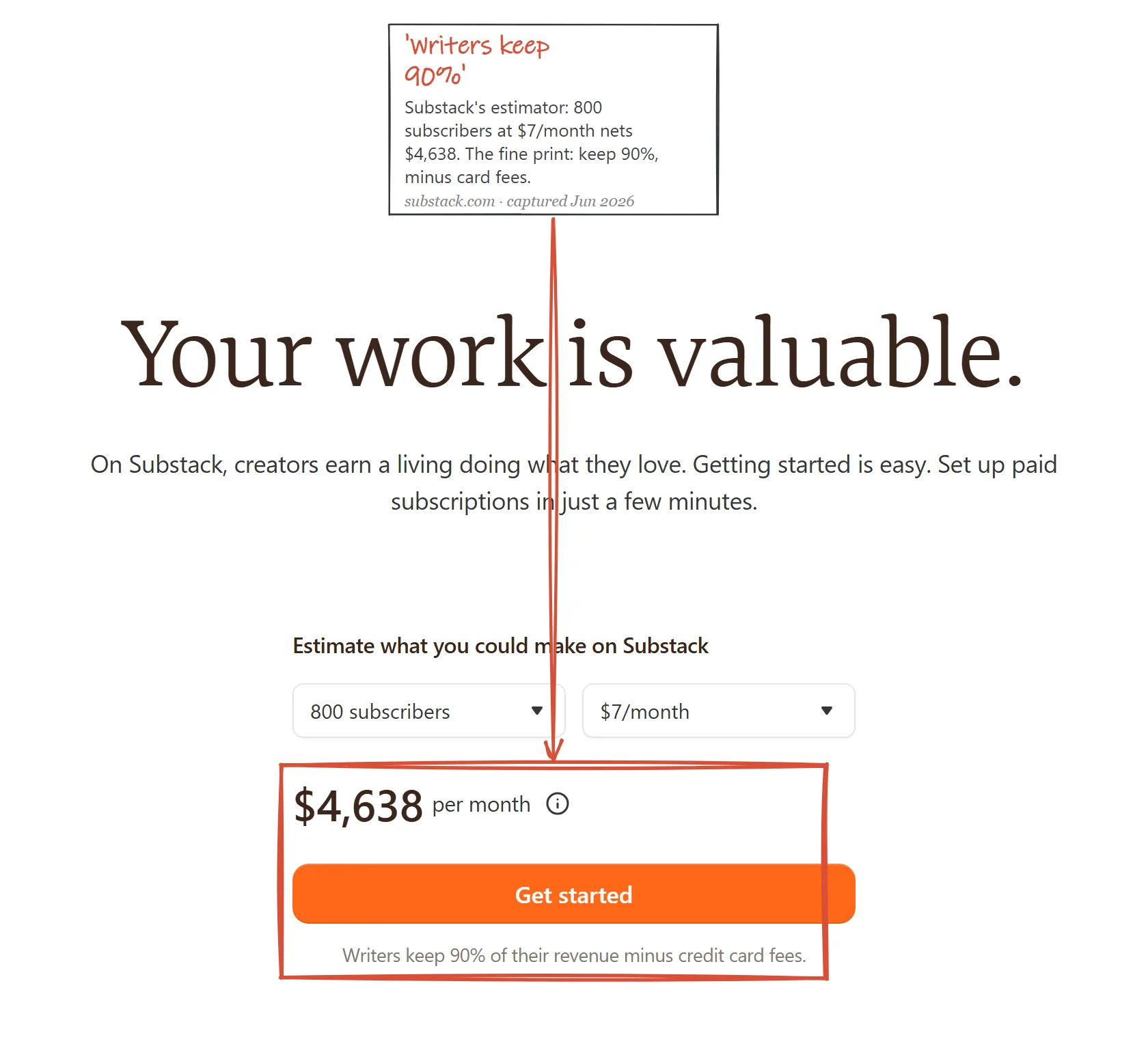
The problem is what it costs once you succeed. Substack takes 10% of paid revenue, and with Stripe and Apple in-app purchases the effective cut runs closer to 13-15%. That fee grows with your income, not your list. Zero human support is the top complaint across the review corpus (58 mentions):
“There is literally ZERO human support… The only thing that their AI Help does is summarize your problem.” — Trustpilot reviewer, 2026-05-27
Add a perpetual content license, and the network starts to look like a rental you eventually want to leave.
Our take
Where Substack Falls Short
- The 10% cut grows with your successBelow roughly $1,000/month in paid revenue, the 10% is barely noticeable. Above it, that same 10% becomes a real monthly tax on your own audience that a flat-fee platform avoids.
- Zero human supportThe single most common complaint in the review corpus (58 mentions): "There is literally ZERO human support… The only thing that their AI Help does is summarize your problem" (Trustpilot, 2026-05-27).
- Perpetual content license and opaque suspensionsSubstack's terms keep a perpetual, irrevocable license to your content even after you leave, and reviewers report account suspensions with no clear explanation and no appeal path.
Stay on Substack if you are building from zero and the network is doing your marketing. Leave if your paid revenue is past roughly $1,000/month, or you need real support and full control.
 Buttondown
Buttondown: the stark 0% choice for Markdown writers
Buttondown is the cleanest answer to "I just want to keep all my revenue and write." It takes 0% (Stripe only), composes in Markdown, and is the strongest in the panel on pure data ownership: full export on every plan and a claim, unique here, that you can carry active paid Stripe subscribers elsewhere. Its founder-direct support is the most-praised support in the entire study, rated 4.91/5: "an almost immediate response from a real person with a name" (Capterra, 2024-04-05).
What you give up is everything social. There is no discovery network, the analytics are deliberately minimal, and it is run by one person, which is a real continuity question if you are betting a business on it.
Our take
Where Buttondown Falls Short
- No discovery network at allThere is no recommendation engine, leaderboard, or reader network. A writer leaving Substack loses their discovery surface entirely; every new reader has to come from off-platform.
- Analytics are minimal and off by defaultButtondown deliberately ships near-zero analytics with no third-party script injection. Satisfied users flag it themselves: "It doesn't look like I am able to use any analytics software" (Capterra, 2025-05-25).
- Solo-founder continuity risk and a $0 liability capButtondown is run by one person (Justin Duke), and its terms exclude contractual damages entirely: a $0 floor, the lowest in the panel. Real values for writers who want long-term certainty.
Pick Buttondown if keeping 100% and owning your data outrank growth tools, and you grow off platform. Skip it if you need the platform to find readers, want rich analytics, or worry about a one-person team.
 Kit
KitKit: for the writer who is also a seller
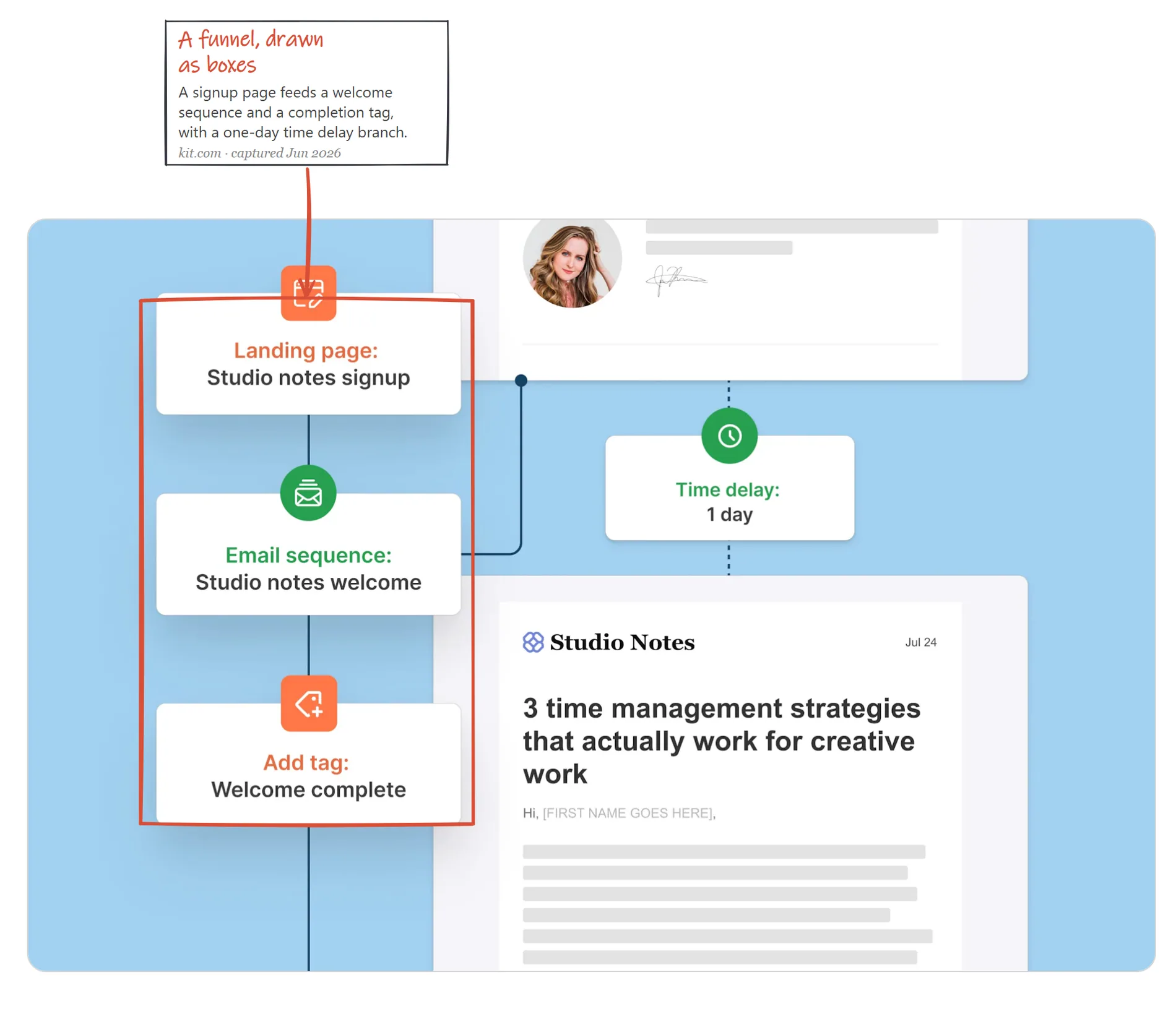
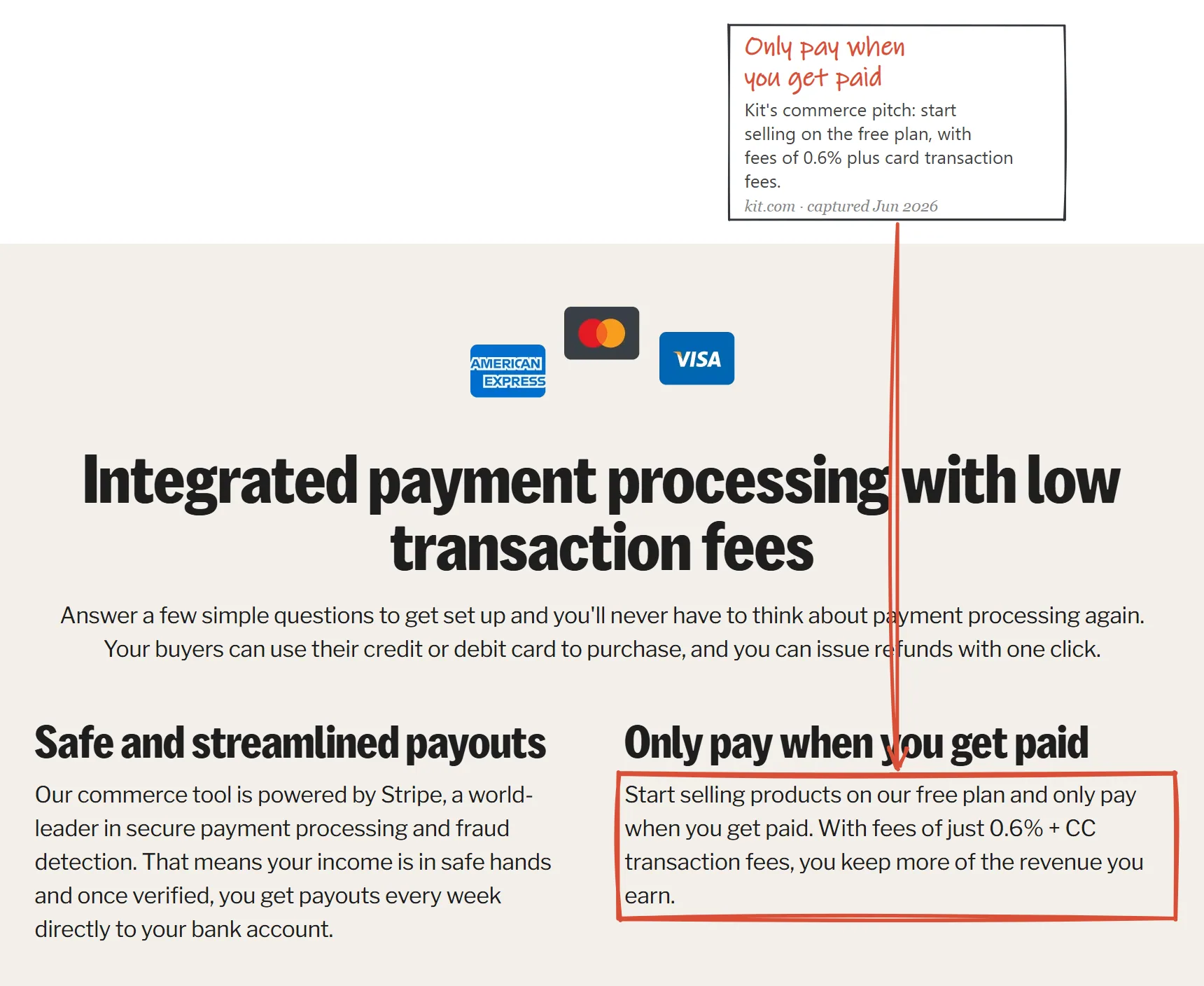
Kit earns its place only for a specific writer: the one who sells products, courses or coaching alongside the words. It is commerce-native from the free plan at a 0.6% fee, and its behavioral automation is the best in the panel: "I send 160k emails and generate thousands of dollars a month, and I only write one email. This is possible due to Kit's automations" (Trustpilot, 2026-03-11).
For pure prose, it is a poor fit. The writing editor is the weakest here, and there is a specific risk for our audience: Kit's policy bars affiliate-style sites and reviewers report account bans for a single affiliate link. If your newsletter carries affiliate links, this is the wrong platform.
Our take
Where Kit Falls Short
- The prose editor is bare-bonesKit's writing editor draws 62 negative review mentions: "The email editor is trash and glitches every couple of minutes. Randomly it will throw my cursor out" (Reddit, 2025-02-13). Custom HTML is paid-only.
- Affiliate links can get your account bannedKit's acceptable-use policy bars "CPA affiliate-type sites," and reviewers report suspensions for a single link: "Mentioned an affiliate link (legit) and suddenly my account is disabled" (Trustpilot, 2025-03-09).
- The free tier forces recommendations and blocks automationOn the free Newsletter plan, automations (Kit's core strength) are locked, and "Recommendations" slots are mandatory and non-removable: you promote other creators without being able to monetize your own.
Pick Kit if selling digital products and behavioral automation matter more than the writing surface. Skip it if you want a polished prose editor or your content includes affiliate links.
The fee reality: why the 10% is the whole game
For a paid-first writer, the platform fee is not a footnote, it is the decision. Substack takes 10% of revenue (closer to 13-15% once Stripe and Apple are counted). Kit takes 0.6% on commerce. Ghost, Beehiiv and Buttondown take nothing beyond Stripe's processing. The reason this matters: a revenue cut grows with your success, while a flat plan does not.
At $50 a month in paid revenue, Substack's 10% is invisible and the free network is doing real work for you. At $5,000 a month, that same 10% is a $500 monthly tax on an audience you built, and a 0%-fee platform pays for itself many times over. The break-even where leaving starts to save money lands around the $1,000/month mark against a flat paid plan.
What each platform costs at your scale
Set your paid subscribers and average price: all five platforms ranked by what they would cost you per month, plan plus fee. Plan prices come straight from our weekly pricing tracker.
Billing
Monthly paid revenue: $1,000 (200 subs × $5/mo)
- 1KitNewsletter plan, $0/mo + 0.6% fee ($6)$6/mo$72/yrVisit →Cheapest at your numbers
- 2ButtondownPaid plan, $9/mo + 0% fee$9/mo$108/yrVisit →
- 3GhostPublisher plan, $28/mo + 0% fee$28/mo$336/yrVisit →
- 4BeehiivScale plan, $42/mo + 0% fee$42/mo$504/yrVisit →
- 5SubstackStandard plan, $0/mo + 10% fee ($100)$100/mo$1,200/yrVisit →
Methodology: for each platform we pick the cheapest plan that supports paid subscriptions at your subscriber count (free-tier trade-offs are covered in each platform's section above). Platform fees only; Stripe processing applies to all five equally and is excluded. Annual discounts applied where our tracker has them. Prices update weekly from the public pricing pages.
Who actually controls your audience?
The fee is what you pay. This is what you risk. The five platforms sorted from the safest ownership model to the harshest account-termination clause. Open any row for the verbatim terms and the source.
- GhostFavorable
Self-hosted = zero deplatforming risk by design.
Read the clause
Ghost Pro can terminate "with or without cause, with or without notice." But Ghost is open source, so you can always move to self-hosting and keep everything.source
- ButtondownFavorable
Least aggressive policy; full CSV export.
Read the clause
The license "automatically terminates" on violation, but the prohibited list is short and a full CSV export (email, tags, UTM, IP) is available.source
- beehiivMixed
Clear AUP, but post-ban list portability is not documented.
Read the clause
Can "temporarily or permanently suspend" access (§3). CSV export works in active accounts; behaviour after a ban is not spelled out in the terms.source
- SubstackUnfavorable
Export blocked the moment your account is locked.
Read the clause
Verbatim: "Substack is free to terminate (or suspend access to) your use of Substack, or your account, for any reason at our discretion." Confirmed case (March 2025): a locked account's subscriber list became "not available to view and export."source
- KitUnfavorable
Post-ban export "at Kit's discretion"; bans affiliate sites.
Read the clause
Can terminate "in our sole determination" (§12b). AUP: an account can be "closed immediately and without prior notice", export is "at Kit's discretion", and no new account is allowed afterwards.source
✓ favorable to the creator · ◐ mixed · ✗ unfavorable. Open a row for the verbatim clause and source. Compiled June 2026 from public terms, status pages and the pricing data layer. Re-verified quarterly.
This is the case for Ghost in one table: self-hosting is the only model no company can revoke. See the full eleven-platform breakdown on who controls your audience.
Not sure which fits you?
Our 2-minute quiz scores every platform on what you actually need, then names your best fit. It is blind to commission.
Take the platform quiz →Feature matrix
The full data layer for all five, where they differ. We show coverage per platform, not a winner-by-count: more features is not better for a writer.
Pick a plan from the ▾ menu under a platform to see what that plan unlocks and its price at your subs count.
| Feature | Ghost | Beehiiv | Substack | Buttondown | Kit (ex-ConvertKit) |
|---|---|---|---|---|---|
| Monthly priceat 2.5K subs · monthly | $55/mo · Publisher · 2.5K subs | $0/mo · Free ≤2.5K subs | 10% of revenue | $29/mo · Paid · 5K subs | $0/mo · Free ≤10K subs |
| 5/6 | 6/6 | 5/6 | 3/6 | 6/6 | |
| 4/5 | 4/5 | 2/5 | 4/5 | 4/5 | |
| 8/9 | 9/9 | 6/9 | 8/9 | 9/9 | |
| 7/9 | 9/9 | 7/9 | 6/9 | 9/9 | |
| 1/4 | 2/4 | 2/4 | 3/4 | 2/4 | |
| 2/5 | 4/5 | 3/5 | 3/5 | 5/5 | |
| 5/10 | 10/10 | 8/10 | 6/10 | 7/10 | |
| 5/5 | 5/5 | 5/5 | 4/5 | 4/5 | |
| Get started | Visit → | Try free → | Try free → | Try free → | Try free → |
✓ Yes · Partial · — No · dotted = unverified · a plan tag (e.g. Scale) = the cheapest plan that unlocks it; pick a plan above each column and ↑ marks features above it. Verified against vendor sources, September 2026. Some links are paid — OwnLetter may earn a commission at no extra cost to you. It never affects the data.
What writers actually say
Average ratings from real reviews across G2, Capterra, Trustpilot and Reddit, then the themes writers raise most, compared side by side. Verbatims are exact quotes, never invented. Across 415 Ghost reviews in our aggregation, the writing editor is the single most-praised feature (38 mentions).
Straight from the reviews
What real users say
Each site’s average below comes from its own user reviews across Reddit, Trustpilot, Capterra and G2 — the count per site is on each bar. We never invent a quote.
Average score on each review site
GhostbeehiivSubstackButtondownKitPraised · Complaint · Split opinion
Average scores pulled from each site on May 31, 2026. Trustpilot scores are a recent sample, not the lifetime average; Reddit has no star ratings. Substack isn't listed on Capterra, and on Substack Trustpilot skews toward readers and Reddit toward creators. See our methodology.
Theme by theme, where writers agree and differ.
| What users say about… | Ghost415 reviews read | beehiiv669 reviews read | Substack480 reviews read | Buttondown217 reviews read | Kit885 reviews read |
|---|---|---|---|---|---|
| ▲ | ▼ | ▼ | ▲ | ▲ | |
| ▼ | ▼ | ▼ | ▲ | ▼ | |
| ◆ | ▼ | ▼ | ▲ | ▼ | |
| ▲ | ◆ | ◆ | ◆ | ▲ | |
| ▼ | ◆ | ◆ | ◆ | ▲ | |
| ▼ | ▲ | ◆ | ▲ | ▲ | |
| See for yourself | Visit → | Try free → | Try free → | Try free → | Try free → |
▲ Praised · ▼ Complaint · ◆ Mixed · top theme / common / minor = how often readers bring it up · ❝ hover any cell for the exact count and a real, sourced quote · · = too few reviews to score. Read in full from Reddit, Trustpilot, G2 and Capterra, June 2026. We never invent a quote. Some links are paid — OwnLetter may earn a commission at no extra cost to you. It never affects the data.
Review sources:RedditTrustpilotG2Capterra
Frequently asked
Writer questions, answered
Does Ghost bring you readers the way Substack does?
No. Ghost has no native discovery network. Its growth advantage is technical SEO and a fast, owned website, not a built-in reader feed. Substack's recommendation network is the one structural thing you give up by leaving it, which is exactly why it can still be the right starting point if you have no audience yet.
Is Substack's 10% cut actually worth it?
It depends on how much you earn. Below roughly $1,000/month in paid revenue, the 10% is small and the built-in network is doing real work finding you readers. Above that level, a platform that takes 0% (Ghost, Beehiiv, Buttondown) saves you more than its flat cost, because Substack's fee grows with your revenue while a flat plan does not.
Can I move my paid subscribers off Substack?
Your free subscriber list exports as a CSV and imports cleanly almost anywhere. Paid subscribers are harder: the Stripe billing relationship does not transfer automatically, so most writers re-onboard paying readers manually. Buttondown is the only platform in this set that explicitly claims it can carry active paid Stripe subscribers over without readers re-entering card details.
Which platform has the best writing editor?
Ghost. Its Koenig editor is the single most-praised feature across 415 reviews: "a clean, fast, distraction-free editor focused purely on writing" (Trustpilot, 2026-01-20). Substack and Buttondown (Markdown) are also strong for prose. Kit's editor is the weakest in the panel and is the most common reason writers leave it.
What is the cheapest way to keep 100% of my revenue?
Buttondown and Ghost both take 0% of your subscription revenue (you only pay Stripe's processing fee). Buttondown is the lighter and cheaper option at a small scale and the strongest on pure data ownership. Ghost costs more but gives you a full website and the best editor, so it is the better 0% choice once you treat the newsletter as a business.
Can I get banned and lose my list?
On any hosted platform, yes. Kit and MailerLite have the most-documented sudden suspensions, including for legitimate use. Self-hosted Ghost is the only structural escape, because no vendor can deplatform a site you run yourself. Whatever you choose, export your subscriber CSV every month so a suspension never costs you the audience.
Our verdict
How we ranked them
For a prose writer leaving Substack, Ghost is the one to beat
We ranked these five the way a writer actually decides: keep your revenue, write well, own your audience, find readers. No single platform wins all four, so the honest answer is a best-for-need shortlist, not one winner.
Ghost takes the top spot because it leads on the two things writers feel every day, the editor and ownership, while taking 0%. We put it ahead of the platforms that pay us more, and we lead with nothing-pays-us Substack for writers starting from zero. That is the test: the ranking tracks what writers need, never what earns us a commission.
- Built from 10,810 real reviews plus each platform's live pricing and terms
- Ranking is inversely correlated with commission, and we checked
- Substack, which pays us nothing, still leads the start-from-zero case on merit
The bottom line
Ghost gives prose writers the most they can own.
Best editor, 0% fee, and a site no one can take from you. If you need to monetize today or want the network to find readers, start with Beehiiv or Substack instead.
Editorial pick · not an affiliate link
How we testedVerified June 2026 · 10810 reviews aggregated · Ghost + Beehiiv + Substack + Buttondown + Kit tested · Five platforms crossed on fees, editor, ownership and discovery · pricing tracked weekly · rankings blind to commission
What we did: We cross-read full review-theme maps for each platform, checked every plan-gate against the live pricing pages, and ranked by writer-decisive criteria using a commission-blind model.
What we did NOT do: We did not run live deliverability tests, and we have not yet published first-hand screenshots for Ghost, Kit and Buttondown. Those follow in their individual reviews.
Refresh cadence: Pricing verified weekly via our tracker; rankings reviewed quarterly or on any material vendor change. (pricing verified June 7, 2026). Full methodology →