On this page (16 sections)
Substack vs MailerLite 2026: Real Tools and 0% Fees vs the Network

By Arthur Brulard, Founder of OwnLetter. Cross-vendor analyst review across 11 newsletter platforms, aggregating user signals from Reddit, G2, Capterra, Trustpilot, and Hacker News. LinkedIn
Published June 11, 2026 · Updated June 11, 2026 · 20 min read
Quick verdict
MailerLite wins on tools and keeping your money: 0 percent commission on paid subscriptions (you pay only Stripe), plus the automation, segmentation, landing pages, and website builder Substack does not ship. Paid newsletters run on a flat $17.10/mo plan at 1,000 subscribers, and the math beats Substack's 10 percent once you earn past roughly $171/mo. Substack wins the start and the growth:zero setup, a true free tier, and a discovery network that is real acquisition MailerLite has no native answer to. Two caveats define the honest version. MailerLite's automated moderation can suspend an account with no real appeal, and MailerLite makes you build the readership Substack hands you. Full math, tools, and migration mechanics below.
Both are free to start. MailerLite's free tier covers 500 subscribers; recurring paid subscriptions need Growing Business. Neither link pays us.
Not sure which fits you?
Substack or MailerLite — answer a few questions
Which fits you?
Loading the quiz…
How we testedVerified June 2026 · 2329 reviews aggregated · Substack + MailerLite tested · 36 sourced claims · pricing from our weekly tracker · methodology public
What we did: Read user signals in full: 1,849 MailerLite reviews (Capterra, Reddit, G2, Trustpilot) and 480 Substack reviews, aggregated June 2026, mapped theme by theme with no keyword sampling. Pulled pricing from our weekly automated tracker (verified June 7, 2026). Re-fetched both vendors' primary pages live on June 11, 2026: pricing, the paid-newsletter and monetization pages, feature pages, Trustpilot aggregates, and the HaveIBeenPwned breach entry. Captured and annotated screens as proof. First-hand: we operate a test Substack publication (hands-on log, June 10, 2026); we have not run a paid MailerLite account.
What we did NOT do: We did not run deliverability seed-list tests (they violate both vendors' terms and game the result). We did not test MailerLite's paid plan hands-on yet, so no MailerLite claim here is presented as first-hand product testing.
Refresh cadence: Pricing re-verified weekly by automation; claims manifest with source URL per numeric claim publicly available. Next full refresh September 2026. (pricing verified June 7, 2026). Full methodology →
 SubstackSubstack
 MailerLiteMailerLite
The Fee Gap: 10% of Revenue vs 0% Commission
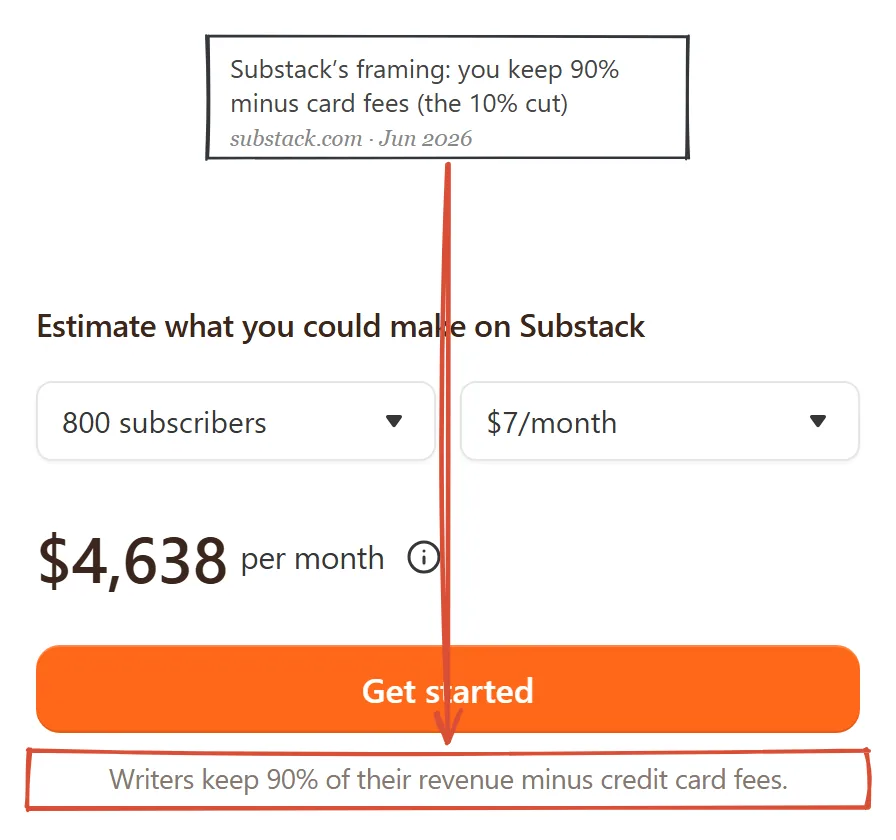
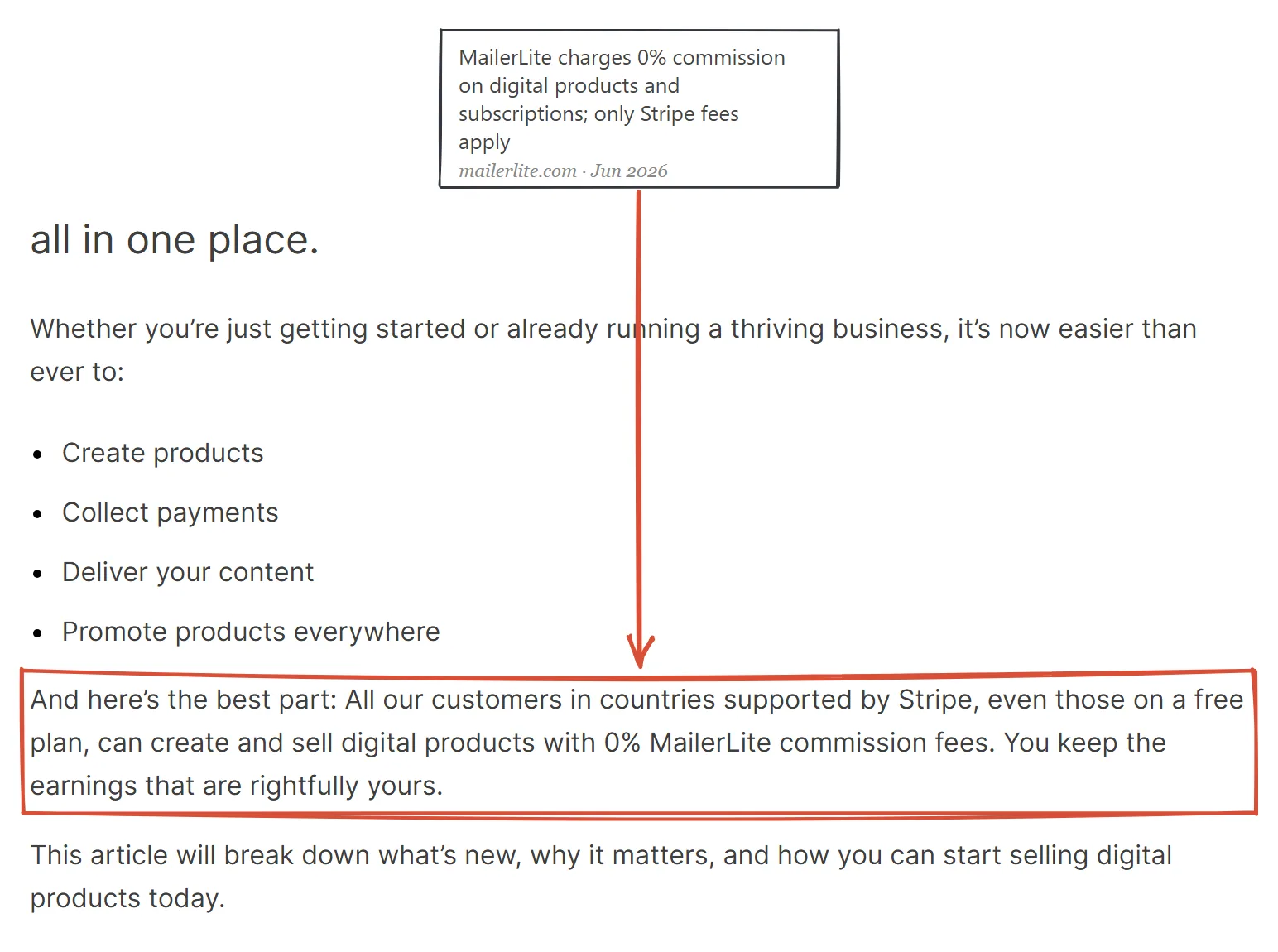
Start with how each platform charges for the same thing: letting you sell a paid newsletter. Substack's support center is plain about its cut, "10% of each transaction," plus Stripe's 2.9 percent + $0.30 and a 0.7 percent recurring billing fee (verified June 2026). Its going-paid page words the same fact as its inverse: "Writers keep 90% of their revenue minus credit card fees." MailerLite takes the opposite position in its own words: "we don't take any commission. You only pay the Stripe processing fee. None of this fee goes to us." You still pay MailerLite, but as a flat monthly subscription priced by list size, not as a slice of every dollar you earn.
The structural difference is the whole story. Substack's cost scales with your revenue; MailerLite's scales with your subscriber count. Paid newsletters require MailerLite's Growing Business plan ($17.10/mo on annual billing at 1,000 subscribers), and above roughly $171/mo in monthly paid revenue, that flat price is already cheaper than Substack's 10 percent. One honest detail MailerLite's own marketing buries: its paid-newsletter comparison page quotes the pricier Advanced plan ($39/moat 1,000 subscribers) against Substack's 10 percent. The real floor is Growing Business, roughly half that. The exact crossover for your numbers is in the calculator further down, derived from our weekly pricing tracker rather than copied from another blog.
Feature Comparison: Publishing, Monetization, Automation, Growth
The split is the cleanest in this whole comparison set. MailerLite brings the toolbox: a visual automation builder, dynamic segmentation on every plan, landing pages, a website builder with a blog, A/B testing even on free, and 0 percent monetization. Substack brings the network and the simplicity: discovery, recommendations, native podcast and video, and a start that asks you for no decisions. Each is strong exactly where the other is weak. The matrix below is data-driven from the OwnLetter feature layer, source-verified against vendor primary documentation (June 2026).
Pick a plan from the ▾ menu under a platform to see what that plan unlocks and its price at your subs count.
| Feature | Substack | MailerLite |
|---|---|---|
| Monthly priceat 2.5K subs · monthly | 10% of revenue | $33/mo · Growing Business · 2.5K subs |
| 5/6 | 3/6 | |
| 2/5 | 4/5 | |
| 6/9 | 8/9 | |
| 7/9 | 8/9 | |
| 2/4 | 4/4 | |
| 3/5 | 5/5 | |
| 8/10 | 8/10 | |
| 5/5 | 2/5 | |
| Get started | Try free → | Try free → |
✓ Yes · Partial · — No · dotted = unverified · a plan tag (e.g. Scale) = the cheapest plan that unlocks it; pick a plan above each column and ↑ marks features above it. Verified against vendor sources, September 2026. Some links are paid — OwnLetter may earn a commission at no extra cost to you. It never affects the data.
Straight from the reviews
What real users say
Each site’s average below comes from its own user reviews across Reddit, Trustpilot, Capterra and G2 — the count per site is on each bar. We never invent a quote.
Average score on each review site
SubstackMailerLitePraised · Complaint · Split opinion
Average scores pulled from each site on May 31, 2026. Trustpilot scores are a recent sample, not the lifetime average; Reddit has no star ratings. Substack isn't listed on Capterra, and on Substack Trustpilot skews toward readers and Reddit toward creators. See our methodology.
Theme by theme: where they agree and differ
| What users say about… | Substack480 reviews read | MailerLite1849 reviews read |
|---|---|---|
| MailerLite leads | ||
| MailerLite leads | ||
| MailerLite leads | ||
| Even | ||
| Even | ||
| Even | ||
| See for yourself | Try free → | Try free → |
▲ Praised · ▼ Complaint · ◆ Mixed · top theme / common / minor = how often readers bring it up · ❝ hover any cell for the exact count and a real, sourced quote · · = too few reviews to score. Read in full from Reddit, Trustpilot, G2 and Capterra, June 2026. We never invent a quote. Some links are paid — OwnLetter may earn a commission at no extra cost to you. It never affects the data.
Review sources:RedditTrustpilotG2Capterra
Deep Dive: Substack
Across 480 Substack community posts and reviews read in full (Reddit, Trustpilot, G2, June 2026), three patterns dominate: the discovery network genuinely works for writers starting from nothing, the toolset stops at publishing, and the fee model stays invisible until the month it is not.
Discovery: the moat MailerLite does not have
Substack claims that 30 percent or more of paid subscriptions come from within its network (substack.com/about, June 2026; self-reported, no third-party audit). Whatever the true figure, the mechanism is real: Notes, cross-publication recommendations, and leaderboards push your writing to readers who never searched for you. In our corpus, discovery is the second most-mentioned theme (35 mentions, mixed). One Reddit user, May 2026: "it's one of the best newsletter platforms out there for discovery if you have no audience."
The same corpus names the limit honestly:
"The hard truth is most of your early readers will be other writers, not general readers, and breaking out of that circle is genuinely difficult."Reddit user (r/Substack source), June 2026 (C-005)
The network is a real advantage with a saturation curve, not a growth guarantee. But it is a guarantee MailerLite simply cannot offer, because MailerLite has no feed and no algorithm pushing your work anywhere. If you are starting from zero, this single difference can outweigh every fee and feature below it.
Where Substack stops: automation and segmentation
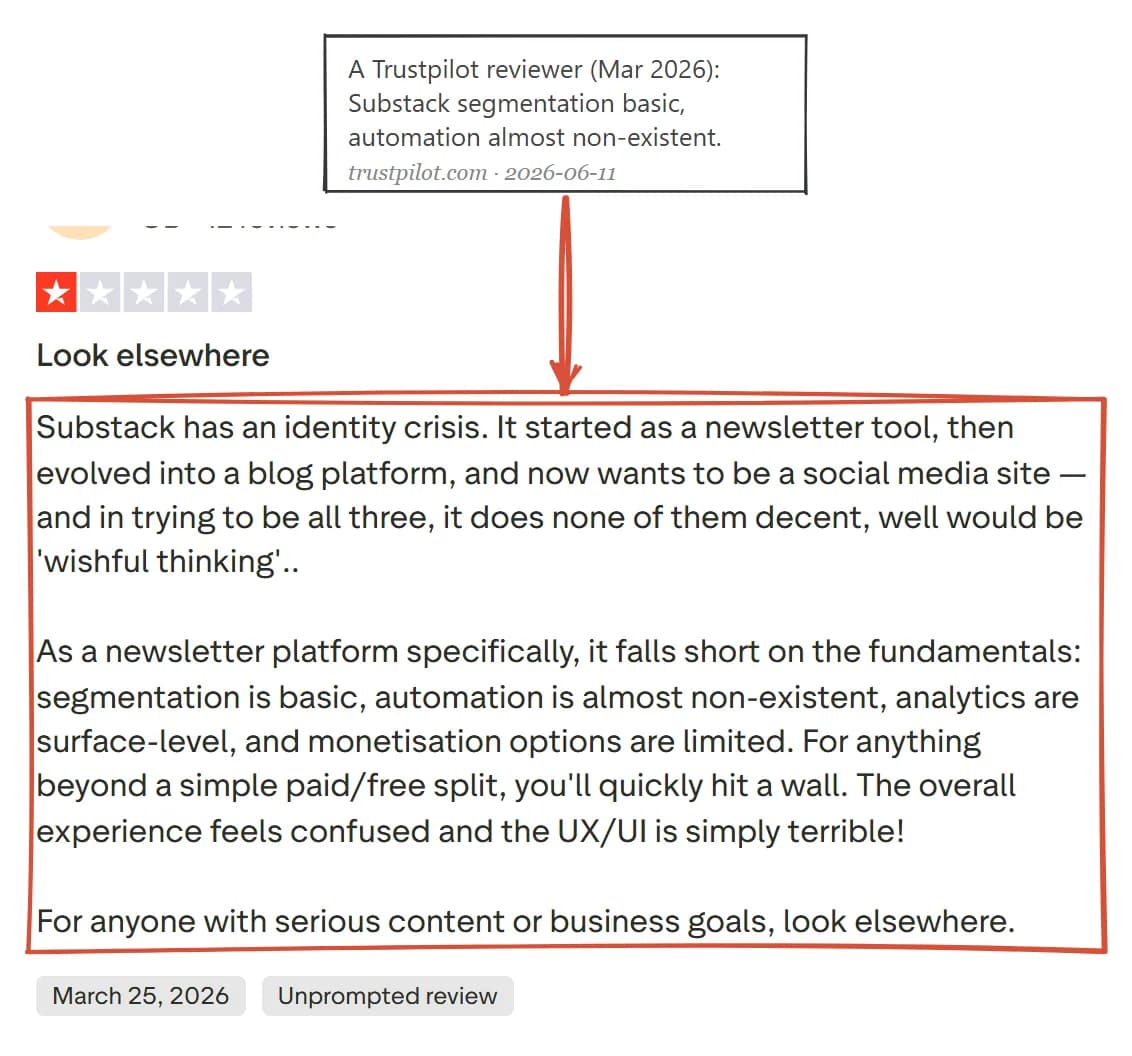
Substack is a publishing tool, not an email-marketing platform, and the corpus is blunt about the ceiling. A Trustpilot reviewer in March 2026:
"As a newsletter platform it falls short on the fundamentals: segmentation is basic, automation is almost non-existent, analytics are surface-level, and monetisation options are limited."Trustpilot reviewer, March 2026 (C-004)
When we created our own test publication (hands-on, June 10, 2026), there was no sequence builder to find, no behavioral trigger, no way to send a welcome series beyond the single automatic welcome email. For a simple paid-or-free newsletter that is fine. For anything resembling a funnel, it is a wall, and it is exactly the wall MailerLite is built to remove.
Support: the #1 complaint, by volume
Fifty-eight of 480 signals concern support, almost all negative. The pattern is structural rather than anecdotal: there is no ticket system and no human escalation path, only an AI assistant. Billing disputes (the second one-star driver) mostly come from readers, double-charged or refused refunds after following chatbot instructions. Factor that population into any Trustpilot score you see; it measures reader billing pain more than creator product quality.
Our take
Where Substack Falls Short
- Automation and segmentation barely existThis is the gap MailerLite exists to fill. A Trustpilot reviewer summed up Substack in March 2026: "segmentation is basic, automation is almost non-existent, analytics are surface-level." Substack's help center documents no multi-step sequence builder; drip campaigns are in a restricted beta (bestsellers first, October 2025), and tags organize content pages rather than audience targeting. If your roadmap needs welcome series, behavioral triggers, or send-time logic, Substack does not serve it.
- The 10 percent compounds with your successSubstack charges nothing monthly and 10 percent of each paid transaction, plus Stripe's 2.9 percent + $0.30 and a 0.7 percent recurring billing fee (support.substack.com, verified June 2026). At $1,000 per month in paid revenue that is $100 every month. At $15,000 monthly it reaches $1,500. The fee is invisible early because no bill ever arrives, which is exactly how it stays out of mind until it is large.
- Zero human support, by designSupport is the dominant complaint theme in our 480-review Substack corpus (58 mentions). The pattern is uniform: no ticket system, no human escalation, an AI chatbot that summarizes your problem and stops. One Trustpilot reviewer in May 2026: "there is literally ZERO human support." MailerLite's live chat, by contrast, is its single most-praised feature among paying users, the inverse of this weakness.
- A breach went undetected for monthsIn October 2025 Substack suffered a data breach exposing 663,000 account records (emails, profile data, a subset with phone numbers). It circulated more widely in February 2026 when HaveIBeenPwned indexed it. Passwords and payment data were not exposed. Combined with a terms-of-service stack that includes a perpetual content license and forced arbitration, the trust picture deserves more scrutiny than the zero-dollar entry price suggests.
Deep Dive: MailerLite
Across 1,849 MailerLite reviews (Capterra, Reddit, G2, Trustpilot, June 2026), the most-praised elements are the price-to-feature ratio and the human support, the structural advantage is keeping 100 percent of your revenue, and the most underrated risk is a moderation engine that can suspend an account without warning.
The tools, and the 0 percent: what users actually praise
Price and value is MailerLite's strongest theme (458 mentions, strongly positive), and the recurring phrase is "more features for less." The features in question are the ones Substack lacks: a visual automation builder, dynamic segmentation, landing pages, and a website builder, with A/B testing included even on the free plan. Support is the second pillar. A Capterra reviewer in September 2025:
"Instead of waiting 24+ hours like I did with ActiveCampaign, I now get live chat responses within seconds."Capterra reviewer, September 2025 (C-020)
On top of the toolset sits the monetization model: 0 percent commission on paid subscriptions, digital products, and bookings, with only Stripe's processing fee applied. For a Substack writer paying 10 percent of every dollar, that is the headline number. It is real, and we re-verified it on MailerLite's own pages in June 2026.
The support is excellent, until it is not there
The single most important nuance about MailerLite's support is that it is bimodal. Among paying users, live chat is the number-one retention argument, with agents named individually and problems solved in minutes, weekends included. On the free plan there is no live chat, and on a suspended account the chat button disappears entirely. As one Trustpilot reviewer put it, after a ban you are "basically forced to create another account just to reach support." The same free tier that attracts Substack refugees is the one with no human on the other end:
"I'm on a free plan and it's crazy that you cannot even send a question to Mailerlite when on free plan. And I used to be a big fan (and a paid user) of the platform." Reddit user (r/Emailmarketing source), March 2025 (C-033)
The 500-subscriber free tier, priced by stored subscribers
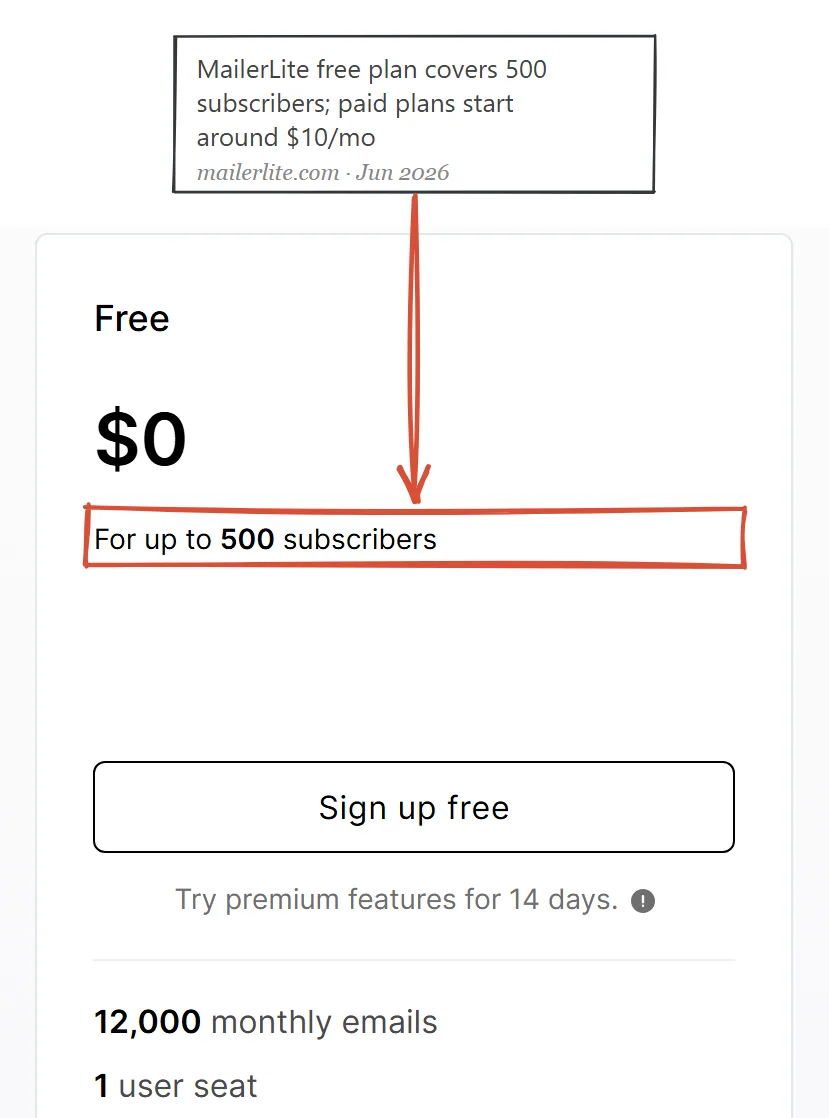
MailerLite's free plan covers up to 500 subscribers and 12,000 emails per month, and unlike Substack it includes real automations and landing pages. Two caveats matter. The free ceiling was cut from 1,000 to 500 in September 2025, late in the Classic-to-New migration, and crossing it locks sending immediately, no grace period. And every paid tier prices on total stored subscribers, free and paid combined, so a big free list costs real money whether or not you email it.
Our take
Where MailerLite Falls Short
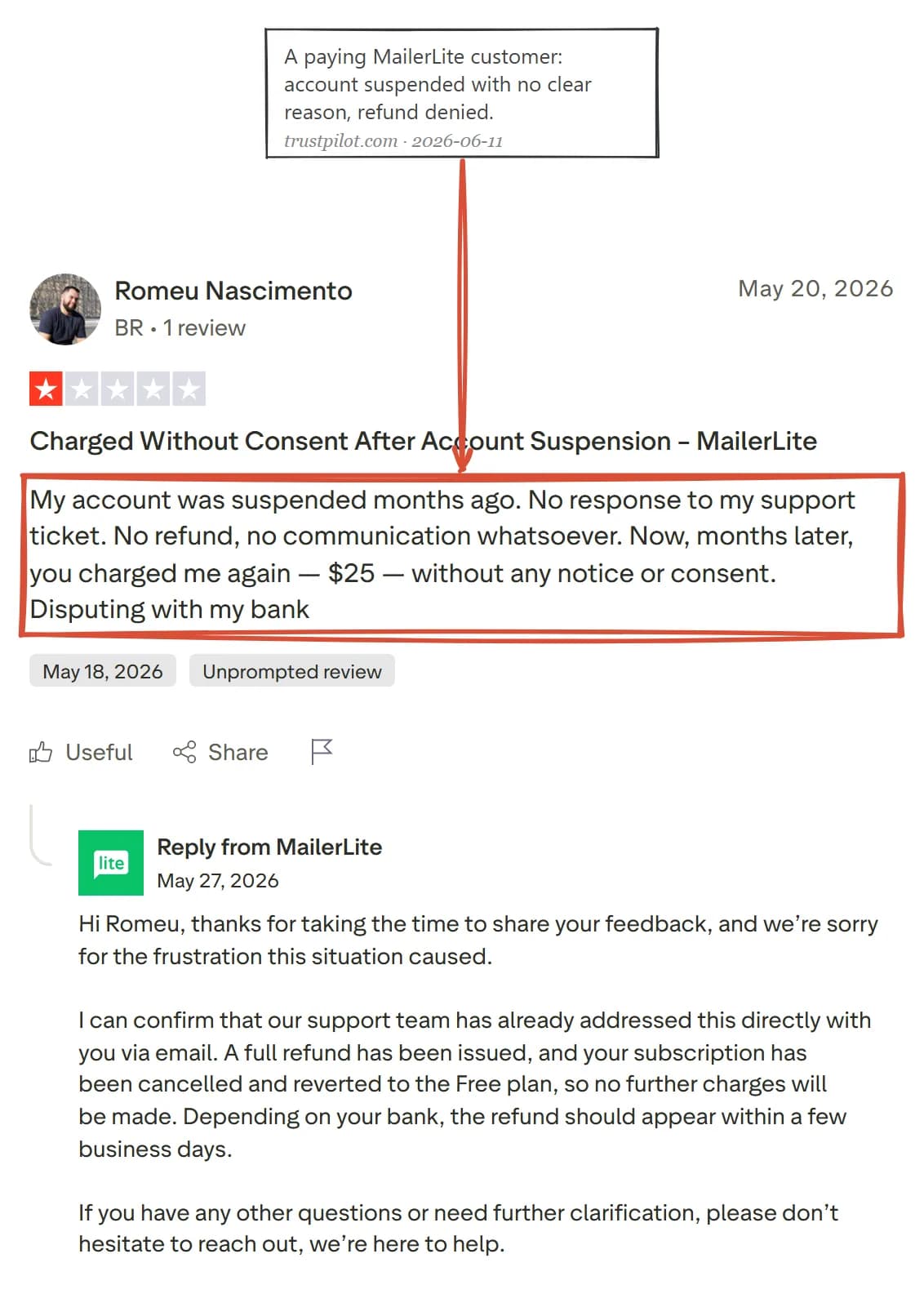
- Algorithmic suspension with no real appealThe most-cited negative across 1,849 MailerLite reviews (87 mentions): accounts disabled by automated moderation without a specific reason, no real appeal, sometimes before the first send, refunds often denied. One reviewer quoted the company verbatim: "this decision is irreversible and further replies to this email will not be reviewed." Importing a legitimate double-opt-in list (from Gumroad, a CRM, or your old platform) is a frequent trigger. The control you gain over your tools comes with a moderation engine that can switch off your business overnight.
- You pay for stored subscribers, not for sendingMailerLite bills on total stored active subscribers, free and paid combined, not on emails sent. A G2 reviewer in April 2026: "the new MailerLite pricing model bills on stored active subscribers, not on who you send to." A monthly sender pays the same as a daily one at the same list size, and a large free list quietly costs more. MailerLite's Classic-to-New migration, rolled out in 2024 and 2025, introduced this model, and in September 2025 it cut the free ceiling from 1,000 to 500 subscribers and pushed some users' bills up by more than half.
- You build the growth Substack hands youMailerLite has no native discovery network. There is no Notes feed, no recommendation engine of its own, no leaderboard pushing your work to new readers. Growth is inbound: forms, pop-ups, landing pages, a website builder, plus third-party integrations like Sparkloop and Paved. For a writer whose readership grew through Substack's network, this is the real cost of leaving, and it is paid in acquisition you now have to run yourself.
- No mobile app, and an editor that lags on long emailsMailerLite ships no dedicated mobile app; reviewers call the mobile web experience "basically useless to create an email." The desktop drag-and-drop editor is generally liked but has documented rough edges: it can lag noticeably on long campaigns (reports of a second of delay per keystroke) and has a known bug where deleting several characters in a row removes whole blocks. Templates are functional but few and not refreshed often.
- Stripe is the only way to take paymentEvery paid feature, subscriptions, digital products, bookings, runs exclusively through Stripe (135+ currencies). There is no PayPal, no Paddle, no local-processor fallback. If your audience sits in a market Stripe does not serve (parts of Africa, Latin America, and Southeast Asia), you cannot take payment through MailerLite at all, regardless of plan. The 0 percent commission is real, but only where Stripe reaches.
Who Controls Your Audience? Better Terms, Sharper Risk
On paper, MailerLite gives you more control than Substack on almost every axis. Its terms do not claim a broad license to your content, it bills you on subscribers rather than taking a cut of revenue, and your data sits in the EU under ISO 27001. Substack, by contrast, takes a perpetual content license, routes disputes to forced arbitration, and reserves discretionary termination; a March 2025 case documented a locked account whose subscriber export became unavailable, and an October 2025 breach (663K accounts, per HaveIBeenPwned) went months before wide disclosure.
The asymmetry that complicates this section: MailerLite's favorable terms sit next to the sharpest operational risk on this page, an automated moderation system that suspends accounts with no real appeal. Better contract, scarier switch. The table below is drawn from our trust-and-risk layer, with verbatim clauses and documented incidents on hover.
Trust and risk: Substack vs MailerLite
| Platform | Account control | Content license | Cost at scale | Reliability & incidents | Billing model | Allowed niches |
|---|---|---|---|---|---|---|
| Substack | ||||||
| MailerLite |
✓ favorable to the creator · ◐ mixed · ✗ unfavorable. Hover or tap a cell for the detail. Compiled June 2026 from public terms, status pages and the pricing data layer. Re-verified quarterly.
Pricing Scenarios: The Break-Even Math
MailerLite becomes cheaper than Substack the moment your paid revenue passes roughly ten times your subscriber-tier price, about $171/mo per month at 1,000 subscribers. Because MailerLite is so cheap, that crossover comes fast for most earning newsletters. The one scenario that flips it: MailerLite prices by total stored subscribers, free plus paid.A large free list with thin paid revenue can cost more on MailerLite than Substack's 10 percent of that small revenue, which is why the last row below is the mirror image of the others. Stripe processing applies on both sides and washes out.
MailerLite Pricing Tiers (verified June 2026)
- · Free: up to 500 subscribers, 12,000 emails/month. Automations, landing pages, and A/B testing included. Sells one one-off digital product, but no recurring paid subscriptions.
- · Growing Business (annual): $17.1/mo (Growing Business, 1K subs) · verified June 7, 2026 at 1K subscribers. Unlocks paid newsletters and recurring subscriptions at 0% commission, unlimited automations, the website builder.
- · Growing Business (monthly): $19/mo (Growing Business, 1K subs) · verified June 7, 2026 at 1K subscribers. Same features, no annual commitment.
- · Advanced (monthly): $39/mo (Advanced, 1K subs) · verified June 7, 2026at 1K subscribers. Multi-trigger automations, AI writing, unlimited digital products. The plan MailerLite's own marketing quotes against Substack.
- · Substack (no tiers): Free to start, unlimited subscribers. 10 percent of paid subscription revenue plus Stripe fees. No flat-rate alternative.
Annual Cost by Revenue Tier
Annual platform cost by revenue tier
Monthly paid revenue Assumed list size | Substack platform fee 10% revenue cut | MailerLite Growing Business (annual) Flat tier by total subscribers | Annual delta Negative = MailerLite saves you |
|---|---|---|---|
| $200/mo paid (1K subscribers) | $20/mo ($240/yr) | $17.10/mo flat | -$35/yr saved |
| $1,000/mo (≈200 paid @ $5, 2.5K subscribers) | $100/mo ($1,200/yr) | $29.70/mo flat | -$844/yr saved |
| $5,000/mo (≈1K paid, 10K subscribers) | $500/mo ($6,000/yr) | $80.10/mo flat | -$5,039/yr saved |
| $200/mo paid but 25K total subscribers | $20/mo ($240/yr) | $161.10/mo flat (priced on 25K stored) | +$1,693/yr (MailerLite costs more) |
$200/mo paid (1K subscribers)
- Substack platform fee
- $20/mo ($240/yr)
- MailerLite Growing Business (annual)
- $17.10/mo flat
- Annual delta
- -$35/yr saved
$1,000/mo (≈200 paid @ $5, 2.5K subscribers)
- Substack platform fee
- $100/mo ($1,200/yr)
- MailerLite Growing Business (annual)
- $29.70/mo flat
- Annual delta
- -$844/yr saved
$5,000/mo (≈1K paid, 10K subscribers)
- Substack platform fee
- $500/mo ($6,000/yr)
- MailerLite Growing Business (annual)
- $80.10/mo flat
- Annual delta
- -$5,039/yr saved
$200/mo paid but 25K total subscribers
- Substack platform fee
- $20/mo ($240/yr)
- MailerLite Growing Business (annual)
- $161.10/mo flat (priced on 25K stored)
- Annual delta
- +$1,693/yr (MailerLite costs more)
Chart It: Where the Lines Cross
Pricing comparison (static fallback)
Loading interactive chart... Static reference below.
| Monthly paid revenue | Substack (10% cut) | MailerLite Growing Business (annual) | Flat plan saves |
|---|---|---|---|
| $500/mo | $50/mo | $17.1/mo (1K subs) | ~$395/yr |
| $5,000/mo | $500/mo | $44.1/mo (5K subs) | ~$5,471/yr |
| $15,000/mo | $1,500/mo | $80.1/mo (10K subs) | ~$17,039/yr |
Stripe processing fees apply equally and wash from the comparison. Verified September 2026.
Test Your Own Scenario
Adjust paid subscribers, revenue per subscriber, and list size to find your own crossover point, including the stored-subscriber effect of a large free list.
Break-even answer (static fallback)
Loading interactive calculator... Static answer below.
Break-even sits at $430 monthly paid revenue. Substack takes 10 percent of paid revenue plus Stripe processing fees. Beehiiv Scale costs $43 per month on annual billing at the 1,000-subscriber baseline, with 0 percent platform fee on paid subscriptions. Above $430 monthly paid revenue, Beehiiv compounds savings every month.
Sample math: at $5,000 monthly revenue, Substack costs $500/mo ($6,000/yr) and Beehiiv Scale costs about $78/mo ($$936/yr) at the 5K subscriber tier on annual billing. Annual savings exceed $5,000.
Migration: Free Subscribers Import, Paid Subscribers Re-Subscribe
Here is the part most comparisons skip, and it cuts against MailerLite. Your free subscribers import cleanly: export the CSV from Substack, import to MailerLite, and onboarding even helps you authenticate your sending domain. Your paying subscribers are the problem. Substack's paid subscriptions bill through a Stripe account Substack controls, so the billing relationship does not transfer. Every paying subscriber has to re-subscribe through your new MailerLite checkout. Practitioner reports put the loss at 20 to 40 percent, depending entirely on how good your re-subscribe email sequence is (directional anecdotes, not an audited study).
This is the opposite of a Substack-to-Ghost move, where a shared Stripe account keeps paid billing intact. If your paid list is the business, plan a real re-subscribe campaign and budget for some attrition. The one upside: once subscribers are on MailerLite, you keep 100 percent of what they pay going forward, so the math can recover the loss within months at typical churn.
One more warning from the corpus, about MailerLite's own internal migration rather than your move into it. MailerLite's forced Classic-to-New transition, in 2024 and 2025, generated real pain: users report losing whole lists and automations that did not carry over, and rebuilding workflows by hand. That event is behind us, but it is a reminder that MailerLite will change its platform under you, and that your automations are worth documenting separately.
Who Switches, and Who Should Stay
Who the switch pays off for
The writer MailerLite rewards has two traits: they already earn enough that 10 percent is a real number, and they want tools Substack does not have. A creator running $1,000 a month in paid revenue hands Substack $1,200 a year; on MailerLite's Growing Business plan at that list size they would pay a fraction of it and keep the rest, while gaining automations and segmentation to grow it further. The corpus is full of exactly this profile migrating from Mailchimp and Kit for the same reasons, "more features for less," and MailerLite is repeatedly named the best price-to-feature ratio in the category.
Who should stay on Substack, and why that is rational
The reverse case is equally clear. A writer below break-even, growing through Notes and recommendations, gives up real acquisition by leaving and saves almost nothing. Substack readers also convert to paid at rates multi-platform creators describe as unusually high: "People on Substack are a lot more inclined to pay" (Reddit, March 2026). If your readership came from the network and you have no other channel, moving to MailerLite means trading a growth engine for a toolbox you then have to drive yourself. The honest framing is sequencing, not allegiance: Substack to build an audience, MailerLite once you have one and the 10 percent starts to sting.
Account risk exists on both, with different shapes
Substack suspension reports center on opacity (no rule cited, generic appeal rejections). MailerLite's are sharper and more numerous: 87 suspension mentions across the corpus, several describing paid accounts disabled before a single campaign, with refunds denied and a canned "irreversible" reply. Both platforms can switch you off; MailerLite's automated moderation is the more documented trigger for legitimate senders, especially right after importing a list. Whoever hosts you, the monthly CSV export habit stands.
Email Deliverability: What Neither Platform Publishes
Neither Substack nor MailerLite publishes an audited inbox-placement rate, and we will not invent one. In our corpus, deliverability is a minor theme on Substack (8 mentions: open rates dropping after list migrations, Gmail Promotions placement) and a larger, mixed one on MailerLite (96 mentions). MailerLite reviewers frequently report open-rate gains after switching from Mailchimp or ActiveCampaign, and just as frequently report sudden reputation drops, one documented case moving from HIGH to BAD in Google's Postmaster Tools overnight, with support slow to explain it.
The structural difference is control. Substack runs entirely on shared sending infrastructure, with no custom sending domain or dedicated IP option, so you cannot manage your own reputation. MailerLite lets you authenticate a custom sending domain, which is both more control and more responsibility. If deliverability decides your choice, test with your own list and content before committing, and distrust any published percentage, including any you wish we had printed here.
Frequently asked
Frequently Asked Questions
Is MailerLite cheaper than Substack?
For most paid newsletters, yes, and often dramatically. Substack takes 10 percent of every paid transaction (support.substack.com, verified June 2026) plus Stripe fees. MailerLite charges 0 percent commission on subscriptions and a flat monthly price by list size: paid newsletters run on the Growing Business plan ($17.10/mo on annual billing at 1,000 subscribers, verified June 2026). The crossover is low: above roughly $171/mo in paid revenue at 1,000 subscribers, MailerLite's flat price beats the 10 percent. One caution the simple math hides: MailerLite prices by total stored subscribers, free and paid combined. A large free list with thin paid revenue can pay MailerLite's higher subscriber tiers while Substack still charges only 10 percent of the small paid revenue. Run your own numbers in the calculator on this page.
Can the MailerLite free plan sell a paid newsletter?
Not a recurring one. MailerLite's free plan (up to 500 subscribers, 12,000 emails per month) lets you sell a single one-off digital product at 0 percent commission, but recurring paid-newsletter subscriptions require the Growing Business plan or higher (mailerlite.com/pricing, verified June 2026). So the honest entry price for replacing Substack's paid subscriptions is Growing Business ($12/mo at 500 subscribers, $17.10/mo annual at 1,000), not free. The free tier is still useful: real automations, landing pages, and A/B testing are included, which Substack does not match even on its paid model.
Will my paid Substack subscribers transfer to MailerLite?
Your free subscribers import cleanly by CSV. Your paying subscribers do not transfer automatically, and this is the part most comparisons skip. Substack's paid subscriptions bill through a Stripe account Substack controls, so every paying subscriber has to re-subscribe through your new MailerLite checkout. Practitioner reports put transition losses at 20 to 40 percent, depending on your re-subscribe email sequence (directional anecdotes, not an audited study). This is the opposite of a Substack-to-Ghost move, where a shared Stripe account keeps paid billing intact. Plan a re-subscribe campaign before you switch, and expect some attrition on the paid side.
Why do people say MailerLite suspends accounts?
Because it is the most-cited negative in our 1,849-review MailerLite corpus (87 suspension mentions). The pattern is consistent: accounts disabled by automated moderation without a specific reason, no real appeal, sometimes before the first real campaign goes out, and refunds frequently denied. One reviewer quoted MailerLite's response verbatim: "Please note that this decision is irreversible and further replies to this email will not be reviewed." Imports of legitimate double-opt-in lists (from Gumroad or another platform) are a common trigger. Substack suspends opaquely too, its own reviews confirm it, so treat algorithmic deplatforming as a shared risk, with MailerLite's the more documented one for paying senders. Whichever you pick, export your subscriber CSV monthly.
Does MailerLite have anything like Substack's discovery network?
No native equivalent, and you should price that in. Substack self-reports that 30 percent or more of paid subscriptions come from inside its network (substack.com/about, self-reported, no third-party audit): Notes, Recommendations, and leaderboards push your work to readers who never searched for you. MailerLite has no algorithmic feed of its own. Its growth tools are inbound (forms, pop-ups, landing pages, a website builder) plus third-party integrations like Sparkloop for cross-newsletter recommendations and Paved for sponsorships. If Substack's network is your main acquisition source today, leaving it means rebuilding growth through SEO, social, or paid channels you own and run.
How We Built This Comparison
OwnLetter operates as a lab-style analyst, not a power-user reviewer. We read 2,329 unique user signals in full (1,849 MailerLite, 480 Substack) across Reddit, Trustpilot, G2 and Capterra, aggregated June 2026; no keyword sampling. Pricing comes from our weekly automated tracker (verified June 7, 2026) and is rendered from that data, never typed by hand. On June 11, 2026 we re-fetched both vendors' primary pages live: pricing, the paid-newsletter and monetization pages, feature pages, Trustpilot aggregates, and the HaveIBeenPwned breach entry.
All 36 claims in our manifest carry a source URL and verification status (26 verified against a primary source, 10 attributed to the review corpus or flagged as a derived editorial judgment). Zero claims are invented. First-hand status, stated plainly: we operate a test Substack publication (hands-on log, June 10, 2026); we have not run a paid MailerLite account, so nothing on this page presents MailerLite's product as "tested by us." Full methodology →
Affiliate status: Substack runs no affiliate program. MailerLite runs one (about 30 percent lifetime), but OwnLetter is not enrolled. This page earns us nothing, which we flag as a trust asset: the verdict has no commission behind it.
Sources
- · MailerLite pricing page (verified June 11, 2026)
- · MailerLite paid-newsletter platform comparison (0% sales fee) (verified June 11, 2026)
- · MailerLite blog: 0% commission on digital products and subscriptions (verified June 11, 2026)
- · Substack support: How much does Substack cost? (verified June 11, 2026)
- · Substack going-paid page ("keep 90%" framing) (verified June 11, 2026)
- · HaveIBeenPwned: Substack breach entry (663K accounts, Oct 2025) (verified June 11, 2026)
- · Substack about page (30%+ network claim, self-reported) (verified June 11, 2026)
- · Trustpilot MailerLite reviews (4.3/5, read live June 11, 2026)
- · Trustpilot Substack reviews (1.3/5, read live June 11, 2026)
- · MailerLite help: free-plan limits and the 500-subscriber send lock (verified June 11, 2026)
Who Should Pick Which
If you already earn and want real marketing tools:
MailerLite, on Growing Business. You stop paying 10 percent, you keep 100 percent of revenue past Stripe's fee, and you gain automation, segmentation, landing pages, and a website Substack does not offer. Plan the paid re-subscribe campaign before you move, and keep a documented backup of your automations in case moderation ever touches the account.
Try MailerLite (free plan) →If you're starting from zero, no audience yet:
Substack. It costs nothing until you earn, onboarding requires no decisions, and the Recommendations network is real acquisition MailerLite cannot match. The 10 percent on early revenue is cheap for what the network returns at that stage. Re-run the math when the cut approaches a Growing Business bill, and export your CSV monthly from day one.
Start free on Substack →If you sell digital products or coaching, not just subscriptions:
MailerLite, clearly. It sells digital products, bookings, and e-commerce at 0 percent commission, even a single product on the free plan, while Substack sells only subscriptions. For a creator with a product line, that is the difference between one revenue stream and several.
If a stable, hands-off platform matters more than tools:
Be cautious with both, but know the trade. MailerLite's automated moderation is the most-cited risk here; Substack's is opacity plus a 2025 breach. If you cannot afford a surprise suspension, document your list and automations off-platform from day one, whichever you choose. Buyers who want ownership with no landlord at all should read our Substack vs Ghost comparison instead.
Looking wider? See the full Substack alternatives 2026 guide or the MailerLite alternatives if MailerLite's suspension risk gives you pause.
Join the Discussion
Using Substack or MailerLite? Share your experience or correct an inaccuracy. No account required: email and name only. Comments are moderated.