On this page (23 sections)
- Quick verdict
- Why people leave Kit
- The fine print
- When staying is right
- Pick by your trigger
- 8 alternatives at a glance
- MailerLite: the price floor
- Substack: zero bill, 10% cut
- Beehiiv: analytics + ad network
- Ghost: out of anyone's reach
- Buttondown: active-only billing
- AWeber: affiliate links allowed
- GetResponse: courses + webinars
- ActiveCampaign: automation pro
- Who controls your audience
- The switch math
- What survives the move
- Which fits you?
- Feature matrix
- What users say
- FAQ
- Methodology
- Bottom line
Kit (ConvertKit) Alternatives 2026: Eight Platforms, Matched to Your Trigger

By Arthur Brulard, Founder of OwnLetter. Cross-vendor analyst review across 11 newsletter platforms, aggregating user signals from Reddit, G2, Capterra, Trustpilot, and Hacker News. LinkedIn
Published June 11, 2026 · Updated June 11, 2026 · 26 min read
Quick verdict
There is no single best Kit alternative; there is a best one for the trigger pushing you out. If the September 2025 repricing broke your budget, MailerLite holds this panel's price floor with automations included, and Substack costs nothing at any list size. If you want the visual control Kit's text-first editor refuses, MailerLite and beehiiv run the two best builders here. If affiliate content is part of your model, Kit's own help center caps it at roughly 20-30% of your emails; AWeber tolerates it, and self-hosted Ghost removes the policy layer entirely. If the auto-upgrade billing stung you, Buttondown bills active subscribers only. One thing before any move: Kit holds the highest score our engine has produced (8.1/10) and pays us nothing, so read the stay-case first.
 Kit
Kit MailerLite
 Substack
 beehiiv
 Ghost
Ghost Buttondown
 AWeber
 GetResponse
 ActiveCampaign
How we testedVerified June 2026 · 8376 reviews aggregated · Kit + Beehiiv + MailerLite + AWeber + Substack + Ghost tested · 53 sourced claims · 7 proprietary data layers · methodology public
What we did: Read the full review corpus behind the nine platforms on this page (8,376 reviews re-themed across G2, Capterra, Trustpilot and Reddit, including 885 for Kit alone). Crossed it with our seven data layers: weekly-scraped pricing, the 53-feature matrix, trust and termination clauses, capability docs. Captured 11 dated screenshots in June 2026, each one fresh for this page, including Kit's affiliate rule and billing policy in its own help center.
What we did NOT do: We did not run seed-list deliverability tests (they violate vendor terms) and we quote no inbox-placement percentages, ours or anyone's. We emit no combined star rating across platforms: review populations differ too much to average.
Refresh cadence: Pricing re-verified weekly by automated tracker; trust clauses quarterly; this page's claims manifest (53 entries with source URLs) is archived and auditable. (pricing verified June 11, 2026). Full methodology →
Why People Actually Leave Kit
Start with the part the listicles ranking above us skip: Kit's review corpus is not an indictment. The loudest themes in it are positive: ease of use (186 mentions), the tag-based automation system (129), deliverability (46). Our own engine scores Kit 8.1/10, the highest of the nine platforms we test, and Kit pays us nothing for saying so. People do not drift away from a tool like that out of vague dissatisfaction. Across 885 Kit community posts and reviews read in full, they leave on events. Four of them, by the data.
September 2025: the repricing
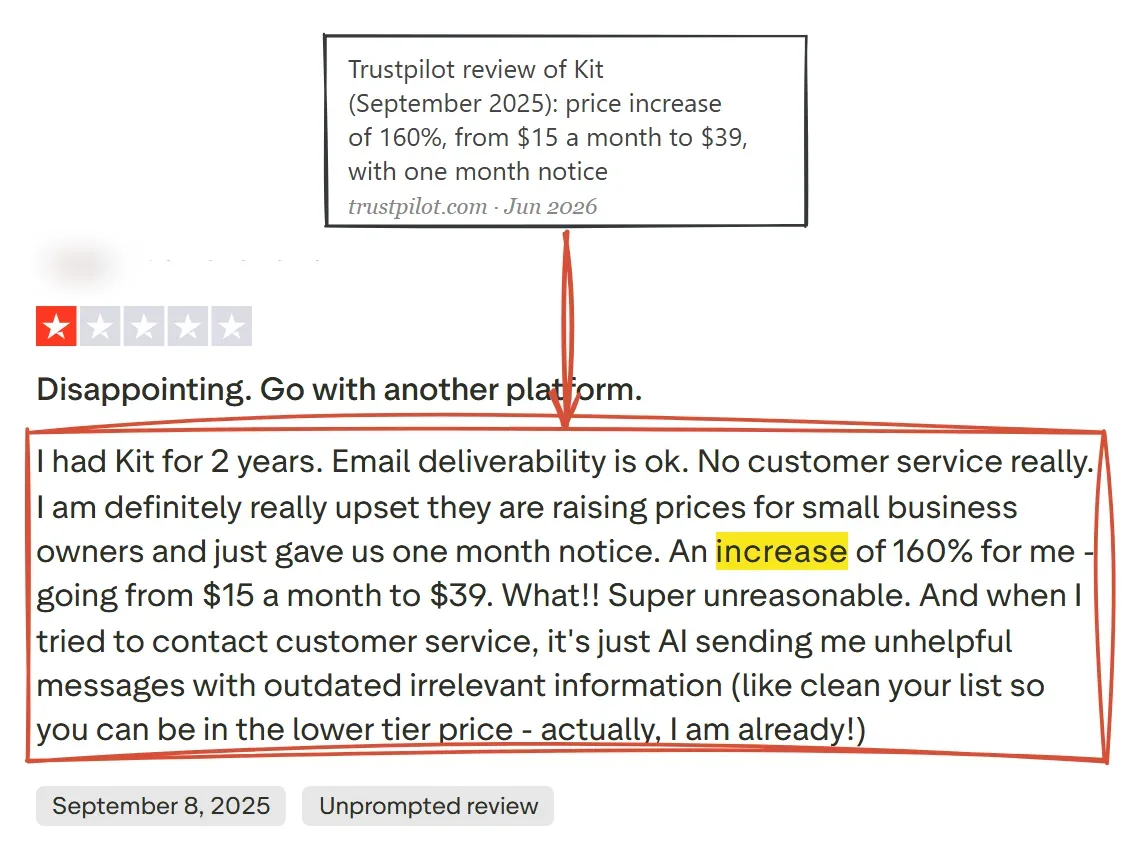
The loudest trigger is recent and dated. In September 2025 Kit announced new pricing with roughly one month's notice. The entry Creator plan rose about 34% (from $29 to $39 a month at 1,000 subscribers, now $39/mo (Creator, 1K subs) · verified June 9, 2026 on our live tracker), and creators on older legacy plans reported steeper jumps. The corpus carries 140 pricing mentions plus 17 on the hikes specifically, and the reviews from that autumn read like an exit wave.
"I am definitely really upset they are raising prices for small business owners and just gave us one month notice. An increase of 160% for me - going from $15 a month to $39."Trustpilot, September 2025
Billing that only climbs by itself
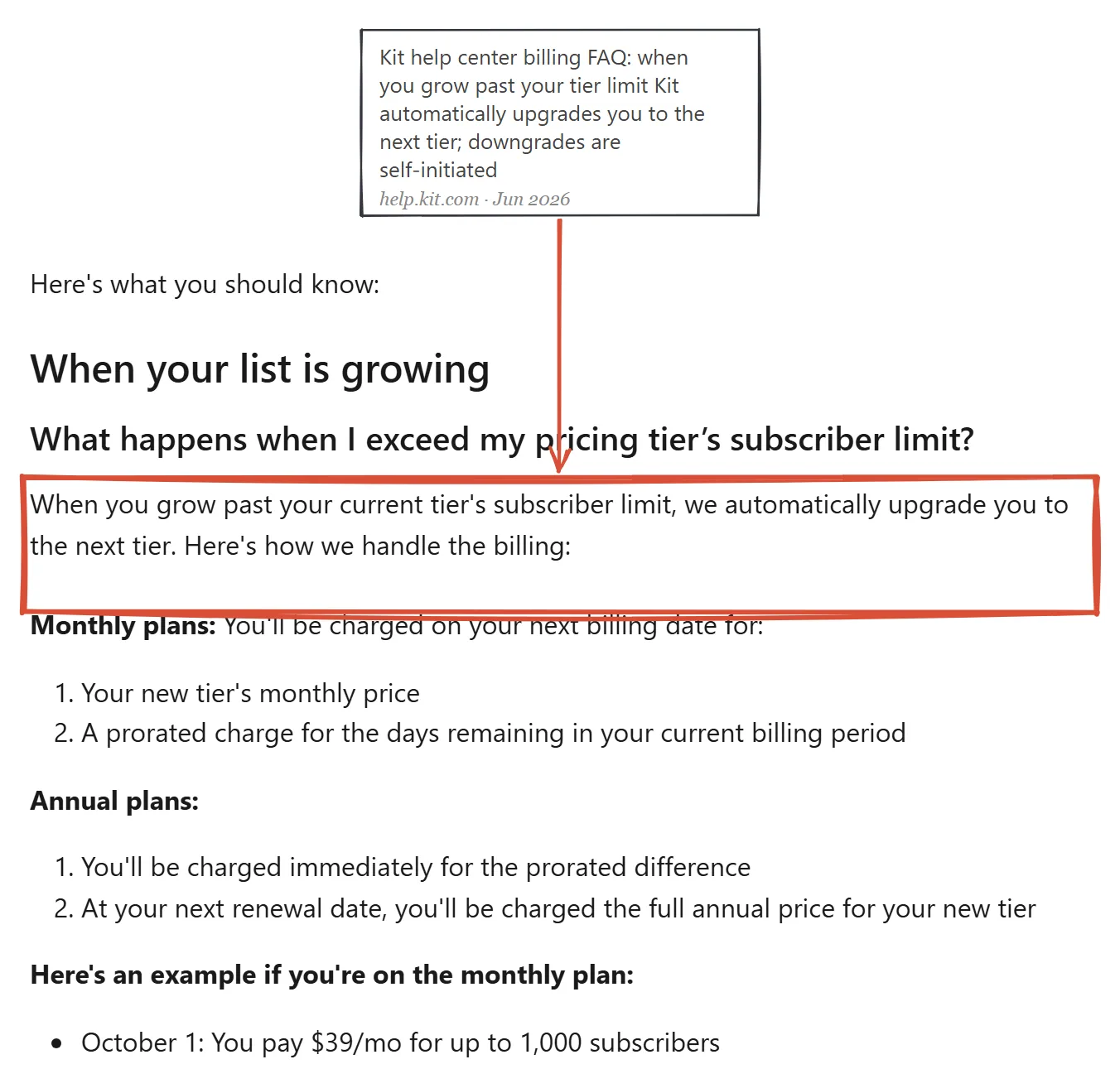
The second trigger is mechanical, and Kit documents it in its own help center. Grow past your tier's subscriber limit and Kit upgrades you automatically, with the charge applied the day it triggers. Shrink back below the threshold and nothing happens until you go downgrade yourself in account settings. Reviewers describe the result: a list crosses 1,000 subscribers in July, and $120 leaves the account without notice. Two details compound it. Cold subscribers who never open still count toward your tier until you clean them out by hand. And the corpus reports no renewal reminders, with refused refunds once the cancellation window passes.
The design ceiling, by design
The third trigger has the biggest aggregate volume in the corpus: 62 mentions on the editor, 46 on landing pages, 42 on customization. Kit's editor is text-first on purpose. Color backgrounds, spacing control, font choices: reviewers have asked for them since 2019 and Kit has not moved, because its thesis is that plain emails land in inboxes. Power users defend that trade. Visual creators hit a wall, and the landing-page builder does not catch them: reviewers call it acceptable for a capture page and inferior to a dedicated tool for anything that sells.
"The default formatting is hard to read. Need a code snippet to fix it and it's still not perfect." G2, May 2026
The fourth trigger is the quiet one: the analytics worth having live one plan higher than most people budget for. Engagement scoring, the Insights dashboard and deliverability reporting are Pro-only, and the corpus notices (31 mentions). Add the gaps with no fix at any price (no creator mobile app, seven mentions and zero defenses) and you have the full documented map of why people leave. Each one is a route below.
Our take
Where kit Falls Short
- The 2025 repricing, with one month's noticeIn September 2025 Kit announced an entry-price increase of about 34% (Creator at 1,000 subscribers went from $29 to $39 a month, billed monthly) with roughly one month's notice, and reviewers on older legacy plans reported jumps as steep as 160%, from $15 to $39. The reviews from that autumn read like an exit wave: 17 corpus mentions on the hikes alone, on top of 140 about pricing in general. The figures on this page are the live post-increase rates, re-checked weekly by our tracker.
- Billing that only moves in one direction by itselfKit's own help center states that growing past your tier's limit upgrades you automatically, with charges applied the day it triggers. Shrinking back never downgrades automatically; you have to do it yourself from account settings. Reviewers document the sting: $120 taken without notice after a list crossed 1,000 subscribers (Trustpilot, August 2025). Cold subscribers who never open still count toward your tier until you clean the list by hand.
- An affiliate policy that decides who gets to stayKit's help center caps affiliate marketing at around 20-30% of your email content and bans whole categories outright (CPA affiliate-type sites, affiliate education offers, loans, get-rich-quick). The corpus documents accounts disabled over affiliate links reviewers describe as legitimate, sometimes before a first send, with an AI support bot closing tickets. Post-ban, Kit's terms put data export at Kit's discretion, cap liability at $5 for free accounts, and route disputes to forced arbitration in Idaho.
- A design ceiling that is a choice, not a bugThe editor is text-first by design: 62 corpus mentions want color, spacing and font control it refuses to give, and the landing-page builder is judged too thin for real sales pages (46 mentions, the same complaint in 2021 as in 2026). Advanced users defend the trade for inbox placement. Know which camp you are in before you pay. The deep analytics (engagement scoring, Insights, deliverability reporting) sit one tier higher than most people expect, on Pro only.
The Fine Print That Decides Who Has to Leave
None of the pages ranking for this search reads Kit's paperwork, which is strange, because for one group of creators the paperwork IS the trigger. Kit's help center puts a number on its affiliate policy: 70-80% of your email content must be your own products, services and story, with only 20-30% related to affiliate marketing. Some categories are banned outright regardless of your ratio: affiliate links for education, loans, online pharmacies and get-rich-quick software, plus CPA affiliate-type sites and purchased lists under the acceptable-use policy.
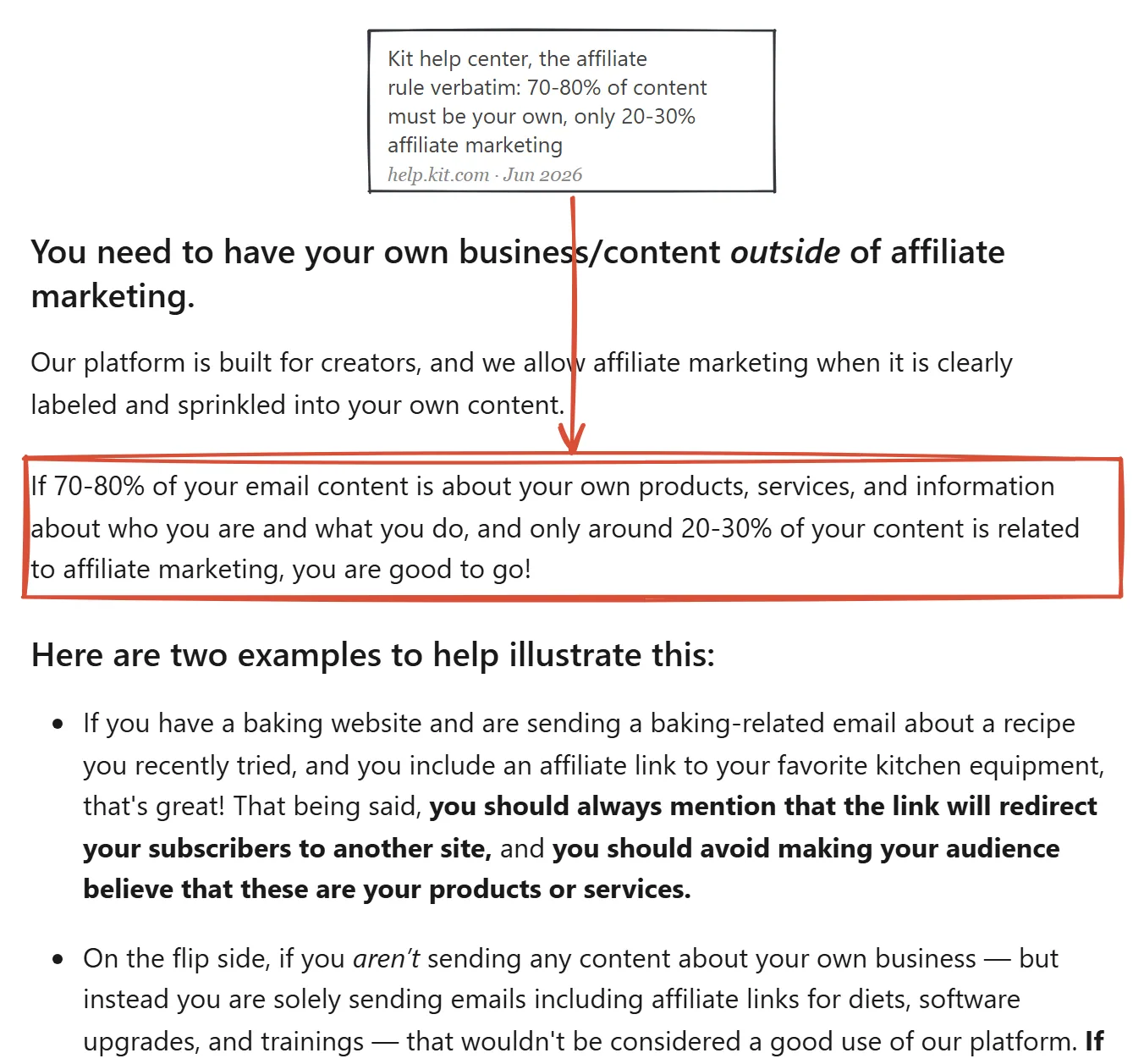
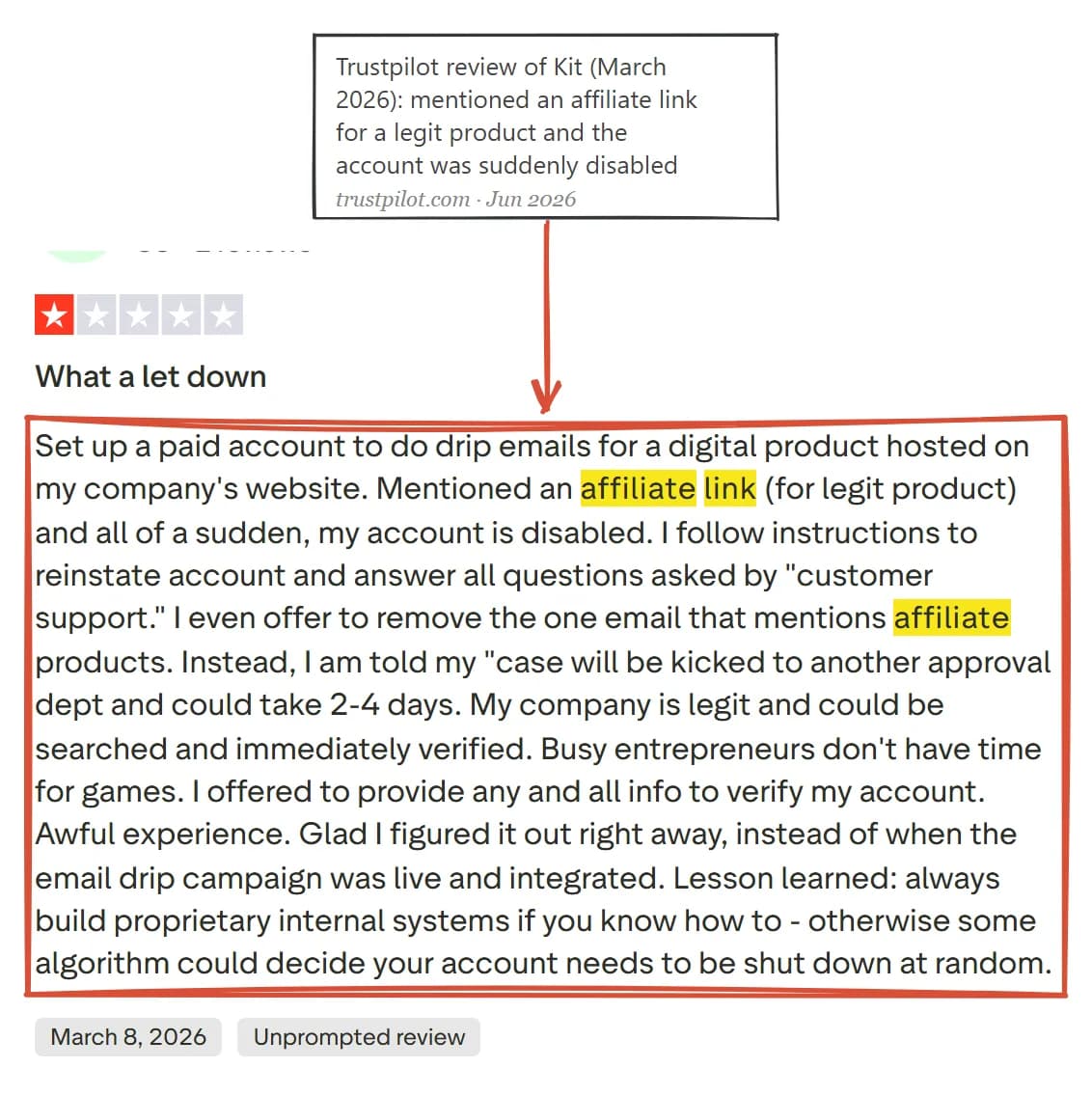
The rule itself is defensible; deliverability suffers when a list is a coupon firehose. What the corpus documents is the enforcement: accounts disabled over affiliate links reviewers describe as legitimate, sometimes before a single email went out, with an AI support bot closing the tickets afterward (35 suspension mentions plus 22 on content policy).
"Set up a paid account to do drip emails for a digital product hosted on my company's website. Mentioned an affiliate link (for legit product) and all of a sudden, my account is disabled." Trustpilot, March 2026
What happens after a closure is where Kit's paper turns genuinely harsh. The terms allow termination in Kit's sole determination. Post-ban data export sits at Kit's discretion, and the corpus carries export refusals reported in 2021 and again in 2024. Liability is capped at the greater of $5 or twelve months of fees, so a free-plan creator's recourse is five dollars, pursued through forced arbitration in Idaho with a class-action waiver. Even the free plan's generosity has a string: the Free Recommendations slot is marked Required, so your signup page promotes other creators' newsletters and turning that off costs a paid plan.
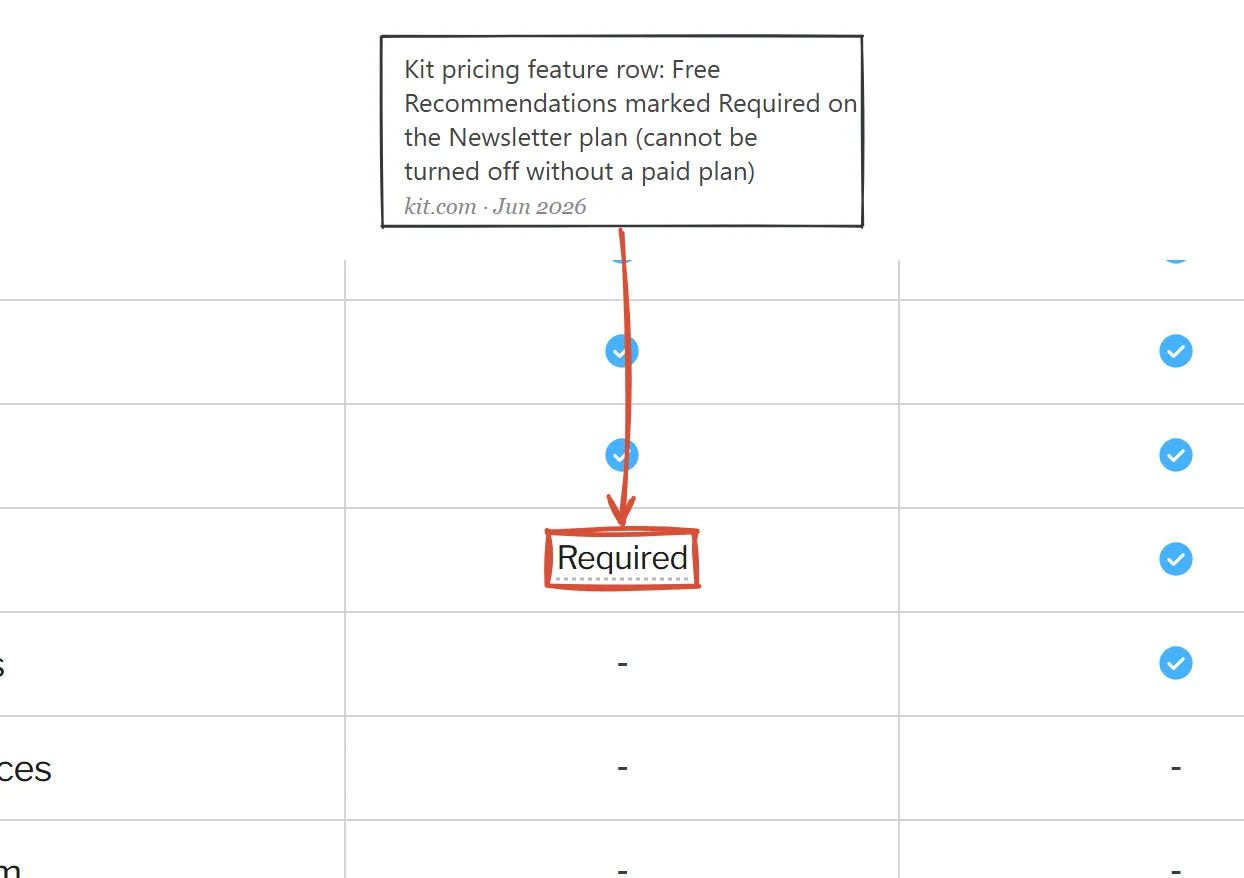
Two clarifications, because precision cuts both ways. Those required slots are reciprocal list-growth promotion; no money changes hands, and the paid version (Paid Recommendations, where Kit takes 23.5%) is a separate Creator-and-up feature. And the defense against everything in this section costs five minutes a month: export your subscriber CSV on a schedule, before you need it.
When Staying on Kit Is the Right Call
This section carries unusual weight on this particular site. Kit is not our affiliate; it pays us nothing, while three of the platforms below do. And Kit still holds the highest score our engine has produced, 8.1/10 in our full Kit review, above every platform that pays us. So when we say the stay-case is strong, no commission is talking.
Three claims hold up under our layers. First, the automation and segmentation system is the panel's creator-side benchmark: tags and segments, conditional content and digital products all score a perfect 1.0 in our depth layer, and the corpus agrees in volume (129 automation mentions, positive). Second, the commerce stack works from the free tier at a 0.6% platform take (3.5% + 30¢ all-in with card processing), against Substack's 10%. For a creator selling $5,000 a month in products or paid subscriptions, that gap is roughly $30 versus $500 in monthly fees. Third, the company itself is the stability pick of this panel: bootstrapped, profitable, with an estimated $43M in annual revenue (2025) and a founder publicly against VC funding, while several rivals run on venture timelines.
"I send 160k emails and generate thousands of dollars a month - and I only write one email. This is possible due to Kits automations segmentations."Trustpilot, March 2026
Add the parts migrants only notice after leaving: deliverability that reviewers moving from Mailchimp, Constant Contact and AWeber repeatedly praise (46 mentions, positive), a free tier that reaches 10,000 subscribers, the widest we track, and a Creator Network that quietly compounds list growth. So stay if your trigger is not on this page: if the repricing fits your budget, your content is your own, and text-first suits your voice, the data says you already use the best creator-business engine in this panel. Whatever you decide, take the five-minute insurance: export your subscriber CSV monthly.
Pick Your Alternative by Your Trigger
Generic rankings answer a question nobody asks. The platform that fixes the repricing (MailerLite, Substack) is the wrong answer to the affiliate fine print (AWeber, Ghost), and the reverse. The table routes each documented trigger to the destination the data supports; the deep dives below carry the evidence, dealbreakers included. One warning before you read it: if suspension risk is your trigger, our corpora document opaque suspensions at MailerLite (87 mentions, the panel's highest), AWeber (46), GetResponse (30) and Substack (20) too. Changing hosts changes whose discretion you live under; only self-hosting removes it.
Routing by departure trigger, June 2026
Your trigger ranked by review volume | First stop where the data points | Also consider the credible runner-up |
|---|---|---|
| The September 2025 repricing hit your plan (140 pricing + 17 hike mentions) | MailerLite (the panel's price floor, automations included) | Substack ($0 at any size, pays only when you earn) |
| You want visual control Kit's text-first editor refuses (150 design mentions) | MailerLite (the panel's most polished builder) | Beehiiv (modern editor plus a real site builder) |
| Affiliate content is part of your model (35 suspension + 22 policy mentions) | AWeber (affiliate links allowed, hosted) | Ghost self-hosted (no acceptable-use policy above you) |
| Auto-upgrade charged you before you noticed (18 + 17 mentions) | Buttondown (bills active subscribers only) | Substack (no subscriber-count billing at all) |
| Engagement scoring and Insights locked behind Pro (31 mentions) | Beehiiv (the panel's deepest dashboard, from its first paid plan) | Honest answer: paying for Kit Pro, if the rest still fits |
| You want ad income and Kit has no self-serve network | Beehiiv (the only open self-serve ad network here) | Honest answer: nobody else in this panel runs one either |
| You outgrew even Kit's automations (multi entry points, granular orchestration) | ActiveCampaign (the panel's deepest, CRM-grade) | Honest answer: for creator workflows, Kit is already near the ceiling |
| You sell courses and want live webinars in the same tool | GetResponse (webinars + courses + email bundled, alone here) | Kit plus a standalone webinar tool (the unbundled route) |
| Suspended before your first send, or scared of the stories | Ghost self-hosted (the only structural exit) | Buttondown (the friendliest hosted account-control terms) |
The September 2025 repricing hit your plan (140 pricing + 17 hike mentions)
- First stop
- MailerLite (the panel's price floor, automations included)
- Also consider
- Substack ($0 at any size, pays only when you earn)
You want visual control Kit's text-first editor refuses (150 design mentions)
- First stop
- MailerLite (the panel's most polished builder)
- Also consider
- Beehiiv (modern editor plus a real site builder)
Affiliate content is part of your model (35 suspension + 22 policy mentions)
- First stop
- AWeber (affiliate links allowed, hosted)
- Also consider
- Ghost self-hosted (no acceptable-use policy above you)
Auto-upgrade charged you before you noticed (18 + 17 mentions)
- First stop
- Buttondown (bills active subscribers only)
- Also consider
- Substack (no subscriber-count billing at all)
Engagement scoring and Insights locked behind Pro (31 mentions)
- First stop
- Beehiiv (the panel's deepest dashboard, from its first paid plan)
- Also consider
- Honest answer: paying for Kit Pro, if the rest still fits
You want ad income and Kit has no self-serve network
- First stop
- Beehiiv (the only open self-serve ad network here)
- Also consider
- Honest answer: nobody else in this panel runs one either
You outgrew even Kit's automations (multi entry points, granular orchestration)
- First stop
- ActiveCampaign (the panel's deepest, CRM-grade)
- Also consider
- Honest answer: for creator workflows, Kit is already near the ceiling
You sell courses and want live webinars in the same tool
- First stop
- GetResponse (webinars + courses + email bundled, alone here)
- Also consider
- Kit plus a standalone webinar tool (the unbundled route)
Suspended before your first send, or scared of the stories
- First stop
- Ghost self-hosted (the only structural exit)
- Also consider
- Buttondown (the friendliest hosted account-control terms)
Coming from a different platform? The same framework runs the Substack alternatives hub, the MailerLite spoke and the beehiiv spoke; for a one-on-one, see Substack vs Kit or Beehiiv vs Kit.
The 8 Alternatives at a Glance
Real free-tier ceilings, the paid-newsletter fee model, the strength our review corpus actually confirms against Kit, and the honest reason to walk away. Kit's own line, for reference: 10,000 free subscribers with one basic automation, commerce at a 0.6% platform take from the free tier, the panel's best creator automations one plan up, and the repricing, billing and fine-print caveats above.
Free tiers, fees, dealbreakers (June 2026)
Platform | Free tier real ceiling, June 2026 | Paid newsletters platform fee model | Beats Kit at from the review corpus | Walk away if the honest dealbreaker |
|---|---|---|---|---|
| MailerLite | 500 subs | 0% (Growing Business and up) | Price, visual builder, EU hosting | Growth has to come from inside the product |
| Substack | Unlimited | 10% of paid revenue | Zero bill at any size, deepest discovery network | You rely on Kit-grade automations |
| Beehiiv | 2,500 subs | 0% (from the paid Scale plan) | Analytics depth, self-serve ad network | Suspension stories with revenue at stake scare you |
| Ghost | None | 0% (Publisher tier and up) | Ownership: your Stripe, your server, a real site | You want a free start or a growth network |
| Buttondown | 100 subs | 0% (paid subs add-on) | Active-only billing, account control, full API | You need rich analytics or a visual editor |
| AWeber | 500 subs (hidden) | No native paid newsletters | Affiliate links allowed, phone support on free | Paid subscriptions are your model |
| GetResponse | 500 contacts | 0% (Creator tier, 3rd paid plan) | Webinars + courses + email in one | You want a simple newsletter tool |
| ActiveCampaign | Trial only | No creator monetization at all | CRM-grade automation deeper than Kit's | You publish for readers, not pipelines |
MailerLite
- Free tier
- 500 subs
- Paid newsletters
- 0% (Growing Business and up)
- Beats Kit at
- Price, visual builder, EU hosting
- Walk away if
- Growth has to come from inside the product
Substack
- Free tier
- Unlimited
- Paid newsletters
- 10% of paid revenue
- Beats Kit at
- Zero bill at any size, deepest discovery network
- Walk away if
- You rely on Kit-grade automations
Beehiiv
- Free tier
- 2,500 subs
- Paid newsletters
- 0% (from the paid Scale plan)
- Beats Kit at
- Analytics depth, self-serve ad network
- Walk away if
- Suspension stories with revenue at stake scare you
Ghost
- Free tier
- None
- Paid newsletters
- 0% (Publisher tier and up)
- Beats Kit at
- Ownership: your Stripe, your server, a real site
- Walk away if
- You want a free start or a growth network
Buttondown
- Free tier
- 100 subs
- Paid newsletters
- 0% (paid subs add-on)
- Beats Kit at
- Active-only billing, account control, full API
- Walk away if
- You need rich analytics or a visual editor
AWeber
- Free tier
- 500 subs (hidden)
- Paid newsletters
- No native paid newsletters
- Beats Kit at
- Affiliate links allowed, phone support on free
- Walk away if
- Paid subscriptions are your model
GetResponse
- Free tier
- 500 contacts
- Paid newsletters
- 0% (Creator tier, 3rd paid plan)
- Beats Kit at
- Webinars + courses + email in one
- Walk away if
- You want a simple newsletter tool
ActiveCampaign
- Free tier
- Trial only
- Paid newsletters
- No creator monetization at all
- Beats Kit at
- CRM-grade automation deeper than Kit's
- Walk away if
- You publish for readers, not pipelines
MailerLite: the Price Floor, Without the Automation Tax
MailerLite answers the two loudest Kit triggers at once, which is why it leads this page. The repricing first: at 1,000 subscribers, MailerLite's Growing Business plan runs $19/mo (Growing Business, 1K subs) · verified June 9, 2026 against Kit Creator's $39/mo (Creator, 1K subs) · verified June 9, 2026, and at 10,000 subscribers the gap widens ($89/mo (Growing Business, 10K subs) · verified June 9, 2026 versus $139/mo (Creator, 10K subs) · verified June 9, 2026), with automations included rather than gated. Then the design ceiling: its drag-and-drop builder is the most polished in our depth layer (0.9), the exact thing Kit refuses to be. Paid newsletters carry 0% commission from Growing Business, and it is the one newsletter-first vendor here with EU-exclusive hosting and ISO 27001 certification.
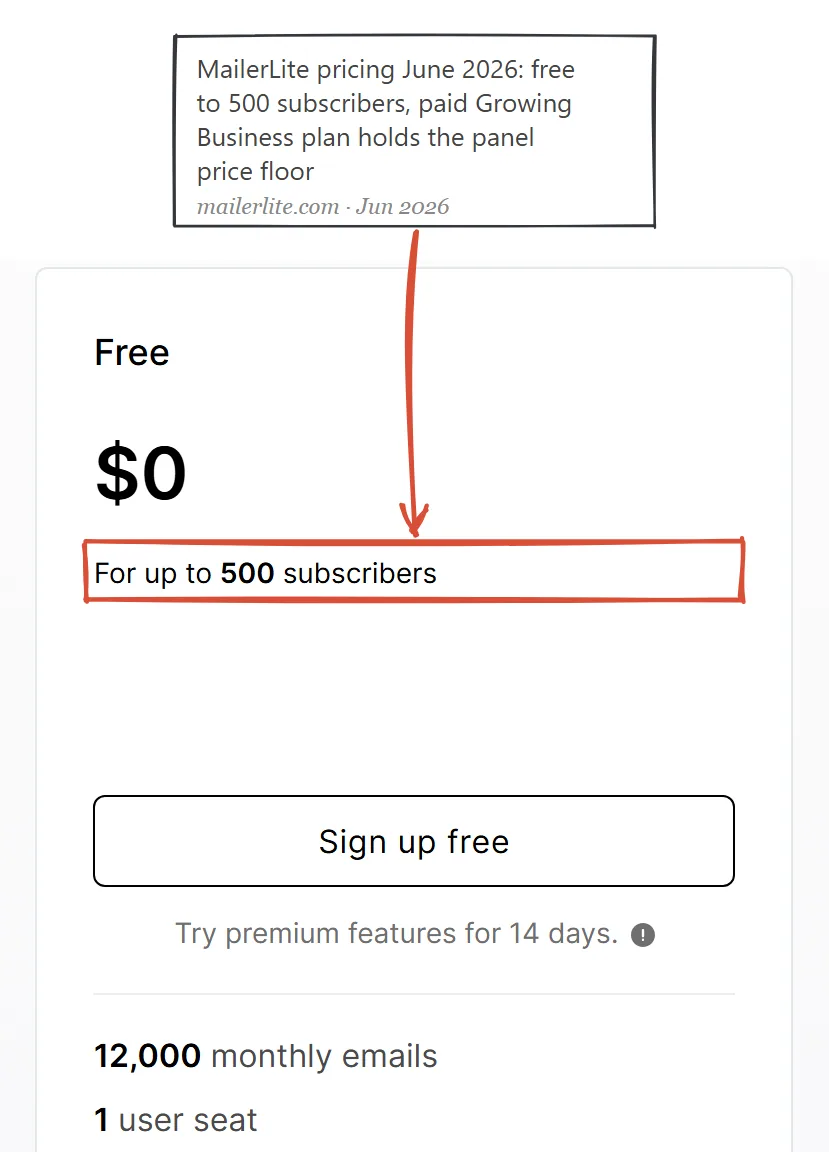
The ledger cuts three ways. The free tier covers 500 subscribers, one twentieth of Kit's. Growth tooling is absent: no recommendations network, no referral system, so the Creator Network compounding you would leave behind has no equivalent here. And if the suspension stories pushed you to this page, MailerLite is the wrong exit: its corpus documents 87 suspension mentions, the highest volume in our panel, algorithmic and, per reviewers, hard to appeal. Approval is also front-loaded; affiliate-heavy senders tend to fail its onboarding review.
Full first-hand walkthrough: our MailerLite review (7.3/10) · leaving MailerLite instead? MailerLite alternatives.
Visit MailerLite (free to 500 subs) →Substack: Zero Bill, Network Included, Tooling Gone
Substack deletes both of Kit's billing triggers in one move. There is no monthly fee at any list size, so the repricing cannot reach you and neither can the auto-upgrade: there is no subscriber-count billing to upgrade. You pay 10% of paid-subscription revenue, and nothing before that. It also brings the one asset nobody else here has: the deepest reader discovery network in our panel (Notes, recommendations, leaderboards, scored 1.0 in our depth layer), plus a real mobile app and an editor its corpus actually praises.
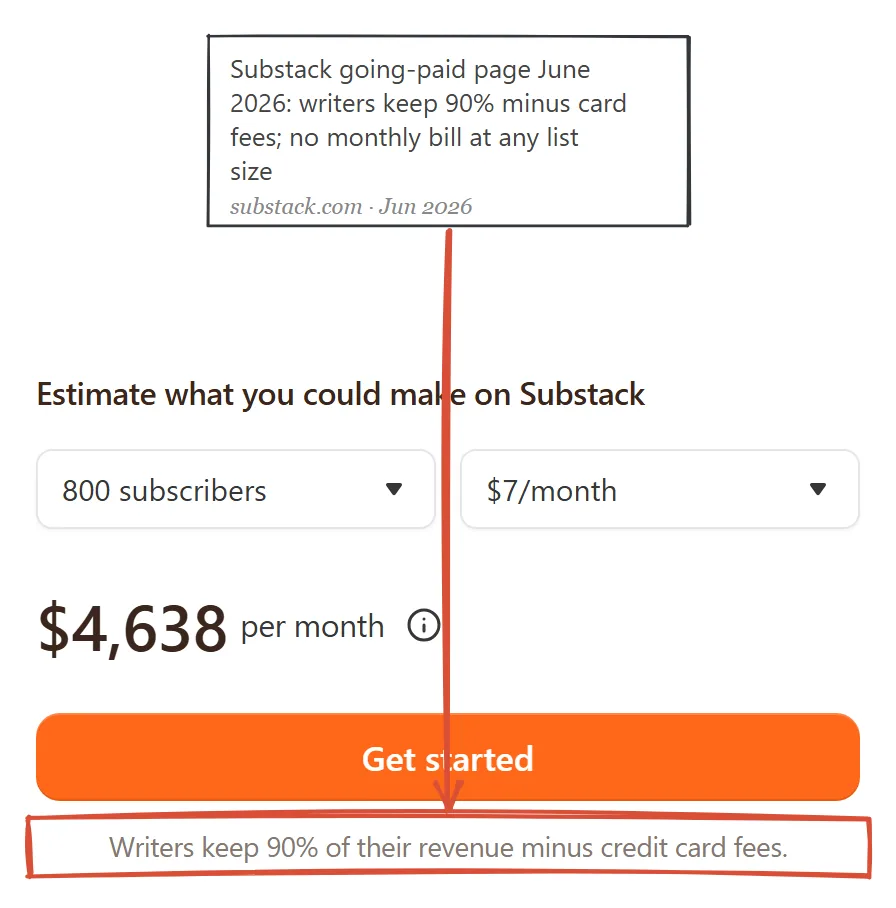
Now weigh what a Kit user gives up, because it is nearly everything Kit is good at. The automation surface is two welcome emails; tags, sequences, conditional content and behavioral triggers do not exist. The commerce math inverts at scale: Kit takes 0.6% on paid subscriptions where Substack takes 10% (closer to 13% effective with Stripe processing), so a $5,000-a-month publication pays Substack roughly $500 monthly for what Kit prices near $30 plus the plan. Support is an AI chatbot with no human escalation, the #1 departure driver in Substack's own 480-review corpus. And the ownership paper is worse than Kit's, not better: a perpetual license on what you publish, and a confirmed March 2025 case where a locked account's list export was blocked. Pick it pre-revenue or discovery-hungry, not as a tooling upgrade.
Our Substack review scores it 5.4/10; Substack vs Kit runs the head-to-head, fee math included.
Visit Substack (free, 10% on paid) →Beehiiv: the Documented Analytics Exit
Beehiiv is where the analytics trigger actually goes, and we can prove the direction: the one repeated migration story in our corpora runs Kit to beehiiv, creators leaving specifically for the dashboard. Beehiiv's analytics score 1.0 in our depth layer against Kit's 0.8, and they arrive with the first paid plan rather than Kit's Pro tier. It is also the only platform in this panel running an open, self-serve ad network, the thing Kit's marketing implies and its pricing page does not list. A growth-and-monetization creator gets the full stack in one place: ads, sponsorships, paid subscriptions at 0% fee from Scale, and a modern editor with a real site builder, the runner-up answer to Kit's design ceiling.
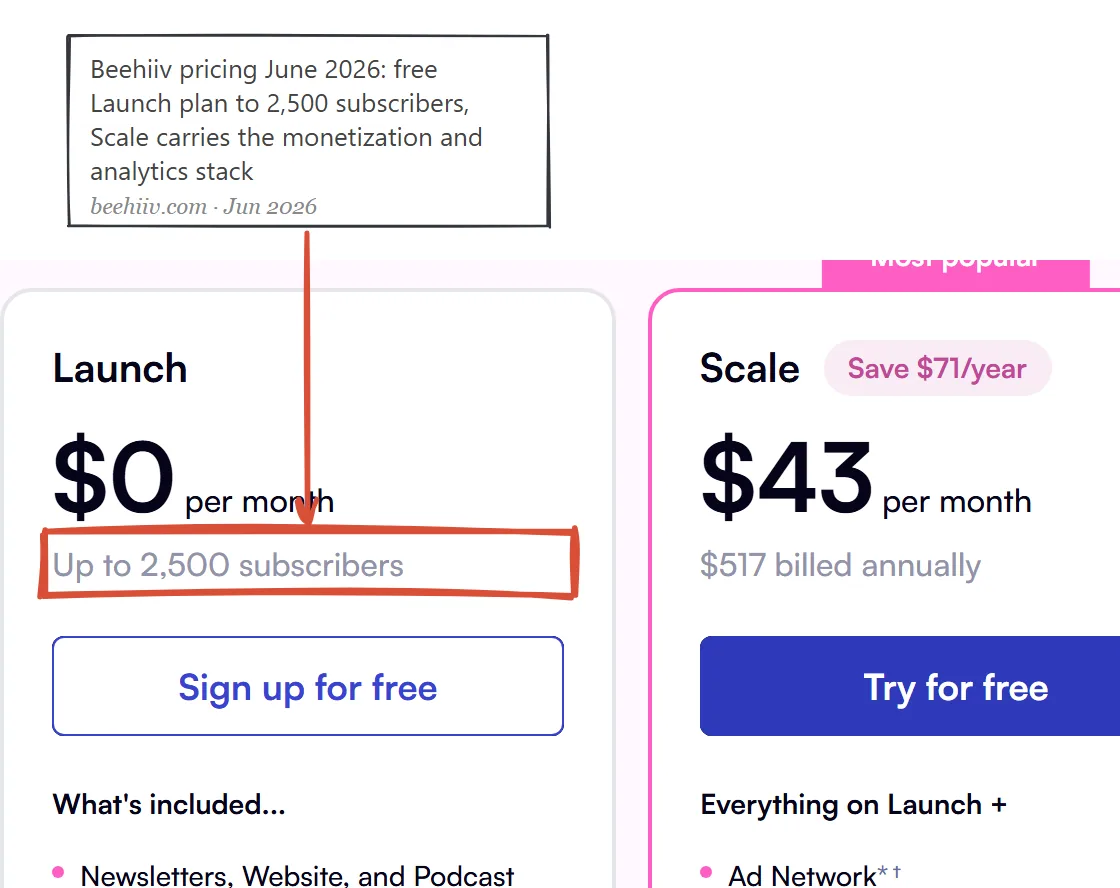
Read the ledger with both eyes, because beehiiv is our top-paying affiliate and this paragraph is where that conflict lives. Its free plan stops at 2,500 subscribers, a quarter of Kit's. Its automations are the reverse trade: Scale-gated and shallower than Kit's (0.7 versus 0.9 in our layer), so the automation trigger does not route here. Its corpus documents suspensions with accumulated ad revenue withheld in the worst cases, plus reliability complaints under daily use through early 2026. If suspension fear or affiliate content brought you to this page, beehiiv answers neither. We wrote the same exit guide about beehiiv; read it before you migrate toward it.
First-hand test: our beehiiv review (7.4/10) · the direct matchup: Beehiiv vs Kit.
Try beehiiv (free to 2,500 subs) →Ghost: Out of Anyone's Discretion
Every hosted platform on this page, Kit included, reserves the right to close your account at its own judgment. Self-hosted Ghost is the one destination that removes that sentence from your life: open source, on your server, with Stripe connected directly under your control. No acceptable-use policy reads your affiliate ratio. No billing tier upgrades itself. Memberships carry 0% transaction fees from the Publisher tier ($29/mo (Publisher, 1K subs) · verified June 9, 2026), against Kit's 0.6%, and the website is a real CMS with themes, the strongest answer in this panel to Kit's landing-page ceiling.
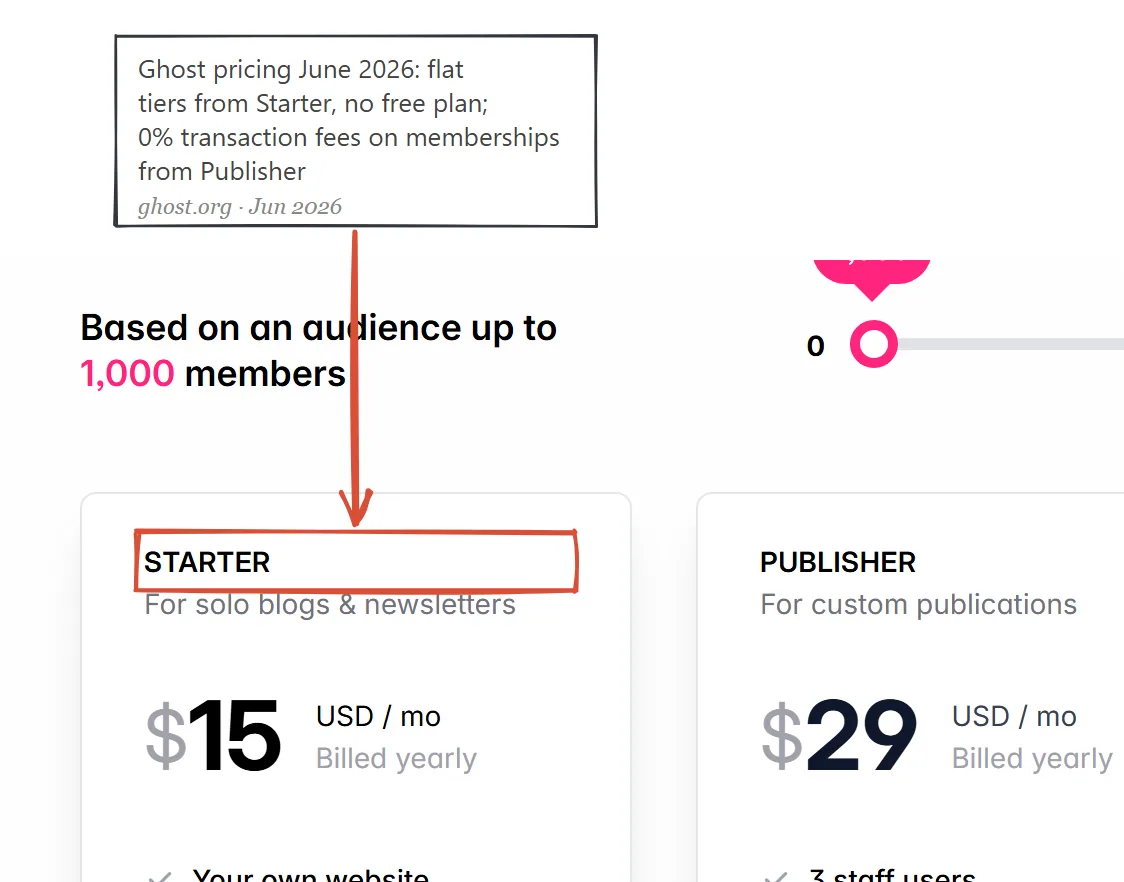
The costs are real. There is no free plan at all; Starter begins at $15/mo (Starter, 1K subs) · verified June 9, 2026 and cannot monetize. The automation surface is thinner than Kit's by a wide margin: no visual workflows, no behavioral triggers, no tag-based sequences. There is no Creator Network equivalent, and self-hosting is free in license but not in operations (bulk email needs Mailgun, updates are yours). And precision matters here too: the full-ownership promise belongs to self-hosting. Managed Ghost(Pro) terms keep a perpetual license on what you publish and cap liability at $100, better paper than Kit's $5, but not sovereignty.
Direct comparison: Substack vs Ghost.
Visit Ghost (14-day trial) →Buttondown: Billing That Only Counts the Living
If Kit's billing asymmetry is your trigger, Buttondown is its exact inverse. It bills on active subscribers only, so the cold contacts Kit counts until you prune them simply fall off your bill. The account-control paper inverts too: our trust matrix rates Buttondown favorable on control, content license and billing model, the friendliest hosted terms in this panel, where Kit sits unfavorable on control with its $5 cap. Developers get full API parity and a real CLI. Support is the founder himself, the highest support score in our panel (0.98). Paid subscriptions carry 0% platform fee as a $9/month add-on, under Kit's 0.6%.
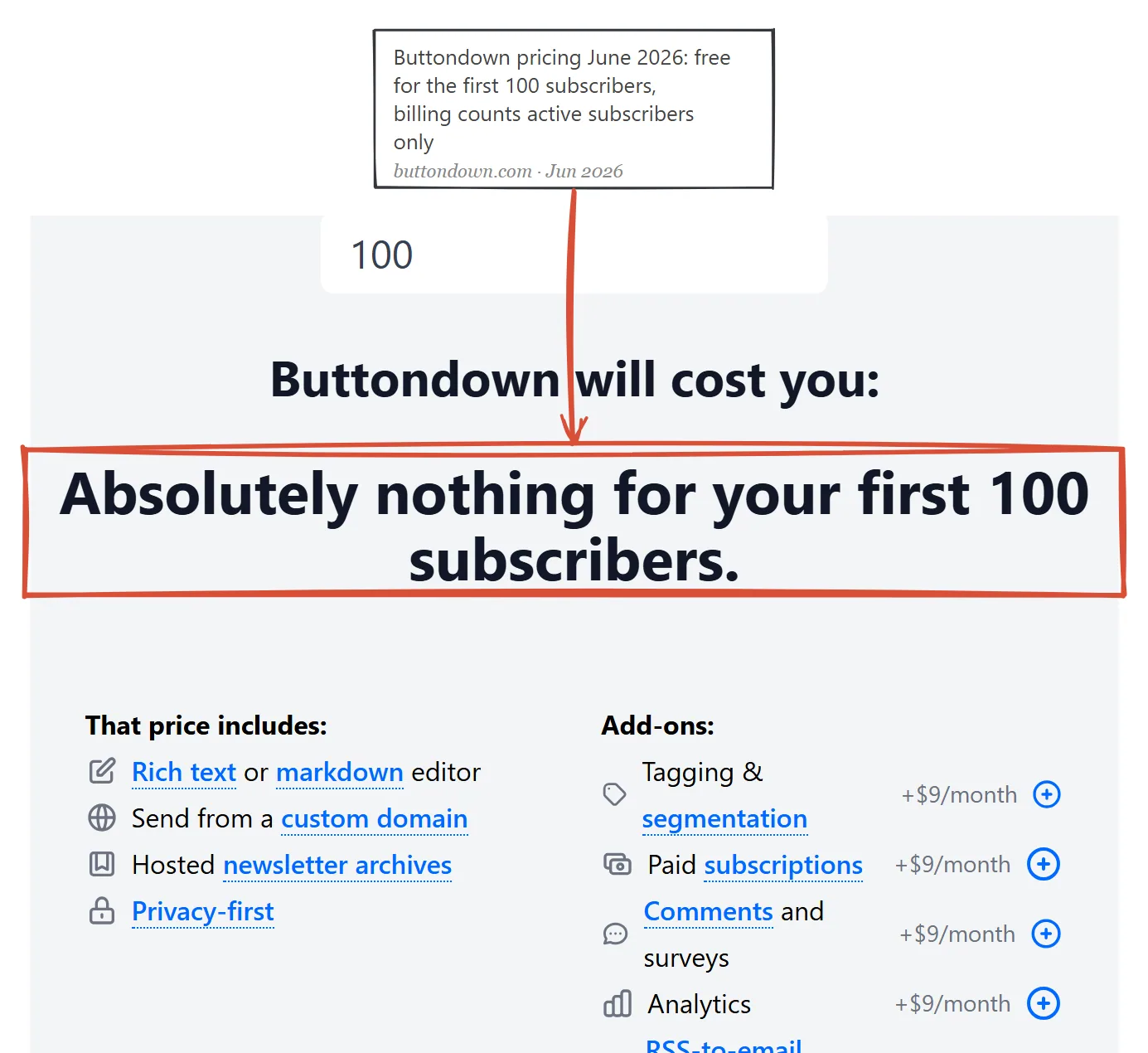
The trade is scale and surface. The free tier covers 100 subscribers, one hundredth of Kit's. Writing is Markdown-first, so a creator leaving Kit over its design ceiling would be running toward less visual control, not more. Analytics are privacy-first and thin by design, automations are a fraction of Kit's, and the company is one person, which cuts both ways: brilliant support, bus factor of one, with a $0 liability floor in the terms. Pick it for billing sanity and account control, not for dashboards or funnels.
Try Buttondown ($9 off first month) →AWeber: Where Affiliate Links Are Allowed
One trigger routes here above all others, and it happens to be the one Kit enforces hardest. AWeber tolerates affiliate links; its practitioner community has used it for affiliate sends for years, the documented opposite of Kit's 20-30% cap and category bans. It also answers Kit's missing-human complaint literally: phone and live-chat support on every plan including free, the only vendor in this panel offering it. The free tier covers 500 subscribers and 3,000 emails a month, with one oddity we verified on our own account: the public pricing page does not mention the free plan at all.
Full first-hand test, hidden free tier included: our AWeber review (6.3/10).
Try AWeber free (500 subs, hidden tier) →GetResponse: Courses and Webinars in One Tool
One real use case sends Kit users here: you sell courses and want live webinars native to the same tool. Kit sells courses well (digital products score 1.0 in our layer) but has no webinar anywhere. GetResponse bundles webinars (up to 100 attendees on Creator, $69/mo (Creator, 1K subs) · verified June 9, 2026 at 1,000 contacts), course hosting and premium newsletters at 0% fee, something nobody else in this panel does. It keeps a quiet 500-contact free plan, and its sub-minute live chat is its #1 review theme.
Already weighing the exits from GetResponse itself? Start with GetResponse alternatives.
Visit GetResponse (free to 500 contacts) →ActiveCampaign: When Kit's Automations Are the Ceiling
This route exists for a small, specific group: creators who hit the limits of Kit's automations themselves, multi-entry sequences, granular orchestration, CRM-grade conditions. The corpus documents them, in the singular complaints about missing multi entry points. ActiveCampaign is the end of that road: the deepest automation platform in our panel (1.0 in our depth layer, above Kit's 0.9), built for the operations-minded sender running segmented lifecycle flows.
Visit ActiveCampaign (if automation is the job) →Who Controls Your Audience? Read Before You Move
None of the pages ranking for this search covers termination clauses, post-ban export or content licenses, which is exactly what the fine-print section above says should worry a Kit creator most. So we read every platform's terms, clause by clause. Kit's row is a study in contrast: the best viability profile in the panel (bootstrapped, profitable, anti-VC) sitting next to some of its harshest paper (termination at sole determination, discretionary post-ban export, the $5 cap, forced Idaho arbitration, an acceptable-use policy that bans whole niches). Moving does not retire platform risk; it changes whose discretion you live under, and sometimes improves the paper, sometimes worsens it.
| Platform | Account control | Content license | AI training rights | Account transfer | Legal recourse | Liability cap | Cost at scale | Vendor longevity | Reliability & incidents | Billing model | Allowed niches |
|---|---|---|---|---|---|---|---|---|---|---|---|
| Kit | |||||||||||
| MailerLite | |||||||||||
| Substack | |||||||||||
| beehiiv | |||||||||||
| Ghost | |||||||||||
| Buttondown | |||||||||||
| AWeber | |||||||||||
| GetResponse | |||||||||||
| ActiveCampaign |
✓ favorable to the creator · ◐ mixed · ✗ unfavorable. Hover or tap a cell for the detail. Compiled June 2026 from public terms, status pages and the pricing data layer. Re-verified quarterly.
Clause-by-clause verbatims, ban case studies and the portability test live on the dedicated page: who controls your audience.
The Switch Math: Run Your Own Numbers
Here is the arithmetic an exit page owes you. A free-plan Kit creator under 10,000 subscribers pays nothing today; every hosted destination except Substack would charge money or cap far lower, so a pure price move only makes sense once you are ON a paid Kit tier. There, the gap is real: at 1,000 subscribers MailerLite runs less than half of Kit Creator, and the distance holds at 10,000. But two costs do not show up on a pricing page: rebuilding tag-based automations on a platform with shallower tooling, and walking away from deliverability the corpus consistently praises. Sellers should run the fee line too: Kit's 0.6% take is the second-best commerce deal here after the true 0% platforms.
So we built the calculator instead of hand-waving: your list size, your destination, year-one math from our weekly-scraped pricing data. When staying on Kit is cheaper, it says so, and since Kit pays us nothing while three destinations do, the calculator telling you to stay is the verdict that costs us money. It says it anyway.
Migration: What Survives the Move Out
Your list survives cleanly, from an active account. Kit exports subscribers to CSV with tags and custom fields, and destination importers (MailerLite, beehiiv, Substack) read Kit exports directly; reviewers rate arrival migrations as smooth. The qualifier matters: from an ACTIVE account. Post-suspension, export sits at Kit's discretion, with export refusals reported in 2021 and again in 2024. The monthly CSV habit is your insurance, here more than anywhere on this page.
Your automations do not migrate; they get rebuilt. No destination imports Kit's visual automations, and most cannot represent them: only ActiveCampaign matches the depth, MailerLite covers the common cases, and Substack has nothing to rebuild them in. Inventory your workflows before choosing a destination; the automation ceiling is where most Kit exits quietly fail.
Paid subscriptions are the project. There is no documented path for moving active Kit paid subscriptions to another platform with billing intact, and the rare corpus reports describe them as not migrating cleanly. Budget for re-subscription asks, or time the move to your renewal cycle. Landing pages and forms rebuild by hand anywhere. And before anything else: screenshot your analytics benchmarks, because the history stays behind.
Pressure-test the cost side first in the switch calculator.
Two minutes to your shortlist
The quiz scores all nine platforms, Kit included, on what you actually need (automation, billing, design, ownership) and names your best fit. It is blind to commission; the engine cannot see who pays us.
Take the platform quiz →Feature Matrix: All Nine, Side by Side
The full 53-feature data layer behind this page, source-verified against vendor documentation, with Kit in view so every comparison answers the question you came with. Counting checkmarks is not the goal; finding where your dealbreaker sits is.
Compare 4 / 5 platforms
Pick a plan from the ▾ menu under a platform to see what that plan unlocks and its price at your subs count.
| Feature | Kit (ex-ConvertKit) | MailerLite | Beehiiv | Substack |
|---|---|---|---|---|
| Monthly priceat 2.5K subs · monthly | $0/mo · Free ≤10K subs | $33/mo · Growing Business · 2.5K subs | $0/mo · Free ≤2.5K subs | 10% of revenue |
| 6/6 | 3/6 | 6/6 | 5/6 | |
| 4/5 | 4/5 | 4/5 | 2/5 | |
| 9/9 | 8/9 | 9/9 | 6/9 | |
| 9/9 | 8/9 | 9/9 | 7/9 | |
| 2/4 | 4/4 | 2/4 | 2/4 | |
| 5/5 | 5/5 | 4/5 | 3/5 | |
| 7/10 | 8/10 | 10/10 | 8/10 | |
| 4/5 | 2/5 | 5/5 | 5/5 | |
| Get started | Try free → | Try free → | Try free → | Try free → |
✓ Yes · Partial · — No · dotted = unverified · a plan tag (e.g. Scale) = the cheapest plan that unlocks it; pick a plan above each column and ↑ marks features above it. Verified against vendor sources, September 2026. Some links are paid — OwnLetter may earn a commission at no extra cost to you. It never affects the data.
What Users Say, Theme by Theme
Average ratings first, read knowing review populations differ (Kit's Trustpilot mixes established creators with proven ROI and the suspension and billing cases quoted above; G2 and Capterra skew toward marketing professionals), then the themes users actually raise, side by side. Every verbatim is an exact quote.
Straight from the reviews
What real users say
Each site’s average below comes from its own user reviews across Reddit, Trustpilot, Capterra and G2 — the count per site is on each bar. We never invent a quote.
Average score on each review site
KitMailerLitebeehiivSubstackGhostPraised · Complaint · Split opinion
Average scores pulled from each site on May 31, 2026. Trustpilot scores are a recent sample, not the lifetime average; Reddit has no star ratings. Substack isn't listed on Capterra, and on Substack Trustpilot skews toward readers and Reddit toward creators. See our methodology.
Where the review themes agree and split
Compare 4 / 5 platforms
| What users say about… | Kit885 reviews read | MailerLite1849 reviews read | beehiiv669 reviews read | Substack480 reviews read |
|---|---|---|---|---|
| ▲ | ▲ | ▼ | ▼ | |
| ▼ | ▲ | ▼ | ▼ | |
| ▼ | ▲ | ▼ | ▼ | |
| ▲ | ◆ | ◆ | ◆ | |
| ▲ | ◆ | ◆ | ◆ | |
| ▲ | ◆ | ▲ | ◆ | |
| See for yourself | Try free → | Try free → | Try free → | Try free → |
▲ Praised · ▼ Complaint · ◆ Mixed · top theme / common / minor = how often readers bring it up · ❝ hover any cell for the exact count and a real, sourced quote · · = too few reviews to score. Read in full from Reddit, Trustpilot, G2 and Capterra, June 2026. We never invent a quote. Some links are paid — OwnLetter may earn a commission at no extra cost to you. It never affects the data.
Review sources:RedditTrustpilotG2Capterra
Frequently asked
Kit alternatives, the questions that matter
What is the best Kit (ConvertKit) alternative in 2026?
It depends on the trigger pushing you out, which is how this guide routes you. MailerLite is the pick when the September 2025 repricing broke your budget: it holds the price floor of our eleven-platform panel at most list sizes, with automations included on its first paid plan. Substack removes the bill entirely and takes 10% only when you earn. Beehiiv is the documented analytics exit, and the only platform here with a self-serve ad network. AWeber allows the affiliate links Kit suspends accounts over, and self-hosted Ghost removes platform policy from your life altogether. Buttondown inverts Kit's billing by counting active subscribers only. And the honest case: Kit holds the highest score our review engine has produced (8.1/10) and pays us nothing, so if no trigger on this page describes you, staying is the choice the data supports.
Why do people actually leave Kit?
Not out of broad dissatisfaction. Across 885 reviews read in full, Kit's biggest themes are positive: ease of use (186 mentions), automation and tagging (129), deliverability (46). Departures cluster on events instead: the September 2025 repricing, felt hardest by growth-stage creators between paid tiers; billing that upgrades automatically the day you cross a threshold but never downgrades by itself; suspensions tied to affiliate content, sometimes before a first email; a text-first editor and landing-page builder that frustrate visual creators; and deep analytics gated behind the Pro plan. If none of those describes you, the data says you are probably fine where you are.
Is Kit still good in 2026?
Yes, and this page says so even though it is an exit guide. Kit scores 8.1/10 on our engine, the highest of the nine platforms we have scored, and it pays us nothing, so that number has no commission behind it. Its tag-based segmentation, conditional content and digital-products commerce lead our depth layer outright, commerce works from the free plan at a 0.6% platform take, and the free tier reaches 10,000 subscribers, the widest we track. The honest counterweights: the 2025 repricing landed badly, the affiliate fine print is real and enforced, analytics worth having live on Pro, and there is no mobile app. Match yourself to a trigger before you migrate anything.
Can I use affiliate links on Kit?
Within limits Kit writes down and enforces. Its help center says you are fine if 70-80% of your email content is your own products, services and story, with only 20-30% related to affiliate marketing. It bans affiliate links for education, loans, online pharmacies and get-rich-quick software outright, plus CPA affiliate-type sites and purchased lists under the acceptable-use policy. The corpus shows enforcement is real and sometimes opaque: reviewers report accounts disabled over affiliate links they describe as legitimate, including one March 2026 Trustpilot case where mentioning an affiliate link for a product on the reviewer's own site preceded the account being disabled. If affiliate content is a pillar of your model rather than a garnish, AWeber tolerates it and self-hosted Ghost has no policy layer at all.
Did Kit raise its prices?
Yes. Announced in September 2025 with roughly one month's notice, entry pricing rose about 34 percent (Creator at 1,000 subscribers went from $29 to $39 a month), and reviewers on older legacy plans reported jumps as high as 160 percent, from $15 to $39. Two billing mechanics amplify the sting: crossing a subscriber threshold upgrades and charges you automatically the same day, and cold subscribers count toward your tier until you remove them by hand. The prices rendered on this page come from our weekly-scraped tracker, with their verification date, so they are the live post-increase rates.
Which Kit alternatives have a free plan?
Six of the eight, verified June 2026, and all of them smaller than Kit's. Kit's free Newsletter plan reaches 10,000 subscribers, the widest free tier we track, with the trade printed on the label: one basic automation, no A/B testing, and a Required recommendations slot you cannot turn off without paying. MailerLite covers 500 subscribers and 12,000 monthly emails. AWeber keeps a permanent 500-subscriber, 3,000-email free tier its public pricing page does not show; we confirmed it on our own account. GetResponse keeps a quiet 500-contact free plan. Buttondown is free to 100 subscribers. Substack is free at any list size and takes 10% when you charge readers. Ghost and ActiveCampaign have no permanent free tier.
What happens if Kit suspends my account?
The documented pattern, from 35 suspension mentions plus 22 on content policy: closures arrive without prior warning or a clear reason, sometimes before a first email is sent, and reviewers describe an AI support bot closing tickets without resolution. The paper behind it is harsher than most platforms here: Kit's terms allow termination in its sole determination, put post-ban data export at Kit's discretion (reviewers in 2021 and again in 2024 reported exports refused), cap liability at the greater of $5 or twelve months of fees, and route disputes to forced arbitration in Idaho with a class-action waiver. Your defense costs five minutes a month: export your subscriber CSV on a schedule. And know the category context: our corpora count 87 suspension mentions at MailerLite, 46 at AWeber, 30 at GetResponse and 20 at Substack. Only self-hosted Ghost removes the discretion structurally.
How We Built This Page
OwnLetter works as a lab-style analyst, not a power-user reviewer. This page crosses seven proprietary data layers. Pricing is scraped weekly for 17 vendors. The 53-feature matrix is source-verified against vendor docs. The 8,376reviews behind these nine platforms were re-themed and read in full, 885 of them for Kit alone. The trust layer comes from reading every platform's terms of service; the $5 liability cap, the discretionary post-ban export and the affiliate-policy findings above come from it and from Kit's own help center, captured in June 2026. Add feature-depth scoring, plus first-hand testing on our own Kit, beehiiv, MailerLite, AWeber, Substack and Ghost accounts. All screenshots are dated June 2026 and captured by us, fresh for this page.
What we did not do: no seed-list deliverability tests (they violate vendor terms; we quote nobody's inbox-placement numbers, including our own), no combined star rating across platforms (populations differ too much to average), and no pricing from memory: every plan figure on this page renders from the tracker, with its verification date. Full methodology →
Affiliate status, restated where it matters most: Kit pays us nothing, and our engine still ranks it first of the nine platforms we score. Beehiiv (our top-paying affiliate), AWeber and Buttondown pay us; MailerLite, Substack, Ghost, GetResponse and ActiveCampaign pay us nothing. The trigger ranking comes from review volumes we cannot edit, the #1 trigger routes to two platforms that pay us nothing, and every claim in the sections naming our affiliates carries a source plus its dealbreakers in the same breath.
Sources
- · Kit pricing page (free 10,000 cap, fee lines, Required recommendations row; captured June 11, 2026)
- · Kit help: what affiliate marketing is and isn't allowed (70/30 rule + banned categories, captured June 11, 2026)
- · Kit help: account upgrade and downgrade FAQs (automatic upgrade + import suspension, captured June 11, 2026)
- · Kit acceptable-use policy (CPA affiliate-type sites clause, verified June 2026)
- · Kit Terms of Service (termination, export discretion, $5 liability cap, arbitration; verified June 2026)
- · Kit help: migrating to Kit (concierge on paid plans only, verified June 2026)
- · Trustpilot reviews of Kit (September 2025 + March 2026 reviews captured June 11, 2026, identities blurred)
- · MailerLite pricing page (captured June 11, 2026)
- · Beehiiv pricing page (captured June 11, 2026)
- · Substack going-paid page (fee model, captured June 11, 2026)
- · Ghost pricing page (captured June 11, 2026)
- · Buttondown pricing page (captured June 11, 2026)
- · ActiveCampaign Terms of Service (§6.6 data clause, verified June 2026)
- · OwnLetter review corpus: 8,376 reviews behind these nine platforms, re-themed across G2, Capterra, Trustpilot and Reddit (June 2026), including 885 for Kit; per-claim source URLs in our public claims manifest.
Our verdict
How we routed them
Match the platform to your trigger, not to a ranking
We did not rank eight platforms against a vendor and tilt the order; Kit pays us nothing and still tops our own scoring. We took the documented triggers that actually push people off Kit (the September 2025 repricing first, the design ceiling second, the affiliate fine print and the one-way billing after) and routed each to the platform whose data holds up.
MailerLite is the first stop for most leavers: the panel's price floor with automations included, and the visual builder Kit refuses to be. Substack deletes the bill entirely for pre-revenue lists. Beehiiv is the documented analytics exit and the only self-serve ad network here. AWeber takes the affiliate senders Kit suspends, eyes open about its own paper. Ghost, self-hosted, is the only structural answer to platform discretion, and Buttondown is the hosted runner-up with billing that only counts active subscribers. GetResponse and ActiveCampaign serve two specific profiles.
Three of those destinations pay us and Kit does not, so the test we accept is printed above: the #1 trigger routes to platforms that pay us nothing, the stay-case is the longest section before the routing table, and the calculator will tell you to stay when staying is cheaper.
- Built from 8,376 reviews read in full (885 for Kit alone), weekly-scraped pricing and every platform's terms
- Kit's affiliate rule, billing policy and fine print captured from its own pages, June 2026
- Kit pays us nothing and scores 8.1/10 on our engine, the panel's highest; the #1 trigger routes to non-affiliates
Choosing by who you are instead of what pushed you out? See best platforms for beginners and best platforms for writers; or read the full Kit review before deciding to leave at all.