On this page (22 sections)
- Quick verdict
- Why people leave Substack
- Why people stay
- Pick by your reason
- 8 alternatives at a glance
- Beehiiv: the full replacement
- Ghost: 0% platform fee
- Kit: automation and selling
- Buttondown: the quiet exit
- MailerLite: the budget pick
- AWeber: a human on the phone
- GetResponse: the all-in-one
- ActiveCampaign: read this first
- Who controls your audience
- The switch math
- What survives the move
- Which fits you?
- Feature matrix
- What users say
- FAQ
- Methodology
- Bottom line
Substack Alternatives 2026: Match the Platform to Your Reason for Leaving

By Arthur Brulard, Founder of OwnLetter. Cross-vendor analyst review across 11 newsletter platforms, aggregating user signals from Reddit, G2, Capterra, Trustpilot, and Hacker News. LinkedIn
Published June 10, 2026 · Updated June 10, 2026 · 23 min read
Quick verdict
There is no single best Substack alternative; there is a best one for your reason to leave. If the 10% cut is the wound, Ghost charges 0% on flat tiers and Kit charges 0.6%. If you want Substack without Substack, Beehiiv is the only feature-for-feature match, free to 2,500 subscribers. If the AI-chatbot support drove you out (our #1 departure reason, 58 of 480 reviews), AWeber answers a phone. Budget and EU hosting point to MailerLite; ownership-first minimalism points to Buttondown. And if your growth comes from Substack's recommendations network, the honest answer may be staying: nothing here replicates it.
 Substack
 beehiiv
 Ghost
Ghost Kit
Kit Buttondown
 MailerLite
 AWeber
 GetResponse
 ActiveCampaign
How we testedVerified June 2026 · 8376 reviews aggregated · Substack + Beehiiv + AWeber + MailerLite + Ghost + Kit tested · 35 sourced claims · 7 proprietary data layers · methodology public
What we did: Read the full review corpus behind the nine platforms on this page (8,376 reviews re-themed across G2, Capterra, Trustpilot and Reddit). Crossed it with our seven data layers: weekly-scraped pricing, the 53-feature matrix, trust and termination clauses, capability docs. Captured 11 dated screenshots in June 2026, including inside our own Substack, Beehiiv and AWeber accounts.
What we did NOT do: We did not run seed-list deliverability tests (they violate vendor terms) and we quote no inbox-placement percentages, ours or anyone's. We emit no combined star rating across platforms: review populations differ too much to average.
Refresh cadence: Pricing re-verified weekly by automated tracker; trust clauses quarterly; this page's claims manifest (35 entries with source URLs) is archived and auditable. (pricing verified June 10, 2026). Full methodology →
Why People Actually Leave Substack
Across 480 Substack community posts and reviews read in full, the departure drivers rank themselves. The result contradicts the usual roundup framing: the 10% fee is real, but it is not what pushes most people out the door.
The top driver is support: 58 mentions describe an AI chatbot with no ticket system and no path to a human. Billing and refund failures come second (42 mentions), then opaque account suspensions (20), platform bugs (14), and the automation ceiling (11). The fee problem threads through everything because of how it is presented, not just how much it costs.
"Substack is the ultimate "zero-risk" drug. No monthly fees, a clean interface, and a built-in discovery network. It feels free because you aren't getting a bill in your inbox every month." Reddit, March 2026
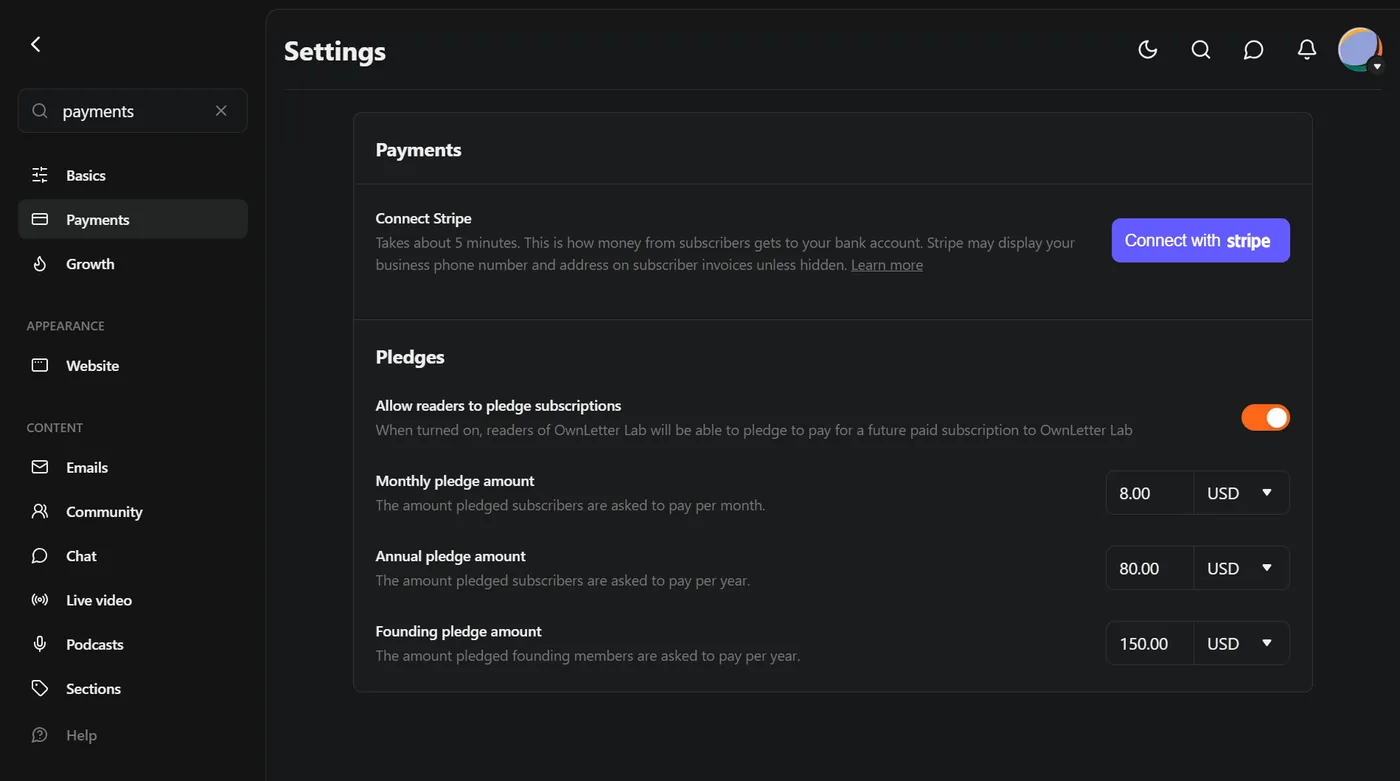
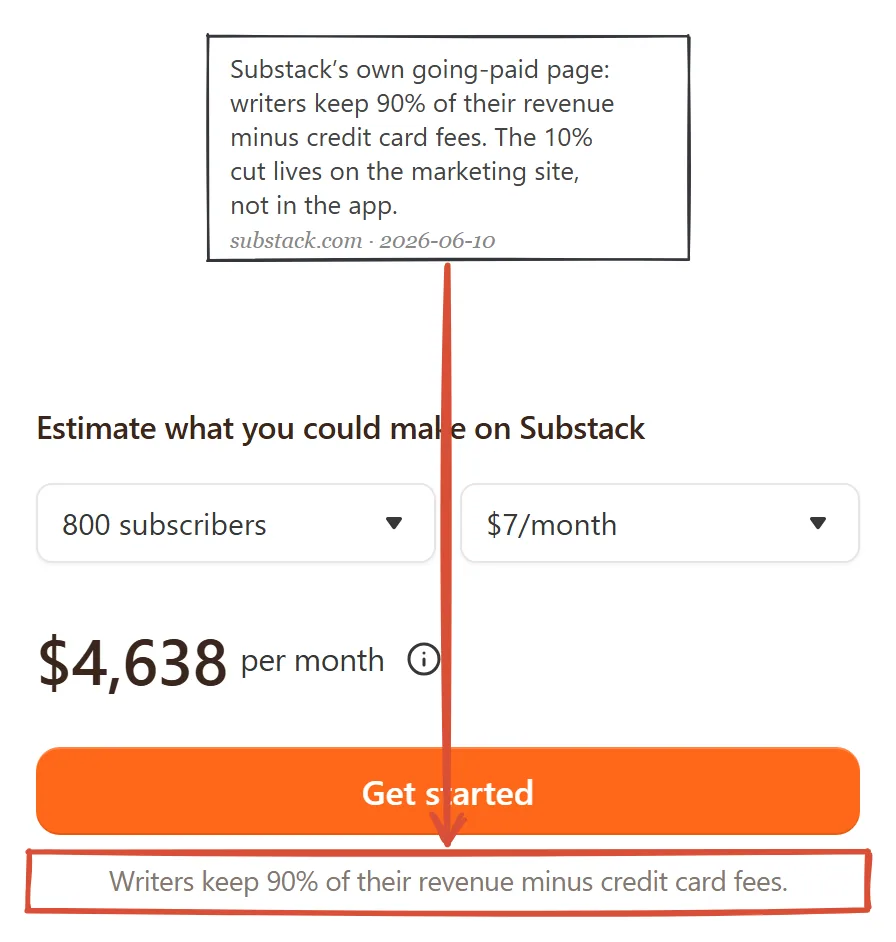
That bill never arrives because the fee lives outside the product. We went looking for it inside our own publication: payments settings show a pending Stripe connection and reader pledges pre-enabled at $8, $80 and $150 defaults. No plan screen, no invoice, no payout preview. The 10% is stated on marketing pages, and with Stripe's processing on top the effective cut runs near 13%.
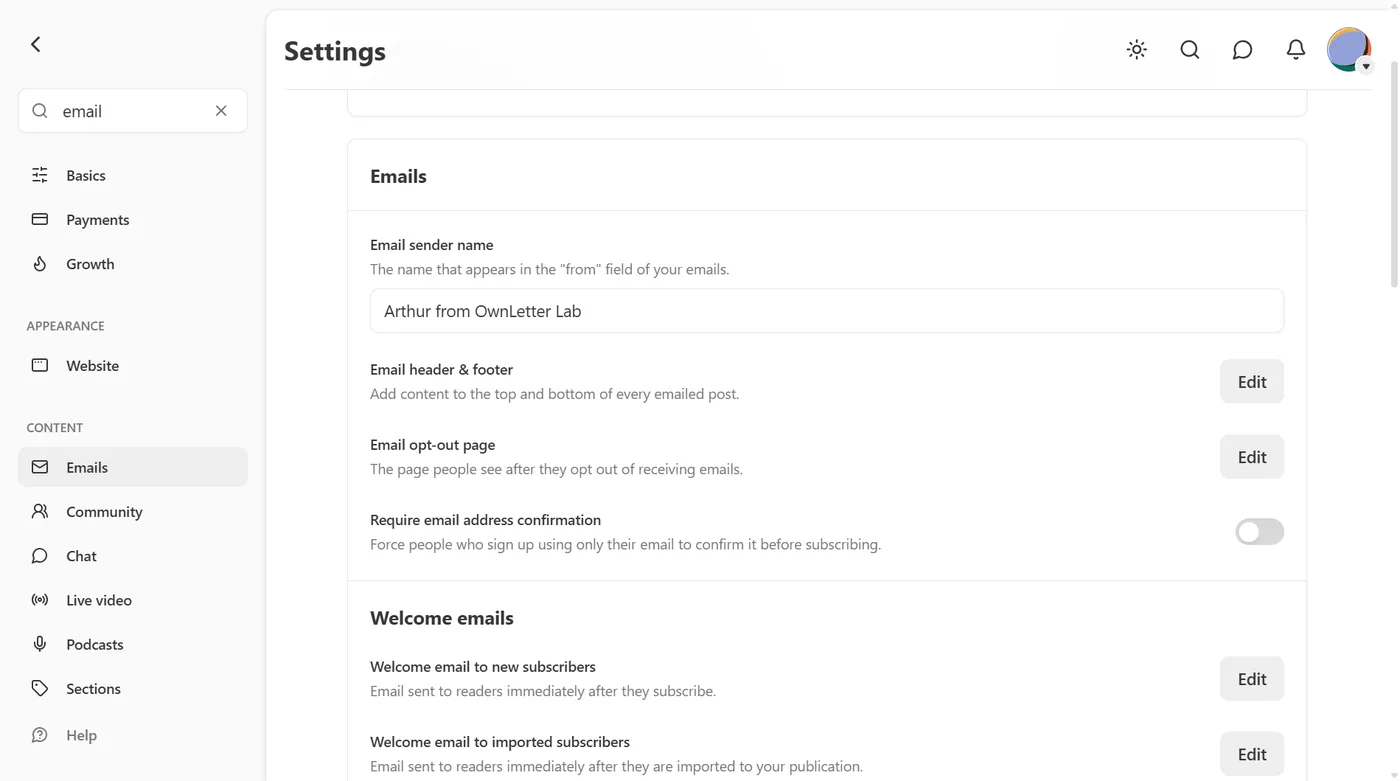
The automation ceiling is just as concrete. There is no Automations tab in settings. The entire email automation surface on a standard account is two welcome emails; drip campaigns remain a beta rolled out to bestsellers first (October 2025). One reviewer drew the line for everyone scaling past a hobby:
"segmentation is basic, automation is almost non-existent, analytics are surface-level, and monetisation options are limited. For anything beyond a simple paid/free split, you'll quickly hit a wall." Trustpilot, March 2026
Our take
Where Substack Falls Short
- The 10% never shows up in the appOn our own free publication (June 2026), no price, plan, fee or invoice appears anywhere in the product: payments settings show Stripe pending and pledges pre-enabled, and that is all. The 10% cut on paid subscriptions is stated on marketing pages only. With Stripe processing on top, the effective cut runs near 13%, and more through Apple in-app purchases. You discover it in your payout math, because no monthly bill ever arrives.
- Two welcome emails are the whole automation surfaceSettings on a standard account contain no Automations tab. The entire email automation surface is a welcome email for new subscribers and one for imported subscribers. Drip campaigns exist as a restricted beta rolled out to bestsellers first (October 2025). One Trustpilot reviewer put the ceiling plainly in March 2026: for anything beyond a simple paid/free split, you'll quickly hit a wall.
- Support is the #1 reason people quit58 mentions in our 480-review Substack corpus describe an AI chatbot with no ticket system and no human escalation, our highest-volume departure driver. Billing and refund complaints (42 mentions) compound it: readers report double charges resolved only through their card issuer. When something breaks, and 14 mentions document bugs like lost drafts, there is no one to call.
- Your list exports; your network does notEmail subscribers leave cleanly by CSV. Notes followers and recommendation traffic stay behind, and Substack's terms keep a perpetual, irrevocable, worldwide licence to what you published. In a confirmed March 2025 case, a locked account's subscriber list became unavailable to view and export. The October 2025 breach (663,000 accounts' emails and phone numbers, detected about five months late) belongs in the same trust ledger.
Why People Stay, and When You Should Too
An honest alternatives guide has to start with what no alternative gives you. Substack's discovery network (Notes, recommendations, leaderboards) is the deepest in our eleven-platform panel. We score it 1.0 against beehiiv's 0.85, and beehiiv's equivalent leans on paid Boosts. Substack claims 30%+ of paid subscriptions come from inside its network. That is the vendor's own figure, but 35 corpus mentions confirm the discovery effect is real.
"it's one of the best newsletter platforms out there for discovery if you have no audience." Reddit, May 2026
The same corpus adds the asterisk the marketing leaves out: early network readers are mostly other writers, not general readers, and several creators describe the pool as saturating. Still, three reader profiles should probably stay put. If you are starting from zero with no list and no budget, nothing else finds you readers for free. If a large share of your paid conversions arrives through recommendations, those will not migrate with you. And if you publish a newsletter, a podcast and video in one workflow, Substack is the only panel platform bundling all three.
A documented middle path: keep Substack as the discovery channel and send from elsewhere. Creators in our corpus run exactly that dual stack, using Notes for acquisition while the actual list lives on a platform with automations. It costs the overhead of two tools; it removes the choice between reach and tooling.
Pick Your Alternative by Your Reason for Leaving
Every roundup ranks platforms in the abstract. Switching does not work that way: the platform that fixes a fee problem (Ghost) is the wrong answer to a support problem (AWeber), and the reverse. The table routes each documented departure reason to the destination the data supports; the deep dives below carry the evidence, including the dealbreakers.
Routing by departure reason, June 2026
Your reason for leaving ranked by review volume | First stop where the data points | Also consider the credible runner-up |
|---|---|---|
| The 10% fee compounds as you grow | Ghost (0%, flat tiers) or Kit (0.6%) | Buttondown if you want minimal |
| Support is an AI chatbot (58 mentions, our #1) | AWeber (phone on every plan) | MailerLite or GetResponse (fast chat, paid tiers) |
| You hit the automation wall | Kit (behavioral automations) | Beehiiv (sequences + segments) |
| You want Substack, minus Substack | Beehiiv (the only 6/6 feature match) | Ghost if ownership outranks growth tools |
| Platform association bothers you | Beehiiv (documented switch motive) | Buttondown (ethical exodus pick, in 2024-2025) |
| Export and ownership worries | Ghost self-hosted (the only true exit) | Buttondown (exports paid subs, Stripe intact) |
| You want cheap, simple, EU-hosted | MailerLite (lowest serious price, EU + ISO 27001) | Buttondown under 100 subs |
| You sell courses, not just posts | Kit (commerce at 0.6%) or GetResponse (webinars) | ActiveCampaign only if CRM leads, newsletter follows |
The 10% fee compounds as you grow
- First stop
- Ghost (0%, flat tiers) or Kit (0.6%)
- Also consider
- Buttondown if you want minimal
Support is an AI chatbot (58 mentions, our #1)
- First stop
- AWeber (phone on every plan)
- Also consider
- MailerLite or GetResponse (fast chat, paid tiers)
You hit the automation wall
- First stop
- Kit (behavioral automations)
- Also consider
- Beehiiv (sequences + segments)
You want Substack, minus Substack
- First stop
- Beehiiv (the only 6/6 feature match)
- Also consider
- Ghost if ownership outranks growth tools
Platform association bothers you
- First stop
- Beehiiv (documented switch motive)
- Also consider
- Buttondown (ethical exodus pick, in 2024-2025)
Export and ownership worries
- First stop
- Ghost self-hosted (the only true exit)
- Also consider
- Buttondown (exports paid subs, Stripe intact)
You want cheap, simple, EU-hosted
- First stop
- MailerLite (lowest serious price, EU + ISO 27001)
- Also consider
- Buttondown under 100 subs
You sell courses, not just posts
- First stop
- Kit (commerce at 0.6%) or GetResponse (webinars)
- Also consider
- ActiveCampaign only if CRM leads, newsletter follows
Want the per-need detail instead? Two of these match-ups have full head-to-head pages: Substack vs Beehiiv and Substack vs Kit, plus Substack vs Ghost and Substack vs MailerLite.
The 8 Alternatives at a Glance
Fee on paid subscriptions, real free-tier ceiling, the strength the review corpus actually confirms, and the honest reason to walk away. Substack's own line, for reference: 10% of paid revenue, unlimited free subscribers, the best discovery in the panel, and the support/automation ceilings above.
Fees, free tiers, strengths, dealbreakers (June 2026)
Platform | Fee on paid subs platform cut, before Stripe | Free tier subscriber ceiling | Strongest at from the review corpus | Walk away if the honest dealbreaker |
|---|---|---|---|---|
| Beehiiv | 0% (on paid Scale plan) | 2,500 subs | Growth tools, analytics, ad network | You monetize little past 2,500 subs |
| Ghost | 0% (Publisher tier and up) | None | Ownership, real website, writing focus | You want zero setup or a free start |
| Kit | 0.6% (from the free tier) | 10,000 subs | Automations, selling products | You run CPA affiliate content |
| Buttondown | 0% (paid subs add-on) | 100 subs | Markdown, API, founder support | You need rich analytics or visuals |
| MailerLite | 0% (paid tier required) | 500 subs | Price, ease, EU hosting | You depend on network discovery |
| AWeber | No native paid newsletters | 500 subs (hidden) | Phone support on every plan | Paid subscriptions are your model |
| GetResponse | 0% (Creator tier, 3rd paid plan) | 500 contacts | Webinars + courses + email in one | You want a simple newsletter tool |
| ActiveCampaign | No creator monetization at all | Trial only | CRM-grade automation | You publish a newsletter for readers |
Beehiiv
- Fee on paid subs
- 0% (on paid Scale plan)
- Free tier
- 2,500 subs
- Strongest at
- Growth tools, analytics, ad network
- Walk away if
- You monetize little past 2,500 subs
Ghost
- Fee on paid subs
- 0% (Publisher tier and up)
- Free tier
- None
- Strongest at
- Ownership, real website, writing focus
- Walk away if
- You want zero setup or a free start
Kit
- Fee on paid subs
- 0.6% (from the free tier)
- Free tier
- 10,000 subs
- Strongest at
- Automations, selling products
- Walk away if
- You run CPA affiliate content
Buttondown
- Fee on paid subs
- 0% (paid subs add-on)
- Free tier
- 100 subs
- Strongest at
- Markdown, API, founder support
- Walk away if
- You need rich analytics or visuals
MailerLite
- Fee on paid subs
- 0% (paid tier required)
- Free tier
- 500 subs
- Strongest at
- Price, ease, EU hosting
- Walk away if
- You depend on network discovery
AWeber
- Fee on paid subs
- No native paid newsletters
- Free tier
- 500 subs (hidden)
- Strongest at
- Phone support on every plan
- Walk away if
- Paid subscriptions are your model
GetResponse
- Fee on paid subs
- 0% (Creator tier, 3rd paid plan)
- Free tier
- 500 contacts
- Strongest at
- Webinars + courses + email in one
- Walk away if
- You want a simple newsletter tool
ActiveCampaign
- Fee on paid subs
- No creator monetization at all
- Free tier
- Trial only
- Strongest at
- CRM-grade automation
- Walk away if
- You publish a newsletter for readers
Beehiiv: the Full Substack Replacement
Beehiiv is the only platform in our panel matching Substack on all six publisher features: web archive, recommendations, referrals, paid subscriptions, ad monetization and a reader-facing network. In our beehiiv corpus, migration is its own positive theme (~22 mentions), with Substack named as the origin and a pattern creators state outright: start on Substack, scale on Beehiiv. The free Launch plan covers 2,500 subscribers with unlimited sends and the recommendation network included.
"there's also automations which is helpful - welcome sequence, and targeted emails to certain segments which isn't possible with substack" Reddit, February 2026
Beehiiv vs Substack: a 0% cut and a built-in ad network
The monetization spread is the structural difference. Beehiiv takes 0% of paid-subscription revenue and runs a self-serve ad network with pre-negotiated sponsors; both live on the paid Scale plan ($69/mo (Scale, 3K subs) · verified June 9, 2026 at 2,500 subscribers). We can show you the gate honestly, because we hit it on our own free account:
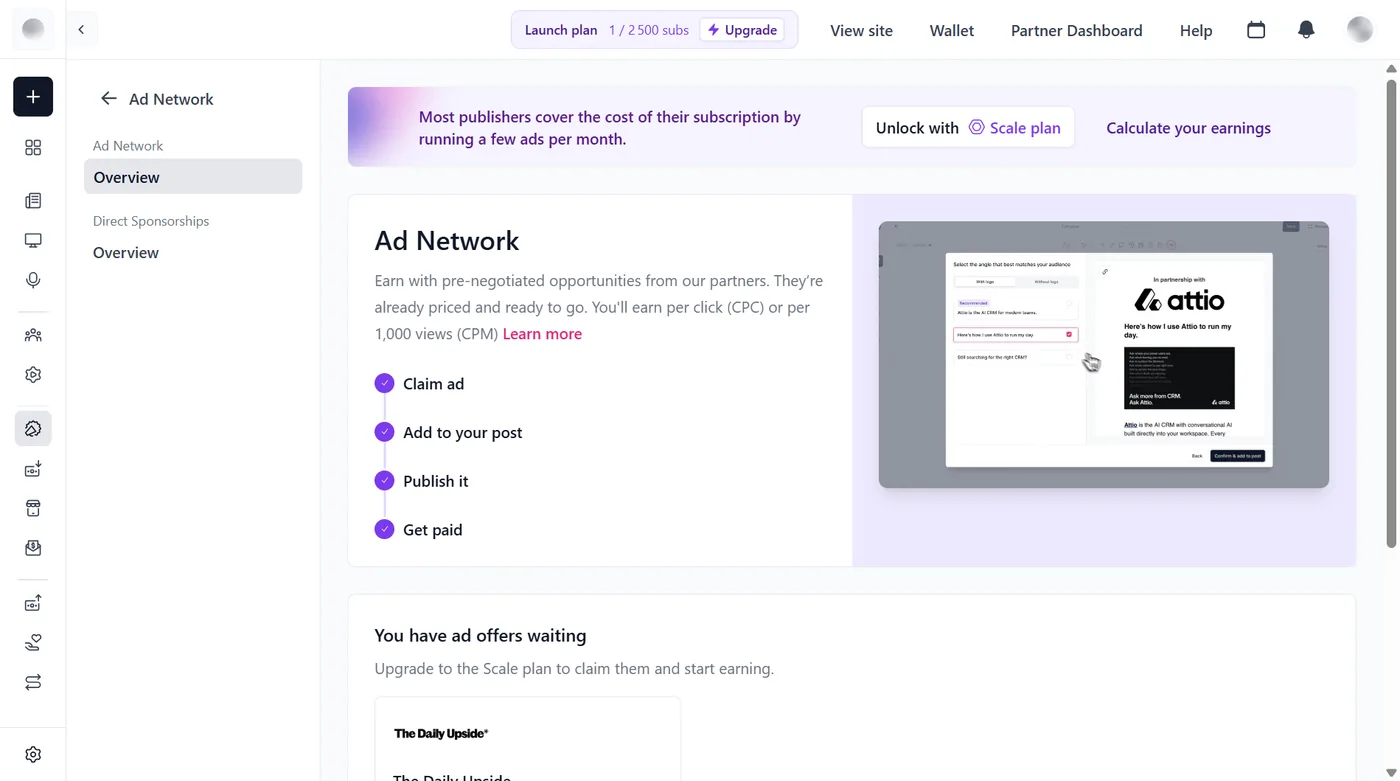
Where Beehiiv falls short
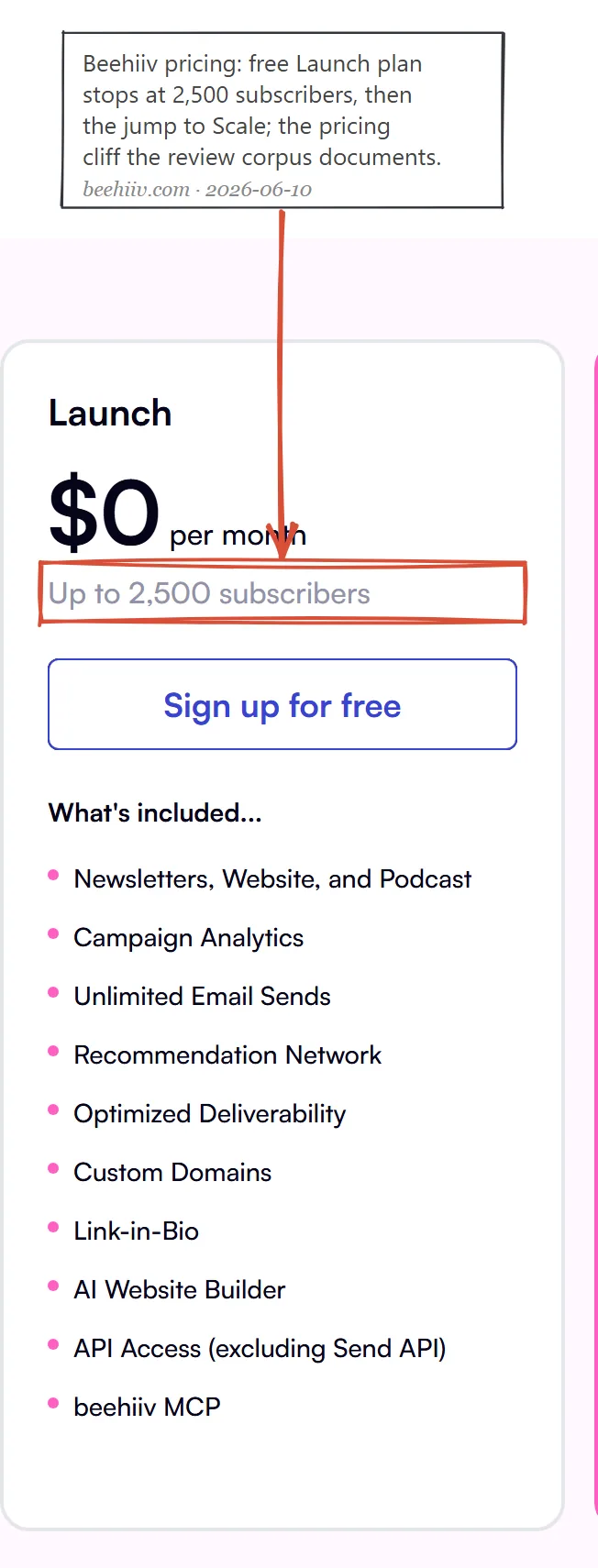
The jump from free to Scale is the pricing cliff its own corpus documents (~42 pricing mentions). If you cross 2,500 subscribers without monetizing, you pay real money for capacity you got free yesterday. About 28 Trustpilot reviews document accounts suspended without explanation, in cases with ad revenue withheld. The terms do not spell out post-ban list portability. Support is praised on paid plans and gated away from free ones. And one operational trap: the Scale plan caps you at 3 publications, the same ceiling as the free plan.
Full first-hand walkthrough: our Beehiiv review. Direct comparison: Substack vs Beehiiv. Already on beehiiv and looking to leave? Beehiiv alternatives. Ready to move? step-by-step Substack to Beehiiv migration guide.
Try Beehiiv free (to 2,500 subs) →Ghost: 0% Platform Fee on Membership Revenue
Ghost exists for one departure reason above all: the fee. It takes 0% of membership revenue (Stripe connects directly to your account), runs on flat monthly tiers, and is open source, so the self-hosted exit is always available. The arithmetic is concrete: at 1,100 paid subscribers on a $10/month plan, Substack's 10% cut alone exceeds $1,000 a month — more than most Ghost tiers cost at that list size.
"The platform delivers on what it promises: a clean, fast, distraction-free editor focused purely on writing and publishing."Trustpilot, January 2026
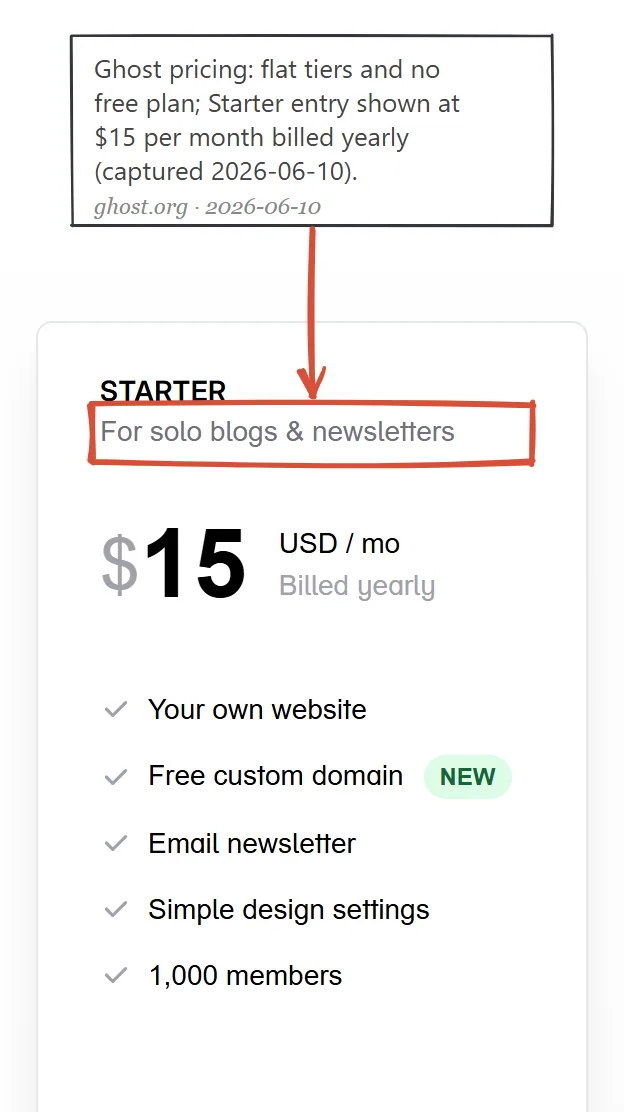
What Ghost costs: 0% fees, monetization on Publisher
Read the gate before you sign up: Starter ($15/mo (Starter, 1K subs) · verified June 7, 2026) publishes a newsletter and a website but cannot monetize at all. Paid subscriptions need Publisher ($29/mo (Publisher, 1K subs) · verified June 7, 2026 at 1,000 members). The 0% fee usually still beats 10% once revenue is real; run your own numbers in the switch calculator below.
Where Ghost falls short
Two honesty notes the fan coverage skips. Managed Ghost(Pro) terms take a perpetual, irrevocable, sublicensable licence on what you publish and cap liability for data and security failures at a flat $100; full ownership is the self-host promise, not the managed one. And self-hosting is free in licence, not in operations: bulk email requires Mailgun, and a migrating blogger sending 600K emails a month calculated a tenfold cost difference against Amazon SES. Growth tooling is the other gap: no referral program, no ad network, no native discovery. Ghost assumes you bring the audience, and do not pick it for a fast, free start either: there is no free plan, and setup is real work.
Direct comparison: Substack vs Ghost.
Visit Ghost (14-day trial) →Kit: For Automation and Selling Things
Kit (formerly ConvertKit) is the route for the automation wall. Its tag-based automations and visual builder are the corpus's #3 theme by volume (129 mentions, positive-dominant) and the feature Substack structurally lacks. Commerce is the second argument: paid newsletters and digital products at a 0.6% platform fee, working from the free tier. The free plan reaches 10,000 subscribers, the biggest ceiling in the panel, with the catch printed on Kit's own pricing label:
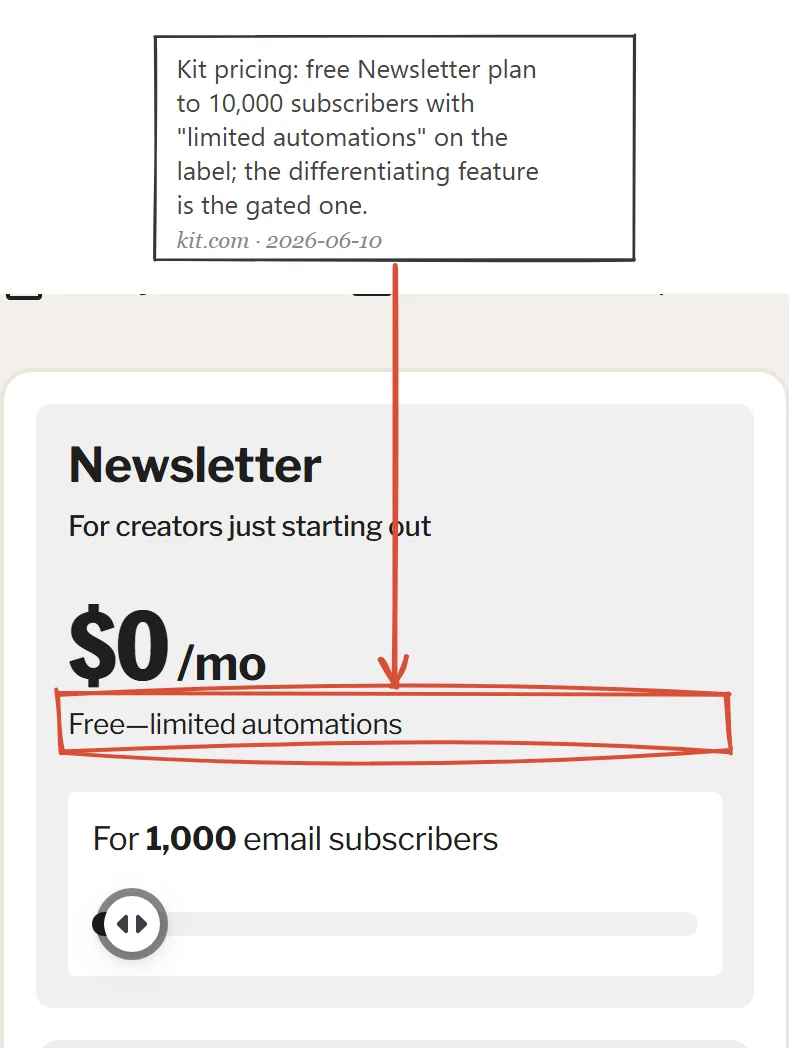
What Kit costs: free to 10,000, automations on Creator
Unlimited automations start on Creator ($33/mo (Creator, 1K subs) · verified June 9, 2026at 1,000 subscribers, annual). Factor the September 2025 repricing into any long-term model: the Creator tier roughly doubled at that repricing, with one month's notice; one grandfathered reviewer reported a 160% jump.
Where Kit falls short: the affiliate-site ban
The risk that matters for this site's audience is sharper: Kit's acceptable-use policy prohibits "CPA affiliate-type sites", and reviewers through 2025-2026 report accounts disabled over affiliate links they describe as legitimate, sometimes before a first email went out. Kit is not for you if affiliate content is any part of your model.
"I send 160k emails and generate thousands of dollars a month - and I only write one email. This is possible due to Kits automations segmentations."Trustpilot, March 2026
The full fee math (10% vs 0.6%, break-even included) lives in Substack vs Kit; weighing Kit against Beehiiv instead? Beehiiv vs Kit.
Visit Kit (free to 10K subs) →Buttondown: the Quiet, Owner-Friendly Exit
Buttondown took in a documented wave of Substack leavers in 2024-2025 who left over moderation, not money, and stayed for the ownership posture. The terms claim no licence over your newsletter content (a notable contrast with Substack's perpetual one), billing counts active subscribers only, and it is the one platform stating that active paid subscriptions can be exported to a competitor without subscribers re-entering card details, the inverse of lock-in.
Buttondown pricing: free to 100, 0% on paid
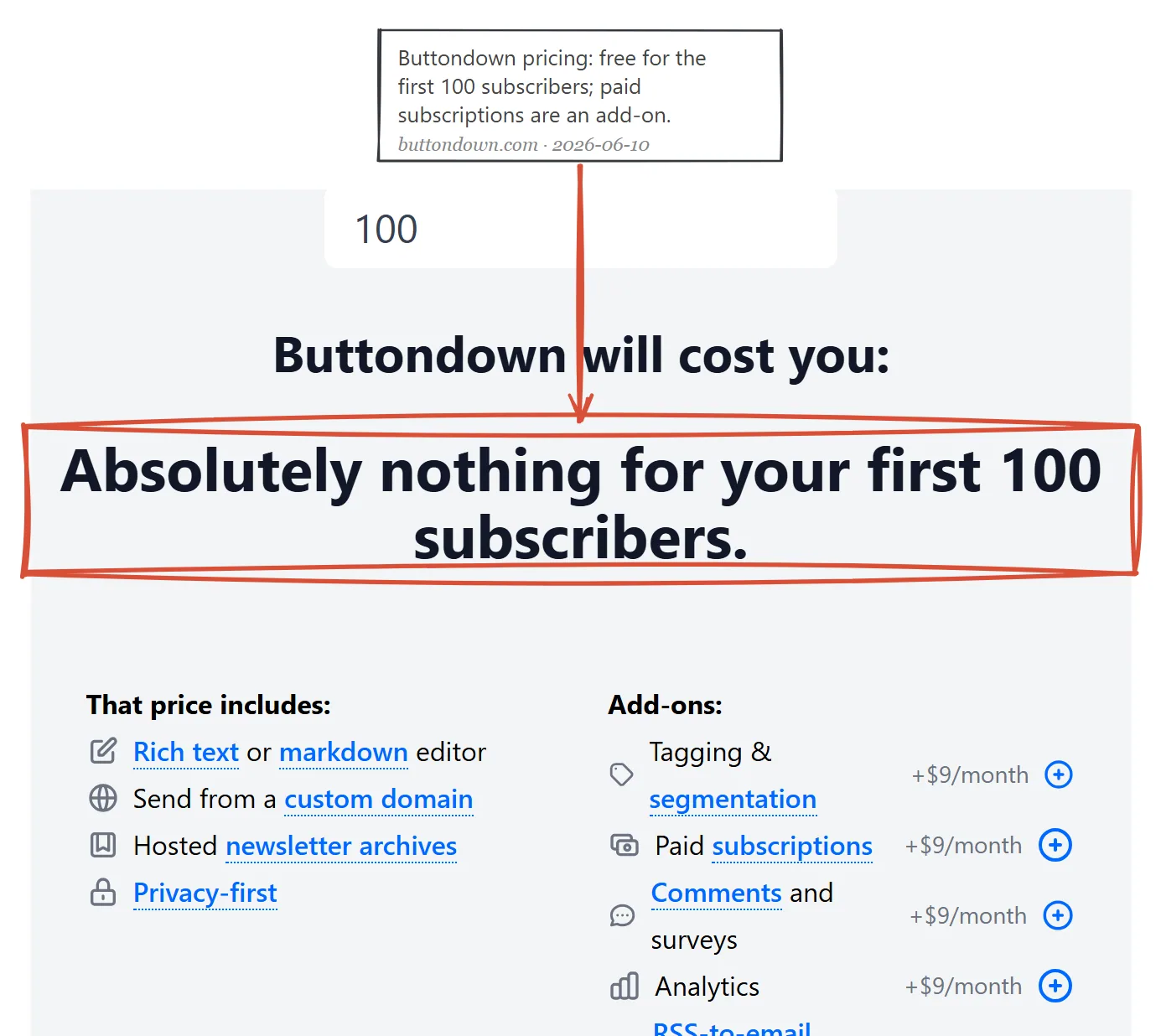
Where Buttondown falls short
The trade-offs are structural, and the vendor concedes most of them. Analytics are privacy-first and thin, a stated dealbreaker for data-driven creators. There is no discovery network, no ad network, no drag-and-drop builder: writing is Markdown-first, and non-technical users stay because the founder-run support (the highest support score in our panel, 0.98) carries them. Weigh two more facts before committing a business to it: the liability floor in the terms is zero, with data loss named, and the company is one person, brilliant support being the flip side of a bus factor of one. Three feature waves also moved behind the paywall between March and April 2026; the free tier is narrowing.
Try Buttondown ($9 off first month) →MailerLite: the Budget and EU Pick
MailerLite wins on a different axis: price. It is the cheapest serious ESP at most list sizes in our weekly-scraped pricing layer ($19/mo (Growing Business, 1K subs) · verified June 9, 2026 at 1,000 subscribers). It is also the only newsletter-first vendor in the panel combining EU-exclusive data hosting with ISO 27001 certification, and its terms explicitly claim no intellectual-property rights over your content. Paid newsletters carry 0% commission from the Growing Business tier. Ease of use is its second-biggest review theme (672 mentions).
MailerLite pricing: cheapest in the panel, EU hosting
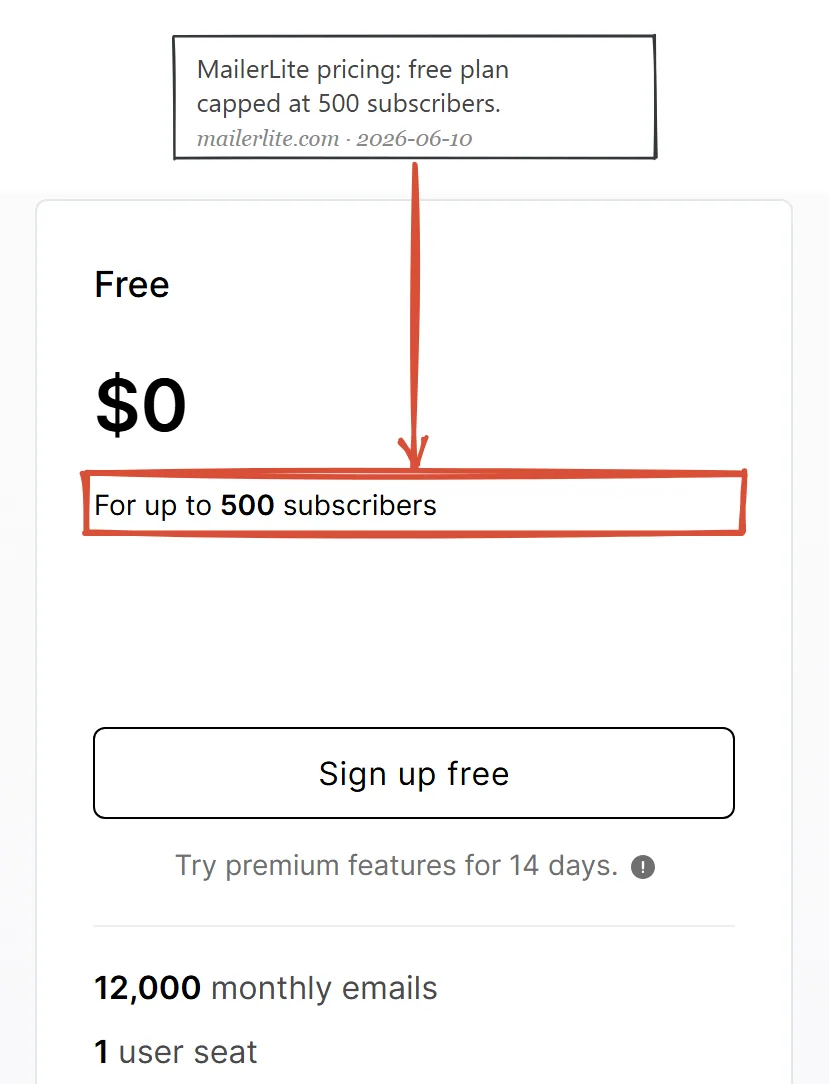
Where MailerLite falls short
The risks concentrate in two places. Suspension is algorithmic and, in 87 corpus mentions, described as irreversible. The live-chat button disappears the moment an account is flagged. One rejection letter read: "this decision is irreversible and further replies to this email will not be reviewed." The second risk is the billing basis: it counts stored active subscribers with automatic prorated upgrades, so clean your list before each cycle. There is no discovery network of any kind: MailerLite sends your emails and hosts your site, and growth is entirely your job. Stripe is the only payment processor, which excludes some non-US/EU markets.
First-hand walkthrough: our MailerLite review · Substack vs MailerLite · already on MailerLite and looking around? MailerLite alternatives.
Visit MailerLite (free to 500 subs) →AWeber: When You Need a Human on the Phone
Remember the #1 reason people leave Substack? AWeber is its exact inverse: phone and live-chat support on every plan, including free, the only vendor in the panel offering it. Support is its biggest review theme (~195 mentions, positive-dominant) and the documented reason users stay nine and ten years. Nobody in our corpus migrated from Substack to AWeber over features; people land here because they want a company that answers.
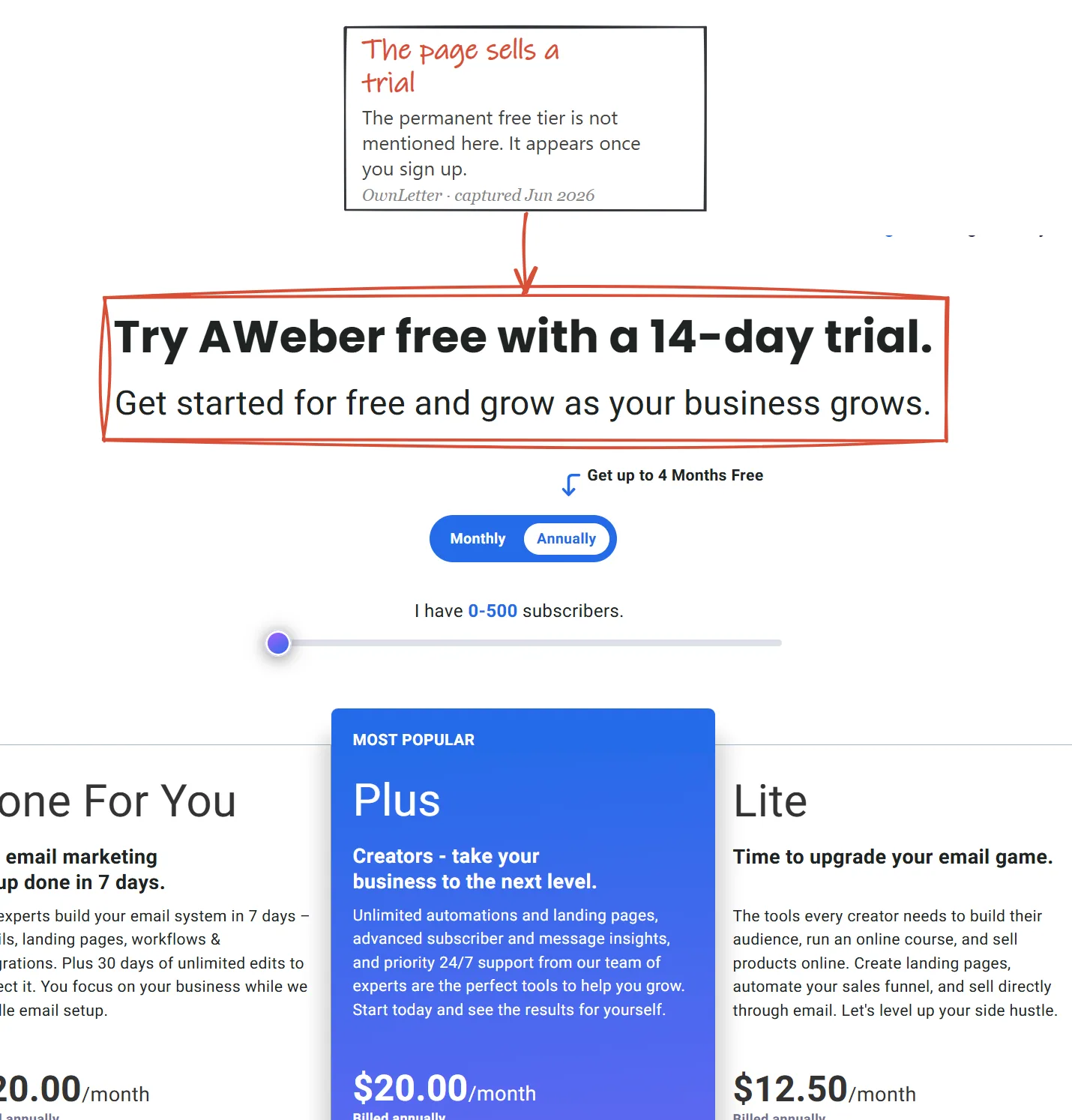
AWeber pricing: a hidden permanent free tier
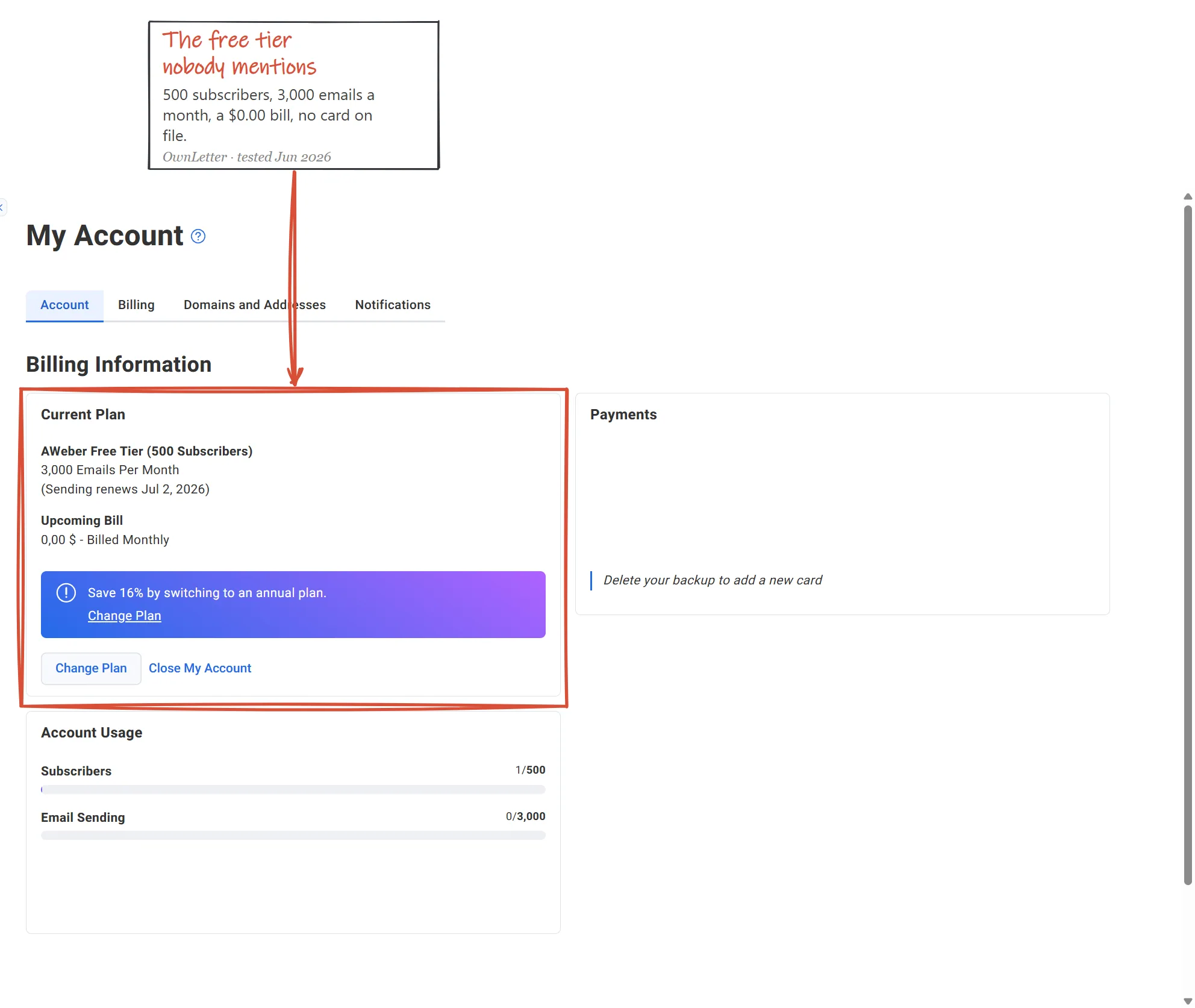
Its free tier is the panel's strangest fact: 500 subscribers, 3,000 emails a month, $0, no card, and invisible on the public pricing page, which sells a 14-day trial. We only found it because it appeared on our own account's billing screen:
Where AWeber falls short
The dealbreaker for Substack leavers specifically: AWeber has no native paid newsletters. Charging readers means wiring Stripe through its e-commerce tools and managing access by tag. That is a workaround, not a product. Three more facts belong in the ledger. The repricing in 2024 (December) ended grandfathered rates; one Reddit user went from $60 to $185 in a month. Unsubscribed contacts count toward your billing tier until you delete them. And the terms allow suspension "at any time, and for any reason, without notice", with one attributed report of a permanent closure within 24 hours at a 0.01% complaint rate. Affiliate senders, who AWeber otherwise tolerates better than Kit, should weigh that asymmetry.
Full first-hand test: our AWeber review.
Try AWeber free (500 subs, hidden tier) →GetResponse: the All-in-One, With Eyes Open
What GetResponse offers: webinars, courses, 0% newsletters
Nobody in our corpus left Substack for GetResponse, and we will not pretend otherwise. It earns its place for a different need: it is the only vendor in this comparison bundling native webinars (up to 100 attendees on the Creator tier) with courses, premium newsletters at 0% fee and email in one product. Its sub-minute live chat is its #1 review theme (279 mentions), and it is the one vendor whose terms contractually prohibit AI training on your content. The company is 27 years old, bootstrapped, and going nowhere.
Where GetResponse falls short
The billing mechanics are the warning label. You are billed on peak subscriber count (a contact added and deleted the same day still counts for the cycle), downgrades require a support ticket, and cancelling an annual plan cuts access immediately, a pattern that shows up in 48 billing complaints including a documented $2,000 dispute. Premium newsletters also sit on the third paid tier (Creator, $69/mo (Creator, 1K subs) · verified June 9, 2026 at 1K), so the 0% fee carries a real monthly floor. A newsletter-only writer has no business here; a knowledge business selling courses by webinar might.
Reading this from inside a GetResponse account? The exit map is GetResponse alternatives.
Visit GetResponse (free to 500 contacts) →ActiveCampaign: Listed Everywhere, an Alternative Nowhere
Visit ActiveCampaign (if CRM is the job) →Who Controls Your Audience? The Part Roundups Skip
None of the three pages ranking above us for this search covers termination clauses, post-ban export or content licences. Yet opaque suspension is a category-wide risk our corpora document at every hosted platform: 20 mentions for Substack, 15 for Beehiiv, 35 for Kit, 87 for MailerLite, 46 for AWeber, 30 for GetResponse. Leaving Substack does not retire the risk; it changes whose discretion you live under.
The matrix below comes from reading every platform's terms, clause by clause: who can lock you out, who keeps a licence on your words, who caps their liability at $5 (Kit), $100 (Ghost-managed) or zero (Buttondown). Only self-hosted Ghost and Buttondown rate favourable on account control. Whatever you pick, the five-minute defense is the same: export your subscriber CSV monthly.
| Platform | Account control | Content license | AI training rights | Account transfer | Legal recourse | Liability cap | Cost at scale | Vendor longevity | Reliability & incidents | Billing model | Allowed niches |
|---|---|---|---|---|---|---|---|---|---|---|---|
| Substack | |||||||||||
| beehiiv | |||||||||||
| Ghost | |||||||||||
| Kit | |||||||||||
| Buttondown | |||||||||||
| MailerLite | |||||||||||
| AWeber | |||||||||||
| GetResponse | |||||||||||
| ActiveCampaign |
✓ favorable to the creator · ◐ mixed · ✗ unfavorable. Hover or tap a cell for the detail. Compiled June 2026 from public terms, status pages and the pricing data layer. Re-verified quarterly.
Clause-by-clause verbatims, ban case studies and the portability test live on the dedicated page: who controls your audience.
The Switch Math: 10% vs a Flat Fee
The crossover logic is simple even when the numbers move. Substack costs nothing until you earn, then takes 10% of everything (about 13% effective with Stripe). A flat-fee platform costs money from day one and takes nothing after. Below roughly $300-400 a month in paid revenue, Substack's model usually wins. Past it, the flat fee wins by a widening margin. At $5,000 a month, the 10% alone is $500 every month. Where the lines cross for you depends on your list size, your price and your platform.
So we built the calculator instead of hand-waving: pick your current numbers, pick a destination, and get the year-one math from our weekly-scraped pricing data, including the honest case where staying put is cheaper.
Migration Risks: What Survives the Move
Your email list survives. The CSV export carries every subscriber to any destination on this page. Posts export too. That is the easy half.
Paid subscriptions are the cliff. On most destinations, paying subscribers must cancel and re-subscribe with their card, and practitioner estimates put the drop around 5-15% in the process. Beehiiv's Substack importer is the exception that carries Stripe subscriptions across. Apple in-app subscriptions transfer nowhere: if readers subscribed through the iOS app, those subscriptions end with your departure, silently.
The network stays behind. Notes followers and recommendation placements are not export-able assets, and Substack's terms keep a perpetual licence on what you published there. One often-missed step before you go: email Substack support to remove the 10% cut on any paid subscribers who remain during your transition window, or you pay two platforms on the overlap.
Moving with a paid list? Start with Substack vs Beehiiv (the Stripe-portable path) and pressure-test the cost side in the switch calculator.
Two minutes to your shortlist
The quiz scores all eleven platforms on what you actually need (growth, fees, automations, ownership) and names your best fit. It is blind to commission; the engine cannot see who pays us.
Take the platform quiz →Feature Matrix: All Nine, Side by Side
The full 53-feature data layer behind this page, source-verified against vendor documentation. Swap any platform into the comparison; counting checkmarks is not the goal (ActiveCampaign out-checks Substack and remains the wrong tool for a newsletter), but seeing where your dealbreaker sits is.
Compare 4 / 5 platforms
Pick a plan from the ▾ menu under a platform to see what that plan unlocks and its price at your subs count.
| Feature | Substack | Beehiiv | Ghost | Kit (ex-ConvertKit) |
|---|---|---|---|---|
| Monthly priceat 2.5K subs · monthly | 10% of revenue | $0/mo · Free ≤2.5K subs | $55/mo · Publisher · 2.5K subs | $0/mo · Free ≤10K subs |
| 5/6 | 6/6 | 5/6 | 6/6 | |
| 2/5 | 4/5 | 4/5 | 4/5 | |
| 6/9 | 9/9 | 8/9 | 9/9 | |
| 7/9 | 9/9 | 7/9 | 9/9 | |
| 2/4 | 2/4 | 1/4 | 2/4 | |
| 3/5 | 4/5 | 2/5 | 5/5 | |
| 8/10 | 10/10 | 5/10 | 7/10 | |
| 5/5 | 5/5 | 5/5 | 4/5 | |
| Get started | Try free → | Try free → | Visit → | Try free → |
✓ Yes · Partial · — No · dotted = unverified · a plan tag (e.g. Scale) = the cheapest plan that unlocks it; pick a plan above each column and ↑ marks features above it. Verified against vendor sources, September 2026. Some links are paid — OwnLetter may earn a commission at no extra cost to you. It never affects the data.
What Users Say, Theme by Theme
Average ratings first (read them knowing review populations differ: Substack's Trustpilot skews toward readers with billing complaints, not creators rating the product), then the themes users actually raise, side by side. Every verbatim is an exact quote.
Straight from the reviews
What real users say
Each site’s average below comes from its own user reviews across Reddit, Trustpilot, Capterra and G2 — the count per site is on each bar. We never invent a quote.
Average score on each review site
SubstackbeehiivGhostKitMailerLitePraised · Complaint · Split opinion
Average scores pulled from each site on May 31, 2026. Trustpilot scores are a recent sample, not the lifetime average; Reddit has no star ratings. Substack isn't listed on Capterra, and on Substack Trustpilot skews toward readers and Reddit toward creators. See our methodology.
Where the review themes agree and split
Compare 4 / 5 platforms
| What users say about… | Substack480 reviews read | beehiiv669 reviews read | Ghost415 reviews read | Kit885 reviews read |
|---|---|---|---|---|
| ▼ | ▼ | ▲ | ▲ | |
| ▼ | ▼ | ▼ | ▼ | |
| ▼ | ▼ | ◆ | ▼ | |
| ◆ | ◆ | ▲ | ▲ | |
| ◆ | ◆ | ▼ | ▲ | |
| ◆ | ▲ | ▼ | ▲ | |
| See for yourself | Try free → | Try free → | Visit → | Try free → |
▲ Praised · ▼ Complaint · ◆ Mixed · top theme / common / minor = how often readers bring it up · ❝ hover any cell for the exact count and a real, sourced quote · · = too few reviews to score. Read in full from Reddit, Trustpilot, G2 and Capterra, June 2026. We never invent a quote. Some links are paid — OwnLetter may earn a commission at no extra cost to you. It never affects the data.
Review sources:RedditTrustpilotG2Capterra
Frequently asked
Substack alternatives, the questions that matter
What is the best Substack alternative in 2026?
It depends on why you are leaving, which is exactly how this guide routes you. Beehiiv is the only platform matching Substack feature-for-feature as a newsletter product (free to 2,500 subscribers, 0% cut on its paid Scale plan, recommendation network included). Ghost is the pick when the 10% fee is the wound: 0% platform fee on flat tiers, full ownership if you self-host, but no free plan. Kit wins when you need behavioral automations or sell digital products (0.6% fee from its free tier). Budget and EU hosting point to MailerLite; phone support points to AWeber; minimalist, developer-friendly publishing points to Buttondown. All routing on this page follows our review corpus and data layers, not commissions: three of nine links pay us, six do not. We ranked the eight alternatives against the documented reasons creators actually leave Substack, read from a 480-review corpus, so the answer is matched to your specific friction rather than a generic best-of list.
Can I move my paid subscribers off Substack?
Partially, and this is the step to plan hardest. Your subscriber list and posts export by CSV. Paid subscriptions are the friction point: on most destinations (Kit, Ghost, MailerLite), subscribers must re-enter payment details, which produces a re-subscription drop practitioner estimates put around 5-15%. Beehiiv's Substack importer carries Stripe subscriptions across, which is why it hosts so many ex-Substack paid newsletters and is the lowest-friction destination for a paid list. Apple in-app subscriptions are non-portable everywhere: those end when you leave, so check whether any of your paying readers subscribed through the Substack iOS app before you move. One often-missed step is emailing Substack support to remove the 10% cut on subscribers who stay behind during your transition window, so you are not paying the platform share twice while you run both newsletters in parallel.
Is Substack actually free?
Free to publish, never free to earn. Substack charges no monthly fee at any list size and takes 10% of paid-subscription revenue, plus Stripe's processing fees (about 2.9% + 30¢), an effective cut near 13%, and more through Apple in-app purchases. On our own account we verified the fee appears nowhere inside the product: no plan screen, no invoice, no payout preview at setup. The arithmetic only bites once you monetize: at $1,000 a month in paid revenue, the platform share is about $100 a month, more than most flat-fee alternatives charge at that list size. At $5,000 a month it is roughly $500, where a flat plan on Beehiiv or Ghost would cost a fraction of that. The free price is real; it just stops being the cheapest option the moment your newsletter starts earning.
Which Substack alternatives have a real free plan?
Six of the eight, with very different ceilings, verified June 2026. Kit's free Newsletter plan reaches 10,000 subscribers, but its own free-tier label flags it as limited on automations: the feature people come for is the gated one. Beehiiv's Launch plan runs to 2,500 subscribers with unlimited sends. MailerLite covers 500 subscribers (cut from 1,000 in September 2025; older roundups still print the old number). AWeber's 500-subscriber, 3,000-email free tier exists but is invisible on its public pricing page; we confirmed it on our own billing screen. Buttondown is free to 100 subscribers. GetResponse keeps a quiet 500-contact, 2,500-email free plan; the premium features it bundles expire after 14 days, the plan itself does not. Ghost and ActiveCampaign have no permanent free tier. The honest comparison is not whether a free plan exists but where it caps and what it locks, which is why we list both the ceiling and the catch for each.
Will I lose my followers if I leave Substack?
You keep email subscribers; you lose the network. The CSV export carries every email address, and that list is the asset that matters. What does not transfer: Notes followers, recommendation placements, and the discovery traffic Substack's network generates, the one capability no alternative replicates at scale (our depth layer scores Substack 1.0 there, against beehiiv at 0.85 with paid Boosts and Kit at 0.8). If a meaningful share of your growth and paid conversions comes from inside the network, treat that as a real switching cost and consider keeping Substack as a discovery channel while sending from elsewhere, a dual-stack pattern our corpus documents. In practice that means publishing a short free post on Substack to catch Notes and recommendations, then pointing those readers to your primary newsletter on the platform you actually own, so you keep the discovery without paying the 10% cut on the subscribers you convert.
Is deliverability better on any of these platforms?
Nobody can honestly tell you, including us. No platform in this comparison publishes an audited inbox-placement rate, and we publish none either: seed-list tests violate vendor terms, and one account's numbers do not generalize. Our review corpora show bimodal outcomes on the same platforms: one GetResponse migrant reports open rates up 48% after leaving AWeber, another reports a crash below 3% after leaving Mailchimp. Treat any site quoting a universal deliverability percentage as a red flag. What you can control matters more than the platform: authenticate your own sending domain with SPF, DKIM, and DMARC, keep your list clean by removing dead subscribers, and watch your first month's open and bounce rates closely wherever you land. We are building an opt-in inbox-placement panel and will publish per-vendor results only once the sample is large enough to be honest.
How We Built This Page
OwnLetter works as a lab-style analyst, not a power-user reviewer. This page crosses seven proprietary data layers. Pricing is scraped weekly for 17 vendors. The 53-feature matrix is source-verified against vendor docs. The 8,376 reviews behind these nine platforms were re-themed and read in full. The trust layer comes from reading every platform's terms of service; the suspension counts and licence clauses above come from it. Add feature-depth scoring, plus first-hand testing on our own Substack, Beehiiv, AWeber and MailerLite accounts. All 11 screenshots are dated June 2026 and captured by us.
What we did not do: no seed-list deliverability tests (they violate vendor terms; we quote nobody's inbox-placement numbers, including our own), no combined star rating across platforms (populations differ too much to average), and no pricing from memory: every plan figure on this page renders from the tracker, with its verification date. Full methodology →
Affiliate status, restated where it matters: Beehiiv, AWeber and Buttondown pay us a commission; Substack, Ghost, Kit, MailerLite, GetResponse and ActiveCampaign pay us nothing. The reasons-to-leave ranking comes from review volumes we cannot edit, and our trust matrix puts two non-paying platforms (Ghost, Buttondown) at the top of the ownership column.
Sources
- · Substack going-paid page (fee model, captured June 10, 2026)
- · Substack Terms of Service (licence + termination clauses, verified June 2026)
- · Beehiiv pricing page (captured June 10, 2026)
- · Ghost pricing page (captured June 10, 2026)
- · Ghost(Pro) Terms of Service (content licence + liability cap, verified June 2026)
- · Kit pricing page (captured June 10, 2026)
- · Kit Terms of Service (AUP affiliate clause + liability, verified June 2026)
- · Buttondown pricing page (captured June 10, 2026)
- · MailerLite pricing page (captured June 10, 2026)
- · MailerLite Terms of Service (no-IP clause, verified June 2026)
- · AWeber Service Agreement (termination clause, verified June 2026)
- · ActiveCampaign Terms of Service (§6.6 data clause, verified June 2026)
- · GetResponse Terms (US) (billing basis + AI clause, verified June 2026)
- · Have I Been Pwned (Substack October 2025 breach entry)
- · OwnLetter review corpus: 8,376 reviews behind these nine platforms, re-themed across G2, Capterra, Trustpilot and Reddit (June 2026); per-claim source URLs in our public claims manifest.
Our verdict
How we routed them
Match the platform to your reason, not to a ranking
We ranked nothing in the abstract, because nobody switches in the abstract. We took the documented reasons people leave Substack, in their real order (support first, billing second, fees threaded through everything), and routed each to the platform whose data holds up.
Beehiiv is the only like-for-like replacement and the first stop for most leavers. Ghost is the fee answer for paid-first writers who accept setup work. Kit is the automation-and-commerce route, unless you run affiliate content. Buttondown, MailerLite and AWeber win narrower, real profiles: ownership minimalists, budget/EU senders, and people who want a phone answered. Two of the nine (GetResponse for newsletter-only writers, ActiveCampaign for almost everyone reading this) we steer you away from, in writing.
Three of nine links pay us; six do not, including both platforms our trust matrix puts on top. That is the test we accept: the routing tracks your reason for leaving, never our commission.
- Built from 8,376 reviews read in full, weekly-scraped pricing and every platform's terms of service
- First-hand June 2026 captures inside our own Substack, Beehiiv and AWeber accounts
- Affiliates pay us on 3 of 9 platforms; the routing and trust matrix favor two that pay nothing
Choosing by who you are instead of why you are leaving? See best platforms for writers and best platforms for beginners; or read the full Substack review before deciding to leave at all.