On this page (16 sections)
Substack vs Beehiiv 2026: a 10% Cut or a Flat Fee?

By Arthur Brulard, Founder of OwnLetter. Cross-vendor analyst review across 11 newsletter platforms, aggregating user signals from Reddit, G2, Capterra, Trustpilot, and Hacker News. LinkedIn
Published June 11, 2026 · Updated June 11, 2026 · 22 min read
OwnLetter is supported by readers like you. When you sign up through our links, we may earn a commission that helps keep our reviews independent and free. How we make money · How we test.
Quick verdict
Beehiiv wins on business mechanics: a flat fee instead of a 10 percent revenue cut, a 0 percent take rate on paid subscriptions, and ad-network plus sponsorship tooling Substack does not offer. Its Stripe import also moves paid subscribers, and their billing, off Substack without asking anyone to re-subscribe. Substack wins on starting from zero: unlimited free subscribers, no monthly bill before you earn, and a discovery network that, by Substack's own count, drives more than half of new subscriptions. The crossover sits near $430per month in paid revenue at 1,000 subscribers (full math below). Under it, Substack's free model costs less. Above it, the 10 percent cut becomes the largest line in your newsletter budget, and Beehiiv's flat fee keeps more of every dollar. Both carry documented account-suspension risk, so export your list monthly either way.
Both are free to start. The Beehiiv link is an affiliate link (14-day trial + 20% off for 3 months on Scale, vendor-side); the Substack link earns us nothing.
Not sure which fits you?
Substack or Beehiiv — answer a few questions
Which fits you?
Loading the quiz…
How we testedVerified June 2026 · 1149 reviews aggregated · Substack + Beehiiv tested · 32 sourced claims · pricing from weekly scraper · methodology public
What we did: Read 1,149 user signals in full (480 Substack + 669 Beehiiv: Reddit, Trustpilot, G2, Capterra, aggregated June 2026). Pricing comes from our weekly automated scraper, last run June 7, 2026, cross-checked against both vendors' pages on June 11. Captured and annotated both platforms' public pricing, migration, and network pages in June 2026.
What we did NOT do: We did not run seed-list deliverability tests (they violate both platforms' terms of service), and we quote no deliverability percentages: no audited number exists for either platform.
Refresh cadence: Pricing re-scraped weekly (automated). Claims manifest with a source URL per numeric claim archived publicly. Quarterly trust-layer review. (pricing verified June 7, 2026). Full methodology →
 SubstackSubstack
 beehiivBeehiiv
The Fee Gap: 10% of Revenue vs a Flat Fee
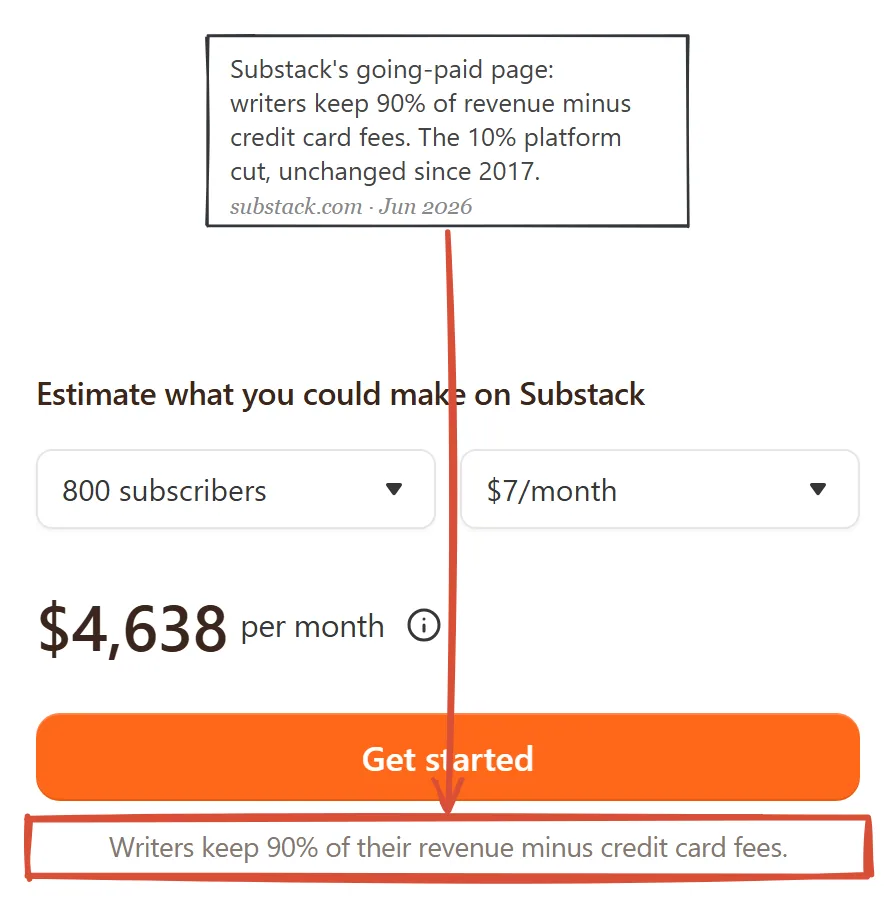
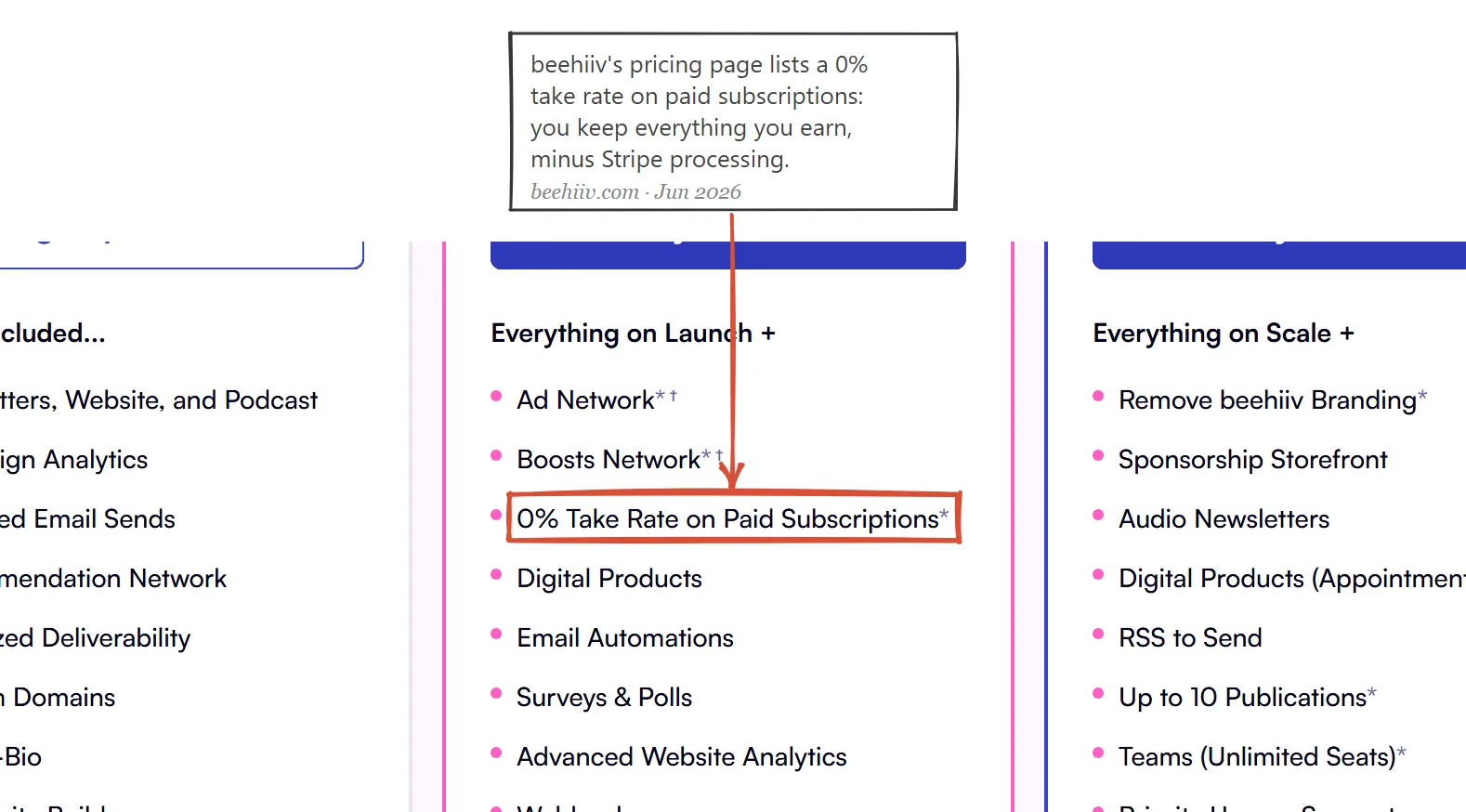
Every other difference between these two platforms flows from one structural choice. Substack charges no monthly fee and takes 10 percent of each paid subscription transaction, per its own fee documentation. Stripe adds 2.9 percent + $0.30 plus a 0.7 percent recurring billing fee (C-001, C-003). Beehiiv charges a flat tier price and takes 0 percent of paid subscription revenue; its pricing FAQ says you keep everything you earn minus Stripe's standard processing (C-004). One model taxes your success. The other bills you whether or not you succeed.
Substack's defenders state their side well. A Reddit user put it this way in March 2026:
"Substack is the ultimate 'zero-risk' drug. No monthly fees, a clean interface, and a built-in discovery network. It feels free because you aren't getting a bill in your inbox every month." Reddit user (r/Substack source), March 2026 (C-023)
The word "drug" is doing real work there. No bill arrives, yet the cost compounds: creators doing the full math on Reddit describe losing closer to 13 to 15 percent of every dollar once Stripe and Apple fees stack on the 10 percent. On $1,000 per month in paid revenue, Substack's cut alone is $100 monthly. Beehiiv's Scale plan at 1,000 subscribers costs $43/mo on annual billing and takes nothing on top (platform fees only; Stripe applies on both and washes out). The crossover lands near $430 per month in paid revenue. Past it, the gap grows with every new paid subscriber.
One asymmetry cuts the other way and rarely gets quoted: Beehiiv's free Launch tier does not support paid subscriptions at all (C-007). Monetizing on Beehiiv means paying for Scale from day one. A pre-revenue writer comparing "free vs free" is really comparing Substack's full monetization stack at $0 upfront against a Beehiiv tier that cannot charge readers yet.
Feature Comparison: Monetization, Growth, Automation, Publishing
The feature split is unusually clean for a head-to-head. Beehiiv carries 48 of 53 tracked features against Substack's 26, with the gaps concentrated in monetization breadth, automation, and analytics. Substack's wins cluster around discovery, multi-format publishing (podcast, video, live), and an unlimited free tier. The matrix below is data-driven from the OwnLetter feature SSoT, source-verified against vendor primary documentation.
Pick a plan from the ▾ menu under a platform to see what that plan unlocks and its price at your subs count.
| Feature | Substack | Beehiiv |
|---|---|---|
| Monthly priceat 2.5K subs · monthly | 10% of revenue | $0/mo · Free ≤2.5K subs |
| 5/6 | 6/6 | |
| 2/5 | 4/5 | |
| 6/9 | 9/9 | |
| 7/9 | 9/9 | |
| 2/4 | 2/4 | |
| 3/5 | 4/5 | |
| 8/10 | 10/10 | |
| 5/5 | 5/5 | |
| Get started | Try free → | Try free → |
✓ Yes · Partial · — No · dotted = unverified · a plan tag (e.g. Scale) = the cheapest plan that unlocks it; pick a plan above each column and ↑ marks features above it. Verified against vendor sources, September 2026. Some links are paid — OwnLetter may earn a commission at no extra cost to you. It never affects the data.
Straight from the reviews
What real users say
Each site’s average below comes from its own user reviews across Reddit, Trustpilot, Capterra and G2 — the count per site is on each bar. We never invent a quote.
Average score on each review site
SubstackbeehiivPraised · Complaint · Split opinion
Average scores pulled from each site on May 31, 2026. Trustpilot scores are a recent sample, not the lifetime average; Reddit has no star ratings. Substack isn't listed on Capterra, and on Substack Trustpilot skews toward readers and Reddit toward creators. See our methodology.
Theme by theme: where they agree and differ
| What users say about… | Substack480 reviews read | beehiiv669 reviews read |
|---|---|---|
| beehiiv leads | ||
| beehiiv leads | ||
| beehiiv leads | ||
| Even | ||
| Even | ||
| beehiiv leads | ||
| See for yourself | Try free → | Try free → |
▲ Praised · ▼ Complaint · ◆ Mixed · top theme / common / minor = how often readers bring it up · ❝ hover any cell for the exact count and a real, sourced quote · · = too few reviews to score. Read in full from Reddit, Trustpilot, G2 and Capterra, June 2026. We never invent a quote. Some links are paid — OwnLetter may earn a commission at no extra cost to you. It never affects the data.
Review sources:RedditTrustpilotG2Capterra
Deep Dive: Substack
Across 480 Substack signals read in full (Reddit, Trustpilot, G2), three findings organize everything else. The discovery network genuinely works and is the platform's moat. The free model converts readers to paying subscribers unusually well. And the operational tooling around both is thin to the point of fragility.
The Discovery Network Is Real, With a Catch
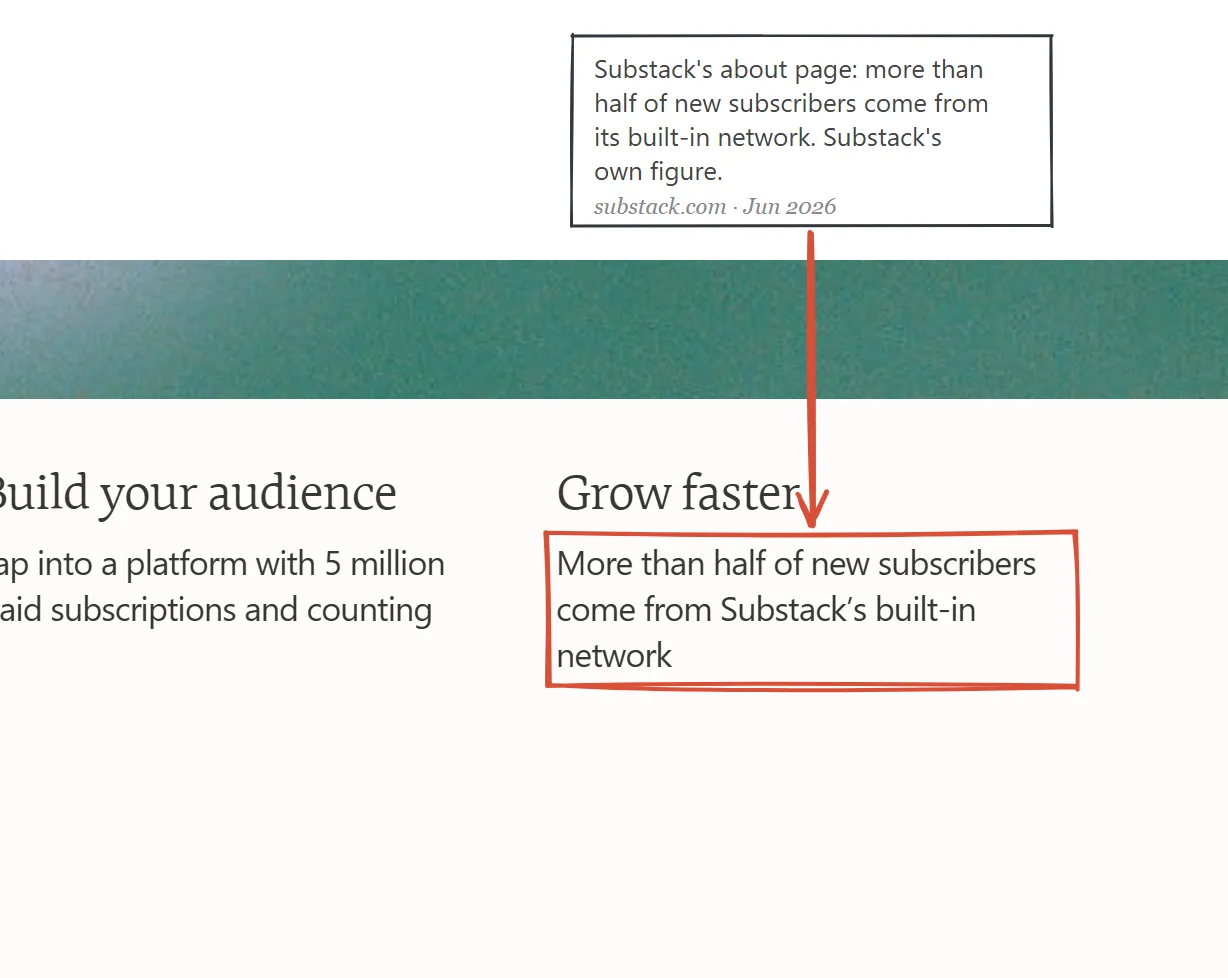
Substack's about page claims more than half of new subscribers come from its built-in network of recommendations, Notes, and app discovery. It told press in March 2025 that the network drives over 50 percent of subscriptions and 30 percent of paid ones (C-016, self-reported figures). The review corpus backs the direction: 35 signals discuss network growth, and one Reddit creator (May 2026) called it one of the best platforms for discovery when you have no audience. No competitor in this category has an equivalent. Beehiiv's recommendation network exists and reviewers like it, but its paid growth lane, Boosts, buys subscribers rather than surfacing your writing to readers.
The catch comes from inside the same corpus:
"The hard truth is most of your early readers will be other writers, not general readers, and breaking out of that circle is genuinely difficult."Reddit user (r/Substack source), June 2026 (C-027)
Other 2025-2026 threads describe the pool crowding as more writers compete for the same recommendation slots. The network is a genuine moat. It is also a saturating one, and what it gives you stays on Substack: Notes followers and recommendation placements do not export (see the migration section).
Readers Pay More Willingly Here
A counter-intuitive advantage surfaces from creators who have run lists on several platforms: Substack readers convert to paid at higher rates. One multi-platform Reddit voice (March 2026) observed that people on Substack are a lot more inclined to pay, and to actually read your content word by word. The subscription-first culture, the app, and the network compound here. Sacra estimated Substack at $45M annualized revenue in July 2025, taking 10 percent of roughly $450M in creator earnings across 5 million paid subscriptions (C-022, third-party estimate). The money flowing through the platform is real; the question this page answers is what share of yours it should keep.
The Tooling Gap: Beta Drips, Thin Analytics, No Real API
Substack shipped automation in October 2025, in the form of drip campaigns in restricted beta: no stats, no paywalled posts, no behavioral triggers (C-015). Practitioner coverage is blunt about the rest: every email goes to your whole list or its paid/free halves, with no way to target by behavior. Analytics drew 9 negative signals, with open rates blinded by Apple's privacy changes; one creator described flying blind on what content works (Reddit, February 2026). The developer story is thinner still: a read-only public API, no native webhooks, and a developer portal reviewers note has been a stub for years. Substack is a publishing house with a network attached, not an email operations platform. For many writers, that is the appeal. For anyone running a business on segments and sequences, it is a wall.
Our take
Where Substack Falls Short
- The 10 percent cut compounds with your successSubstack charges nothing until you earn, then takes 10 percent of every paid dollar forever, plus Stripe's 2.9 percent + $0.30 and a 0.7 percent recurring billing fee listed on its own fee page. Reddit creators doing the math describe losing closer to 13 to 15 percent of every dollar once all fees stack. At $1,000 per month in paid revenue that is $100 monthly; at $15,000 it reaches $1,500 per month. The cost grows with revenue, not with list size, which is precisely backwards from how every flat-fee competitor prices.
- No human support, anywhere, at any sizeAcross 58 Substack community posts and reviews, support is the single most-cited complaint: an AI-only chatbot with no ticket system and no escalation path. One Trustpilot reviewer (May 2026) wrote that there is literally zero human support and the AI Help only summarizes your problem for your records. Creators with broken billing, lost drafts, or suspended accounts report having no recourse beyond the chatbot loop. Several name it as their direct reason for leaving despite liking the product.
- Automation is a restricted beta, segmentation barely existsSubstack shipped drip campaigns in October 2025, but as a restricted beta: no stats, no paywalled posts in sequences, no behavioral triggers or branching (practitioner documentation, verified June 2026). Tags organize content pages rather than targeting subscribers, and segmentation amounts to a paid/free split plus sections. A Trustpilot reviewer (March 2026) summarized it: segmentation is basic, automation is almost non-existent, and for anything beyond a simple paid/free split you'll quickly hit a wall.
- Notes followers and network reach do not exportYour email list leaves cleanly as CSV. Everything the network gave you does not: Notes followers, recommendation placements, leaderboard visibility, and app discovery all stay behind. Since Substack itself attributes more than half of new subscribers to that network, the real exit cost is losing your top acquisition channel, not moving the list. Analytics make the decision harder: reviewers describe surface-level stats and open rates blinded by Apple's privacy changes, so many creators cannot even measure what the network is worth before leaving.
Deep Dive: Beehiiv
Across 669 Beehiiv signals (Reddit, Trustpilot, G2, Capterra), the platform reads as the operational inverse of Substack. The ex-Morning Brew team built it around one assumption: a newsletter is a media business. Monetization options, analytics, and growth tooling are the strengths reviewers name. Reliability wobbles and plan-gating surprises are the recurring costs.
Monetization Beyond Subscriptions
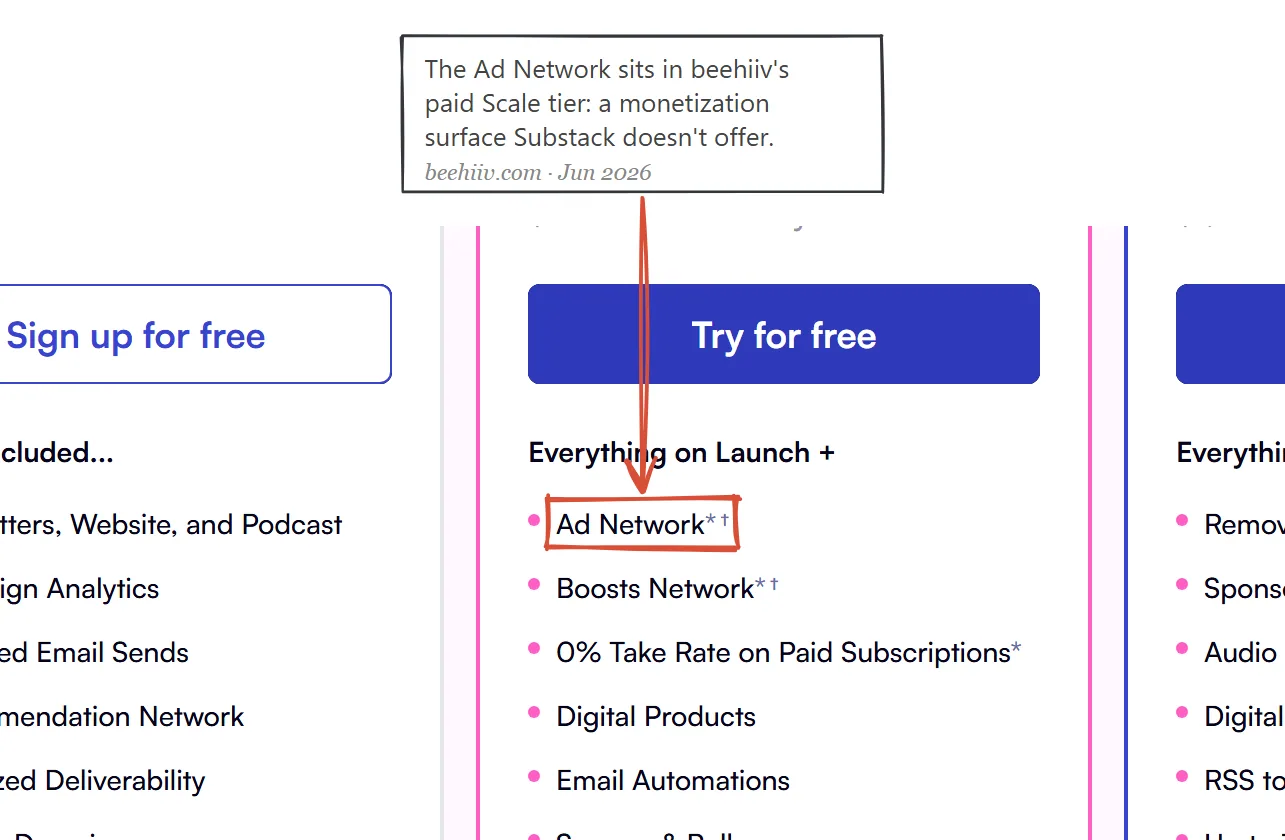
Beehiiv stacks four revenue surfaces Substack does not offer: an ad network with automated sponsor matching (Scale and above, for accounts actively sending, C-011), direct sponsorships, paid recommendations through Boosts, and digital products sold at 0 percent commission since the Winter release (C-021). Add the 0 percent take rate on paid subscriptions and the structural pitch is clear: Beehiiv makes money on the tier fee, not on your revenue. The entry-level reality from the corpus:
"I just made $27 straight to my PayPal from a newsletter sponsor from beehiiv. I only average 5 or 6 clicks per email. You do not need huge numbers to start generating cash."Reddit user (r/beehiiv source), February 2026 (C-024)
At the other end of the corpus, a creator with an 80,000-subscriber list reported $3,000 to $4,000 monthly from sponsored placements. Between those poles sits the honest middle documented in the limitations section below: CPMs softened through 2025 and Boost-bought subscribers engage less. The tooling is real; the yield varies.
Analytics Worth Migrating For
Analytics is Beehiiv's most defensible product edge, and the evidence is unusually strong: creators describe leaving Kit specifically for Beehiiv's dashboards. One Trustpilot reviewer (February 2026) switched from Kit a few years ago for the better analytics dashboard and never regretted it; another (March 2026) called the stats actually actionable rather than just decorative, citing click heat maps and growth tracking. Against Substack's surface-level stats, this is the largest quality gap our feature-depth layer records between the two outside monetization. One limit reviewers flag: revenue data does not connect natively to Stripe, so income reconciliation stays manual.
Growth Tooling You Control, Including Its Costs
Where Substack grows you through an algorithm it controls, Beehiiv hands you the levers: a recommendation network, a referral program (Scale and above, a gating the pricing page confirms but most coverage misses, C-013), magic links, and Boosts. Across 28 beehiiv community posts and reviews on growth tooling, reviewers vouch for the organic side; one called referrals the best part for the subscribers you get without much work (Reddit, March 2026). A March 2026 Reddit thread drew the contrast directly: Substack imposes its own algorithm for visibility, while Beehiiv leaves the growth mechanics in your hands. The trade is effort for control, and the paid lane has the engagement cost documented below.
Our take
Where Beehiiv Falls Short
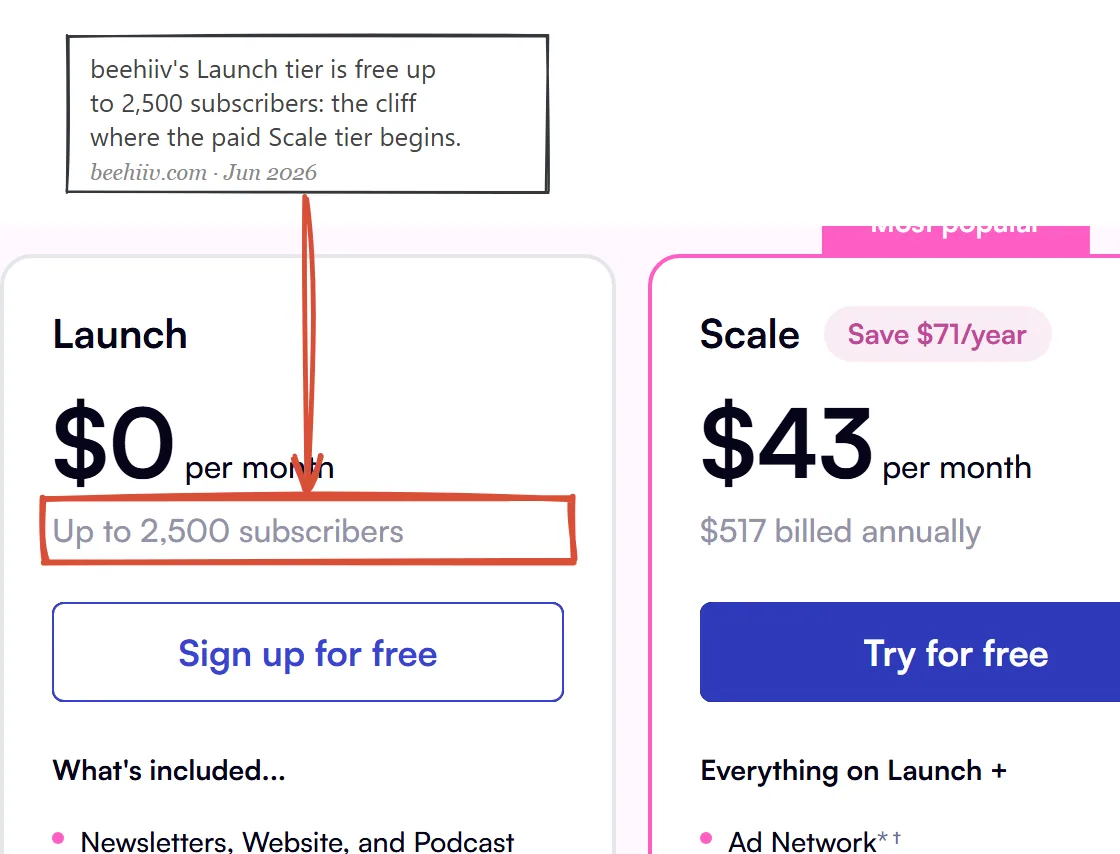
- The free tier cannot monetize, and the paid cliff is realLaunch (free) stops at 2,500 subscribers and supports no paid subscriptions, no ad network, no referral program, and no automations. Monetizing anything on Beehiiv means paying for Scale from day one, at $43/mo on annual billing for a 1,000-subscriber list. Roughly 30 review signals describe the jump as a barrier: one Reddit creator (April 2026) sticks to the free tier because the gap between free and the first paid tier is just way too high. Reviewers also report discovering paywalled features only after building on them, calling the unmarked gating bait.
- Suspension reports include withheld ad revenueAround 15 Trustpilot reports (2025-2026) describe accounts suspended without explanation, several with accumulated ad earnings gone at payout time: $8,000 in one account, over $4,000 in another, per the reviewers. Some describe blocks before a single email was sent, or the day after upgrading to a paid plan. These are attributed reviewer reports, not a verified Beehiiv policy, and Beehiiv's claimed Trustpilot profile replies to most negative reviews. The asymmetry versus Substack matters though: a Beehiiv suspension can freeze money, not just reach.
- Monetization returns have softened since the early gold rushThe ad network is real but not the windfall that threads posted in 2023 and in 2024 suggested. One creator reported sponsorship CPMs paying half of what they paid two months earlier (Reddit, January 2025, a dated signal worth re-checking). Boosts buy growth at a measured engagement cost: 60 percent list growth with open rates dropping from 41 to about 32 percent (Reddit, in 2024 (October)). Treat Beehiiv's monetization as a genuine toolset with variable yield, not passive income.
- Editor reliability and the website builder lag the marketingCreators publishing daily report recurring editor failures through 2026: one-second-per-keystroke lag, cursor jumps on long posts, and mornings where the editor was basically unusable so they drafted in Evernote and pasted over (Reddit, January 2026). The website builder draws the harshest reviews of any surface, with broken section deletion and templates reviewers compare unfavorably to Framer or Webflow. Support is responsive on paid plans, including replies from the CEO, but free-tier users report no human access at all.
Who Controls Your Audience?
Both platforms suspend accounts without detailed explanations. The review corpora document roughly 20 Substack cases and 15 Beehiiv cases, and neither vendor publishes what happens to your data after a ban. The asymmetry is in what gets frozen. Substack suspension reports center on opacity: no rule cited, generic appeal rejections, and a March 2025 case where a locked account's subscriber list became unavailable to export. Beehiiv suspension reports add money: several reviewers describe accumulated ad revenue withheld when the account closed. Substack also carries the worst reliability event of the pair. A breach disclosed in October 2025 exposed emails and phone numbers of about 663,000 accounts. Detection took roughly five months (passwords and cards untouched, per HaveIBeenPwned).
The table below is drawn from our trust-and-risk layer: verbatim terms-of-service clauses and documented incidents, not vibes. Hover any cell for the source. Whichever platform you pick, the operational conclusion is identical: export your subscriber CSV on a schedule, because export only provably works while an account is active.
Trust and risk: Substack vs Beehiiv
| Platform | Account control | Content license | Cost at scale | Vendor longevity | Reliability & incidents | Billing model |
|---|---|---|---|---|---|---|
| Substack | ||||||
| beehiiv |
✓ favorable to the creator · ◐ mixed · ✗ unfavorable. Hover or tap a cell for the detail. Compiled June 2026 from public terms, status pages and the pricing data layer. Re-verified quarterly.
Email Deliverability: What Neither Platform Publishes
Neither Substack nor Beehiiv publishes an audited inbox-placement rate, and we will not quote one. No defensible number exists for either platform, and single-account tests are too small to rank them. What the 1,149-signal corpus does document is that both platforms swing. Substack threads describe open rates dropping under 20 percent after list migrations and emails landing in Gmail's Promotions tab. Beehiiv threads describe sudden open-rate dives after Gmail's security updates. Reader-side reports add spam abuse of its shared sending infrastructure, which can drag on legitimate senders' domain reputation.
The practical difference is control. Beehiiv exposes deliverability tooling: SPF and DKIM automation, a DMARC wizard, and custom sending domains. Substack runs entirely on shared infrastructure with no custom sending domain and no dedicated IP option. Neither stack guarantees the inbox; one of them at least hands you the levers when something breaks. If deliverability is your deciding factor, test with your own list and your own content before committing. Distrust any published percentage, including any you might wish we had printed here.
Pricing Scenarios: The Break-Even Math
Beehiiv becomes cheaper than Substack once your paid revenue passes roughly $430 per month at a 1,000-subscriber list; below that, Substack's no-monthly-bill model wins. Platform fees only: Stripe processing applies on both sides and washes out. Beehiiv Scale auto-scales with list size ($43/mo at 1K subscribers, $78/mo at 5K, $96/mo at 10K, annual billing, scraped from beehiiv.com June 7, 2026). The break-even revenue therefore moves with your list. The table pins five scenarios; the chart and calculator below it pin yours.
The Tiers (verified June 2026)
- · Beehiiv Launch (free): Free up to 3K subs. Up to 2,500 subscribers, unlimited sends, website and podcast included. No paid subscriptions, no ad network, no automations.
- · Beehiiv Scale (annual): $43/mo (Scale, 1K subs) · verified June 7, 2026 at 1K subs. Unlocks paid subscriptions (0% take rate), the ad network, Boosts, automations, and the referral program.
- · Beehiiv Scale (monthly): $49/mo (Scale, 1K subs) · verified June 7, 2026 at 1K subs. Same features, no annual commitment.
- · Substack (no tiers): free with unlimited subscribers and every feature included. 10 percent of paid subscription revenue plus Stripe fees. There is no flat-rate option at any size.
Annual Cost by Revenue Tier
Annual platform fees by revenue tier
Monthly paid revenue Net subscription income | Substack platform fee 10% revenue cut | Beehiiv flat cost Scale tier (0% take rate) | Annual delta Negative = Beehiiv saves you |
|---|---|---|---|
| $200/mo paid revenue | $20/mo ($240/yr) | Scale $43/mo annual ($516/yr): Substack cheaper here | +$276/yr (Substack wins below break-even) |
| $430/mo paid revenue (1K subs) | $43/mo ($516/yr) | Scale $43/mo ($516/yr): same cost | ~$0/yr (break-even zone) |
| $1,000/mo (≈200 paid subs @ $5) | $100/mo ($1,200/yr) | Scale $43/mo ($516/yr), 0% take rate | -$684/yr saved |
| $5,000/mo (≈1K paid subs, ~5K list) | $500/mo ($6,000/yr) | Scale $78/mo at 5K subs ($936/yr) | -$5064/yr saved |
| $15,000/mo (≈3K paid subs, ~10K list) | $1,500/mo ($18,000/yr) | Scale $96/mo at 10K subs ($1152/yr) | -$16848/yr saved |
$200/mo paid revenue
- Substack platform fee
- $20/mo ($240/yr)
- Beehiiv flat cost
- Scale $43/mo annual ($516/yr): Substack cheaper here
- Annual delta
- +$276/yr (Substack wins below break-even)
$430/mo paid revenue (1K subs)
- Substack platform fee
- $43/mo ($516/yr)
- Beehiiv flat cost
- Scale $43/mo ($516/yr): same cost
- Annual delta
- ~$0/yr (break-even zone)
$1,000/mo (≈200 paid subs @ $5)
- Substack platform fee
- $100/mo ($1,200/yr)
- Beehiiv flat cost
- Scale $43/mo ($516/yr), 0% take rate
- Annual delta
- -$684/yr saved
$5,000/mo (≈1K paid subs, ~5K list)
- Substack platform fee
- $500/mo ($6,000/yr)
- Beehiiv flat cost
- Scale $78/mo at 5K subs ($936/yr)
- Annual delta
- -$5064/yr saved
$15,000/mo (≈3K paid subs, ~10K list)
- Substack platform fee
- $1,500/mo ($18,000/yr)
- Beehiiv flat cost
- Scale $96/mo at 10K subs ($1152/yr)
- Annual delta
- -$16848/yr saved
The Cost-Divergence Curve
One picture of the structural difference: Substack's cost line climbs with revenue while Beehiiv's steps with list size.
Pricing comparison (static fallback)
Loading interactive chart... Static reference below.
| Monthly paid revenue | Substack (10% cut) | Beehiiv Scale (annual) | Flat plan saves |
|---|---|---|---|
| $500/mo | $50/mo | $43/mo (1K subs) | ~$84/yr |
| $5,000/mo | $500/mo | $78/mo (5K subs) | ~$5,064/yr |
| $15,000/mo | $1,500/mo | $96/mo (10K subs) | ~$16,848/yr |
Stripe processing fees apply equally and wash from the comparison. Verified September 2026.
Test Your Own Scenario
Adjust paid subscribers, price per subscription, and list size to see exactly where Beehiiv's flat fee overtakes Substack's 10 percent for your numbers.
Break-even answer (static fallback)
Loading interactive calculator... Static answer below.
Break-even sits at $430 monthly paid revenue. Substack takes 10 percent of paid revenue plus Stripe processing fees. Beehiiv Scale costs $43 per month on annual billing at the 1,000-subscriber baseline, with 0 percent platform fee on paid subscriptions. Above $430 monthly paid revenue, Beehiiv compounds savings every month.
Sample math: at $5,000 monthly revenue, Substack costs $500/mo ($6,000/yr) and Beehiiv Scale costs about $78/mo ($$936/yr) at the 5K subscriber tier on annual billing. Annual savings exceed $5,000.
Migration: Paid Subscribers Move Without Re-Subscribing
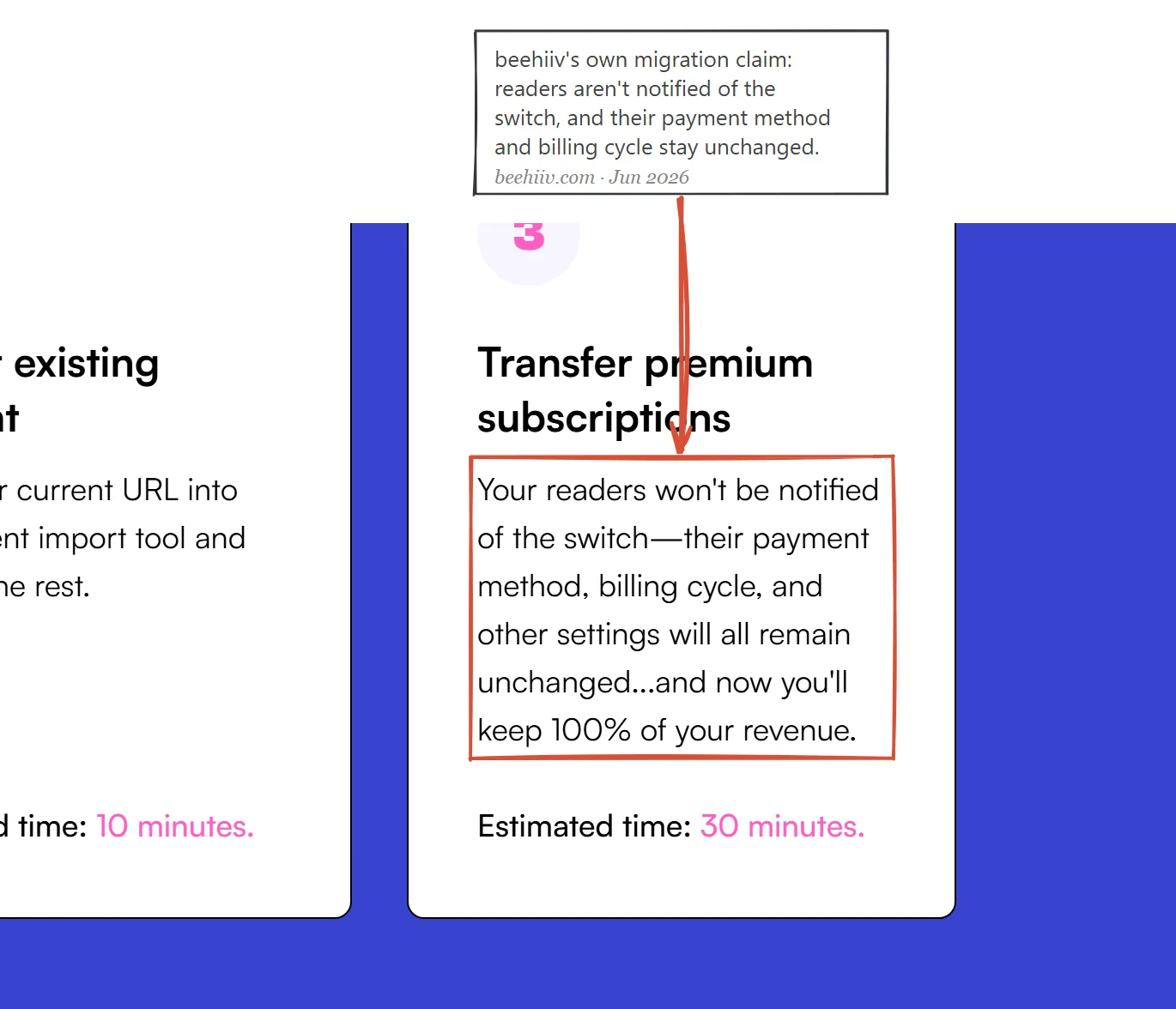
This is the strongest migration story among the major Substack exits, so we checked it twice. Beehiiv's paid-subscriber import documentation describes the mechanism: the process securely copies customer information and payment method data (PAN data) from the Stripe account connected to Substack into the one connected to Beehiiv (C-008). Beehiiv's comparison page states the consequence: readers are not notified of the switch, and their payment method, billing cycle, and subscription stay unchanged (C-009, the vendor's own claim, consistent with the Stripe documentation). There is no cancel-and-re-subscribe event. That event is the step that costs an estimated 5 to 15 percent of the paid base on a Substack-to-Kit move. The comparison with Ghost is subtler: a Ghost migration can keep existing subscriptions alive on the same Stripe account, but Ghost's own migration documentation notes that Substack will continue to take 10 percent fees on your existing paid subscriptions. The beehiiv import re-homes billing into the beehiiv-connected Stripe account, which is what actually ends the cut.
What still breaks, on any destination
Apple in-app subscriptions do not move: Substack's IAP FAQ confirms Apple does not transfer billing relationships between platforms, so you keep those subscribers' emails but lose their payment method (C-017). And nothing network-shaped migrates: Notes followers, recommendation slots, and leaderboard positions stay on Substack. If the network drives most of your growth, that loss can outweigh every fee saved.
The off-boarding steps people forget
Substack's own documentation requires turning off paid subscriptions and disconnecting Stripe before deleting a publication (C-018). Do it once the import settles, or the 10 percent keeps applying to anyone still billed through Substack. Then watch deliverability for a few weeks: both corpora document open-rate dips after migrations, whatever the platforms promise.
Migration is also where Beehiiv's reviews are at their warmest: 22 signals, mostly positive, citing the onboarding webinars and named migration staff. One Trustpilot reviewer (March 2026) moved from another platform and called not doing it sooner their only regret. If your alternative exit is Kit, that path and its re-subscribe cliff are covered in our Substack vs Kit comparison.
Real-World Cases From 1,149 Signals
Three patterns from the aggregation say more than any feature table.
The growth case
A Trustpilot reviewer (March 2026) credits Beehiiv as one reason The Baseball Buffet grew from 500 subscribers to over 10,000 in a year (C-028). The corpus contains several such growth stories tied to the referral and recommendation tooling. It also contains their mirror: Boost-driven growth that inflated lists while open rates sagged. Beehiiv's growth stack rewards creators who treat it as a system to operate, not a button to press.
The dual-platform creator
A recurring 2026 pattern invisible in formal reviews: creators keep Substack as a discovery surface while running their real list on Beehiiv. Substack supplies Notes reach and network subscriptions; Beehiiv supplies the analytics, automations, and ad revenue. The corpus documents the trade-off honestly, including the operational drag of running two platforms. It is a bridge, not a destination: most who describe it are testing whether their audience follows them off the network before cutting the cord.
The suspension stories, on both sides
Substack's version (about 20 signals): accounts suspended with no rule cited and appeals answered generically, including a writer of a year-old publication who asked which post broke which rule and was refused an answer (Trustpilot, March 2026). Beehiiv's version (about 15 signals) adds the financial dimension shown below. Neither pattern is the median experience; both are documented often enough that monthly CSV exports should be standard practice on either platform.
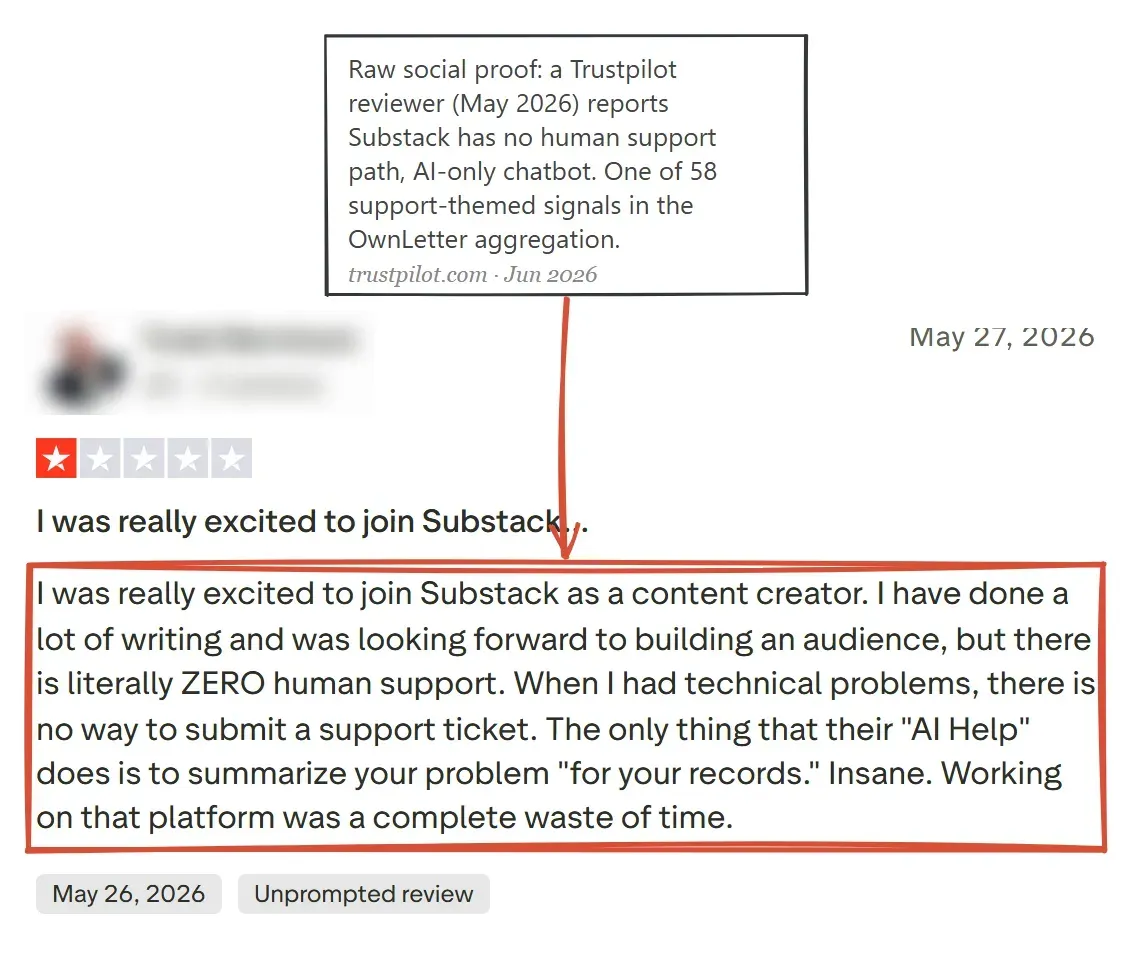
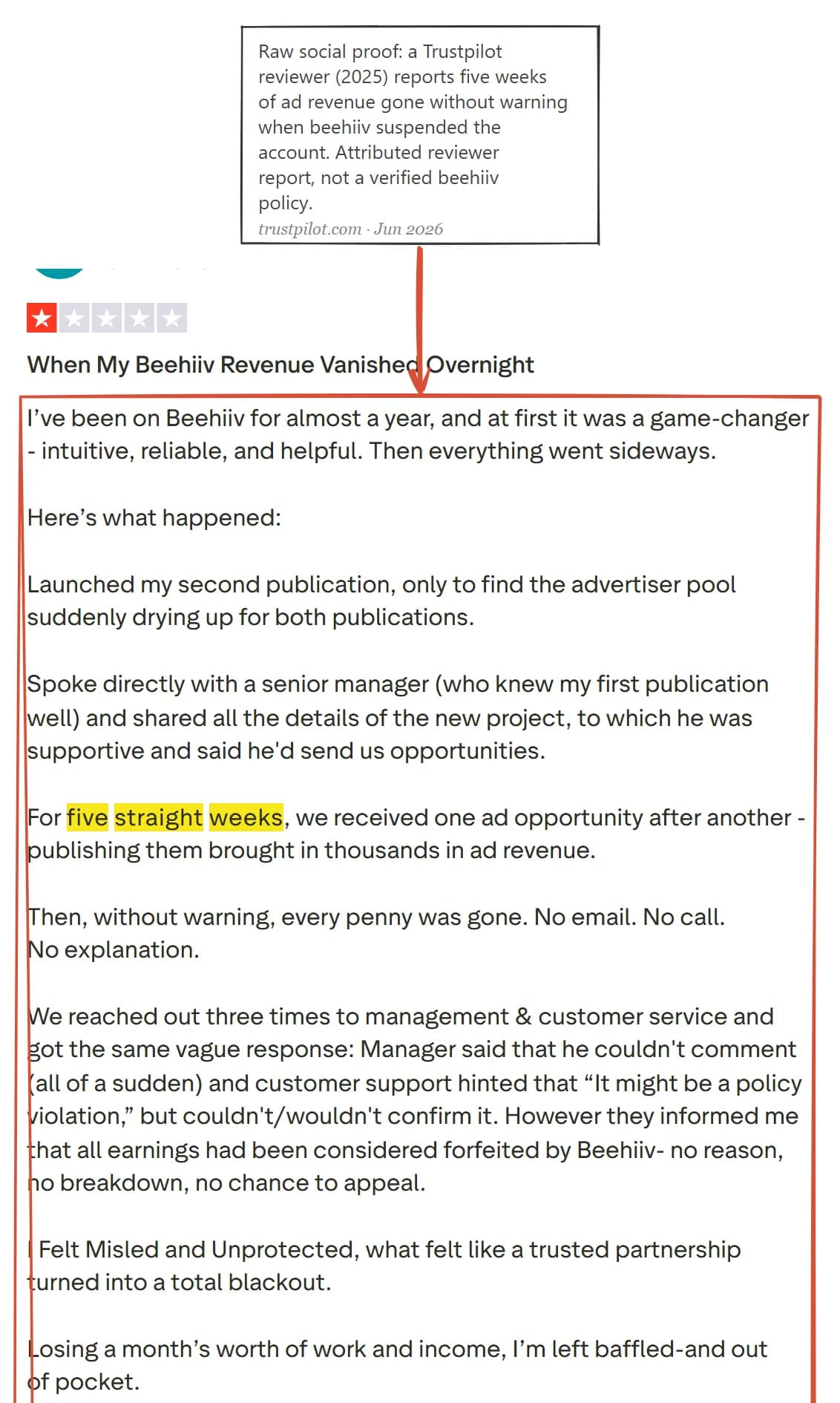
A note on Trustpilot scores:Substack sits at 1.3/5 (161 reviews, unclaimed profile) and Beehiiv at 4.1/5 (353 reviews, claimed, replying to 100% of negative reviews), captured June 11, 2026. Both numbers are polluted: Substack's by readers fighting double-billing, Beehiiv's by readers reporting spam sent through its infrastructure. Read individual reviews like the two above; the headline scores measure profile management as much as product.
Frequently asked
Frequently Asked Questions
Is Beehiiv cheaper than Substack?
It depends on your paid revenue. Substack charges nothing monthly but takes 10 percent of every paid subscription. Stripe fees stack on top (2.9 percent + $0.30 per transaction, and a 0.7 percent recurring billing fee per Substack's own fee page). Beehiiv inverts that: a flat tier price and a 0 percent take rate on paid subscriptions, with only Stripe processing on top. At 1,000 subscribers on annual billing, Beehiiv Scale runs $43/mo. Substack's 10 percent matches that flat cost at roughly $430 per month in paid revenue. Below that point, Substack's no-bill model costs less. Above it, Beehiiv keeps more of every dollar, and the gap widens as revenue grows. One catch: Beehiiv's free Launch tier does not support paid subscriptions at all. Monetizing on Beehiiv means paying for Scale from day one. Pricing verified on beehiiv.com/pricing (June 2026).
Do my paid Substack subscribers have to re-subscribe on Beehiiv?
No. Beehiiv's paid-subscriber import copies customer information and payment method data (PAN data) directly between Stripe accounts, per Beehiiv's official import documentation (verified June 2026). Beehiiv's Substack comparison page states that readers are not notified of the switch. Their payment method, billing cycle, and subscription stay unchanged. Compare the other exits: moving paid subscribers to Kit requires each one to cancel and re-subscribe (practitioners estimate that step costs 5 to 15 percent of the paid base), and a Ghost migration can keep subscriptions alive on the same Stripe account but, per Ghost's own docs, Substack continues to take 10 percent fees on those existing subscriptions. The exception on any destination: Apple in-app subscriptions cannot move, because Apple keeps the billing relationship (you retain those subscribers' email addresses, not their payment method).
Do I lose Substack's discovery network if I leave?
Yes, and you should price that in honestly. Substack's about page says more than half of new subscribers come from its built-in network of recommendations, Notes, and app discovery (Substack's own figure, self-reported). Your email list exports cleanly as CSV. Notes followers and recommendation placements do not transfer anywhere. Beehiiv has its own growth tooling: a recommendation network, a paid acquisition marketplace called Boosts, and a referral program on Scale and above. Reviewers describe Beehiiv's organic recommendations positively. Its network is younger, though, and the paid Boosts route has a documented engagement cost: one creator reported open rates falling from 41 to about 32 percent after Boost-driven growth (Reddit, in 2024 (October), a dated signal). If Substack's network is your main acquisition channel and you are pre-revenue, leaving early can cost more than the 10 percent fee saves.
Does Beehiiv really take 0% of paid newsletter revenue?
Yes, on paid plans. Beehiiv's pricing FAQ states it takes 0 percent of paid subscription revenue; you keep everything you earn minus Stripe's standard processing fee (verified on beehiiv.com/pricing, June 2026). The two qualifiers that matter: paid subscriptions require the Scale plan or above, so the flat tier price is the real cost of monetizing there, and Stripe's processing applies on both platforms, so it washes out of any honest comparison. Substack's equivalent figure is a 10 percent platform cut on top of Stripe. Beehiiv applies the same 0 percent logic to digital products, announced as keep 100 percent of your earnings in its Winter release (2025-2026).
Can I use Substack and Beehiiv at the same time?
Some creators do exactly that, and the pattern shows up in both review corpora. They keep Substack as a discovery surface (Notes, recommendations, leaderboards) and run the actual mailing list on Beehiiv for the analytics, automations, and monetization tooling. A March 2026 Reddit thread describes Substack imposing its own algorithm for visibility while Beehiiv leaves growth mechanics in the creator's hands. Several creators in the corpus run both rather than choosing. The costs are operational: two platforms to maintain, list segmentation to manage, and Beehiiv's Scale fee on top of Substack's cut on any paid revenue you keep there. It is a defensible bridge strategy while you test whether your audience follows you off Substack's network.
How We Built This Comparison
OwnLetter operates as a lab-style analyst rather than a power-user reviewer. We read 1,149 unique user signals in full: 480 for Substack (Reddit, Trustpilot, G2) and 669 for Beehiiv (Reddit, Trustpilot, G2, Capterra), aggregated June 2026. Full reading, not keyword sampling; sampling demonstrably misses dominant themes. Pricing comes from our automated weekly scraper (last run June 7, 2026) and was cross-checked against both vendors' public pages on June 11, 2026. All 32 claims in the manifest carry a source URL and verification status; zero are invented.
What we did not do: no seed-list deliverability tests (they violate both platforms' terms of service), and no deliverability percentages anywhere on this page, because no audited number exists. Full methodology →
Affiliate status: Beehiiv runs a partner program and OwnLetter participates in it; Substack has no affiliate program. That is exactly why the discovery-network section above credits Substack with a moat Beehiiv does not match, why the verdict below sends several profiles to Substack, and why our quiz engine never sees commission data. Judge us on whether the sourcing holds.
Sources
- · Substack fee documentation (10% + Stripe fees) (verified June 11, 2026)
- · Substack going-paid page (verified June 11, 2026)
- · Beehiiv pricing page (0% take rate FAQ + tier grid) (verified June 11, 2026)
- · Beehiiv paid-subscriber import documentation (Stripe PAN copy) (verified June 11, 2026)
- · Beehiiv's Substack comparison page (migration claims) (verified June 11, 2026)
- · Beehiiv Ad Network page (Scale+ eligibility) (verified June 11, 2026)
- · Substack about page (network claim, self-reported) (captured June 11, 2026)
- · Have I Been Pwned: Substack breach (Oct 2025, 663,000 accounts) (verified June 2026)
- · Hollywood Reporter: Substack network figures (March 2025)
- · Sacra: Substack at $45M ARR (estimate, July 2025)
- · Substack drip campaigns beta documentation (October 2025)
- · Substack Apple IAP FAQ (billing non-portability) (verified June 11, 2026)
- · Trustpilot Substack reviews (1.3/5, 161 reviews, unclaimed profile, captured June 11, 2026)
- · Trustpilot Beehiiv reviews (4.1/5, 353 reviews, claimed profile, captured June 11, 2026)
- · FTC Consumer Review Rule, in 2024 (October)
Who Should Pick Which
If you already earn from your newsletter, or plan to within a year:
Beehiiv. Past roughly $430 per month in paid revenue, the flat fee beats the 10 percent cut. The 0 percent take rate compounds in your favor from there, and the ad network and digital products add revenue surfaces Substack does not have. Factor in the real cost: Scale pricing from day one, since the free tier cannot monetize.
Try Beehiiv free →If you're starting from zero, no audience yet:
Substack, without much hesitation. The discovery network is the only mechanism in this category that brings readers to an unknown writer. The free plan has no subscriber ceiling, and readers there convert to paid unusually well. The 10 percent on early revenue is cheap for what the network provides. Re-run the math when paid revenue approaches the break-even point, and remember what stays behind if you leave: Notes followers and network reach.
Start free on Substack →If you monetize with ads or sponsors:
Beehiiv, because Substack offers no open alternative: its sponsorship pilot (December 2025) remains a restricted, hand-picked beta. Go in clear-eyed: CPMs have softened versus what creators reported in 2024-2025, Boost-bought growth costs engagement, and the withheld-revenue suspension reports above are the reason to export earnings data and subscriber lists on a schedule.
If you just want to write, with no business ambitions:
Substack, and skip the spreadsheet. Beehiiv's edge is business tooling you would not touch, paid for through a tier upgrade you would not need. Substack's editor is its best-reviewed surface, publishing is genuinely free at any list size, and a 10 percent cut on revenue you never charge is zero dollars.
Weighing more than these two? See the full Substack alternatives 2026 guide or the Substack vs Kit comparison if automation matters more to you than monetization.
Join the Discussion
Using Substack or Beehiiv? Share your experience or correct an inaccuracy. No account required: email and name only. Comments are moderated.