On this page (16 sections)
Kit vs Mailchimp 2026: a Creator OS Against a Marketing Suite

By Arthur Brulard, Founder of OwnLetter. Cross-vendor analyst review across 11 newsletter platforms, aggregating user signals from Reddit, G2, Capterra, Trustpilot, and Hacker News. LinkedIn
Published June 12, 2026 · Updated June 12, 2026 · 20 min read
Quick verdict
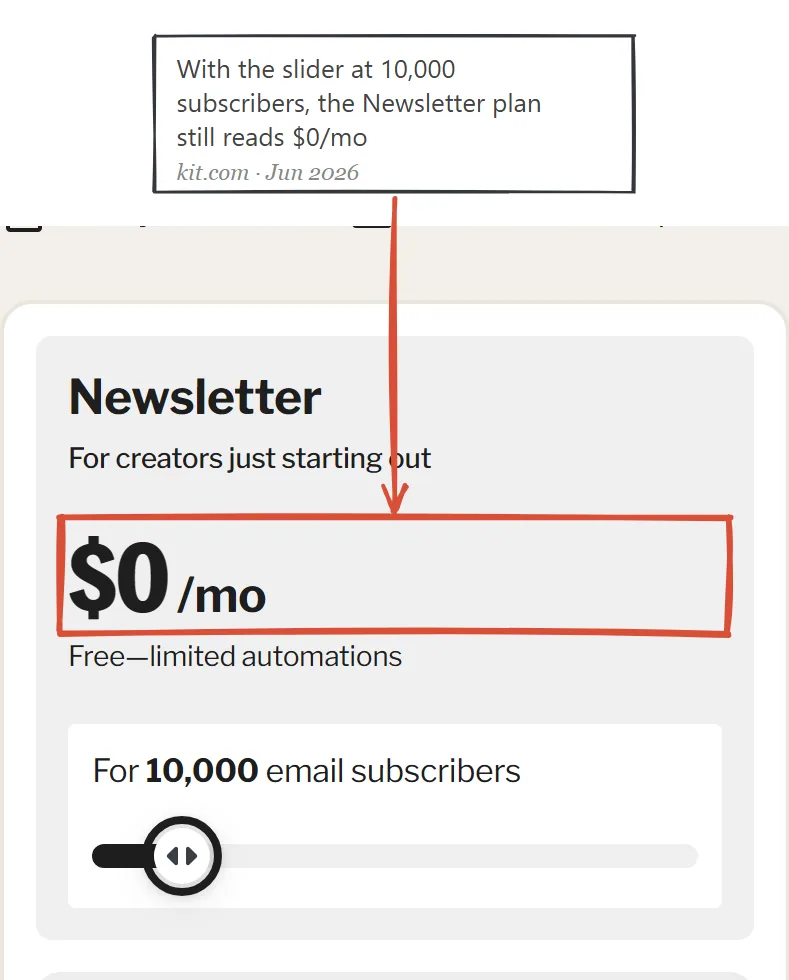
Pick by what you are, not by a score. Kit is built for creators whose list is the business: free publishing to 10,000 subscribers, native selling at a 0.6 percent fee from the free tier, tag-based behavioral automation our depth layer ranks first among creator tools, and a recommendations network that grows lists. Mailchimp is built for businesses that market to a list: the category's friendliest editor, over 300 integrations, readable analytics, AI content tools. The traps are symmetric. Kit auto-upgrades your plan the day you cross a threshold and polices affiliates hard; Mailchimp bills unsubscribed contacts until you archive them and its free plan stops at 250 contacts. At 10,000 subscribers the paid plans nearly converge, $139/mo against $135/mo. A creator monetizing the newsletter itself should start with Kit. A shop emailing customers should start with Mailchimp.
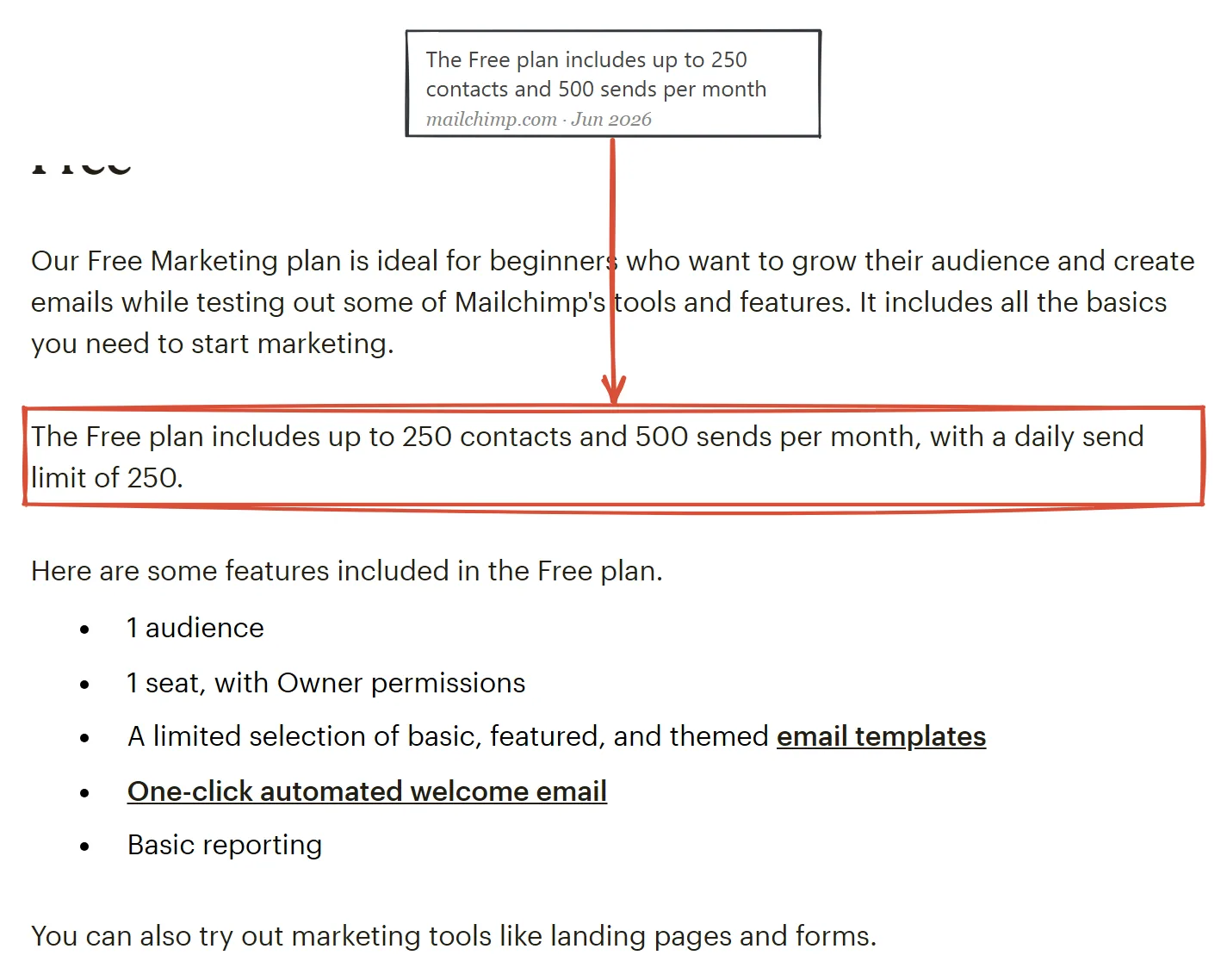
Both free tiers are real but unequal: Kit covers 10,000 subscribers with one basic automation and required recommendation slots; Mailchimp covers 250 contacts and 500 sends. Neither link pays us anything.
Not sure which fits you?
Kit or Mailchimp — answer a few questions
Which fits you?
Loading the quiz…
How we testedVerified June 2026 · 2919 reviews aggregated · Kit + Mailchimp tested · 60 sourced claims · pricing from our weekly tracker · methodology public
What we did: Read user signals in full: 885 Kit reviews and 2,034 Mailchimp reviews (Capterra, Reddit, G2, Trustpilot), aggregated June 2026, mapped theme by theme with no keyword sampling. Pulled pricing from our weekly automated tracker (verified June 12, 2026). Captured the primary pages live on June 12, 2026: Kit's pricing page with the slider at 10,000 subscribers, its commerce page (the 0.6% fee), its Creator Network page and its acceptable-use article; Mailchimp's pricing help page (free-plan limits and the contact-count billing rule). Read both Trustpilot aggregates live the same day. First-hand: we ran a hands-on Kit trial on June 10, 2026 for our Kit review (11 documented captures); we have not run a hands-on Mailchimp account.
What we did NOT do: We did not run deliverability seed-list tests (they violate both vendors' terms and game the result). We did not test Mailchimp hands-on, so no Mailchimp claim here is presented as first-hand testing. We did not invent a deliverability percentage for either platform.
Refresh cadence: Pricing re-verified weekly by automation; claims manifest with source URL per numeric claim publicly available. Next full refresh September 2026. (pricing verified June 12, 2026). Full methodology →
 KitKit
 MailchimpMailchimp
Two Different Machines Wearing the Same Label
Most comparisons treat these two as interchangeable email tools separated by price. They are not. Kit grew from a tool for professional bloggers into what it calls an operating system for creators: one list, unlimited tags, automations that react to what each reader clicks and buys, and a checkout so the creator can charge money without leaving the platform. Mailchimp grew from a newsletter tool into a small-business marketing suite: campaigns, landing pages, social posting, a CRM layer, and connectors into seemingly every store and booking system on the internet. The overlap is the inbox; the machines behind it point in different directions.
The clearest expression of that difference is what each gives away. Kit's free Newsletter plan covers 10,000 subscribers, because Kit monetizes creators later, through plan upgrades and its 0.6 percent cut of sales. Mailchimp's free plan covers 250 contacts and 500 sends a month, a trial door rather than a home, because Mailchimp monetizes the list itself, every stored contact, every month. A beginner can publish on Kit free for years. On Mailchimp, the meter starts almost immediately.
Feature Comparison: Monetization, Automation, Growth
The matrix below renders from the OwnLetter feature layer, source-verified against both vendors' primary documentation in June 2026. Watch three rows in particular. Monetization: Kit sells digital products, subscriptions and tips natively from the free tier; Mailchimp has nothing native. Automation: both say yes, but our depth layer scores Kit's tag-and-trigger system at the top of the creator field while Mailchimp's journeys rate as functional and dated. Integrations and AI run the other way: Mailchimp's 300-plus connector catalog and built-in AI content tools have no Kit equivalent, and Kit ships no AI writing assistant at all.
Pick a plan from the ▾ menu under a platform to see what that plan unlocks and its price at your subs count.
| Feature | Kit (ex-ConvertKit) | Mailchimp |
|---|---|---|
| Monthly priceat 2.5K subs · monthly | $0/mo · Free ≤10K subs | $45/mo · Essentials · 2.5K subs |
| 6/6 | 0/6 | |
| 4/5 | 4/5 | |
| 9/9 | 9/9 | |
| 9/9 | 9/9 | |
| 2/4 | 4/4 | |
| 5/5 | 5/5 | |
| 7/10 | 8/10 | |
| 4/5 | 2/5 | |
| Get started | Try free → | Try free → |
✓ Yes · Partial · — No · dotted = unverified · a plan tag (e.g. Scale) = the cheapest plan that unlocks it; pick a plan above each column and ↑ marks features above it. Verified against vendor sources, September 2026. Some links are paid — OwnLetter may earn a commission at no extra cost to you. It never affects the data.
Straight from the reviews
What real users say
Each site’s average below comes from its own user reviews across Reddit, Trustpilot, Capterra and G2 — the count per site is on each bar. We never invent a quote.
Average score on each review site
KitMailchimpPraised · Complaint · Split opinion
Average scores pulled from each site on May 31, 2026. Trustpilot scores are a recent sample, not the lifetime average; Reddit has no star ratings. See our methodology.
The shape of each rating matters more than the average. Kit's Trustpilot pool of 194 reviews splits between creators with documented revenue and suspension or billing victims. Mailchimp's 2.6 on Trustpilot coexists with a 4.5 on Capterra: business users love the ease, crisis cases concentrate where billing meets compliance.
Theme by theme: where the two corpora agree and differ
| What users say about… | Kit885 reviews read | Mailchimp2034 reviews read |
|---|---|---|
| Mailchimp leads | ||
| Kit leads | ||
| Kit leads | ||
| Kit leads | ||
| Mailchimp leads | ||
| Kit leads | ||
| See for yourself | Try free → | Try free → |
▲ Praised · ▼ Complaint · ◆ Mixed · top theme / common / minor = how often readers bring it up · ❝ hover any cell for the exact count and a real, sourced quote · · = too few reviews to score. Read in full from Reddit, Trustpilot, G2 and Capterra, June 2026. We never invent a quote. Some links are paid — OwnLetter may earn a commission at no extra cost to you. It never affects the data.
Review sources:RedditTrustpilotG2Capterra
Deep Dive: Kit
Across 885 Kit reviews read in full (Capterra, Reddit, G2, Trustpilot, June 2026), the profile is sharp: ease of use leads the positives (186 mentions), the tag-based automation system is the loyalty engine, and the angriest reviews cluster on billing thresholds and account moderation.
The automation system is the product
Kit runs one list. Every subscriber carries tags, and automations branch on behavior: what someone clicked, bought, or ignored. Reviewers who use it properly describe outcomes, not features. The strongest verbatim in the corpus is also the simplest business case:
"I send 160k emails and generate thousands of dollars a month - and I only write one email. This is possible due to Kits automations segmentations."Trustpilot reviewer, March 2026 (kvmc-10)
Our eleven-platform depth layer agrees with the crowd: Kit scores 1.0 on tags and segments and 1.0 on conditional content, the panel leads, and 0.9 on trigger automations, behind only ActiveCampaign's raw enterprise power. Mailchimp scores below Kit on all of them. The fine print is plan-gating: the free tier allows exactly one basic automation, so the system that defines Kit starts at the Creator plan, $39/mo at 1,000 subscribers.
Commerce from the free tier, at 0.6 percent
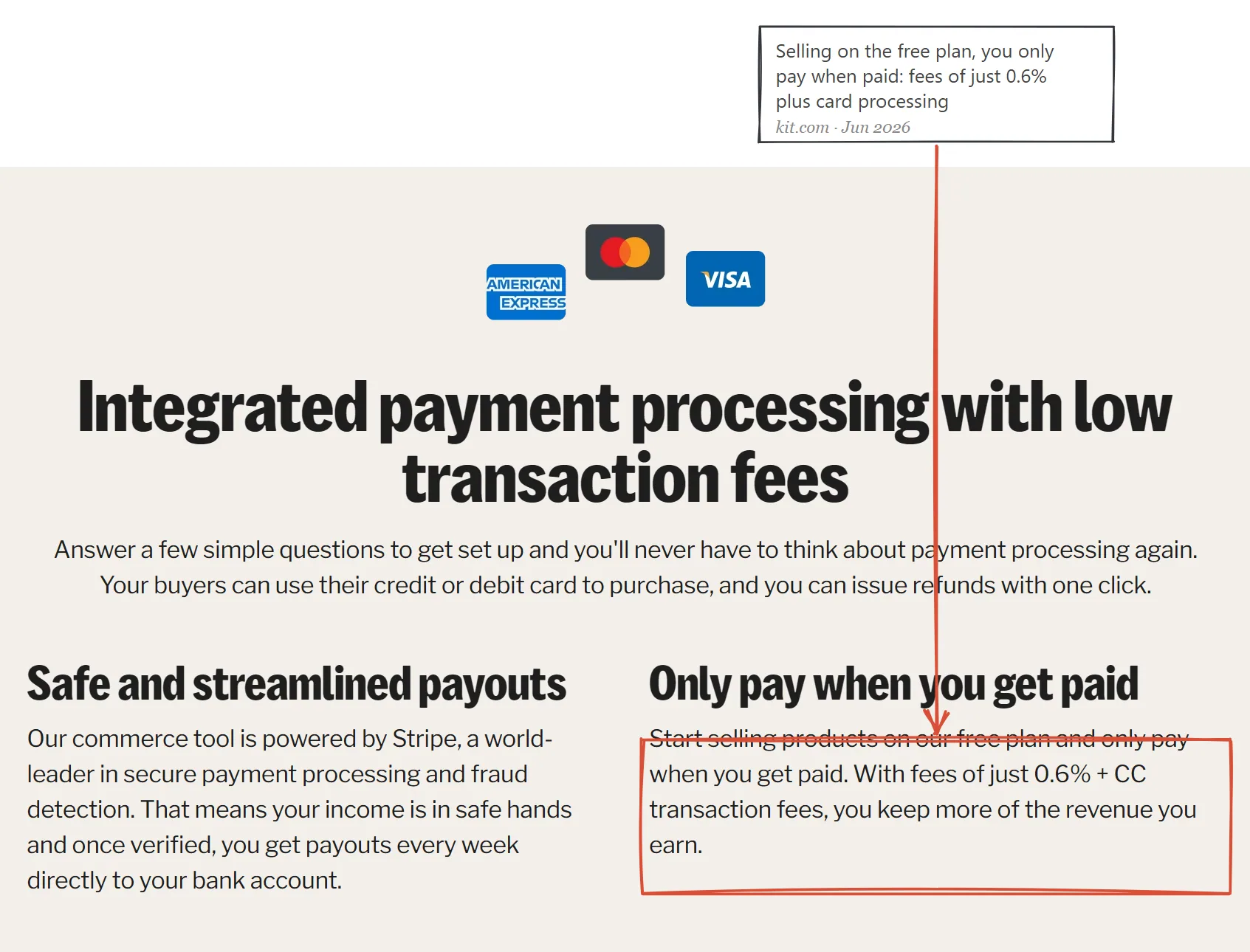
Kit's second structural edge is that money can change hands on the platform from day one. Digital products, paid newsletter subscriptions and a tip jar work on the free plan, with Kit keeping 0.6 percent plus card processing. One reviewer put a number on it: $4,488 of product sales through the feature in 2023. Mailchimp's corpus, eight years deep and more than twice the size, mentions creator monetization nine times, because there is nothing there to review.
The Creator Network, and what the free tier costs instead of money
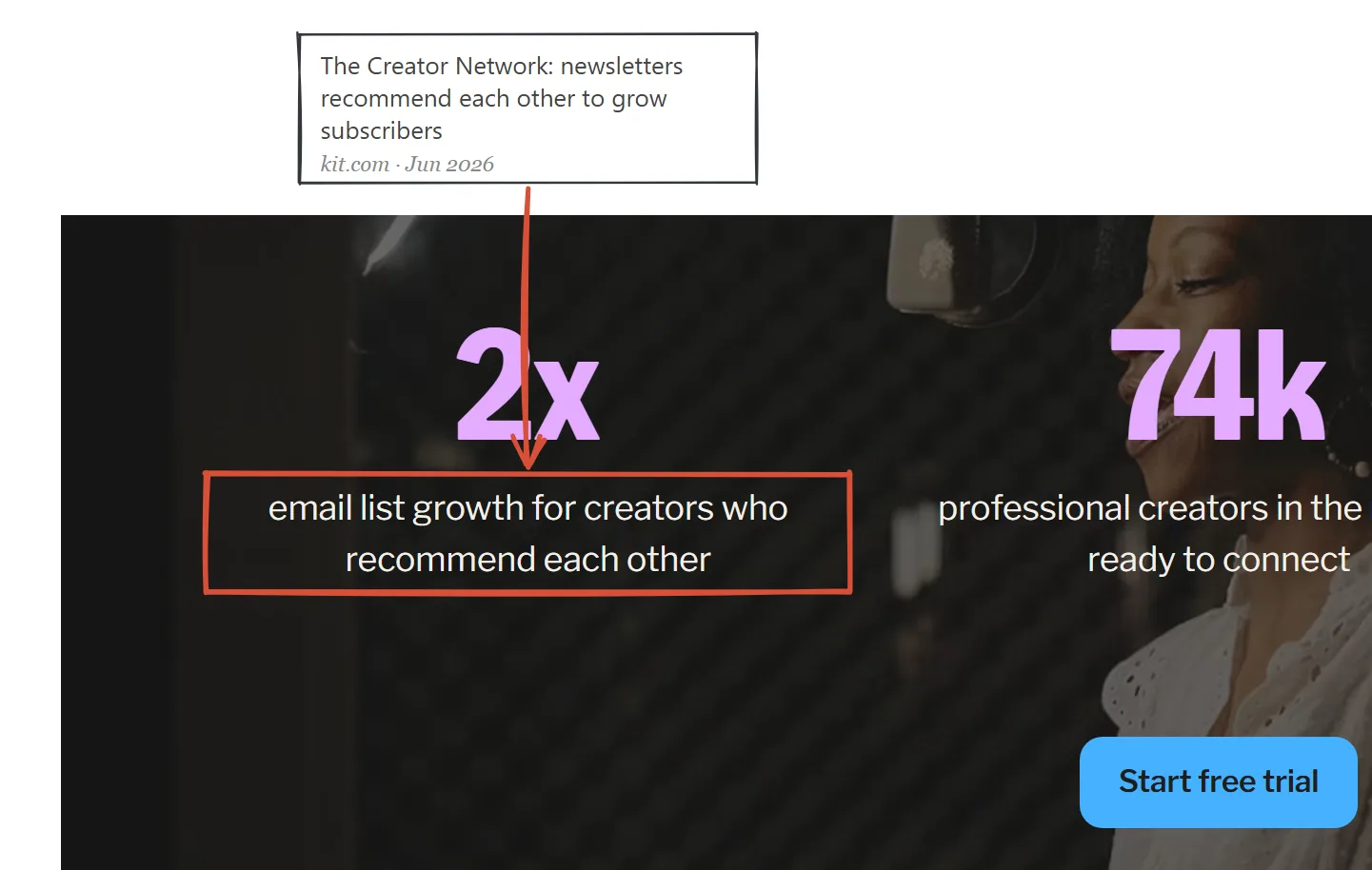
Kit newsletters recommend each other through the Creator Network, which Kit advertises at twice the list growth for participating creators among 74k professional creators (its own figures). Reviewers treat it as a quiet bonus rather than the headline: "Kit's creator network helps us get more subscribers via recommendations. Most other platforms don't offer this" (G2, April 2026). Mailchimp has no equivalent; readers do not discover newsletters through Mailchimp.
The same mechanism is also the free tier's hidden price. Free Recommendations are marked Required on the Newsletter plan: your emails carry other creators' newsletters and the slots only become removable on paid plans. To say it precisely: these are reciprocal growth swaps, no money flows through them to anyone. But on the free plan you cannot switch them off, and you also cannot join Paid Recommendations, the rewarded version where Kit takes a 23.5 percent fee, until Creator.
Our take
Where Kit Falls Short
- The free tier carries forced recommendation slots you cannot turn offKit's pricing page marks Free Recommendations as "Required" on the Newsletter plan: your emails display other creators' newsletters, and removing the slots needs a paid Creator plan. To be precise about what this is, because it is often misreported: these are reciprocal list-growth swaps, no money changes hands, and Kit does not pocket revenue from them. The actual catch is the combination: on the free plan you must show the slots and you cannot earn from recommendations either, since Paid Recommendations (where Kit takes a 23.5% fee) start at Creator.
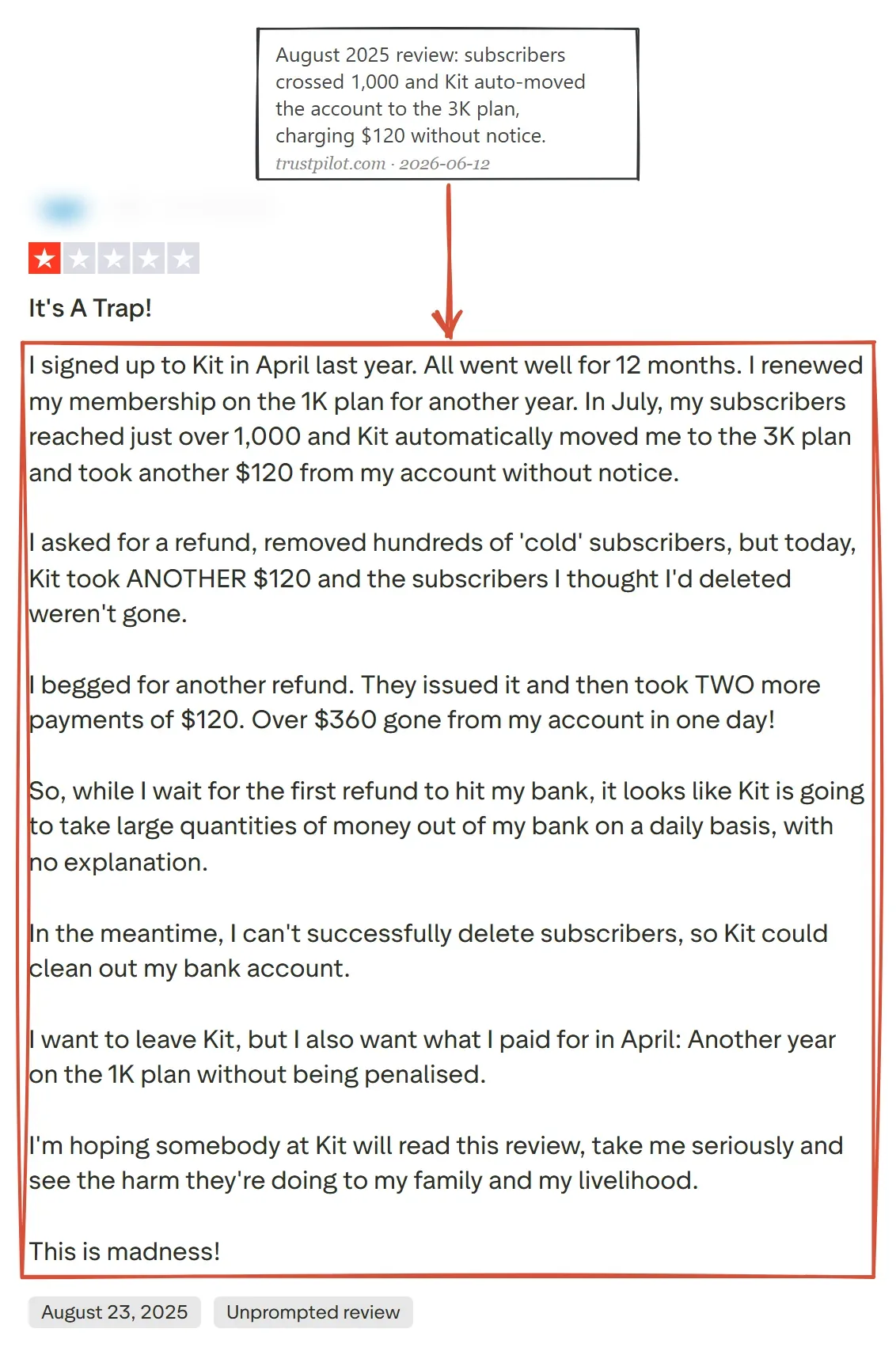
- Billing auto-upgrades on the way up and never on the way downCross your tier's subscriber threshold and Kit moves you to the next plan and charges the difference, without a confirmation step. Shrink back under the threshold and nothing happens until you open a request. An August 2025 Trustpilot review documents the mechanism: just over 1,000 subscribers, an automatic move to the 3K plan, $120 taken without notice, then a second $120 while support sorted out a refund. Cold and disengaged subscribers count toward the threshold until you actively clean them.
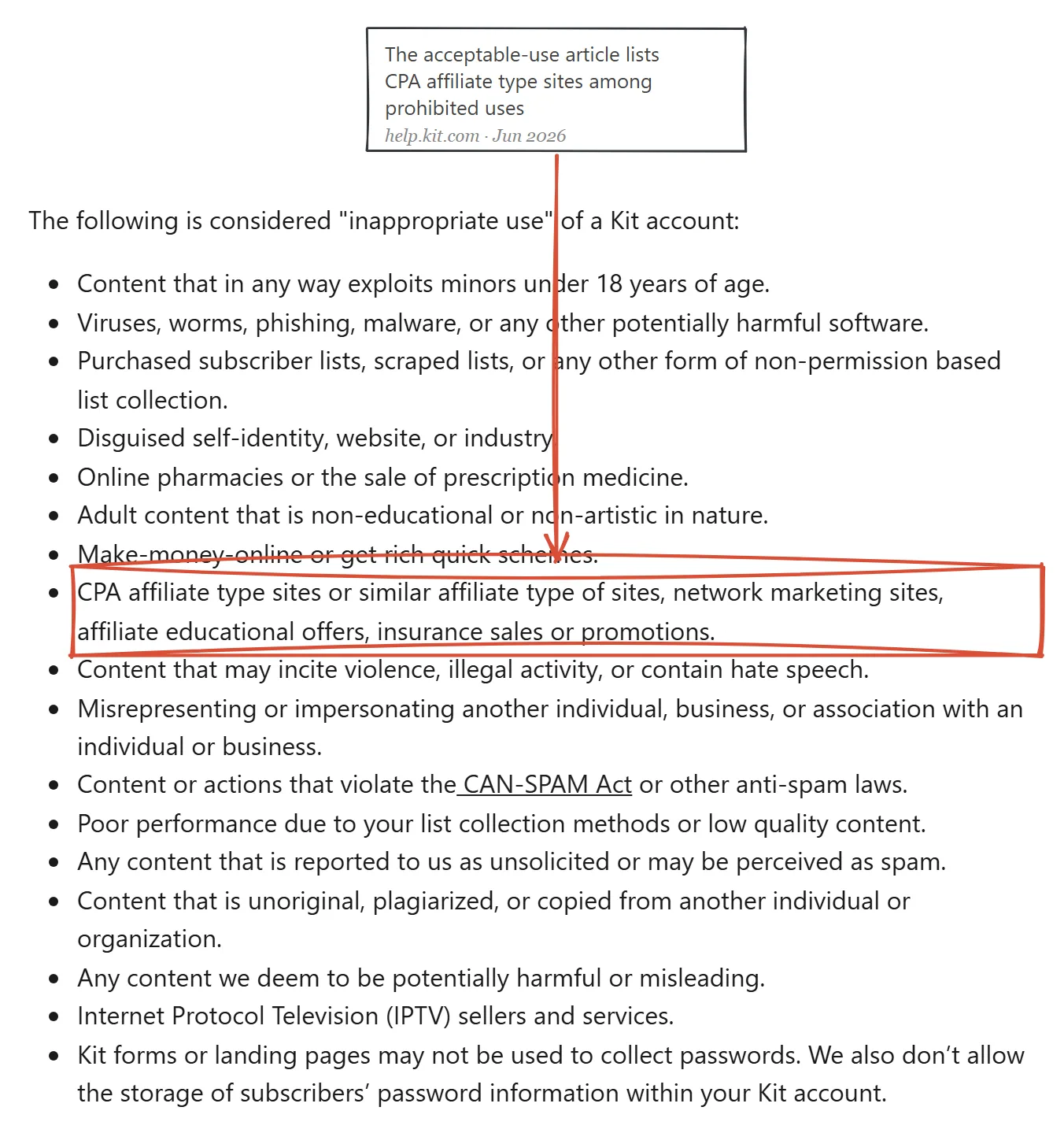
- The moderation machine is strict, opaque, and rough on affiliatesKit's acceptable-use article bans "CPA affiliate type sites" and purchased lists, and reviewers document accounts disabled over a single affiliate link they describe as legitimate, plus brand-new accounts closed before a first send with an AI support bot shutting the tickets. Post-ban, the terms put data export at Kit's discretion, and suspended users report being refused their own subscriber lists. Whatever you think of each individual case, the appeals process is the weak point.
- The differentiating features sit behind Creator and ProThe free tier's one basic automation means the thing Kit is best at, behavioral automation, is effectively paywalled. Deep analytics (engagement scoring, the Insights dashboard, deliverability reporting) and content A/B testing require Pro. A free Newsletter account is a real publishing tool, but it is not the Kit that reviewers praise; budget for Creator if automation is why you came.
- Text-first by design, and no mobile appKit's editor is deliberately minimal: reviewers wanting visual richness call it bare-bones, custom HTML starts on Creator, and the template library is small on purpose. A May 2026 review still flags default formatting that needs a code snippet to fix. There is also no mobile app at all (7 corpus mentions, zero defenses). If your emails are designed artifacts rather than letters, this is the wrong editor.
Deep Dive: Mailchimp
Across 2,034 Mailchimp reviews (Capterra, Reddit, G2, Trustpilot, June 2026), three forces explain who stays and who leaves: an editor anyone can use (773 ease mentions, the corpus's biggest theme), an integration catalog that functions as the real lock-in, and a bill that grows faster than the value for anyone whose list keeps growing.
The friendliest editor in the category, with a known ceiling
A Reddit operator gave the corpus its fairest one-paragraph summary in May 2026:
"Mailchimp wins on polish. the editor is the friendliest in the category, templates look good out of the box, a non-marketer can send something decent unaided. you pay for that, and the price scales aggressively as your list grows. that's the catch everyone eventually hits." Reddit user (r/remotework source), June 2026 (kvmc-08)
Two corpus details sharpen the polish story. First, the ceiling: deep customization is not there, so users who outgrow the templates design in Canva and import images, a workaround common enough to be a documented pattern. Second, the sameness: reviewers note that Mailchimp emails look recognizably Mailchimp, which cuts against a brand trying to stand out in the inbox. Kit's text-first editor has the opposite problem and the opposite virtue: nothing to admire, nothing in the way.
The automation friction shows up in the same channel, from a user whose list had grown past the simple cases:
"Automation workflows that should be simple end up being a hassle, and I've run into random account issues that don't make much sense. I've also noticed some weird limits on what I can do, especially as my email list has grown." Reddit user (r/Emailmarketing source), February 2025 (kvmc-07)
The connectors are the real moat
Mailchimp states over 300 integrations, and in the corpus the ecosystem is the most common reason price-complainers stay anyway: the dental practice software, the booking system, the niche store platform that ships a Mailchimp connector and nothing else. Kit's integrations cover WordPress, WooCommerce and the creator-stack standards, with Zapier filling gaps; a business whose operations run through sector tools will feel that difference weekly. Add Mailchimp's AI layer (content generation, and Analytics AI launched in May 2026) against Kit's deliberate absence of an editor AI, and the business-tooling case for Mailchimp is genuine.
The meter, and the new owner's posture
Price and value is the corpus's most polarizing theme (748 mentions, negative-dominant), and the billing rule compounds it: every stored contact counts, including people who unsubscribed years ago, until you archive them by hand. Post-Intuit price increases form their own grievance theme (159 mentions). And in May 2026, Intuit publicly named Mailchimp an area of reduced investment while cutting roughly 17 percent of staff. Mailchimp will not vanish; it generates cash. The realistic forecast is a product that costs more each year and changes less.
Our take
Where Mailchimp Falls Short
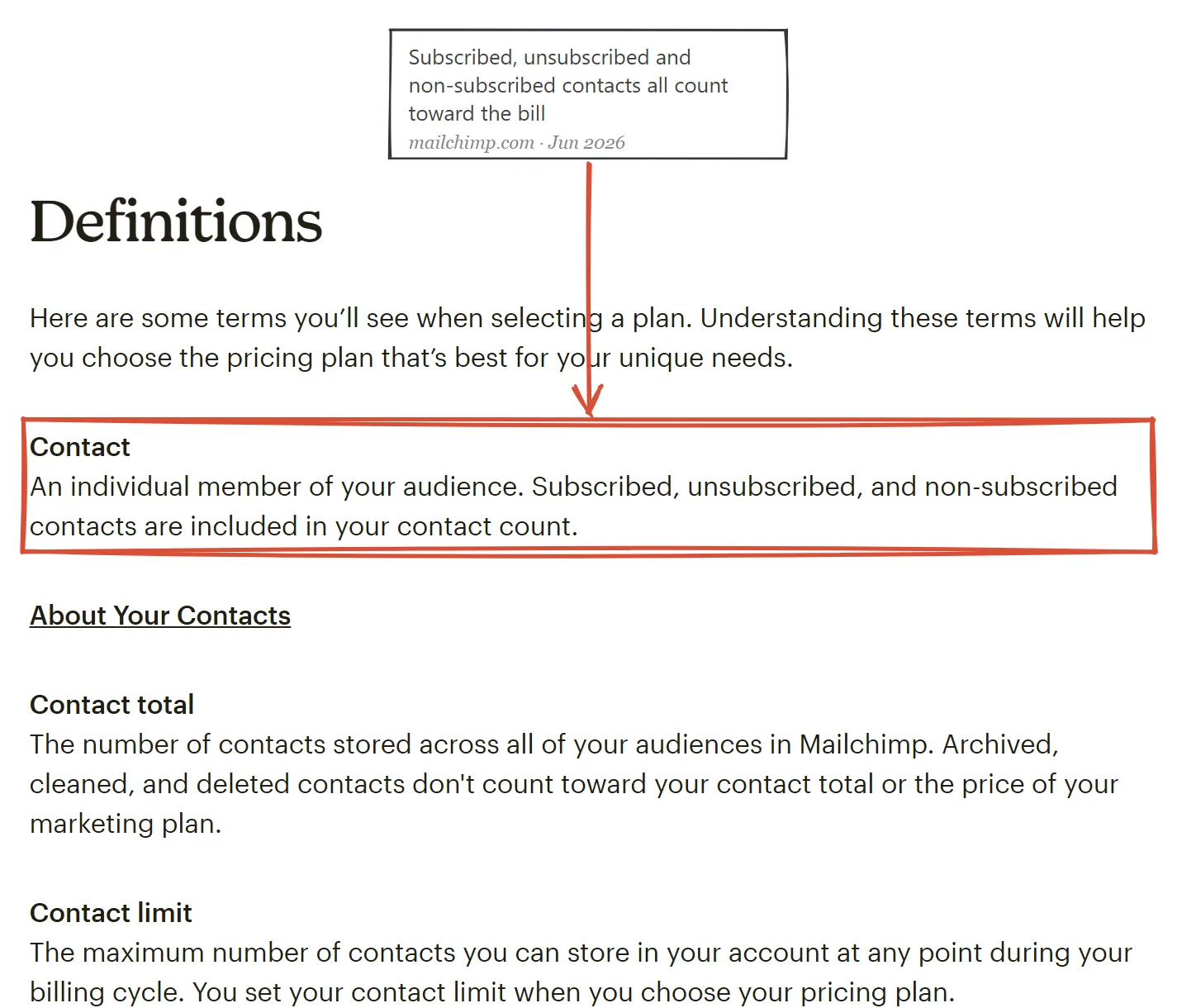
- The contact meter runs on people who already leftYour Mailchimp bill counts every stored contact: subscribed, unsubscribed and non-subscribed alike, until you archive or delete them by hand. The corpus carries a brutal example of the gap between the dashboard and the charge: a reviewer showing $14 a month on screen was billed $566 for contacts already deleted (Trustpilot, December 2025). Monthly archiving is not optional hygiene on this platform; it is bill management.
- Creator monetization simply is not in the productNo paid newsletter, no subscriptions, no product checkout, no tip jar, on any plan. Monetization musters 9 mentions in 2,034 reviews, the quietest theme in the corpus, because there is nothing to discuss. Mailchimp sells outcomes to businesses that monetize elsewhere (a store, a service, a venue); a creator whose list IS the business has to bolt third-party payment plumbing onto the API and maintain it alone.
- Power costs more than the sticker shows, and the price keeps movingPrice is the corpus's most negative major theme (748 mentions): the per-contact model compounds with plan gates, so advanced automation and reporting land on the higher tiers just as the list growth raises the base. Long-tenured users tie a separate wave of grievances (159 mentions) to the Intuit era, describing bills that more than doubled without new value. Since May 2026 the context is public: Intuit is running Mailchimp with reduced investment.
- The automation builder lags the modern fieldCustomer Journeys cover welcome flows, branching and behavioral triggers from Essentials up, and for a 3,000-contact list with simple needs they are fine. Past that, the corpus is blunt: "The automation builder feels dated and lacks the flexibility needed for more sophisticated customer journeys" (G2, March 2026). Reviewers benchmarking against Klaviyo or a tag-based system describe Mailchimp's audience-and-segment model as the wrong shape for behavioral work.
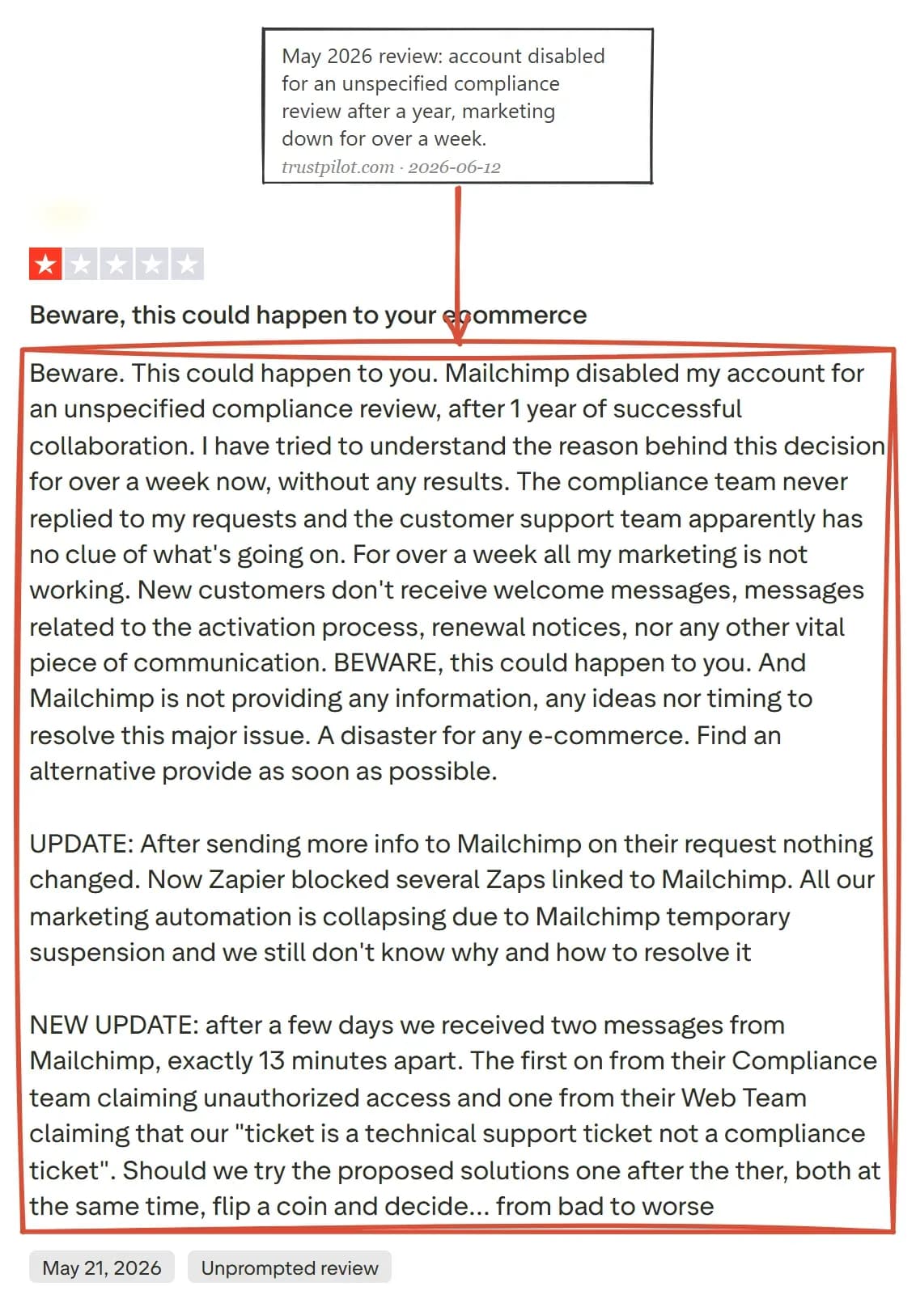
- Compliance can switch off a year-old account without saying whySuspension is a heavy negative theme (110 mentions), and the pattern lands on accounts in production: an "unspecified compliance review" freezes sending, automations stop mid-flow, and support cannot see the reason. A May 2026 reviewer running e-commerce flows lost over a week of all marketing while compliance and the web team gave contradicting answers. The affiliate-marketing category ban sits in the same policy, so affiliate newsletters carry extra exposure.
Trust, Policies and the Risks That Outlast a Pricing Page
Both platforms can turn you off without a conversation, and both have done it to reviewers who believed they were compliant. Kit's enforcement clusters around its acceptable-use rules: the policy bans "CPA affiliate type sites" and purchased lists, its help center expects 70 to 80 percent of email content to be your own, and the corpus documents disabled accounts over single affiliate links plus new accounts closed before a first send. Mailchimp's enforcement lands later and explains less: established accounts frozen for an "unspecified compliance review", with its outright affiliate-marketing ban sitting in the same policy text.
The ownership stories diverge just as sharply. Kit is bootstrapped, profitable, around $43M in annual revenue (2025, private-company estimate), with a founder publicly committed to never raising venture money: stability by independence, priced through 2025's short-notice repricing. Mailchimp is an Intuit line item officially marked for reduced investment: stability by corporate scale, priced through whatever the parent decides next. The table below renders from our trust-and-risk layer, clauses on hover.
Trust and risk: Kit vs Mailchimp
| Platform | Account control | Liability cap | Cost at scale | Vendor longevity | Billing model | Allowed niches |
|---|---|---|---|---|---|---|
| Kit | ||||||
| Mailchimp |
✓ favorable to the creator · ◐ mixed · ✗ unfavorable. Hover or tap a cell for the detail. Compiled June 2026 from public terms, status pages and the pricing data layer. Re-verified quarterly.
Pricing Scenarios: Where Free Ends and the Meters Diverge
Both platforms price by list size, so the table reads straight across. Two things to hold while you read it. Below 10,000 subscribers, Kit's free Newsletter plan makes the comparison lopsided for anyone who can live with one automation. Above it, Mailchimp Standard scales cheaper than Kit Creator, and the real differences move to the billing rules and the features each meter unlocks.
Plans at a glance (verified June 2026)
- · Kit Newsletter (free): up to 10,000 subscribers, unlimited broadcasts, 1 basic automation, Free Recommendations required, commerce at 0.6% available.
- · Kit Creator: $39/mo (Creator, 1K subs) · verified June 12, 2026 at 1,000 subs ($139/mo at 10K, $199/mo at 25K). Unlimited automations, removable recommendations, migration concierge. Annual billing: two months free.
- · Kit Pro: $79/mo (Pro, 1K subs) · verified June 12, 2026 at 1,000 subs ($189/mo at 10K). Adds engagement scoring, Insights analytics, content A/B testing, SparkLoop referrals.
- · Mailchimp Free: 250 contacts, 500 sends/month. No scheduling, no real automation flows.
- · Mailchimp Essentials: $26.5/mo (Essentials, 1K subs) · verified June 12, 2026 at 1,000 contacts ($110/mo at 10K). Scheduling, A/B testing, basic Customer Journeys.
- · Mailchimp Standard: $45/mo (Standard, 1K subs) · verified June 12, 2026 at 1,000 contacts ($135/mo at 10K, $310/mo at 25K). Send-time optimization, behavioral segmentation, custom templates.
Cost by list size, and the two traps
Kit vs Mailchimp cost by list size (monthly billing × 12, June 2026 tracker)
List size Same list on both | Kit Newsletter free to 10K; Creator unlocks full automation | Mailchimp Standard; free plan caps at 250 contacts | What the row really says |
|---|---|---|---|
| Starting out | $0 (Newsletter) or $39/mo → $468/yr for full automation | $45/mo → $540/yr (Essentials $26.50/mo) | Kit publishes free where Mailchimp already bills |
| Established newsletter | $0 (Newsletter, basics) or $139/mo → $1,668/yr | $135/mo → $1,620/yr (Essentials $110/mo) | Paid plans nearly converge; the free option is Kit's alone |
| Serious operation | $199/mo → $2,388/yr | $310/mo → $3,720/yr | Mailchimp pulls clearly ahead on cost at scale |
| The billing-trap row | Auto-upgrades the plan the day you cross, never auto-downgrades | Unsubscribed and non-subscribed contacts keep billing until archived | Different trap, same lesson: prune and watch the meter |
Starting out
- Kit
- $0 (Newsletter) or $39/mo → $468/yr for full automation
- Mailchimp
- $45/mo → $540/yr (Essentials $26.50/mo)
- What the row really says
- Kit publishes free where Mailchimp already bills
Established newsletter
- Kit
- $0 (Newsletter, basics) or $139/mo → $1,668/yr
- Mailchimp
- $135/mo → $1,620/yr (Essentials $110/mo)
- What the row really says
- Paid plans nearly converge; the free option is Kit's alone
Serious operation
- Kit
- $199/mo → $2,388/yr
- Mailchimp
- $310/mo → $3,720/yr
- What the row really says
- Mailchimp pulls clearly ahead on cost at scale
The billing-trap row
- Kit
- Auto-upgrades the plan the day you cross, never auto-downgrades
- Mailchimp
- Unsubscribed and non-subscribed contacts keep billing until archived
- What the row really says
- Different trap, same lesson: prune and watch the meter
Prices from our weekly tracker, verified June 12, 2026, annualized from monthly billing. Kit's annual billing gives two months free; Mailchimp's annual discount runs about 15 percent. The last row prices nothing: it is the two billing rules, Kit's auto-upgrade and Mailchimp's unsubscribed-contacts meter, doing their quiet work.
Migrating From Mailchimp: the Happiest Path in Our Kit Corpus
Of the 21 migration reports in our Kit corpus, the Mailchimp arrivals are the most enthusiastic. The reasons are structural: Kit preserves imported tags, which map naturally onto Mailchimp's tag system, and paid Kit plans include a free migration concierge that moves lists, forms, templates and automations for you. One March 2026 Trustpilot reviewer:
"We moved over from MailChimp, best move we've ever made. This platform offers so much and is so easy to use and work with." Trustpilot reviewer, March 2026 (kvmc-06)
Three cautions keep the move honest. First, on a free Kit account the automation rebuild is yours, and the free tier holds one basic automation; a Mailchimp setup with real Customer Journeys needs Creator to land properly. Second, large imports can hold a new Kit account for review until support clears them, so import the cleanest segment first and keep Mailchimp alive until Kit has verifiably sent. Third, authenticate a custom sending domain immediately: our corpus documents a Kit account that sent from a bare Gmail address for years until Google and Yahoo tightened authentication rules in 2024 and its deliverability collapsed, and nothing in the onboarding had forced the fix.
And one caution about the door you would be walking through: it closes behind paid subscriptions. If you later sell subscriptions through Kit's commerce and want to leave, there is no documented path for moving active paid subscribers to another platform cleanly. The easiest entrance in our panel is not an easy exit.
Who Switches, and Who Should Stay
The profile that gains from switching to Kit
The switcher the data supports is a creator paying Mailchimp for a list that IS the product: a newsletter under 10,000 subscribers using basic journeys, no sector-specific connectors, with plans to sell something to readers. That profile stops paying Mailchimp's meter (possibly to zero on Kit's free tier), gains native commerce at 0.6 percent, inherits a deeper automation system when ready to pay, and plugs into a discovery network Mailchimp does not have. Course creators and digital-product sellers are the cleanest fit in the corpus.
The rational reasons to stay on Mailchimp
Four hold up. Integrations, first and strongest: if your booking system, store or practice software ships a Mailchimp connector and nothing else, the connector outweighs the meter. Visual emails: a brand that needs designed campaigns out of the box will fight Kit's text-first editor daily. AI tooling: Mailchimp generates content and analyzes performance conversationally; Kit offers no editor AI by design. And scale economics: above roughly 25,000 contacts, Mailchimp Standard undercuts Kit Creator on sticker price ($310/mo against $199/mo). What does not hold up is staying for a paid-newsletter plan Mailchimp does not offer, or for a free tier forty times smaller than Kit's.
The risk neither side escapes
Across 452 Reddit community posts in the Mailchimp corpus and the Kit corpus's Trustpilot tail, the same two failure modes recur with different timing: Kit's machine strikes early (new accounts, affiliate links, import flags), Mailchimp's strikes in production (compliance reviews on established accounts). Neither publishes its full criteria. The export habit is the only insurance both sides honor while the account is in good standing.
Deliverability: Kit's Strongest Reviews, Mailchimp's Crowd Problem, No Numbers
Neither vendor publishes an audited inbox-placement rate, and we will not invent one. The corpus signals lean Kit's way: deliverability is one of its most-cited strengths (46 mentions, positive), with migrants from Mailchimp, Constant Contact and AWeber crediting the text-first format and sender-reputation care; one 49,000-subscriber list reports 60 to 65 percent open rates, a self-reported figure we pass along as such. The Mailchimp corpus (150 mentions, mixed) tells a slower story: historically strong, with 2025 and 2026 reviews growing more cautious, and one expert reviewer naming the structural issue of a giant shared pool: less experienced senders drag the reputation everyone shares.
Two honest brakes on the Kit lean. The format helps: plain-text-style emails trip fewer Promotions-tab filters, so some of the gap is the editor, not the infrastructure. And the onboarding does not save you from yourself: the corpus documents a Kit sender on a bare Gmail address whose placement collapsed when the tightened authentication rules landed in 2024. Wherever you land, configure SPF, DKIM and DMARC on a custom domain before the first campaign, and treat every published percentage, including the ones in our corpus, as one sender's story.
Frequently asked
Frequently Asked Questions
Is Kit cheaper than Mailchimp?
It depends entirely on whether the free tier covers you. Kit's Newsletter plan is free up to 10,000 subscribers, with limited automations; Mailchimp's free plan stops at 250 contacts and 500 sends a month, a forty-fold difference at the entry. Once you pay, the gap nearly closes: at 10,000 subscribers Kit Creator runs $139/mo against $135/mo for Mailchimp Standard and $110/mo for Essentials (monthly billing, June 2026 tracker). So a creator who can live with one basic automation publishes free on Kit for years, while a paying customer should compare features at their exact list size, not stickers.
Can I sell a paid newsletter or digital products on Kit or Mailchimp?
On Kit, natively and from the free tier: digital products, paid newsletter subscriptions and a tip jar work on every plan, with Kit taking 0.6% plus card processing. One reviewer documented $4,488 of product sales through the feature in a year. On Mailchimp, no: there is no native paywall, subscription or product checkout at any tier, and creator monetization barely registers in its 2,034-review corpus (9 mentions). Charging readers on Mailchimp means wiring a third-party checkout to the API yourself. If selling to your list is the plan, this question alone settles the matchup.
Will my Mailchimp list and automations survive a move to Kit?
The list yes, the automations no. Mailchimp-to-Kit is the most documented happy path in our Kit corpus (21 migration mentions, positive): subscribers import with their tags intact, and reviewers describe the move in glowing terms. Kit's free migration concierge handles lists, forms, templates and automations for paid plans. What you rebuild by hand on a free account: the automation logic itself, in Kit's visual builder, where the free tier allows exactly one basic automation. One caveat on the way out the other side: there is no documented path for moving ACTIVE paid subscriptions out of Kit later, so commerce success there deepens your commitment.
Which platform is safer for a newsletter that uses affiliate links?
Neither is a safe harbor, and this surprises people. Mailchimp's acceptable-use policy prohibits affiliate marketing as a category. Kit's policy bans "CPA affiliate type sites" rather than the practice itself, and its help center expects 70 to 80 percent of email content to be your own; but our corpus documents Kit accounts disabled over a single affiliate link the reviewers describe as legitimate. If affiliate income is core to your newsletter, read both policies before you commit, and consider platforms whose written terms explicitly permit contextual affiliate links instead.
Are Kit and Mailchimp stable companies to build on?
Stable, with opposite ownership stories. Kit is bootstrapped and profitable, around $43M in annual revenue (2025, private-company estimate), and its founder is publicly against raising venture capital; the trade-off was a repricing announced in September 2025 with about a month's notice, which legacy customers experienced as increases of up to 160%. Mailchimp belongs to Intuit, which paid about $12 billion in 2021 and in May 2026 publicly listed it among areas of reduced investment during a round of roughly 17% job cuts. Neither is going away; the question is whose pricing and roadmap pressure you would rather live under.
How We Built This Comparison
OwnLetter works as a lab-style analyst, not a power-user reviewer. We read 2,919 unique user signals in full (885 Kit, 2,034 Mailchimp) across Capterra, Reddit, G2 and Trustpilot, aggregated June 2026, theme-mapped without keyword sampling. Pricing renders from our weekly automated tracker (verified June 12, 2026) and is never typed by hand. On June 12, 2026 we captured the primary pages live: Kit's pricing page with the slider at 10,000 subscribers, its commerce page, its Creator Network page and its acceptable-use article; Mailchimp's pricing help page for the free-plan limits and the contact-count rule. Both Trustpilot aggregates were read live the same day (Kit 3.41 across 194 reviews; Mailchimp 2.6 across 1,441).
All 60 claims in our manifest carry a source URL and a verification status; zero are invented. First-hand status, stated plainly: we ran a hands-on Kit trial on June 10, 2026 (it powers our Kit review, scored 8.1/10 by our engine); we have not run a hands-on Mailchimp account, so nothing here presents Mailchimp as "tested by us." Full methodology →
Affiliate status: neither Kit nor Mailchimp pays us; we are in neither program and both links are plain. The quiz engine, the feature matrix and the pricing tables are commission-blind by construction, on this page and everywhere else on the site.
Sources
- · Kit pricing page (free Newsletter to 10,000; Free Recommendations required) (captured June 12, 2026)
- · Kit commerce page (selling from the free plan, 0.6% fee) (captured June 12, 2026)
- · Kit Creator Network page (captured June 12, 2026)
- · Kit acceptable-use article (CPA affiliate type sites prohibition) (captured June 12, 2026)
- · Kit terms of service (export discretion, liability cap, arbitration) (verified June 4, 2026, trust layer)
- · Mailchimp help: pricing plans, free-plan limits and the contact-count rule (captured June 12, 2026)
- · Mailchimp acceptable-use policy (affiliate-marketing prohibition) (verified June 11, 2026)
- · MarTech: Intuit's layoffs, reduced investment and Mailchimp (verified June 11, 2026)
- · Trustpilot Kit reviews (3.41/5 across 194, June 2026)
- · Trustpilot Mailchimp reviews (2.6/5 across 1,441, read live June 12, 2026)
Who Should Pick Which
If your newsletter is the business (writing, courses, digital products):
Kit, and it is not close. Free publishing to 10,000 subscribers while you grow, native selling at 0.6 percent from day one, the strongest tag-based automation in the creator field once you pay for Creator, and a recommendations network that compounds growth. Accept the trade-offs knowingly: required recommendation slots on the free tier, a strict moderation machine, and an editor that will never win a design award.
Try Kit free →If you are a business emailing customers (store, practice, venue, team):
Mailchimp earns its keep. The editor your least technical colleague can use, the connector for whatever sector software you run on, AI content and analytics tools Kit deliberately does not build, and cheaper stickers past 25,000 contacts. Manage the meter: archive unsubscribed contacts monthly, and know that the affiliate-marketing ban and opaque compliance reviews are part of the package.
Try Mailchimp free →If you monetize with affiliate links:
Treat both as hostile terrain and read the policies first. Mailchimp bans the category; Kit bans "CPA affiliate type sites" and has suspended reviewers over single legitimate links. Platforms whose terms explicitly permit contextual affiliate links are the safer home; our Kit alternatives guide routes that case in detail.
If you want visual emails AND creator monetization:
This matchup has no winner for you: Kit will not give you the editor, Mailchimp will not give you the checkout. The newsletter-native field (paid subscriptions plus designed templates) is compared in our best newsletter platforms guide.
Coming from Substack instead? Kit is measured against it in our Substack vs Kit comparison, and Mailchimp in Substack vs Mailchimp.
Join the Discussion
Using Kit or Mailchimp? Share your experience or correct an inaccuracy. No account required: email and name only. Comments are moderated.