On this page (16 sections)
MailerLite vs Kit 2026: Twins on Paper, Opposites in Practice

By Arthur Brulard, Founder of OwnLetter. Cross-vendor analyst review across 11 newsletter platforms, aggregating user signals from Reddit, G2, Capterra, Trustpilot, and Hacker News. LinkedIn
Published June 12, 2026 · Updated July 19, 2026 · 23 min read
Quick verdict
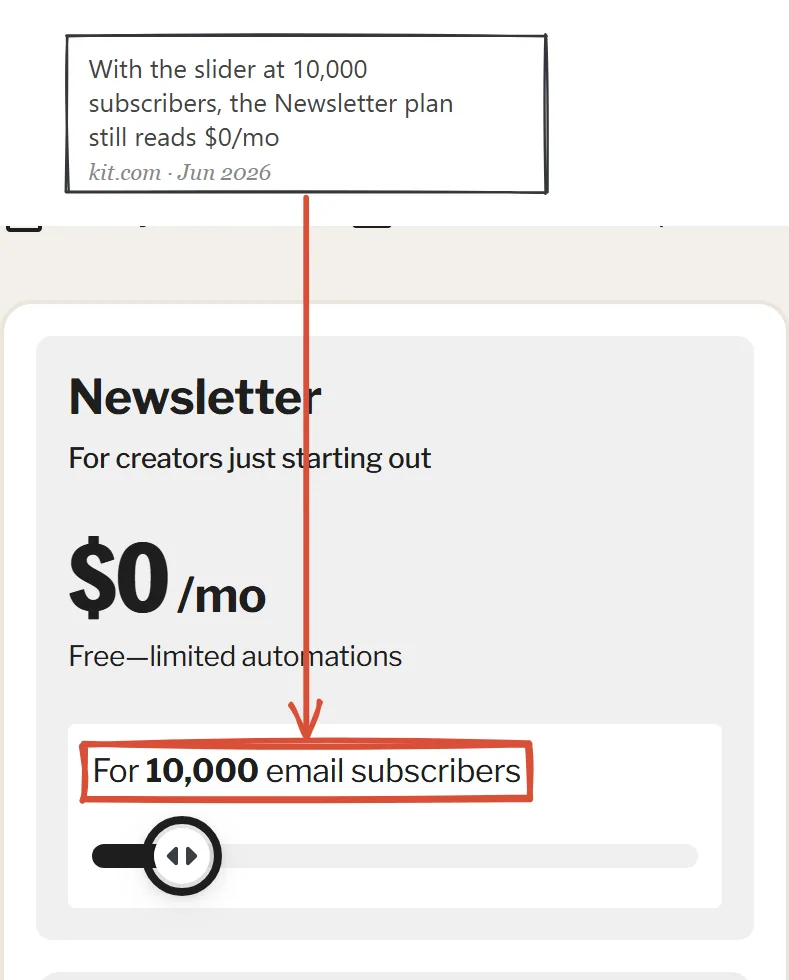
The spec sheets are twins; the machines are not. MailerLite answers yes on 41 of our 53 tracked features and Kit (formerly ConvertKit) on 43, and that tells you nothing. MailerLite is the budget operator's pick: roughly half of Kit's price paid against paid ($89/mo versus $139/mo at 10,000 subscribers), the best-supported paid plans of the eleven platforms we track, EU data hosting under ISO 27001, and 0 percent commission on everything it helps you sell. Kit is the creator operating system: free publishing all the way to 10,000 subscribers, native selling at a 0.6 percent fee from the free tier, the deepest tag-based automation in the creator field, and a recommendations network MailerLite simply does not have.
The traps are real on both sides. MailerLite runs the most trigger-happy suspension machine in our panel and gives free accounts no human support; Kit auto-upgrades your plan the day you cross a threshold and polices affiliate links hard. Under 500 subscribers or paying either way on a budget, start with MailerLite. Monetizing the newsletter itself, or growing past 500 without revenue yet, start with Kit.
Both free tiers are real but unequal: MailerLite covers 500 subscribers and 12,000 sends a month with its automation builder included; Kit covers 10,000 subscribers with one basic automation and required recommendation slots. Neither link pays us anything.
Not sure which fits you?
MailerLite or Kit — answer a few questions
Which fits you?
Loading the quiz…
How we testedVerified June 2026 · 2734 reviews aggregated · MailerLite + Kit tested · 76 sourced claims · pricing from our weekly tracker · methodology public
What we did: Read user signals in full: 1,849 MailerLite reviews and 885 Kit reviews (Capterra, Reddit, G2, Trustpilot), aggregated June 2026, mapped theme by theme with no keyword sampling. Pulled pricing from our weekly automated tracker (verified June 12, 2026). Captured the primary pages live on June 12, 2026: MailerLite's pricing page, its billing help page (the active-subscribers rule), its digital-products page (0% commissions) and its terms of service (the affiliate-links clause); Kit's pricing page with the slider at 10,000 subscribers, its commerce page (the 0.6% fee), its Creator Network page and its acceptable-use article. Read both Trustpilot aggregates live the same day. First-hand: we ran a hands-on Kit trial on June 10, 2026 for our Kit review (11 documented captures); we have not run a hands-on MailerLite account.
What we did NOT do: We did not run deliverability seed-list tests (they violate both vendors' terms and game the result). We did not test MailerLite hands-on, so no MailerLite claim here is presented as first-hand testing. We did not invent a deliverability percentage for either platform.
Refresh cadence: Pricing re-verified weekly by automation; claims manifest with source URL per numeric claim publicly available. Next full refresh September 2026. (pricing verified June 12, 2026). Full methodology →
 MailerLiteMailerLite
 KitKit
The Twin-Spec Trap: Why the Feature Counts Mislead
Put these two side by side on a checklist and they look interchangeable: forty-one yes cells for MailerLite against forty-three for Kit across our 53 tracked features, the same strong categories, paid newsletters and product sales and automation builders on both. Most comparisons stop there and pick the cheaper one. That misses what each machine was built to do. MailerLite grew from a budget email tool into a full marketing suite for people who want email handled: a friendly drag-and-drop editor, a site builder, the lowest sticker in its class, and a support team its users describe by first name. Kit grew from a tool for professional bloggers into what it calls an operating system for creators: one list, unlimited tags, automations that react to clicks and purchases, a checkout, and a network where newsletters grow each other.
The clearest expression of the difference is what each gives away. MailerLite's free plan covers 500 subscribers, down from 1,000 since September 23, 2025, and locks sending the moment you cross the line; the product expects you to pay early and rewards you with low prices. Kit's free Newsletter plan covers 10,000 subscribers, twenty times more, because Kit monetizes creators later: through plan upgrades when they need real automation, and through its 0.6 percent cut when they sell. A creator with 3,000 unmonetized subscribers publishes free on Kit for years while MailerLite already charges around $49/mo for the same list.
Feature Comparison: Where the Twins Actually Diverge
The matrix below renders from the OwnLetter feature layer, source-verified against both vendors' primary documentation in June 2026. Read it knowing the counts are nearly tied, and watch the rows where the orientation shows. Growth: Kit has a recommendations network, MailerLite has none. Monetization: both sell natively, but Kit sells from the free tier at 0.6 percent while MailerLite charges nothing on sales and gates the features by plan. Automation: both say yes; our depth layer scores Kit's tag-and-trigger system at the top of the creator field and MailerLite's step-based builder well behind it, with multi-trigger workflows locked to its Advanced plan. Hosting runs the other way: MailerLite is the only platform in our panel advertising ISO 27001 with EU-only data residency on its public pages.
Pick a plan from the ▾ menu under a platform to see what that plan unlocks and its price at your subs count.
| Feature | MailerLite | Kit (ex-ConvertKit) |
|---|---|---|
| Monthly priceat 2.5K subs · monthly | $33/mo · Growing Business · 2.5K subs | $0/mo · Free ≤10K subs |
| 3/6 | 6/6 | |
| 4/5 | 4/5 | |
| 8/9 | 9/9 | |
| 8/9 | 9/9 | |
| 4/4 | 2/4 | |
| 5/5 | 5/5 | |
| 8/10 | 7/10 | |
| 2/5 | 4/5 | |
| Get started | Try free → | Try free → |
✓ Yes · Partial · — No · dotted = unverified · a plan tag (e.g. Scale) = the cheapest plan that unlocks it; pick a plan above each column and ↑ marks features above it. Verified against vendor sources, September 2026. Some links are paid — OwnLetter may earn a commission at no extra cost to you. It never affects the data.
Straight from the reviews
What real users say
Each site’s average below comes from its own user reviews across Reddit, Trustpilot, Capterra and G2 — the count per site is on each bar. We never invent a quote.
Average score on each review site
MailerLiteKitPraised · Complaint · Split opinion
Average scores pulled from each site on May 31, 2026. Trustpilot scores are a recent sample, not the lifetime average; Reddit has no star ratings. See our methodology.
The shape of each rating matters more than the average. MailerLite's Trustpilot pool is large (4.3 across 3,163 reviews, read live June 12, 2026) and bimodal: paid-plan users praising named support agents at the top, suspension and billing victims in the one-star tail. Kit's pool is small (4.1 across 132) and splits between creators with documented revenue and the auto-upgrade billing cases. Across 267 MailerLite community posts on Reddit, the two recurring anxieties are hidden price creep and sudden algorithmic suspension; in the Kit corpus, they are billing thresholds and a balky editor.
Theme by theme: where the two corpora agree and differ
| What users say about… | MailerLite1849 reviews read | Kit885 reviews read |
|---|---|---|
| MailerLite leads | ||
| MailerLite leads | ||
| MailerLite leads | ||
| Kit leads | ||
| Kit leads | ||
| Kit leads | ||
| See for yourself | Try free → | Try free → |
▲ Praised · ▼ Complaint · ◆ Mixed · top theme / common / minor = how often readers bring it up · ❝ hover any cell for the exact count and a real, sourced quote · · = too few reviews to score. Read in full from Reddit, Trustpilot, G2 and Capterra, June 2026. We never invent a quote. Some links are paid — OwnLetter may earn a commission at no extra cost to you. It never affects the data.
Review sources:RedditTrustpilotG2Capterra
Deep Dive: MailerLite
Across 1,849 MailerLite reviews read in full (Capterra, Reddit, G2, Trustpilot, June 2026), three forces dominate: a support team that is the single most-praised thing in the corpus, a price-to-features ratio reviewers call the best in the category, and a suspension machine that produces its angriest one-star reviews.
The support is the moat, on paid plans
Customer support draws 977 mentions, the largest theme by volume in any corpus we have mapped for this matchup, and the tone is unusual for the category: reviewers name agents individually and describe resolutions in minutes, on weekends included. Our experiential layer agrees, scoring MailerLite's support quality highest of the eleven platforms we track. The retention effect is visible in the reviews themselves:
"I was ready to leave—but after experiencing that level of customer service, I'm MailerLite for life." Trustpilot reviewer, May 2026 (mlvk-18)
Now the structural caveat, because it is the same finding read from the other side: that support exists for paying customers only. The free plan offers no live human channel at all, a sore point reviewers raise unprompted:
"I'm on a free plan and it's crazy that you cannot even send a question to Mailerlite when on free plan… And I used to be a big fan (and a paid user) of the platform." Reddit user (r/Emailmarketing source), March 2025 (mlvk-ml-free-support)
Suspended users report the live-chat button vanishing at the moment of suspension. The best support in the category is also the most conditional.
Zero commission, EU residency, and the budget case
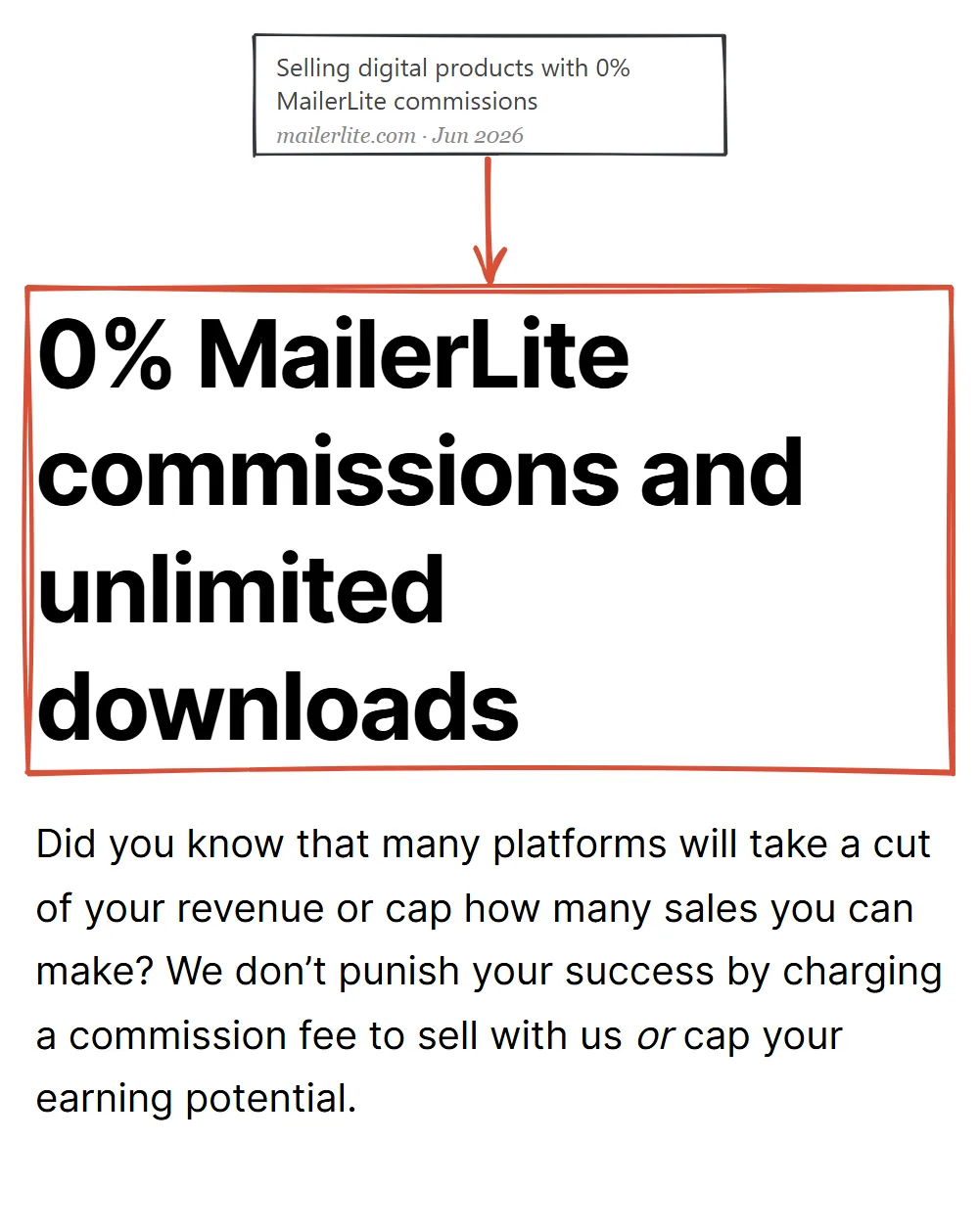
Price and perceived value is the corpus's third theme (458 mentions, strongly positive), and the structural pitch underneath it holds up. MailerLite charges 0 percent commission on its whole monetization stack: paid newsletter subscriptions, digital products, and the booking feature it added in March 2026, with only Stripe's processing fees on top. It is also the only platform in our panel advertising ISO 27001 certification with EU-only data hosting on its public pages, which for a European creator with European subscribers can settle the decision by itself. Two honest brakes: paid subscriptions need the Growing Business plan, so the 0 percent only starts once you pay; and the AI features come with a clause licensing your inputs and outputs to improve MailerLite's models, which sits oddly beside the privacy positioning.
The billing rule that rewards clean lists
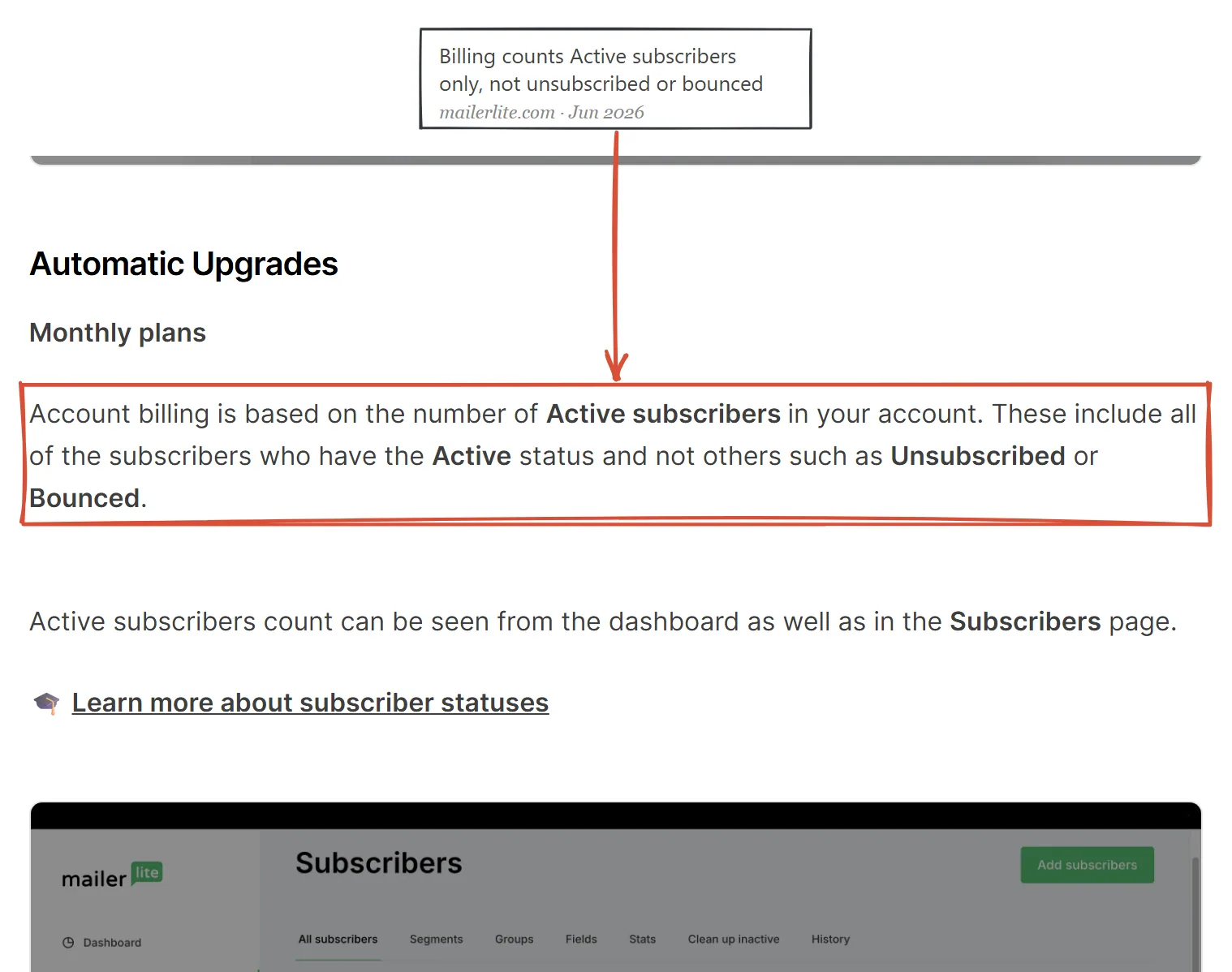
MailerLite bills stored active subscribers: unsubscribed and bounced contacts never count toward your tier, which is genuinely fairer than billing everyone in the database. The nuance reviewers flag is the cycle rule. Any address active at any point during a billing cycle counts for that cycle, even if you delete it mid-month, and the model bills on what you store rather than what you send, so a monthly sender pays the same as a daily one. As one G2 reviewer put it in April 2026, the new pricing "bills on stored active subscribers, not on who you send to."
Our take
Where MailerLite Falls Short
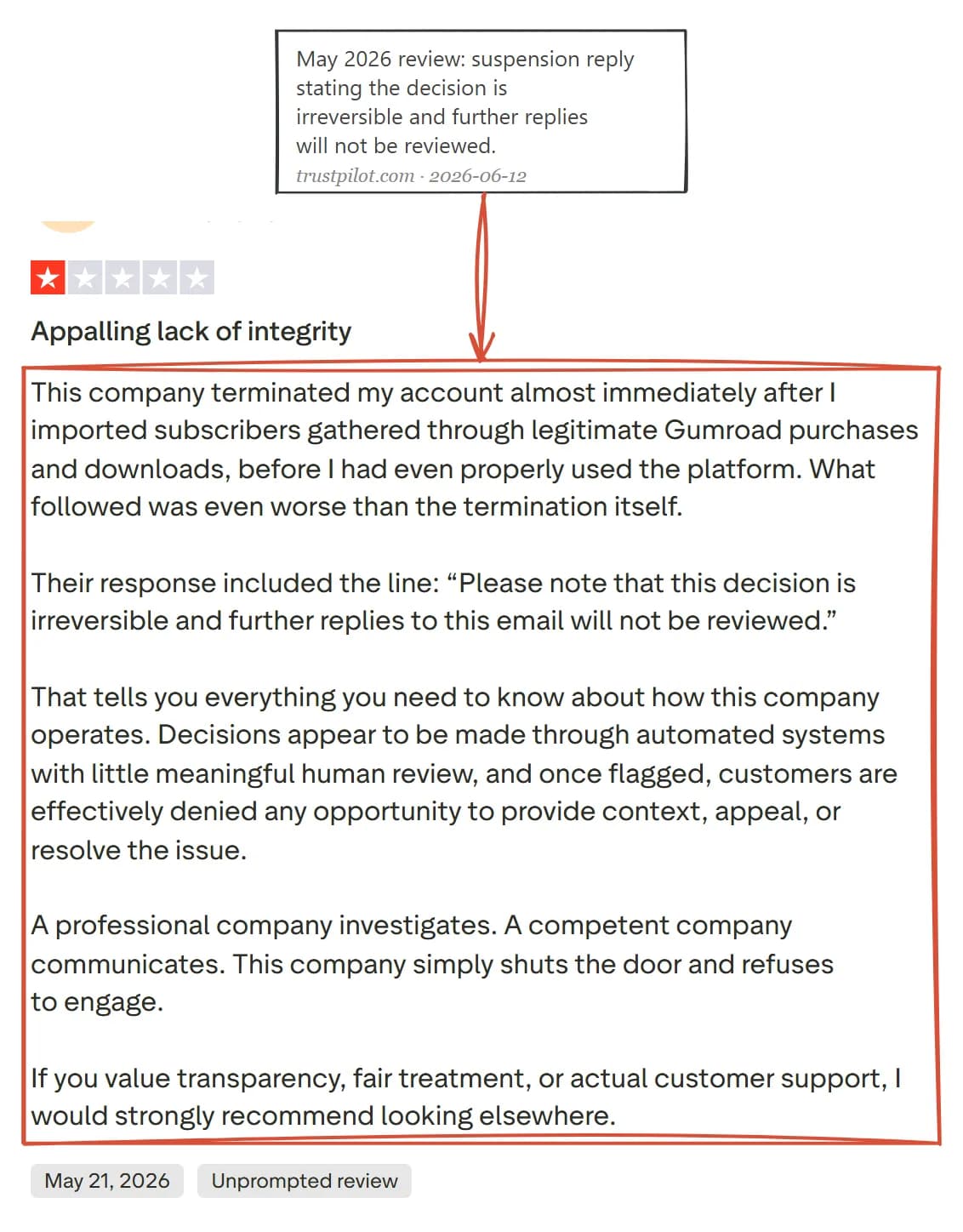
- The suspension machine is the harshest we trackAccount suspension draws 87 mentions in MailerLite's corpus, the strongest negative theme, and the pattern is specific: algorithmic flags with no human recourse, sometimes before a first real send. Reviewers document suspensions after testing between their own mailboxes, after importing double-opt-in lists, and after Gumroad imports. The reply several quote verbatim states that the decision is irreversible and further replies will not be reviewed. Every email platform suspends accounts; what stands out here is the documented absence of appeal.
- The free plan is small, locked, and unsupportedFive hundred subscribers, down from 1,000 since September 23, 2025, with sending locked the moment you cross the limit and no grace period. There is no live human support on the free plan at all, and reviewers report the live-chat button disappearing on suspended accounts, exactly when they need it. The free automation builder is real and genuinely useful; everything around it is fenced.
- Billing has sharp edges around the cycle and after suspensionMailerLite bills stored active subscribers, which fairly excludes unsubscribed and bounced contacts, but any address active at any point in a billing cycle counts for that whole cycle, even deleted mid-month, and infrequent senders pay the same as daily senders on the same base. The corpus also carries post-suspension charges: one reviewer suspended for months was billed $25 again with no notice, no refund and no reply (Trustpilot, May 2026). Annual plans are explicitly no-refund.
- The Classic-to-New migration is a recent scarThe forced move off MailerLite Classic, which ran through 2025, cost some long-time users their lists and automations with no rollback ('users who had emails/automations in Mailerlite Classic could not transfer most of their work across, so had to redo it manually', Capterra, 2025) and came with price increases reviewers put above 50 percent. New arrivals describe external imports as easy, so this is a warning about how the company handles its own transitions, not about joining today.
- No growth network, no mobile app, and an AI clause worth readingMailerLite has no referral program and no discovery mechanism; subscribers arrive only through your own channels. There is no mobile app, and reviewers call the mobile web editor unusable. And for a platform whose strongest structural pitch is EU privacy, its AI terms deserve a careful read: content submitted to the AI features is licensed to improve MailerLite's models, inputs and outputs both.
Deep Dive: Kit
Across 885 Kit reviews read in full (Capterra, Reddit, G2, Trustpilot, June 2026), the profile is sharp: ease of use leads the positives (186 mentions), the tag-based automation system is the loyalty engine, and the angriest reviews cluster on billing thresholds and account moderation. We also tested Kit hands-on in June 2026 for our review; it scored 8.1/10 on our engine, the highest of the six platforms we have scored so far, and pays us nothing.
The automation system is the product
Kit runs one list. Every subscriber carries tags, and automations branch on behavior: what someone clicked, bought, or ignored. Our depth layer puts Kit at the top of the creator field on exactly the axes that matter here, tags and segments, conditional content, trigger automations, where MailerLite's simpler step-based builder trails and locks multi-trigger workflows behind its Advanced plan. The strongest verbatim in the corpus is also the simplest business case:
"I send 160k emails and generate thousands of dollars a month - and I only write one email. This is possible due to Kits automations segmentations."Trustpilot reviewer, March 2026 (kvmc-10)
The fine print is plan-gating, and against MailerLite it cuts ironically. Kit's free tier allows exactly one basic automation, while MailerLite ships its automation builder free. So the platform with the deeper automation paywalls it, and the platform with the shallower one gives it away. Pay for Creator ($39/moat 1,000 subscribers) and the comparison flips decisively in Kit's favor.
The honest counterweight, because the corpus is not all glowing: Kit's editor and reliability draw real complaints, and the sharpest ones come from the same community that praises the automation.
"For the last 2 months it has been SO slow. The email editor is trash and glitches every couple of minutes. Randomly it will throw my curser out…"Reddit user (r/Emailmarketing source), February 2025 (mlvk-kit-editor)
Commerce from the free tier, at 0.6 percent
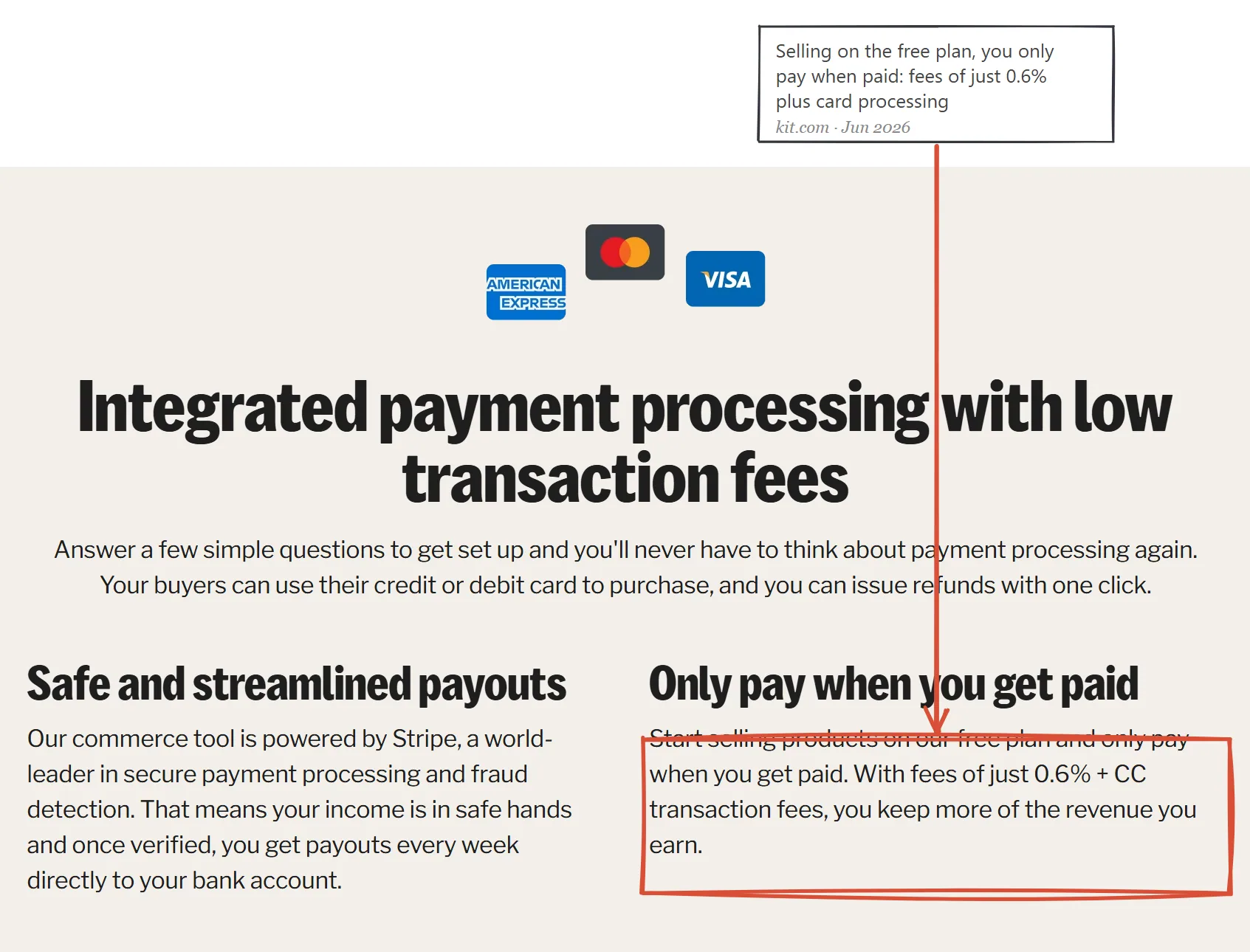
Kit's second structural edge is that money can change hands on the platform from day one. Digital products, paid newsletter subscriptions and a tip jar work on the free plan, with Kit keeping 0.6 percent plus card processing; one reviewer documented $4,488 of product sales through the feature in 2023. MailerLite's 0 percent commission is the better rate, but it starts behind a paid plan and runs exclusively through Stripe. The shapes differ more than the prices: Kit taxes success lightly and charges nothing up front; MailerLite charges up front and taxes nothing.
The Creator Network, the axis with no counterweight
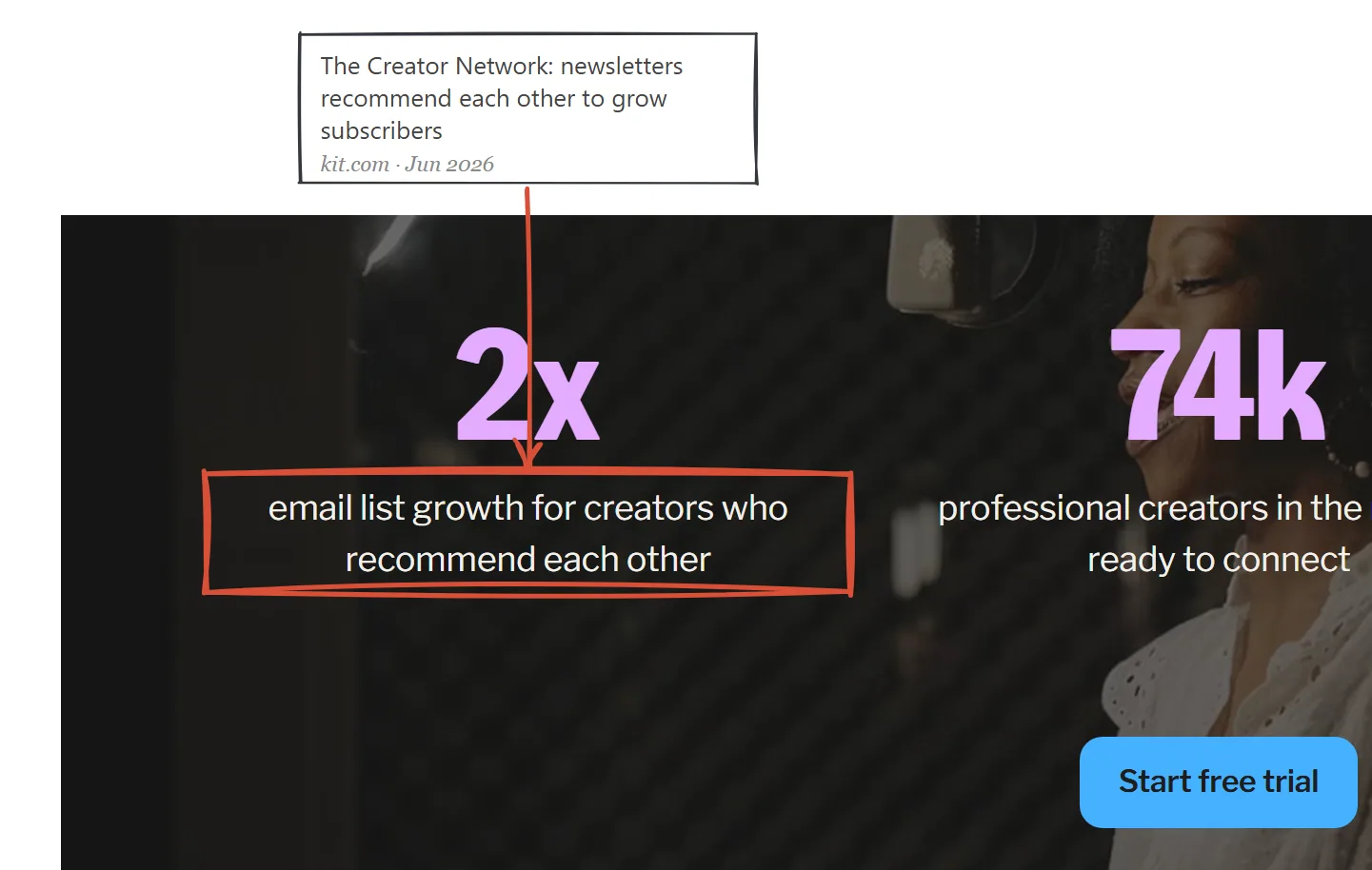
Kit newsletters recommend each other through the Creator Network, which Kit advertises at twice the list growth for participating creators (its own figures). Reviewers treat it as a quiet bonus rather than the headline: "Kit's creator network helps us get more subscribers via recommendations. Most other platforms don't offer this" (G2, April 2026). MailerLite is one of the platforms that does not: no referral program, no discovery mechanism, a gap its own corpus confirms. On every other axis in this comparison the two trade blows; on growth, only one of them shows up.
Our take
Where Kit Falls Short
- The free tier carries forced recommendation slots you cannot turn offKit's pricing page marks Free Recommendations as "Required" on the Newsletter plan: your emails display other creators' newsletters, and removing the slots needs a paid Creator plan. To be precise about what this is, because it is often misreported: these are reciprocal list-growth swaps, no money changes hands, and Kit does not pocket revenue from them. The actual catch is the combination: on the free plan you must show the slots and you cannot earn from recommendations either, since Paid Recommendations (where Kit takes a 23.5% fee) start at Creator.
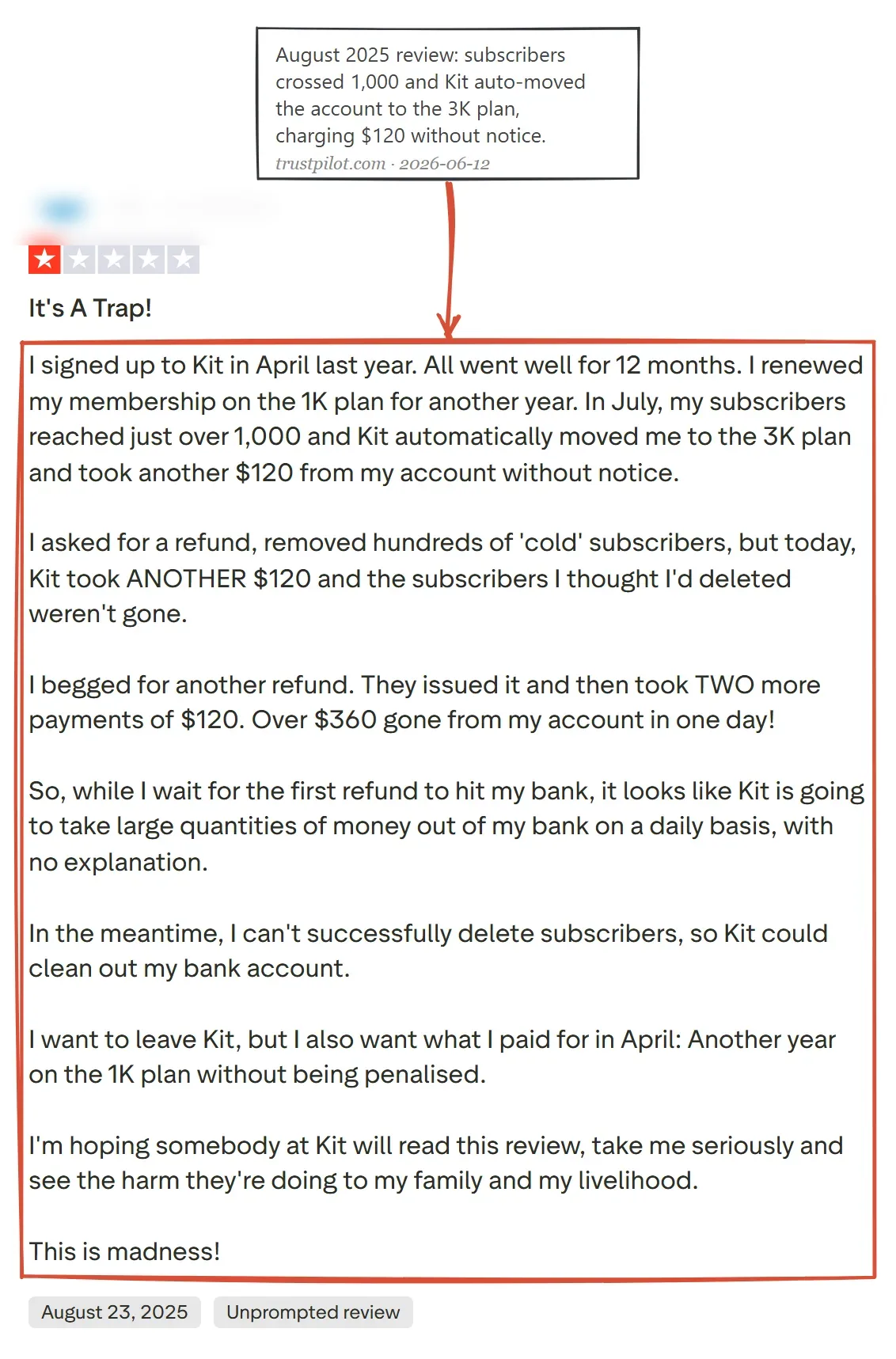
- Billing auto-upgrades on the way up and never on the way downCross your tier's subscriber threshold and Kit moves you to the next plan and charges the difference, without a confirmation step. Shrink back under the threshold and nothing happens until you open a request. An August 2025 Trustpilot review documents the mechanism: just over 1,000 subscribers, an automatic move to the 3K plan, $120 taken without notice, then a second $120 while support sorted out a refund. Cold and disengaged subscribers count toward the threshold until you actively clean them.
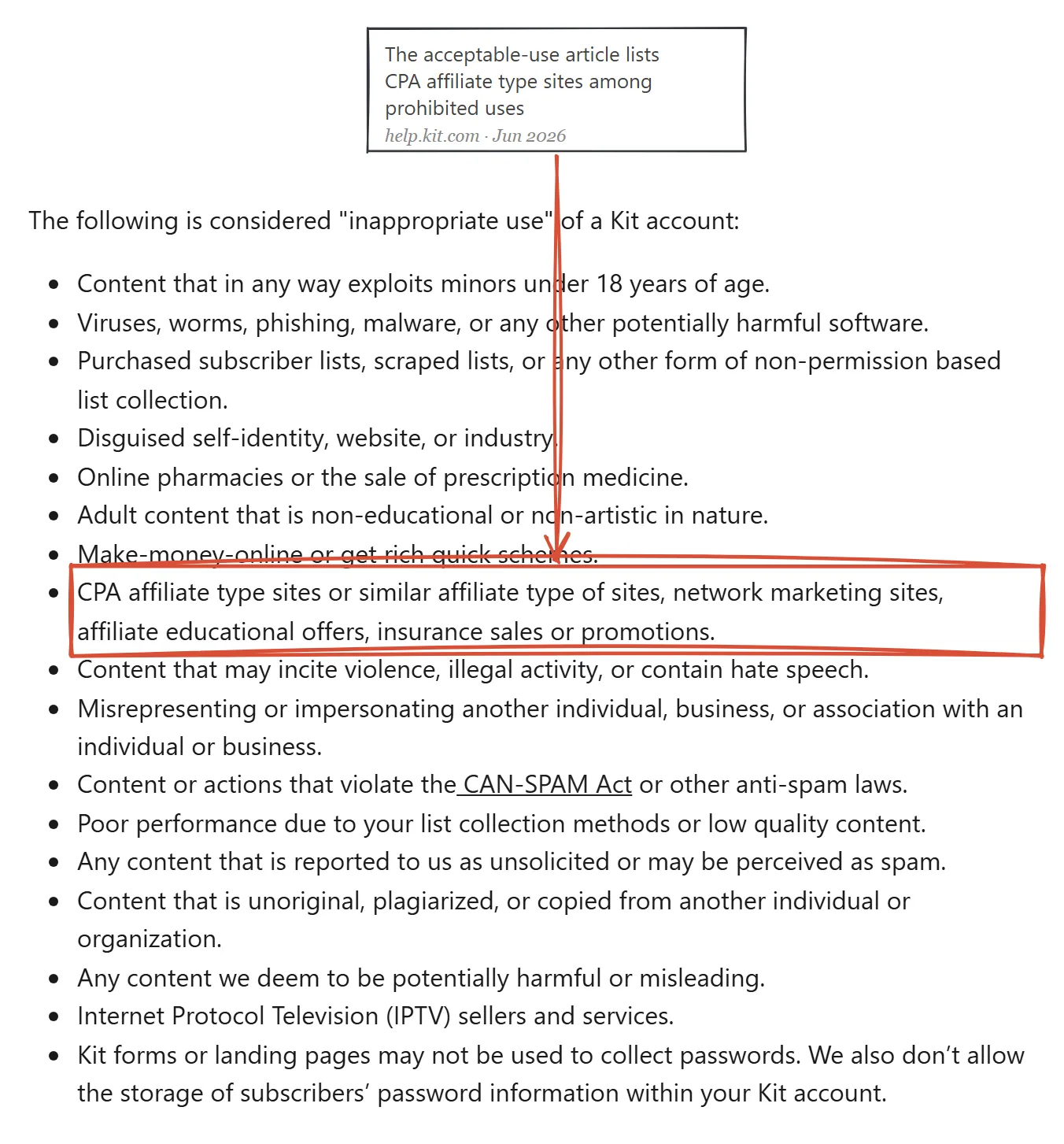
- The moderation machine is strict, opaque, and rough on affiliatesKit's acceptable-use article bans "CPA affiliate type sites" and purchased lists, and reviewers document accounts disabled over a single affiliate link they describe as legitimate, plus brand-new accounts closed before a first send with an AI support bot shutting the tickets. Post-ban, the terms put data export at Kit's discretion, and suspended users report being refused their own subscriber lists. MailerLite's written policy is friendlier to affiliate links; Kit's is not, and it is enforced.
- The differentiating features sit behind Creator and ProThe free tier's one basic automation means the thing Kit is best at, behavioral automation, is effectively paywalled; MailerLite ships its automation builder free. Deep analytics (engagement scoring, the Insights dashboard, deliverability reporting) and content A/B testing require Pro. A free Newsletter account is a real publishing tool for a large list, but it is not the Kit that reviewers praise; budget for Creator if automation is why you came.
- Text-first by design, and no mobile appKit's editor is deliberately minimal: reviewers wanting visual richness call it bare-bones, custom HTML starts on Creator, and the template library is small on purpose. A May 2026 review still flags default formatting that needs a code snippet to fix. There is no mobile app (7 corpus mentions, zero defenses). MailerLite's drag-and-drop is the stronger visual editor of the two; if your emails are designed artifacts rather than letters, Kit is the wrong tool.
Trust, Policies and the Risks That Outlast a Pricing Page
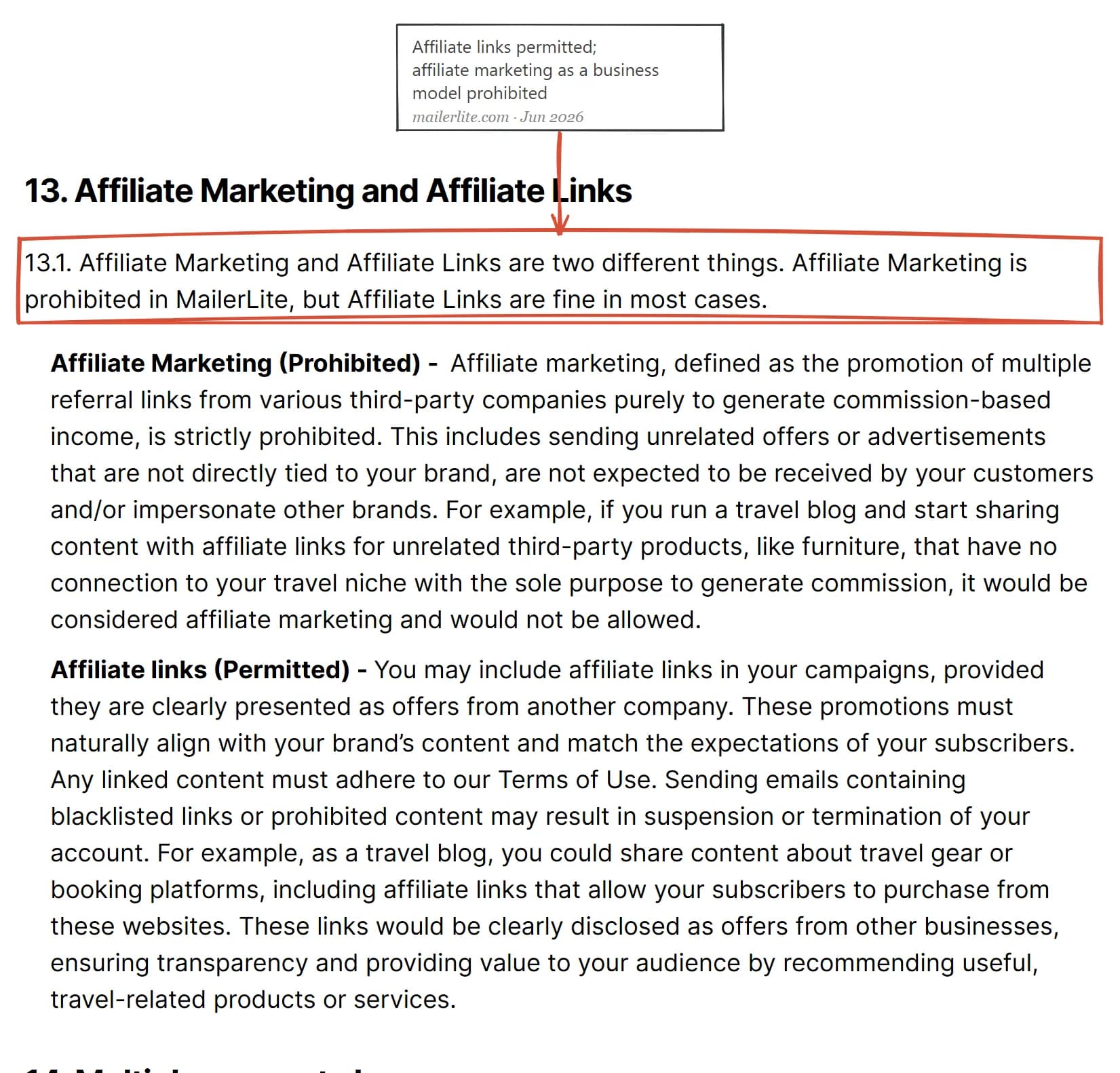
Both platforms can switch you off without a conversation, and both have done it to reviewers who believed they were compliant. The written policies, though, point in opposite directions on the question that matters most to many newsletter operators. MailerLite's terms explicitly permit contextual affiliate links and draw the line at affiliate marketing as the business model itself. Kit's acceptable-use article bans "CPA affiliate type sites", expects most of your content to be your own, and the corpus documents accounts disabled over a single affiliate link. Then practice complicates the paper: MailerLite's enforcement machine is the most aggressive we track, 87 suspension mentions with documented cases before a first real send and replies stating the decision is irreversible.
The ownership stories diverge just as sharply. Kit is bootstrapped, profitable, around $43M in annual revenue (2025, private-company estimate), with a founder publicly committed to never raising venture money: stability by independence, priced through 2025's short-notice repricing. MailerLite has been acquired twice in three years, by Vercom in 2022 and cyber_Folks in 2025, with the new owner targeting SME e-commerce; it also disclosed a breach in 2024 (about 70 accounts, roughly $3.3M stolen via crypto phishing) and handled it in a way security people cite approvingly: notification within hours, a public post-mortem, FIDO2 hardware keys rolled out. The table below renders from our trust-and-risk layer, clauses on hover.
Trust and risk: MailerLite vs Kit
| Platform | Account control | Liability cap | Cost at scale | Vendor longevity | Billing model | Allowed niches |
|---|---|---|---|---|---|---|
| MailerLite | ||||||
| Kit |
✓ favorable to the creator · ◐ mixed · ✗ unfavorable. Hover or tap a cell for the detail. Compiled June 2026 from public terms, status pages and the pricing data layer. Re-verified quarterly.
Pricing Scenarios: Three Zones, Three Different Winners
Both platforms price by list size, so the table reads straight across, but hold the three zones while you read it. Under 500 subscribers, both are free and the comparison is about features. From 500 to 10,000, Kit's free Newsletter plan makes the matchup lopsided for anyone who can live with one automation, because MailerLite is already billing. Paying on both sides, MailerLite runs at roughly half Kit's sticker at every size we track, and the question becomes whether Kit's automation depth, commerce and network earn the difference.
Plans at a glance (verified June 2026)
- · MailerLite Free: 500 subscribers, 12,000 emails/month, automation builder included (single trigger), 1 digital product. No live human support; sending locks at the limit.
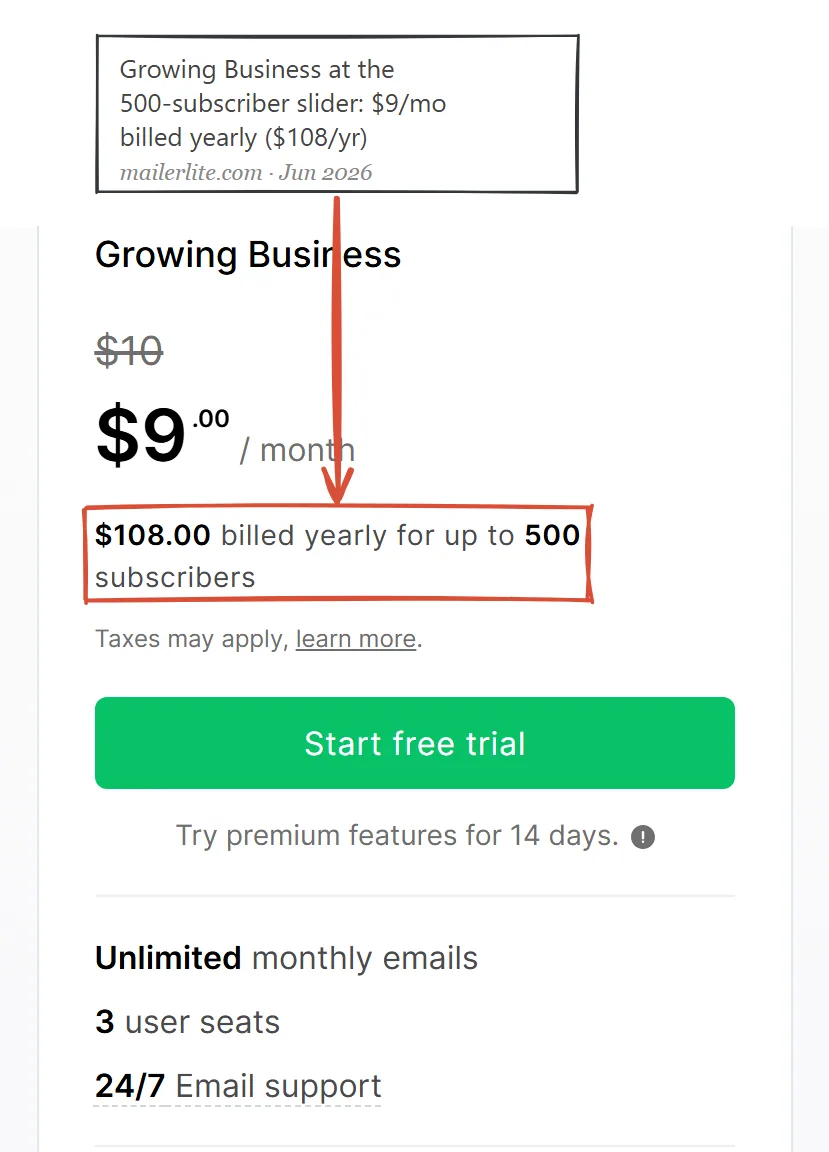
- · MailerLite Growing Business: $19/mo (Growing Business, 1K subs) · verified June 12, 2026 at 1,000 subs ($89/mo at 10K, $179/mo at 25K). Paid newsletter subscriptions at 0% commission, 3 products, unlimited templates and sites.
- · MailerLite Advanced: $39/mo (Advanced, 1K subs) · verified June 12, 2026 at 1,000 subs ($129/mo at 10K). Adds multi-trigger automations, custom HTML, smart sending, live chat support.
- · Kit Newsletter (free): up to 10,000 subscribers, unlimited broadcasts, 1 basic automation, Free Recommendations required, commerce at 0.6% available.
- · Kit Creator: $39/mo (Creator, 1K subs) · verified June 12, 2026 at 1,000 subs ($139/mo at 10K, $199/mo at 25K). Unlimited automations, removable recommendations, migration concierge. Annual billing: two months free.
- · Kit Pro: $79/mo (Pro, 1K subs) · verified June 12, 2026 at 1,000 subs ($189/mo at 10K). Adds engagement scoring, Insights analytics, content A/B testing, SparkLoop referrals.
Cost by list size, and the two traps
MailerLite vs Kit cost by list size (June 2026 tracker)
List size Same list on both | MailerLite Growing Business; free plan stops at 500 subscribers | Kit Creator; Newsletter free to 10K | What the row really says |
|---|---|---|---|
| Starting out | $19/mo → $228/yr | $0 (Newsletter, basics) or $39/mo → $468/yr for full automation | Kit publishes free where MailerLite already bills |
| Established newsletter | $89/mo → $1,068/yr (Advanced $129/mo) | $0 (Newsletter, basics) or $139/mo → $1,668/yr | Paying both ways, MailerLite is about half the price |
| Serious operation | $179/mo → $2,148/yr | $199/mo → $2,388/yr | The gap persists at scale; features decide, not stickers |
| The billing-trap row | Bills any subscriber active at any point in the cycle, even deleted mid-month | Auto-upgrades the plan the day you cross, never auto-downgrades | Different trap, same lesson: prune and watch the meter |
Starting out
- MailerLite
- $19/mo → $228/yr
- Kit
- $0 (Newsletter, basics) or $39/mo → $468/yr for full automation
- What the row really says
- Kit publishes free where MailerLite already bills
Established newsletter
- MailerLite
- $89/mo → $1,068/yr (Advanced $129/mo)
- Kit
- $0 (Newsletter, basics) or $139/mo → $1,668/yr
- What the row really says
- Paying both ways, MailerLite is about half the price
Serious operation
- MailerLite
- $179/mo → $2,148/yr
- Kit
- $199/mo → $2,388/yr
- What the row really says
- The gap persists at scale; features decide, not stickers
The billing-trap row
- MailerLite
- Bills any subscriber active at any point in the cycle, even deleted mid-month
- Kit
- Auto-upgrades the plan the day you cross, never auto-downgrades
- What the row really says
- Different trap, same lesson: prune and watch the meter
Prices from our weekly tracker, verified June 12, 2026, annualized from monthly billing. MailerLite's annual billing runs about 10 percent below monthly; Kit's gives two months free. The last row prices nothing: it is the two billing rules, MailerLite's whole-cycle counting and Kit's auto-upgrade, doing their quiet work.
Switching Between Them: What Moves and What Does Not
The subscriber list moves easily in either direction: CSV export and import are unrestricted on accounts in good standing, Kit preserves imported tags, and MailerLite maps incoming tags onto its Groups. Kit's paid plans add a free migration concierge that moves lists, forms, templates and automations for you. Three asymmetries deserve attention before you commit to a direction.
First, automations never travel as files in either direction; you rebuild the logic in the destination's builder, and the builders think differently (MailerLite in steps, Kit in tag-based branches). Second, trial capacity is asymmetric: a 3,000-subscriber list can rehearse an entire move to Kit on its free tier before paying, while the same list cannot try MailerLite beyond a 14-day premium trial, because the free plan stops at 500. Third, the exit doors differ. Selling paid subscriptions through Kit deepens your commitment: there is no documented path for moving active paid subscribers out cleanly. On MailerLite the equivalent risk is the suspension machine, which can close the account, and with it the support channel, before you have exported.
Whichever direction you move, authenticate a custom sending domain before the first campaign. Our Kit corpus documents an account that sent from a bare Gmail address for years until Google and Yahoo tightened authentication rules in 2024 and its deliverability collapsed; nothing in the onboarding forced the fix, on either platform.
Who Switches, and Who Should Stay
The profile that gains from moving to Kit
The switcher the data supports is a creator on MailerLite whose newsletter is becoming the business: selling something to readers, building behavioral funnels, hunting growth. That profile gains native commerce that works from day one at 0.6 percent, the deepest tag-based automation in the creator field once on Creator, a discovery network MailerLite cannot offer at any price, and, between 500 and 10,000 subscribers, possibly a $0 bill where MailerLite charges monthly. Course creators and digital-product sellers are the cleanest fit in the corpus.
The rational reasons to stay on MailerLite
Five hold up. Price, first and simplest: roughly half of Kit at every paid size, with a billing rule that never charges for unsubscribed contacts. Support: the best-rated paid-plan support of the eleven platforms we track, against Kit's coin-flip. Visual emails: MailerLite's drag-and-drop is the stronger editor of the two, and Kit will not give you one by design. EU compliance: ISO 27001 plus EU-only hosting is an argument no US platform here can copy. And zero commission: an established seller moving real volume keeps more on MailerLite's paid plans than on Kit's 0.6 percent. What does not hold up is staying for the free plan if your list is growing: 500 subscribers with locked sending and no support channel is an exit ramp, not a home.
The risk neither side escapes
Both corpora carry the same failure mode with different fingerprints: MailerLite's machine strikes early and algorithmically (new accounts, imports, even tests between your own mailboxes), Kit's strikes on policy lines (affiliate links, new-account flags). Neither publishes its full criteria, and neither offers an appeal process reviewers describe as real. The export habit is the only insurance both sides honor while the account is in good standing.
Deliverability: Kit's Cleanest Signal, MailerLite's Mixed One, No Numbers
Neither vendor publishes an audited inbox-placement rate, and we will not invent one. The corpus signals lean Kit's way: deliverability is one of its most-cited strengths (46 mentions, positive), with migrants from Mailchimp, Constant Contact, AWeber and MailerLite itself crediting the text-first format and sender-reputation care; one 49,000-subscriber list reports 60 to 65 percent open rates, a self-reported figure we pass along as such. MailerLite's 96 mentions are mixed: solid steady-state placement and several migrants reporting improved opens, against two darker notes, overnight IP-reputation drops without explanation (a Reddit case in 2024, flagged historical, to reconfirm) and 2025 reports of landing in Gmail's Promotions tab more than rivals.
Two honest brakes on the Kit lean. Part of the gap is format, not infrastructure: plain-text-style emails trip fewer Promotions filters, so a designed MailerLite template starts at a disadvantage Kit's editor never takes on. And list quality dominates everything either platform does. Wherever you land, configure SPF, DKIM and DMARC on a custom domain before the first campaign, and treat every published percentage, including the ones in our corpus, as one sender's story.
Frequently asked
Frequently Asked Questions
Is MailerLite cheaper than Kit?
Paid against paid, yes, by roughly half at every size our tracker covers: $19/mo against $39/mo at 1,000 subscribers, $49/mo against $89/mo at 5,000, $89/mo against $139/mo at 10,000 (monthly billing, June 2026 tracker). The free tiers invert the story. Kit's Newsletter plan is free to 10,000 subscribers with one basic automation and required recommendation slots; MailerLite's free plan stops at 500. A 3,000-subscriber list that earns nothing yet publishes on Kit for $0 while MailerLite already bills it around $49/mo. So the honest answer is a question: are you under 500 subscribers, between 500 and 10,000, or paying either way? Each zone has a different winner.
Which platform is safer for a newsletter that uses affiliate links?
On paper, MailerLite: its terms explicitly permit contextual affiliate links and only prohibit affiliate marketing as the business model itself. Kit's acceptable-use policy bans "CPA affiliate type sites", and our corpus documents Kit accounts disabled over a single affiliate link the reviewer describes as legitimate. In practice the answer needs a caveat, because MailerLite runs the most trigger-happy moderation machine we track: 87 suspension mentions, some before a first send was ever made, with replies stating the decision is irreversible. A permissive written policy does not restrain an aggressive algorithm. If affiliate income is core to your newsletter, MailerLite's policy is the better starting point, but on either platform: warm up slowly, keep your list provably opt-in, and export subscribers on a schedule.
Can I sell digital products or a paid newsletter on MailerLite and Kit?
Yes on both, with opposite billing shapes. Kit lets you sell from the free tier and takes 0.6% of revenue plus card processing: digital products, paid newsletter subscriptions and a tip jar all work on every plan. MailerLite charges 0% commission, only Stripe's processing fees, but gates the features by plan: one digital product on free, paid subscriptions from the Growing Business plan, and Stripe is the only supported processor, which excludes markets Stripe does not cover. The math: a fee model costs you nothing until you earn; a gate model costs you a plan before your first sale, then takes nothing as you grow. Low or unproven volume favors Kit's fee; established volume on a list you would pay for anyway favors MailerLite's 0%.
Which has better customer support, MailerLite or Kit?
On paid plans, MailerLite, and it is the widest gap in this comparison. Support is the single largest theme of its 1,849-review corpus (977 mentions, positive-dominant): reviewers name individual agents and describe resolutions in minutes, including weekends, and its G2 support score is the highest of the eleven platforms we track. Kit's 101 support mentions split between genuinely fast help and agents who reviewers say did not read the ticket. The caveat carries real weight: MailerLite's free plan has no live human support at all, and suspended users report the live-chat button disappearing at the exact moment of suspension. Pay MailerLite and you get the category's best support; use it free, or get flagged, and you get none.
Are MailerLite and Kit stable companies to build on?
Both are established, with opposite ownership stories. Kit is bootstrapped and profitable, around $43M in annual revenue (2025, private-company estimate), and its founder is publicly against raising venture capital; the trade-off surfaced as a repricing announced in September 2025 with about a month's notice, which legacy customers experienced as increases of up to 160%. MailerLite has been acquired twice in three years (Vercom in 2022, cyber_Folks in 2025, the new owner targeting SME e-commerce), disclosed a security breach in 2024 affecting about 70 accounts with a response widely considered exemplary, and cut its free tier from 1,000 to 500 subscribers in September 2025. Neither is going anywhere soon; the question is which risk you prefer to live under: independence with founder concentration, or corporate ownership with strategy drift.
How We Built This Comparison
OwnLetter works as a lab-style analyst, not a power-user reviewer. We read 2,734 unique user signals in full (1,849 MailerLite, 885 Kit) across Capterra, Reddit, G2 and Trustpilot, aggregated June 2026, theme-mapped without keyword sampling. Pricing renders from our weekly automated tracker (verified June 12, 2026) and is never typed by hand. On June 12, 2026 we captured the primary pages live: MailerLite's pricing page, billing help, digital-products page and terms of service; Kit's pricing page with the slider at 10,000 subscribers, its commerce page, its Creator Network page and its acceptable-use article. Both Trustpilot aggregates were read live the same day (MailerLite 4.3 across 3,163; Kit 4.1 across 132).
All 76 claims in our manifest carry a source URL and a verification status; zero are invented. First-hand status, stated plainly: we ran a hands-on Kit trial on June 10, 2026 (it powers our Kit review, scored 8.1/10 by our engine); we have not run a hands-on MailerLite account, so nothing here presents MailerLite as "tested by us." Full methodology →
Affiliate status: neither MailerLite nor Kit pays us; we are in neither program and both links are plain. The quiz engine, the feature matrix and the pricing tables are commission-blind by construction, on this page and everywhere else on the site.
Sources
- · MailerLite pricing page (Growing Business / Advanced by subscriber count) (captured June 12, 2026)
- · MailerLite billing help (active subscribers only; unsubscribed and bounced excluded) (captured June 12, 2026)
- · MailerLite digital products page (0% commissions) (captured June 12, 2026)
- · MailerLite terms of service (affiliate links permitted; arbitration; liability) (captured June 12, 2026)
- · MailerLite free-plan FAQ (cut from 1,000 to 500 subscribers, September 23, 2025) (verified June 11, 2026)
- · Kit pricing page (free Newsletter to 10,000; Free Recommendations required) (captured June 12, 2026)
- · Kit commerce page (selling from the free plan, 0.6% fee) (captured June 12, 2026)
- · Kit Creator Network page (captured June 12, 2026)
- · Kit acceptable-use article (CPA affiliate type sites prohibition) (captured June 12, 2026)
- · Trustpilot MailerLite reviews (4.3/5 across 3,163, read live June 12, 2026)
- · Trustpilot Kit reviews (4.1/5 across 132, read live June 12, 2026)
Who Should Pick Which
If your newsletter is the business (writing, courses, digital products):
Kit. Free publishing to 10,000subscribers while you grow, native selling at 0.6 percent from day one, the strongest tag-based automation in the creator field once you pay for Creator, and a recommendations network that compounds growth. Accept the trade-offs knowingly: required recommendation slots on the free tier, roughly double MailerLite's price when paying, a strict moderation machine, and an editor that will never win a design award.
Try Kit free →If you want professional email at the lowest sane price, with real support:
MailerLite earns its keep. Roughly half of Kit's price at every paid size, a billing rule that never charges for people who left, the best-supported paid plans of the eleven platforms we track, the stronger visual editor, EU hosting under ISO 27001, and 0 percent commission on what you sell. Manage the risks: keep your list provably opt-in (the suspension machine is unforgiving), do cleanup at the start of billing cycles, and do not park a growing list on the 500-subscriber free plan.
Try MailerLite free →If you monetize with affiliate links:
MailerLite's written terms are the friendlier home: contextual affiliate links are explicitly permitted, where Kit bans "CPA affiliate type sites" and has suspended reviewers over single legitimate links. Weigh that against MailerLite's enforcement record before relaxing: its algorithm suspends first and does not hear appeals. Whichever you pick, read the policy, warm up slowly, and export on a schedule; our Kit alternatives guide routes the affiliate case across the whole panel.
If you are between 500 and 10,000 subscribers and not earning yet:
This zone has only one $0 option, and it is Kit's. MailerLite's free plan ends at 500 subscribers with sending locked at the line; Kit's Newsletter plan carries you to 10,000with one automation and required recommendation slots. Publish free on Kit, and revisit the comparison the day your list starts paying you, when MailerLite's lower paid prices and 0 percent commission become the counter-argument.
Coming from Substack instead? MailerLite is measured against it in our Substack vs MailerLite comparison, and Kit in Substack vs Kit. The full field is ranked in our best newsletter platforms guide.
Join the Discussion
Using MailerLite or Kit? Share your experience or correct an inaccuracy. No account required: email and name only. Comments are moderated.