On this page (16 sections)
MailerLite vs Mailchimp 2026: Half the Price, a Stricter Door

By Arthur Brulard, Founder of OwnLetter. Cross-vendor analyst review across 11 newsletter platforms, aggregating user signals from Reddit, G2, Capterra, Trustpilot, and Hacker News. LinkedIn
Published June 12, 2026 · Updated June 12, 2026 · 20 min read
Quick verdict
MailerLite is the stronger default for most small senders comparing these two. It runs about half Mailchimp's price at every list size we track: $89/mo versus $135/moat 10,000. It bills only active subscribers, while Mailchimp counts unsubscribed contacts in your bill. It sells paid newsletters natively with a 0 percent fee, and it tops our 3,883-review aggregation on support quality. Mailchimp keeps two real edges: deeper Customer Journey automation, and the category's largest integration ecosystem with over 300 connectors. The caveats run the other way too. MailerLite polices accounts harder than anyone. Every account passes an approval gate, and our corpus documents 87 algorithmic suspensions with no human appeal. Mailchimp's owner Intuit, meanwhile, named it an area of reduced investment in May 2026. Switch for the bill and the support. Stay for the integrations and team familiarity.
Both have free tiers: MailerLite covers 500 subscribers and 12,000 emails a month with the automation builder included; Mailchimp covers 250 contacts and 500 sends. Neither link pays us anything.
Not sure which fits you?
MailerLite or Mailchimp — answer a few questions
Which fits you?
Loading the quiz…
How we testedVerified June 2026 · 3883 reviews aggregated · MailerLite + Mailchimp tested · 44 sourced claims · pricing from our weekly tracker · methodology public
What we did: Read user signals in full: 1,849 MailerLite reviews (Capterra, Reddit, G2, Trustpilot) and 2,034 Mailchimp reviews, aggregated June 2026, mapped theme by theme with no keyword sampling. Pulled pricing from our weekly automated tracker (verified June 9, 2026). Fetched MailerLite's primary pages live on June 12, 2026: the pricing page, the plan-and-billing help page (the Active-subscribers rule), the free-plan FAQ, the paid-newsletter page (0% sales fee), the terms of service (approval gate, affiliate-links clause), and the Mailchimp-import help page. Re-checked Mailchimp's pricing, help and acceptable-use pages (verified live June 11, 2026) and read both Trustpilot aggregates live on June 12. First-hand: we operate a MailerLite account (hands-on review, June 2026); we have not run a paid Mailchimp account.
What we did NOT do: We did not run deliverability seed-list tests (they violate both vendors' terms and game the result). We did not test Mailchimp's paid plans hands-on, so no Mailchimp claim here is presented as first-hand testing. We did not invent a deliverability percentage for either platform.
Refresh cadence: Pricing re-verified weekly by automation; claims manifest with source URL per numeric claim publicly available. Next full refresh September 2026. (pricing verified June 9, 2026). Full methodology →
 MailerLiteMailerLite
 MailchimpMailchimp
Same Pricing Shape, Two Different Rules About Who Counts
Both platforms charge by the size of your list. That makes this the rare matchup where prices compare directly. The first difference is the sticker. At 2,500 subscribers, MailerLite's Growing Business plan runs $33/mo against $60/mo for Mailchimp Standard. At 10,000 it is $89/mo against $135/mo. At 25,000 it is $179/mo against $310/mo. Across our weekly tracker, the like-for-like MailerLite plan sits at roughly half Mailchimp's price (41 to 54 percent, depending on size), every week we have measured.
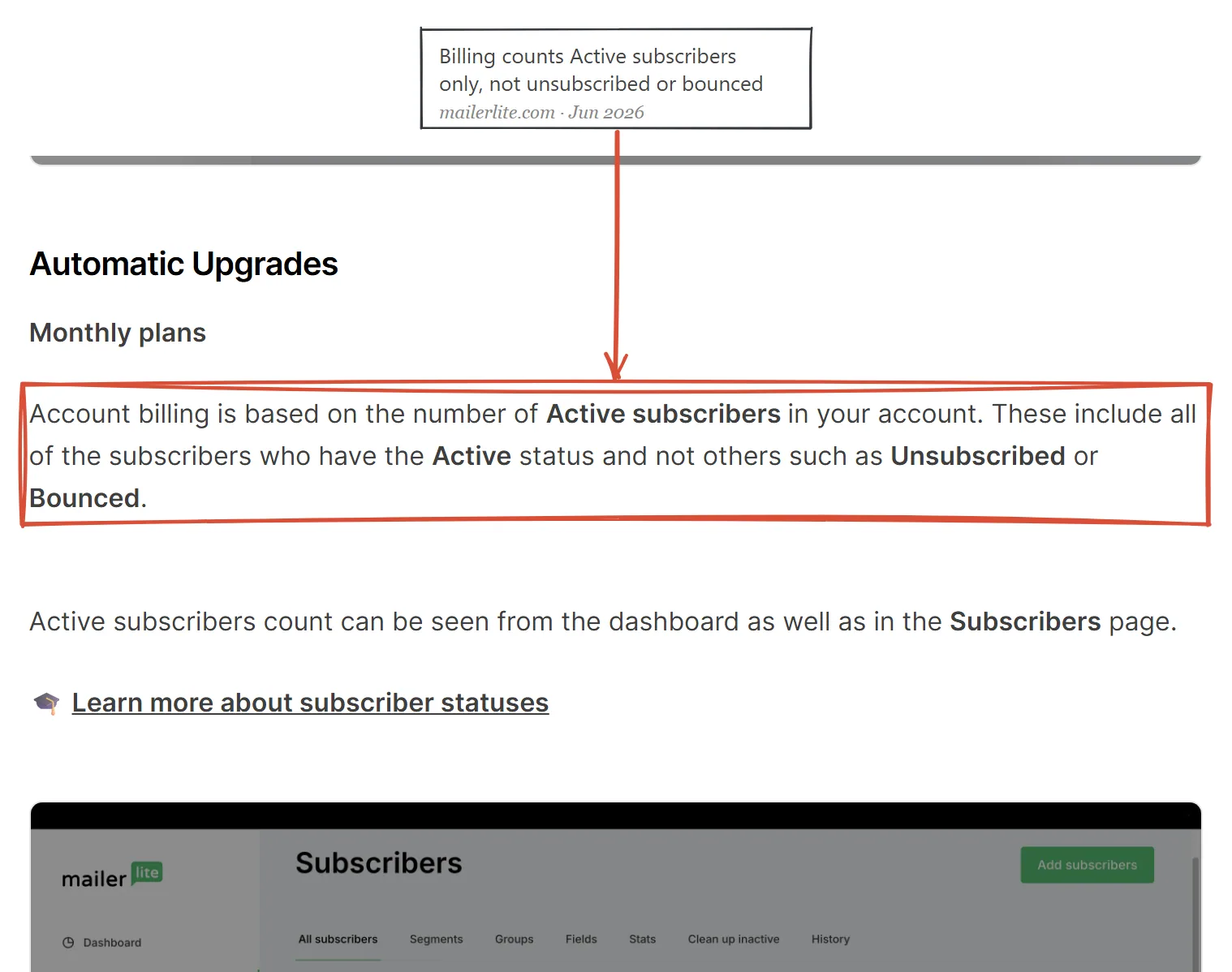
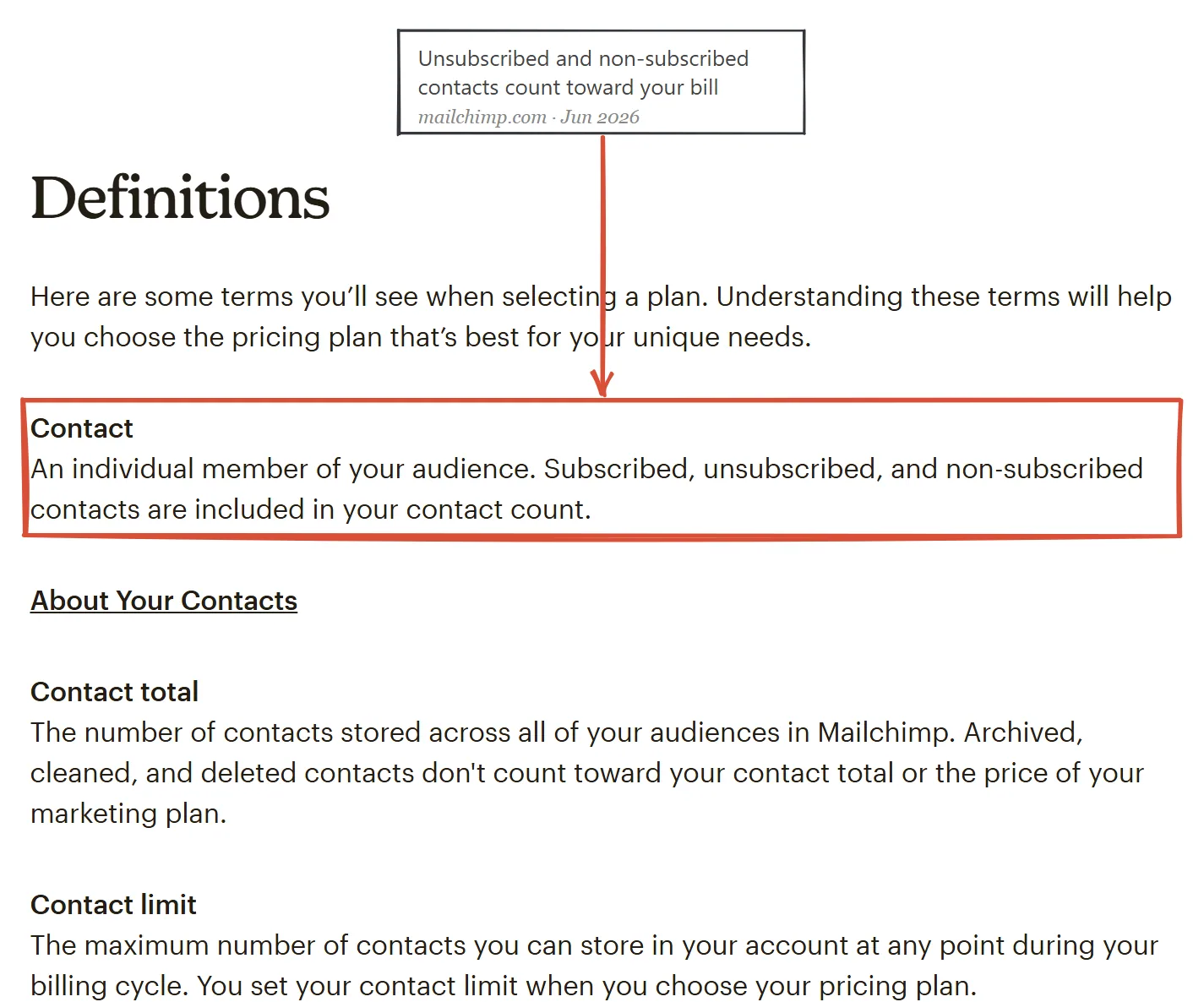
The second difference is subtler and costs real money: who gets counted. MailerLite's help center is explicit that billing is based on Active subscribers, "not others such as Unsubscribed or Bounced." Mailchimp's help is equally explicit in the opposite direction: "Subscribed, unsubscribed, and non-subscribed contacts are included in your contact count." The same neglected list costs nothing extra on MailerLite and keeps billing on Mailchimp until you manually archive the dead weight. One rule punishes churn; the other forgives it.
Feature Comparison: Monetization, Automation, Growth
The capability split is narrower than the price split, and it cuts both ways. MailerLite brings a native paid-newsletter product (Stripe checkout, 0 percent sales fee on Growing Business and up), an automation builder that ships even on the free plan, and websites, landing pages and digital-product sales in the base price. Mailchimp answers with Customer Journey automations that go deeper once you pay for Essentials and up, behavioral segmentation, a 1-to-5 engagement rating, and an integration catalog MailerLite cannot approach: the matrix below is data-driven from the OwnLetter feature layer, source-verified against both vendors' primary documentation in June 2026.
Pick a plan from the ▾ menu under a platform to see what that plan unlocks and its price at your subs count.
| Feature | MailerLite | Mailchimp |
|---|---|---|
| Monthly priceat 2.5K subs · monthly | $33/mo · Growing Business · 2.5K subs | $45/mo · Essentials · 2.5K subs |
| 3/6 | 0/6 | |
| 4/5 | 4/5 | |
| 8/9 | 9/9 | |
| 8/9 | 9/9 | |
| 4/4 | 4/4 | |
| 5/5 | 5/5 | |
| 8/10 | 8/10 | |
| 2/5 | 2/5 | |
| Get started | Try free → | Try free → |
✓ Yes · Partial · — No · dotted = unverified · a plan tag (e.g. Scale) = the cheapest plan that unlocks it; pick a plan above each column and ↑ marks features above it. Verified against vendor sources, September 2026. Some links are paid — OwnLetter may earn a commission at no extra cost to you. It never affects the data.
Straight from the reviews
What real users say
Each site’s average below comes from its own user reviews across Reddit, Trustpilot, Capterra and G2 — the count per site is on each bar. We never invent a quote.
Average score on each review site
MailerLiteMailchimpPraised · Complaint · Split opinion
Average scores pulled from each site on May 31, 2026. Trustpilot scores are a recent sample, not the lifetime average; Reddit has no star ratings. See our methodology.
Read the spread carefully: MailerLite scores high on every site, while Mailchimp splits hard between Capterra (business users praising ease) and Trustpilot (billing and suspension crises). The split itself is information.
Theme by theme: where the two corpora agree and differ
| What users say about… | MailerLite1849 reviews read | Mailchimp2034 reviews read |
|---|---|---|
| Mailchimp leads | ||
| MailerLite leads | ||
| MailerLite leads | ||
| Even | ||
| Even | ||
| Mailchimp leads | ||
| See for yourself | Try free → | Try free → |
▲ Praised · ▼ Complaint · ◆ Mixed · top theme / common / minor = how often readers bring it up · ❝ hover any cell for the exact count and a real, sourced quote · · = too few reviews to score. Read in full from Reddit, Trustpilot, G2 and Capterra, June 2026. We never invent a quote. Some links are paid — OwnLetter may earn a commission at no extra cost to you. It never affects the data.
Review sources:RedditTrustpilotG2Capterra
Deep Dive: MailerLite
Across 1,849 MailerLite reviews read in full (Capterra, Reddit, G2, Trustpilot, June 2026), three signals dominate: support quality that users name as the reason they stay, a price-to-features ratio competitors rarely beat, and a moderation machine that produces the corpus's angriest one-star reviews.
Support is the retention engine, with one big asterisk
Customer support is MailerLite's most-mentioned theme, and by a wide margin: 977 mentions, positive-dominant. Paying users name individual agents, describe resolutions in minutes including on weekends, and compare the experience directly against the platforms they left. A Capterra reviewer in September 2025:
"Instead of waiting 24+ hours like I did with ActiveCampaign, I now get live chat responses within seconds."Capterra reviewer, September 2025 (C-015)
The asterisk: the praise comes almost exclusively from paid plans. Live support is absent on the free tier, and the corpus documents the chat button disappearing entirely on suspended accounts, exactly when a user needs it most. Across 267 r/MailerLite-adjacent Reddit threads in our corpus, the free-tier wall is a recurring sore point:
"I'm on a free plan and it's crazy that you cannot even send a question to Mailerlite when on free plan… And I used to be a big fan (and a paid user) of the platform." Reddit user (r/MailerLite source), March 2025
Mailchimp's support theme shows the same paid-versus-free fracture, so switching does not change the rule that free users talk to a help center, not a human.
The price argument, in the reviewers' own words
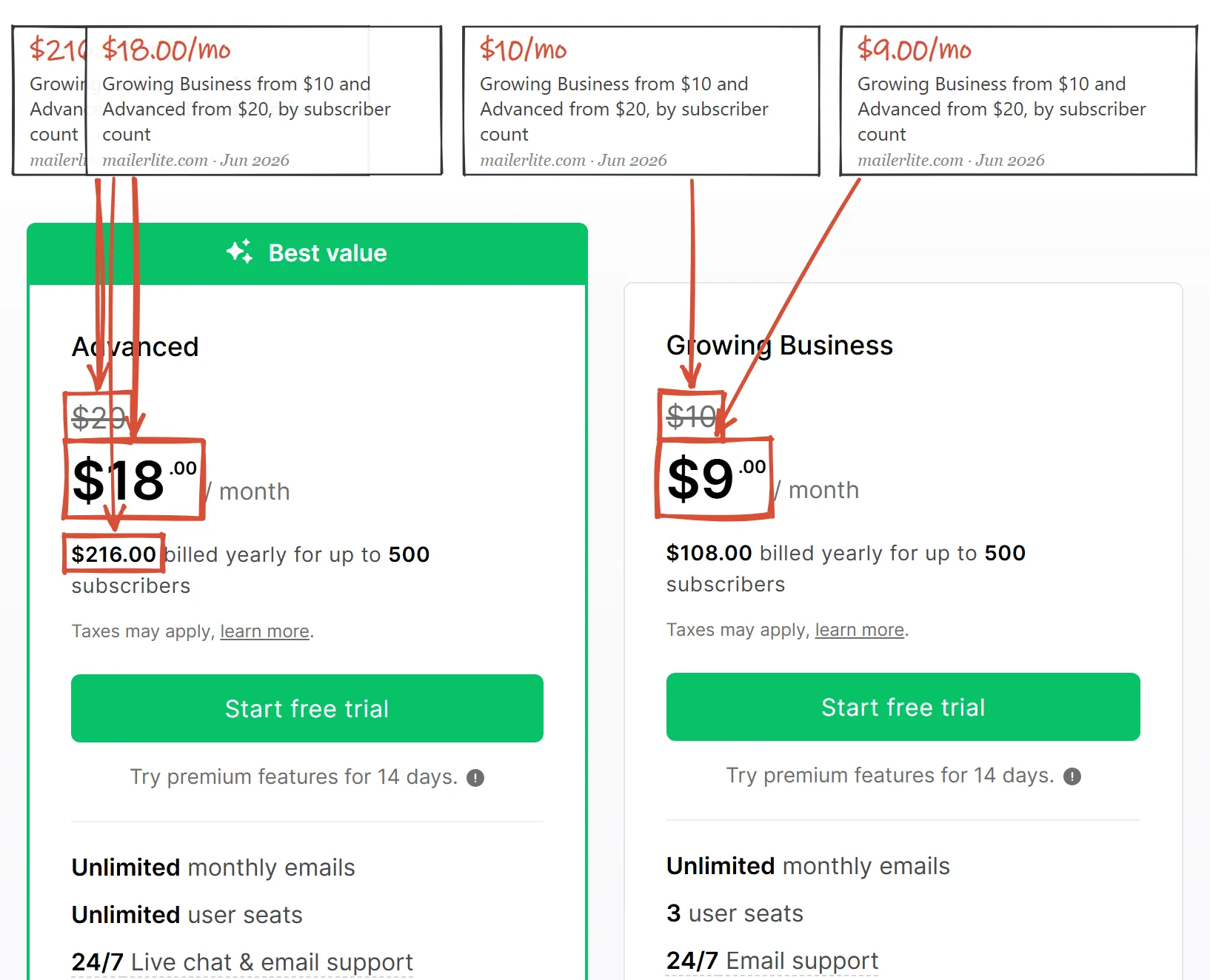
Price and perceived value is MailerLite's third theme (458 mentions, strongly positive), and the corpus consistently frames it against this exact rival: cheaper than Mailchimp, simpler than Kit, far less than ActiveCampaign. Our differentiation table from the full corpus reads, verbatim: MailerLite is "la destination par défaut des fuyards Mailchimp", the default destination for users leaving Mailchimp, with easy list migration cited as part of the draw. The free plan reinforces it: 500 subscribers and 12,000 emails a month with the automation builder included, against Mailchimp's 250 contacts and 500 sends with no real automation flows.
The honest counterweight comes from the same corpus, and it is the single most useful sentence for an infrequent sender:
"the new MailerLite pricing model bills on stored active subscribers, not on who you send to."G2 reviewer, April 2026 (C-008)
A quarterly sender stores subscribers all year and pays for every month of shelf space. The rule is still gentler than Mailchimp's, which adds the unsubscribed on top, but neither platform rewards a big list you rarely email.
The paid newsletter nobody mentions in this matchup
Buried in MailerLite's help center is a feature that settles a whole category of this comparison: Growing Business and Advanced accounts can sell paid newsletter subscriptions, recurring subscriptions and digital products through Stripe, with a 0 percent sales fee. Mailchimp has no native equivalent at any price; charging readers there means a third-party checkout bolted onto the API. For a writer who plans to monetize the list itself, this is a structural advantage hiding behind a budget-tool reputation.

Our take
Where MailerLite Falls Short
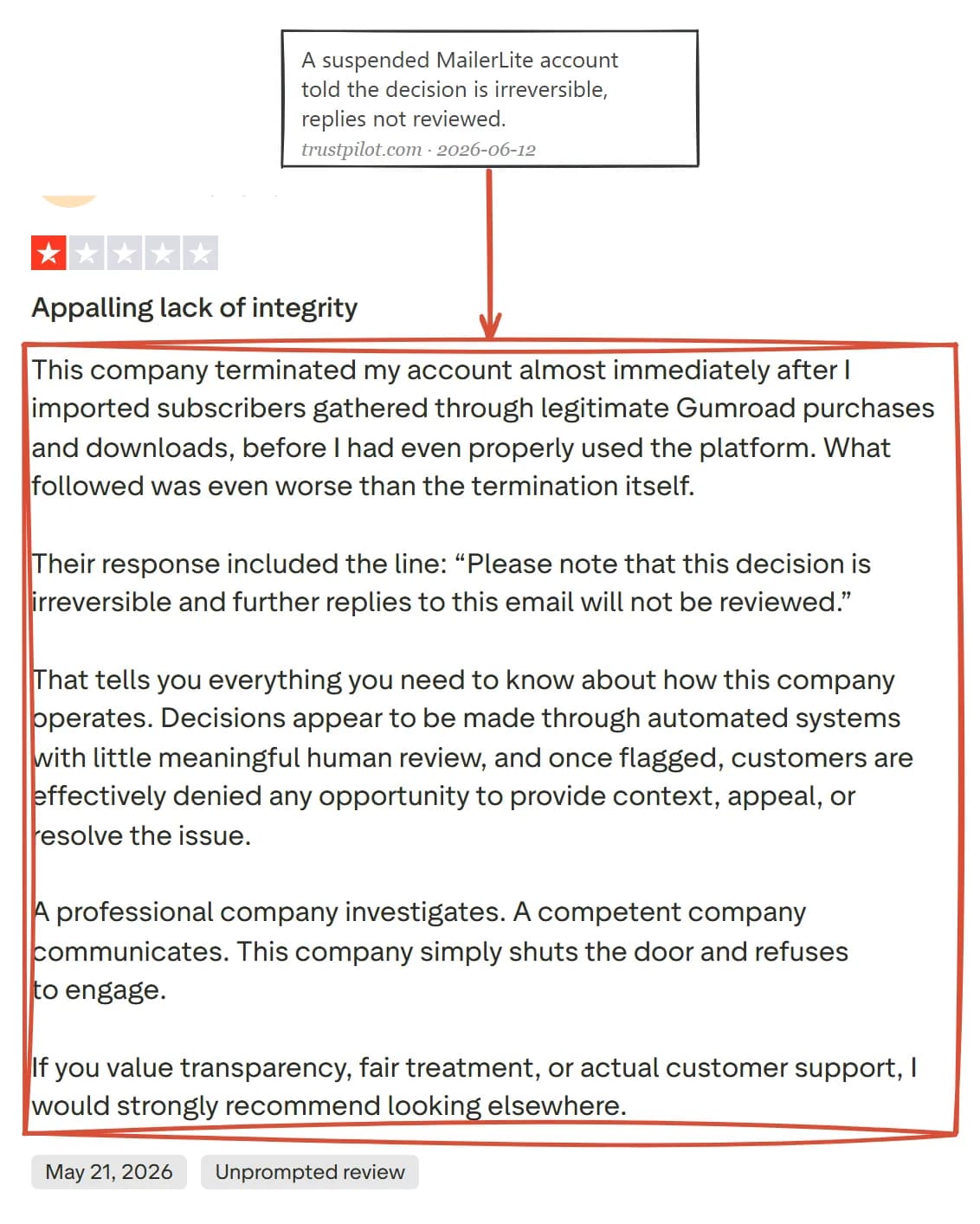
- The approval gate, and suspensions with no human appealEvery new account must request approval before sending (terms of service 5.1), and moderation afterward is algorithmic. Suspension is the sharpest negative theme in our 1,849-review corpus (87 mentions): accounts cut off before a first real send, after importing legitimate double-opt-in contacts, even after testing on the owner's own mailboxes. One documented rejection reply: "Please note that this decision is irreversible and further replies to this email will not be reviewed." Clean lists usually sail through, but there is no human recourse if the algorithm decides otherwise.
- You pay for stored subscribers, not for sendsMailerLite's post-2024 pricing bills on the active subscribers you store, not on how often you email them. A G2 reviewer named the mechanism in April 2026: "the new MailerLite pricing model bills on stored active subscribers, not on who you send to." A monthly sender pays exactly as much as a daily one. The rule is still kinder than Mailchimp's (unsubscribed and bounced contacts are excluded), but an infrequent publisher with a big dormant list is paying for shelf space either way.
- The Classic-to-New migration burned its own usersMailerLite's forced migration from its Classic platform (2023-2025) is the skeleton in its closet: reviewers document entire lists lost in the transfer, automations that could not be carried over and had to be rebuilt by hand, and price increases above 50% on the new billing model. It is finished now, and new signups never touch Classic, but it shows how the company handles a breaking change, and reviewers have not forgotten it.
- Billing complaints cluster around suspensions and refundsA smaller but sharp theme (39 mentions): no refunds on annual plans regardless of when you cancel, and documented cases of charges continuing after an account was suspended. One Trustpilot reviewer in May 2026 reported being billed again months after suspension, with no response to support tickets. Pay monthly until you trust the platform, and calendar your renewal date.
- No mobile app, smaller integration catalogThere is no dedicated mobile editing app, and reviewers call the mobile web experience unusable for building emails (22 mentions). The native integration catalog is also far smaller than Mailchimp's 300+ ecosystem: Shopify and Zapier cover most gaps, but niche tools that ship a one-click Mailchimp connector often have nothing for MailerLite.
Deep Dive: Mailchimp
Across 2,034 Mailchimp reviews (Capterra, Reddit, G2, Trustpilot, June 2026), the picture is a strong product aging into an expensive one: ease of use leads everything (773 mentions), the integration ecosystem keeps users who would otherwise leave, and the bill is the most polarizing topic in the corpus.
Why people still pick it: the on-ramp and the connectors
Mailchimp remains the category's easiest first email tool. A non-marketer can produce a professional campaign unaided, and the corpus says so across every year and platform. A Capterra reviewer in December 2025: "Mailchimp is fairly easy to use. The interface is clean and intuitive and I love how quickly our team was able to put together professional-looking emails." Around that editor sits the real moat: Mailchimp states over 300 integrations, from Shopify and WooCommerce to niche sector tools that ship a Mailchimp connector and nothing else. In the corpus, the integration ecosystem is the most common reason users who complain about price stay anyway.
The ease has a ceiling, and reviewers describe it in architectural terms:
"Over the years, Mailchimp has tried to become a CRM, as a result, the admin ui has become quite painful and hard to navigate. Things are not where you would expect them to be."Capterra reviewer, February 2025 (C-018)
The automation edge is real, and it is the reason to stay
On automation depth, our feature layer routes this axis to Mailchimp, and honestly so: Customer Journeys from the Essentials plan, behavioral and tag segmentation, A/B testing, send-time optimization and an engagement rating make a deeper kit than MailerLite's builder, whose multiple-trigger automations are gated to the Advanced plan. The corpus keeps expectations in check: reviewers call the journey builder "dated" next to Klaviyo or ActiveCampaign (409 automation mentions, mixed). Deeper than MailerLite, well short of a power CRM.
One Reddit operator compressed the whole matchup into two sentences in May 2026, and it is worth quoting as the fairest pro-Mailchimp case in the corpus:
"Mailchimp wins on polish. the editor is the friendliest in the category, templates look good out of the box, a non-marketer can send something decent unaided. you pay for that, and the price scales aggressively as your list grows. that's the catch everyone eventually hits." Reddit user (r/remotework source), June 2026
The catch has a new dimension since May 2026: Intuit, which bought Mailchimp in 2021 for about $12 billion, publicly named it an area of reduced investment, alongside roughly 3,000 job cuts and an AI refocus. Intuit weighed a sale and is not selling on the terms available; it will run Mailchimp for cash flow. You are not betting on a product that disappears. You are betting on one that gets more expensive while getting less attention.
Our take
Where Mailchimp Falls Short
- You pay for contacts you can never emailMailchimp bills by total stored contacts, and its help center is explicit: "Subscribed, unsubscribed, and non-subscribed contacts are included in your contact count." Only archived, cleaned or deleted contacts stop billing. A subscriber who left two years ago keeps consuming a paid slot until you manually purge them. The sharpest verbatim in our corpus: "Showed $14/mo in my dashboard then charged me $566 automatically for contacts which I already deleted."
- Among the most expensive in the category, and climbingPrice and value is Mailchimp's most polarizing theme (748 mentions, negative-dominant): above 5,000 to 10,000 contacts, users report bills two to five times competitors' for the same list. Post-Intuit increases are a separate grievance (159 mentions), with long-tenured customers describing tariffs that more than doubled. In May 2026 Intuit added the final data point by naming Mailchimp an area of reduced investment: a rising bill for a product getting less attention.
- The interface becomes a labyrinth past basic campaignsEase of use is Mailchimp's headline strength, and it is real for simple sends. It degrades at scale. A Capterra reviewer in February 2025: "Over the years, Mailchimp has tried to become a CRM, as a result, the admin ui has become quite painful and hard to navigate. Things are not where you would expect them to be." Audiences, conditional journeys and advanced segments are where the friendly editor stops being friendly.
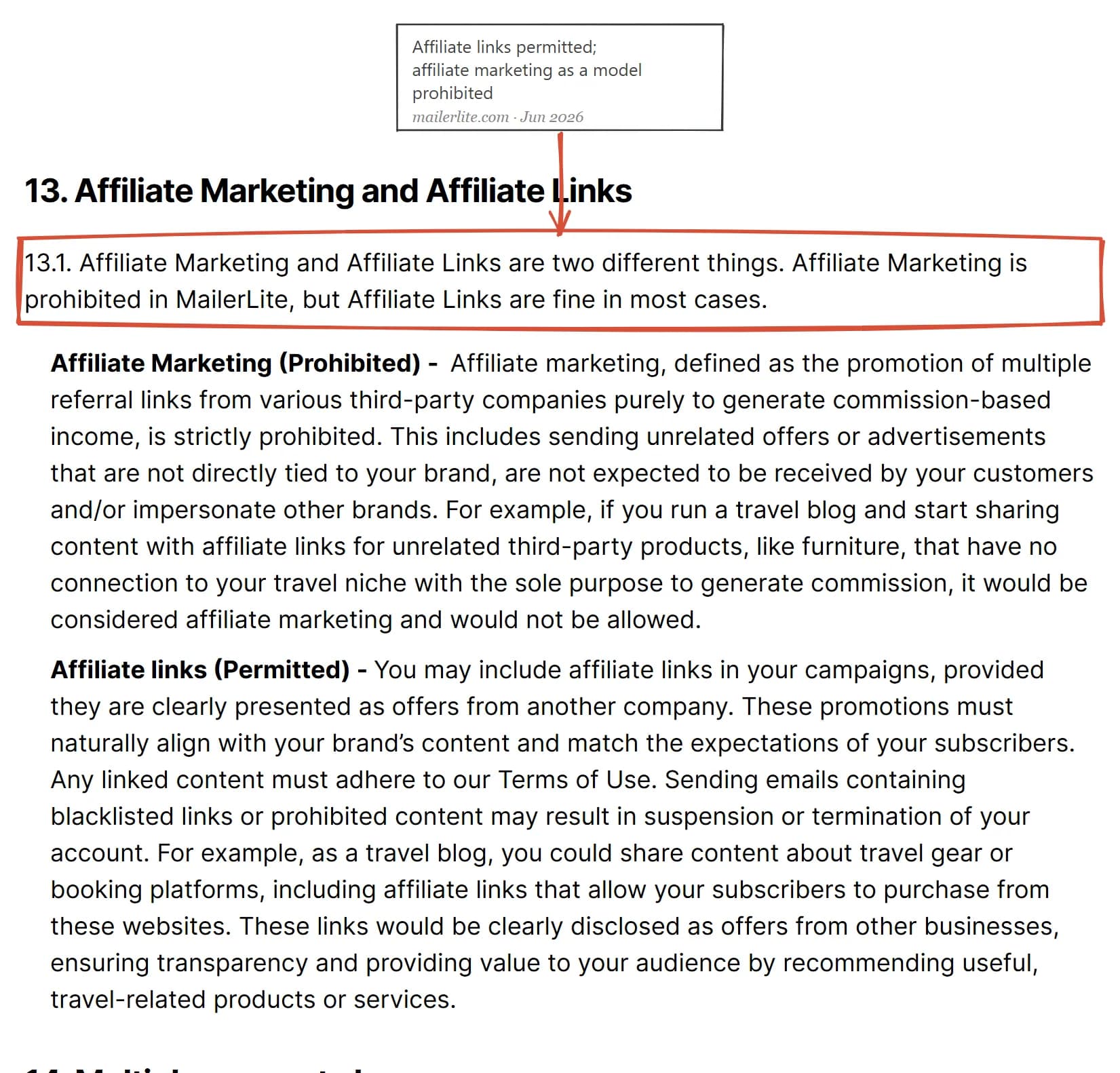
- Affiliate marketing is banned outrightMailchimp's acceptable-use policy prohibits affiliate marketing as a category, alongside crypto, MLM and gambling. MailerLite's terms draw a finer line: affiliate marketing as a business model is prohibited, but contextual affiliate links that match your content are explicitly permitted. For a creator who monetizes with affiliate links, Mailchimp's blanket ban is a compliance risk MailerLite's written policy does not carry.
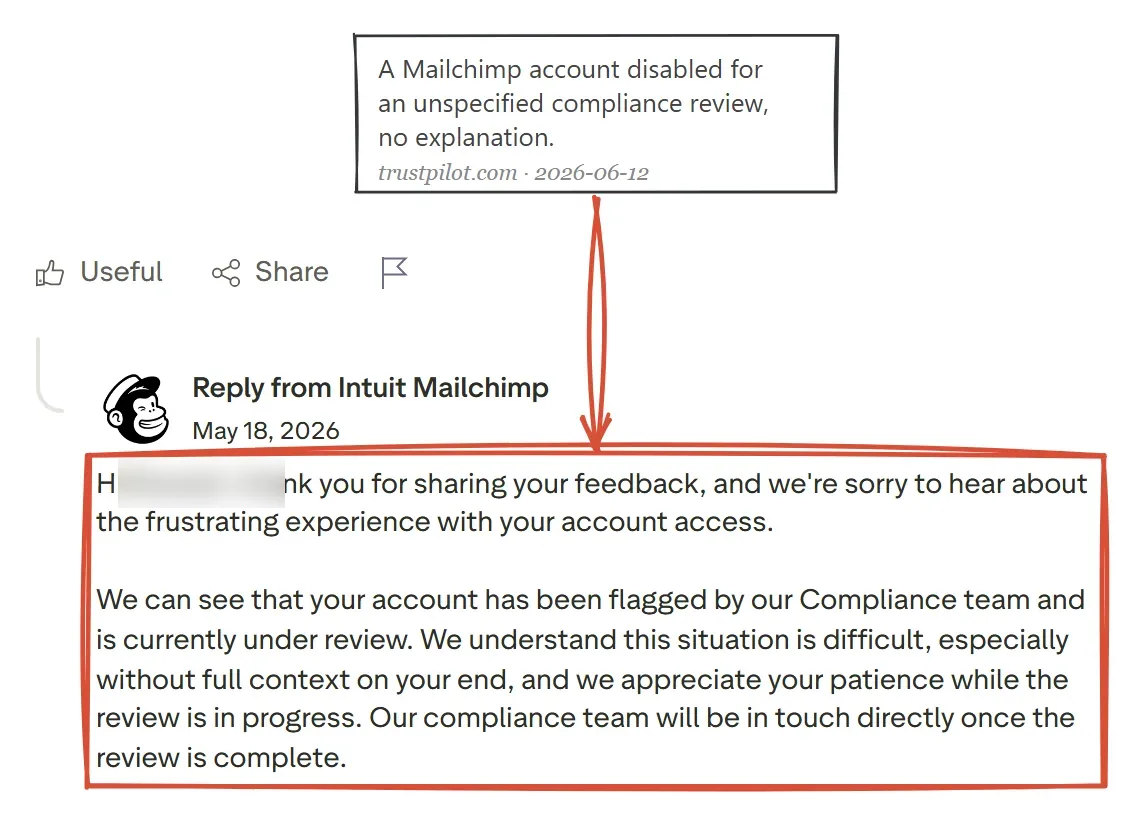
- Opaque compliance suspensions on established accountsAccount suspension is a documented Mailchimp theme (110 mentions): accounts disabled for an "unspecified compliance review" after a year of normal use, automations stopping immediately, support unable to explain. Where MailerLite's algorithm tends to strike at the approval gate, Mailchimp's compliance team strikes accounts already in production, which is operationally worse if your business depends on the sends going out.
Trust, Policies and the Risks That Outlast a Pricing Page
Neither platform is risk-free; they police you differently. MailerLite screens at the door: every account passes an approval step before sending, AI content checks run afterward, and our corpus documents 87 suspensions, some before a first real send, with replies stating the decision is irreversible. Mailchimp polices in production: 110 documented suspensions for an "unspecified compliance review", often on accounts a year into normal use. One pattern hits you before you have invested; the other after.
Policy texts differ in a way that matters for one creator profile in particular. Mailchimp's acceptable-use policy bans affiliate marketing as a category. MailerLite's terms draw a written distinction: affiliate marketing as a business model is prohibited, but contextual affiliate links aligned with your content are explicitly fine. If your newsletter earns through affiliate links, that clause is the difference between written permission and a category ban. The table below is drawn from our trust-and-risk layer, with verbatim clauses on hover.
Trust and risk: MailerLite vs Mailchimp
| Platform | Account control | AI training rights | Cost at scale | Vendor longevity | Billing model | Allowed niches |
|---|---|---|---|---|---|---|
| MailerLite | ||||||
| Mailchimp |
✓ favorable to the creator · ◐ mixed · ✗ unfavorable. Hover or tap a cell for the detail. Compiled June 2026 from public terms, status pages and the pricing data layer. Re-verified quarterly.
Pricing Scenarios: The Gap, Year by Year
Because both platforms bill by list size, the comparison needs no revenue assumptions: pick your subscriber count and read across. The rows below use MailerLite's Growing Business against Mailchimp's Standard, the two most comparable mid plans, monthly billing, from our weekly tracker. Mailchimp's Essentials runs cheaper than Standard ($110/mo at 10,000) but still lands well above MailerLite while gating send-time optimization and advanced segmentation. The last row is not a price at all; it is the billing-rule difference doing its quiet work on a list you forgot to prune.
Plans at a glance (verified June 2026)
- · MailerLite Free: 500 subscribers, 12,000 emails/month, automation builder included (single trigger). Cut from 1,000 subscribers on September 23, 2025.
- · MailerLite Growing Business: $19/mo (Growing Business, 1K subs) · verified June 9, 2026 at 1,000 subs ($89/mo at 10K, $179/mo at 25K). Unlimited emails, paid newsletters at 0% fee, auto-resend, unlimited templates. Annual billing 10% less.
- · MailerLite Advanced: $39/mo (Advanced, 1K subs) · verified June 9, 2026 at 1,000 subs ($129/mo at 10K). Adds multiple automation triggers, custom HTML editor, promotion pop-ups, AI writing assistant.
- · Mailchimp Free: 250 contacts, 500 sends/month (250/day). No scheduling, no real automation flows.
- · Mailchimp Essentials: $45/mo (Essentials, 3K subs) · verified June 9, 2026 at 2,500 contacts ($110/mo at 10K). Scheduling, A/B testing, basic Customer Journeys.
- · Mailchimp Standard: $60/mo (Standard, 3K subs) · verified June 9, 2026 at 2,500 contacts ($135/mo at 10K, $310/mo at 25K). Send-time optimization, advanced segmentation, custom-coded templates.
Annual cost, same list on both
Annual platform cost by list size (MailerLite Growing Business vs Mailchimp Standard, monthly billing × 12)
List size Same list on both | MailerLite Growing Business Bills Active subscribers only | Mailchimp Standard Bills all stored contacts | Annual gap What Mailchimp costs on top |
|---|---|---|---|
| Side project, early list | $33/mo → $396/yr | $60/mo → $720/yr | +$324/yr |
| Established newsletter | $89/mo → $1,068/yr | $135/mo → $1,620/yr | +$552/yr |
| Serious media operation | $179/mo → $2,148/yr | $310/mo → $3,720/yr | +$1,572/yr |
| The pruning-neglect case | Bills 8,000 (unsubscribed excluded) | Bills all 10,000 (unsubscribed included) | Mailchimp charges for people you cannot email |
Side project, early list
- MailerLite Growing Business
- $33/mo → $396/yr
- Mailchimp Standard
- $60/mo → $720/yr
- Annual gap
- +$324/yr
Established newsletter
- MailerLite Growing Business
- $89/mo → $1,068/yr
- Mailchimp Standard
- $135/mo → $1,620/yr
- Annual gap
- +$552/yr
Serious media operation
- MailerLite Growing Business
- $179/mo → $2,148/yr
- Mailchimp Standard
- $310/mo → $3,720/yr
- Annual gap
- +$1,572/yr
The pruning-neglect case
- MailerLite Growing Business
- Bills 8,000 (unsubscribed excluded)
- Mailchimp Standard
- Bills all 10,000 (unsubscribed included)
- Annual gap
- Mailchimp charges for people you cannot email
Prices from our weekly tracker, verified June 9, 2026, annualized from monthly billing. MailerLite's annual billing takes a further 10 percent off its column. The last row shows the billing-rule asymmetry rather than a tier price: MailerLite drops unsubscribed contacts from the count automatically; Mailchimp bills them until you archive.
Migrating From Mailchimp: the Easiest Exit in Our Panel, With Two Catches
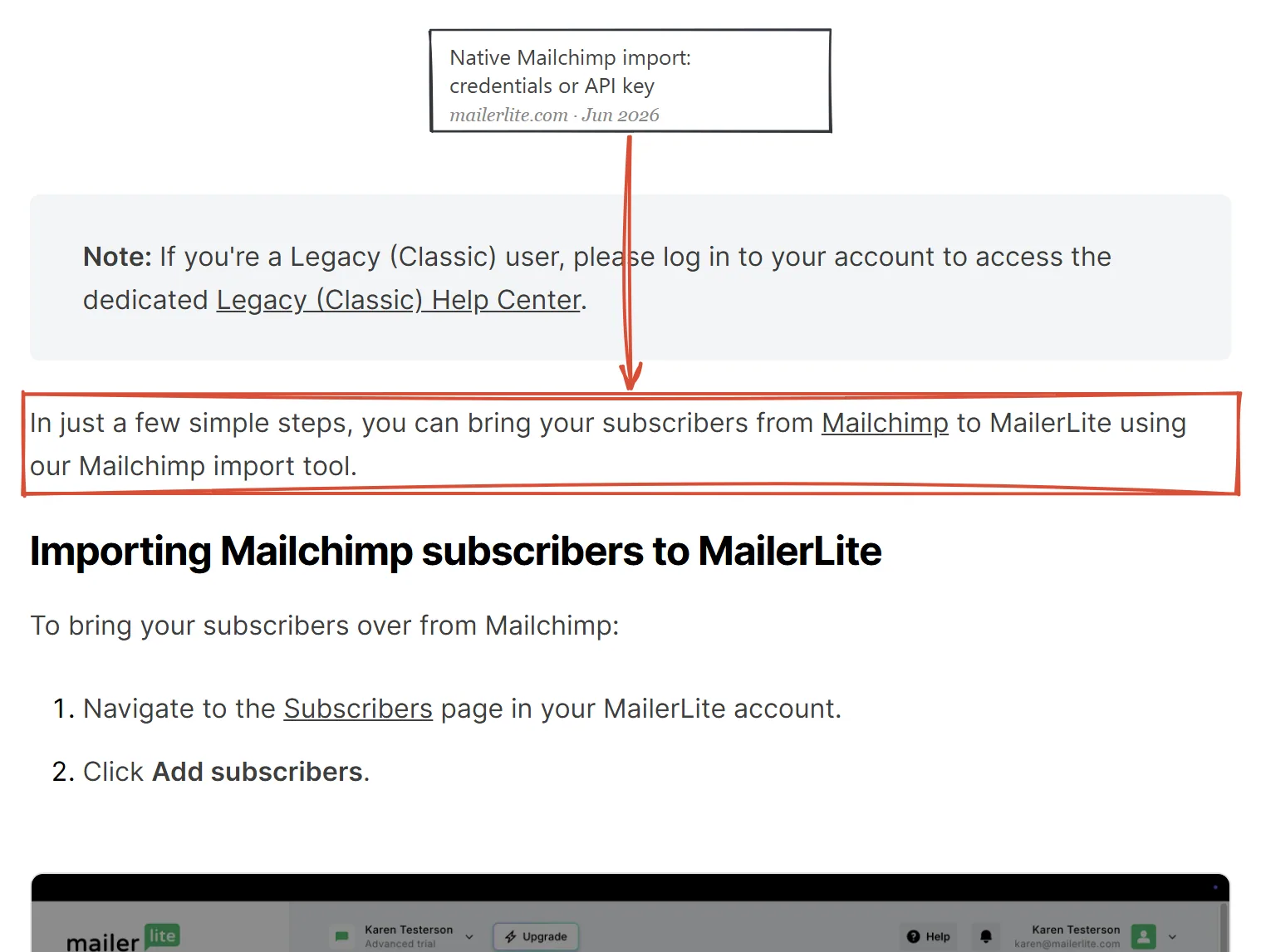
MailerLite has built its growth on this exact migration, and it shows. The help center ships a native Mailchimp import tool: connect with your Mailchimp credentials or an API key, and it moves subscribers, lists, tags (which become MailerLite Groups), basic segments and custom fields, with configurable duplicate handling. Unsubscribed contacts can optionally come along; they land in a separate category, cannot be emailed, and, consistent with the billing rule, never appear on your bill. For the list itself, this is the smoothest vendor-to-vendor path we track.
The first catch is what does not move. Historical, behavioral and e-commerce segments cannot be migrated automatically, and your automation workflows do not transfer at all: welcome series, re-engagement sequences and tag logic must be rebuilt in MailerLite's builder. Budget a rebuild, not a copy. Note also that multiple-trigger automations live on MailerLite's Advanced plan, so a complex Mailchimp journey may need the pricier tier to reproduce.
The second catch comes before any of that: the approval gate. Your import lands in an account that cannot send until MailerLite approves it, and the corpus documents imports of legitimate lists tripping the algorithm. Be accurate in the approval profile, import your cleanest segment first, and keep the Mailchimp account alive until your first MailerLite campaigns have actually gone out.
Who Switches, and Who Should Stay
The profile that gains from switching
The switcher the data supports is paying Mailchimp for size, not for depth: a newsletter operator or small business between 2,500 and 25,000 subscribers, on Standard for the list rather than the journeys, whose integrations are covered by Shopify, Zapier or plain embed forms. That profile halves its bill ($135/mo to $89/mo at 10,000), stops paying for unsubscribed contacts, gains a paid-newsletter option at 0 percent, and lands on the support team our corpus ranks first in the category. The free-plan math points the same way for beginners: 500 subscribers with automation against 250 contacts without.
The rational reasons to stay on Mailchimp
Three hold up. First, integrations: if a tool in your stack ships a Mailchimp connector and nothing else, the connector can be worth the markup. Second, automation depth: Customer Journeys with behavioral branches reproduce on MailerLite only partially, and multi-trigger logic needs the Advanced plan. Third, familiarity: the corpus is full of teams that stay because everyone knows the tool, and that inertia is a real cost saving, not laziness. What does not hold up is staying for the price, the support on a free plan, or a paid-newsletter roadmap Mailchimp does not have.
The risk neither side escapes
Both platforms can switch you off without a human conversation. MailerLite concentrates its enforcement at entry: the approval gate plus algorithmic checks, 87 documented suspension complaints, some pre-launch. Mailchimp concentrates it in production: 110 documented complaints, opaque compliance reviews on established accounts. Pick which failure mode you would rather manage, and keep the monthly CSV export habit regardless of the answer.
Deliverability: Mixed Signals on Both, No Audited Numbers Anywhere
Neither vendor publishes an audited inbox-placement rate, and we will not invent one. In our MailerLite corpus (96 mentions, mixed), stable-state placement is praised, including a case documented in 2022 on Capterra of open rates rising almost 50 percent after a switch from ActiveCampaign, but there are also documented overnight reputation drops and recurring complaints about landing in Gmail's Promotions tab. The Mailchimp corpus (150 mentions, mixed) shows the inverse arc: historically strong, with 2025-2026 reviews growing more cautious. One expert reviewer named the structural risk both share: on a big shared platform your placement rides on everyone else's behavior, and on Mailchimp "most people on MC don't know what they're doing," which drags the pooled reputation.
The practical difference is enforcement. MailerLite's strict approval gate exists precisely to protect its shared pool, which is the charitable reading of its suspension record. Both platforms support custom-domain authentication (DKIM and DMARC); set it up on day one wherever you land, test with your own list before committing, and distrust any published percentage, including any you wish we had printed here.
Frequently asked
Frequently Asked Questions
Is MailerLite actually cheaper than Mailchimp?
Yes, at every list size our weekly tracker covers, at roughly half the price. At 2,500 subscribers MailerLite's Growing Business plan is $33/mo against $60/mo for Mailchimp Standard; at 10,000 it is $89/mo against $135/mo; at 25,000 it is $179/mo against $310/mo. The billing rules widen the gap further: MailerLite bills only contacts with Active status (its help center excludes unsubscribed and bounced people from the count), while Mailchimp's help confirms unsubscribed and non-subscribed contacts are included in your billable total. One honest caveat: MailerLite bills on stored active subscribers rather than on sends, so an infrequent sender pays the same as a daily one.
Why do MailerLite accounts get rejected or suspended before sending anything?
Because MailerLite screens harder than anyone in this matchup, on purpose. Every new account completes a profile and requests approval before it can send (terms of service, section 5.1), and AI-powered content checks run on campaigns afterward. Our 1,849-review corpus documents the dark side: 87 suspension mentions, some before a first real send, with rejection replies stating the decision is irreversible. If you run a clean, permission-based list in an allowed niche, the gate is usually a one-time formality, and it is part of why deliverability holds up. But import a scraped list, or sit in a banned category, and you can lose the account with no human appeal.
Can I sell a paid newsletter on MailerLite or Mailchimp?
On MailerLite, natively: Growing Business and Advanced accounts can sell paid newsletter subscriptions, recurring subscriptions and digital products through Stripe, and MailerLite takes a 0% sales fee (only Stripe's processing fees apply). On Mailchimp, no: there is no native paywall or recurring-subscription product, so charging readers means bolting a third-party processor onto Stripe and the API and maintaining that checkout yourself. If a paid newsletter is part of your plan, this is a structural difference, not a feature gap that a higher Mailchimp tier fixes.
Will my Mailchimp automations and segments survive the move to MailerLite?
Partially. MailerLite ships a native Mailchimp import tool: connect with your Mailchimp credentials or an API key and it brings over subscribers, lists, tags (which become Groups), basic segments and custom fields. What does not migrate automatically: historical, behavioral and e-commerce segments, and your automation workflows themselves, which must be rebuilt in MailerLite's builder. Unsubscribed contacts can optionally come along; they land in a separate category, cannot be emailed, and do not count toward MailerLite's billable total. Plan a rebuild week for automations, not a one-click transfer.
Is Mailchimp still a safe long-term choice after the Intuit news?
It will not disappear: Intuit bought Mailchimp in 2021 for about $12 billion and runs it for cash flow. But in May 2026 Intuit publicly named Mailchimp an area of reduced investment, alongside roughly 3,000 job cuts (about 17%) and a refocus on AI, having weighed a sale but not pursued one on the terms available (MarTech, with Intuit's FY26 earnings). Combined with post-acquisition price increases that long-tenured users describe as more than doubling, the realistic trajectory is a more expensive product with less active development. That is a reason to compare, not a reason to panic.
How We Built This Comparison
OwnLetter works as a lab-style analyst, not a power-user reviewer. We read 3,883 unique user signals in full (1,849 MailerLite, 2,034 Mailchimp) across Capterra, Reddit, G2 and Trustpilot, aggregated June 2026 with no keyword sampling. Pricing renders from our weekly automated tracker (verified June 9, 2026) and is never typed by hand. On June 12, 2026 we fetched MailerLite's primary pages live: pricing, the plan-and-billing help page, the free-plan FAQ, the paid-newsletter page, the terms of service and the Mailchimp-import guide. Mailchimp's pricing, help and acceptable-use pages were verified live on June 11, 2026, and both Trustpilot aggregates were read live on June 12 (MailerLite 4.3 across 3,163 reviews; Mailchimp 2.6 across 1,440).
All 44 claims in our manifest carry a source URL and a verification status; zero are invented. First-hand status, stated plainly: we operate a MailerLite account hands-on (it powers our MailerLite review); we have not run a paid Mailchimp account, so nothing here presents Mailchimp as "tested by us." Full methodology →
Affiliate status: Neither MailerLite nor Mailchimp pays OwnLetter anything on this page; both links are plain. The quiz engine, the feature matrix and the pricing tables are commission-blind by construction. Elsewhere on this site, some platforms do pay us a commission.
Sources
- · MailerLite pricing page (verified June 12, 2026)
- · MailerLite help: plan and billing (the Active-subscribers rule) (verified June 12, 2026)
- · MailerLite help: free plan update FAQ (1,000 → 500 on Sept 23, 2025) (verified June 12, 2026)
- · MailerLite help: selling paid newsletters and subscriptions through Stripe (verified June 12, 2026)
- · MailerLite terms of service (approval gate 5.1; affiliate links 13.1) (verified June 12, 2026)
- · MailerLite help: the native Mailchimp import tool (verified June 12, 2026)
- · Mailchimp help: pricing plans and the contact-count rule (verified June 11, 2026)
- · Mailchimp acceptable-use policy (affiliate-marketing prohibition) (verified June 11, 2026)
- · MarTech: what Intuit's layoffs and reduced investment mean for Mailchimp (verified June 11, 2026)
- · Trustpilot MailerLite reviews (4.3/5 across 3,163, read live June 12, 2026)
- · Trustpilot Mailchimp reviews (2.6/5 across 1,440, read live June 12, 2026)
Who Should Pick Which
If you are leaving Mailchimp over the bill or the support:
MailerLite is the move the data supports, and it is built for exactly this migration. Half the price at every size we track, unsubscribed contacts off the bill automatically, the corpus's best-rated support on paid plans, and a native import tool for your Mailchimp list. Answer the approval questionnaire accurately and import your cleanest segment first; the gate is strict and final.
Try MailerLite free →If your stack or your funnels run through Mailchimp:
Staying is defensible. Customer Journeys with behavioral branches, the 300+ integration catalog, and a team that already knows the tool are real value, and rebuilding complex automations on MailerLite may require its Advanced plan anyway. Just stay for those reasons, not for the price, and archive dead contacts monthly so the per-contact bill stops counting people who left.
Try Mailchimp (free plan) →If you plan to charge readers for the newsletter itself:
MailerLite, structurally. Paid newsletter subscriptions through Stripe with a 0 percent platform fee are native on Growing Business and up; Mailchimp has no equivalent at any tier and needs a third-party checkout bolted on. If paid publishing is the whole business, also weigh the newsletter-native platforms in our wider guides.
If the approval gate or the suspension record puts you off:
Fair concern, and not symmetrical comfort on the other side: Mailchimp's own compliance team suspends established accounts without explanation, and bans affiliate marketing outright. If neither enforcement model suits you, compare the wider field in our MailerLite alternatives guide before committing either way.
Coming from Substack instead? The same per-contact trap is measured against the 10 percent model in our Substack vs Mailchimp comparison.
Join the Discussion
Using MailerLite or Mailchimp? Share your experience or correct an inaccuracy. No account required: email and name only. Comments are moderated.