On this page (15 sections)
Substack vs Kit 2026: Which Newsletter Platform Wins on Revenue?

By Arthur Brulard, Founder of OwnLetter. Cross-vendor analyst review across 11 newsletter platforms, aggregating user signals from Reddit, G2, Capterra, Trustpilot, and Hacker News. LinkedIn
Published June 1, 2026 · Updated June 1, 2026 · 19 min read
Quick verdict
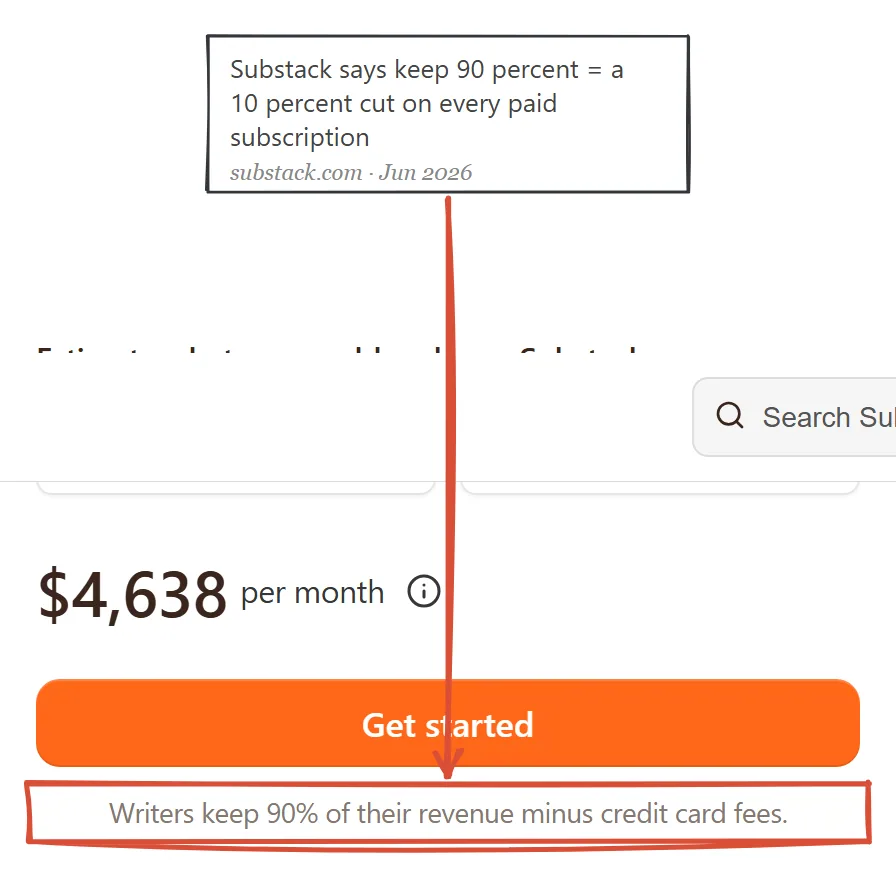
Kit wins on money and automation: you keep roughly 99.4 percent of paid revenue (against 90 percent on Substack), get real behavioral workflows, and can sell digital products from the free tier. Substack wins on cold-start discovery: with no audience yet, its Recommendations network is the reason to start there, at the cost of a 10 percent revenue cut and near-zero automation. Break-even sits around $300 to $400 per month in paid revenue (full math below).
Both are free to start. Full pricing math below.
Not sure which fits you?
Substack or Kit — answer a few questions
Which fits you?
Loading the quiz…
How we testedVerified June 2026 · 496 reviews aggregated · Substack + Kit tested · 29 sourced claims · pricing cross-validated · methodology public
What we did: Read 496 user signals in full (Reddit r/Substack + r/Emailmarketing, G2 verified-buyer reviews 2023-2026, Trustpilot aggregated June 2026). Pricing cross-validated against vendor pages on May 20 and June 1, 2026. Captured and annotated both platforms' product UIs (pricing, automation, commerce, paid-newsletter pages) in June 2026.
What we did NOT do: We did not run live deliverability tests (seed-list tests violate vendor ToS for both platforms). We aggregate documented signals rather than producing metrics from a single account.
Refresh cadence: Pricing verified quarterly minimum (next refresh September 1, 2026). 29-claim manifest with source URL per numeric claim publicly available. (pricing verified June 1, 2026). Full methodology →
 SubstackSubstack
 KitKit
The Platform Fee Gap: 10% vs 0.6%
This is the number that determines which platform serves your business. Substack takes 10 percent of every paid subscription dollar, plus Stripe's standard card fees (approximately 2.9 percent plus $0.30 per transaction). Combined, you pay roughly 13 percent all-in on every paid subscription. Kit's platform cut is 0.6 percent. Add Stripe and the all-in rate runs roughly 3.5 percent total. On $1,000 per month in paid revenue: Substack costs you about $130, Kit about $35. That gap is roughly $1,100 per year on a single $1,000 monthly revenue baseline (C-030).
The framing from Substack's own user community captures it precisely. A Reddit user described it in March 2026:
"Substack is the ultimate zero-risk drug. It feels free because you aren't getting a bill until you start earning." Reddit user (r/Substack source), March 2026
The 10 percent cut is invisible at $50 monthly revenue. At $5,000 monthly, that same 10 percent becomes a meaningful monthly tax on your own audience. Sean Highkin of Rose Garden Report documented saving $2,916 per year by migrating off Substack (The Verge, May 2026, C-018). He migrated to Ghost, not Kit, but the Substack-tax arithmetic is identical regardless of destination.
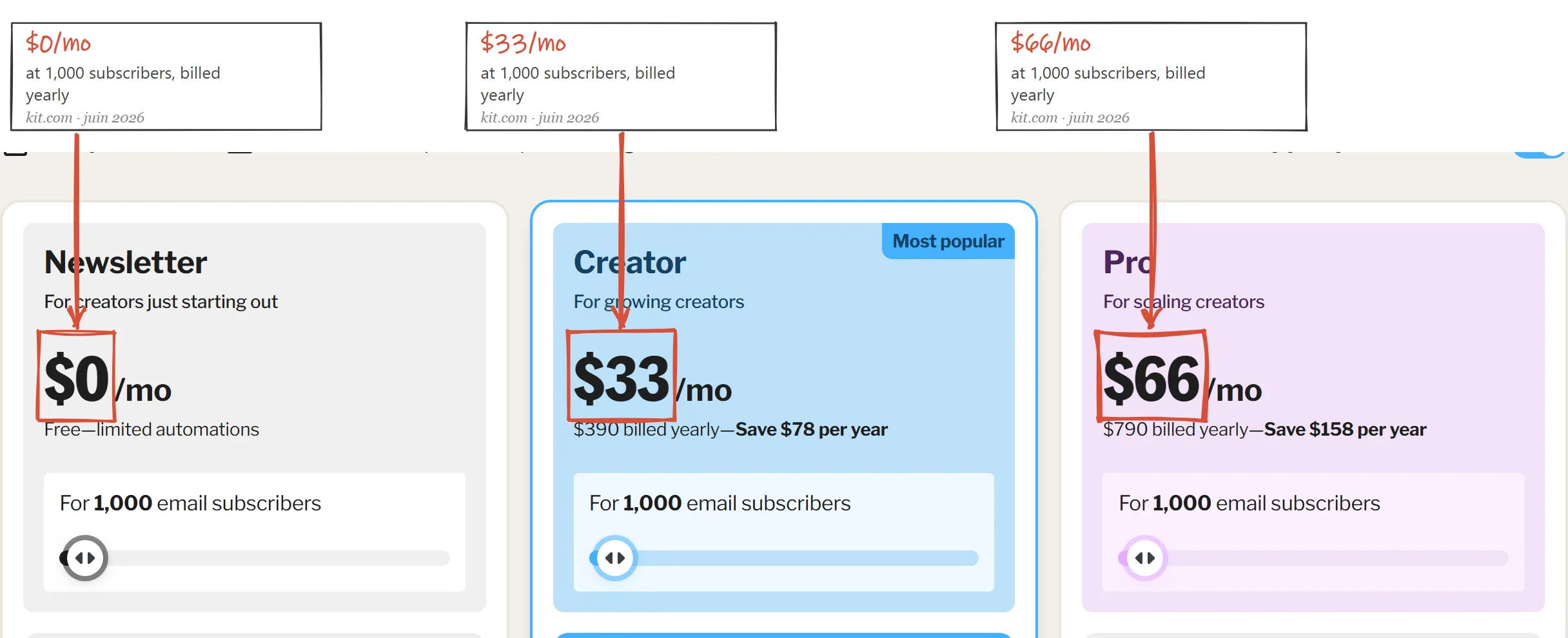
Kit's free Newsletter tier (up to 10,000 subscribers) supports paid subscriptions at the 0.6 percent rate, with no flat monthly cost. The Kit Creator plan adds unlimited automations, sequences, and integrations from $33/mo on annual billing at 1,000 subscribers. That plan pays for itself once your paid revenue crosses the break-even point (see the pricing scenarios table).
Feature Comparison: Monetization, Automation, Audience, Growth
On features, the split is clean: Substack wins discovery and low-friction onboarding; Kit wins automation, commerce, and fee structure. Both carry documented account-suspension risk on different triggers. The table below is data-driven from the OwnLetter feature SSoT, 421 of 432 cells source-verified against vendor primary documentation (May 2026).
Pick a plan from the ▾ menu under a platform to see what that plan unlocks and its price at your subs count.
| Feature | Substack | Kit (ex-ConvertKit) |
|---|---|---|
| Monthly priceat 2.5K subs · monthly | 10% of revenue | $0/mo · Free ≤10K subs |
| 5/6 | 6/6 | |
| 2/5 | 4/5 | |
| 6/9 | 9/9 | |
| 7/9 | 9/9 | |
| 2/4 | 2/4 | |
| 3/5 | 5/5 | |
| 8/10 | 7/10 | |
| 5/5 | 4/5 | |
| Get started | Try free → | Try free → |
✓ Yes · Partial · — No · dotted = unverified · a plan tag (e.g. Scale) = the cheapest plan that unlocks it; pick a plan above each column and ↑ marks features above it. Verified against vendor sources, September 2026. Some links are paid — OwnLetter may earn a commission at no extra cost to you. It never affects the data.
Straight from the reviews
What real users say
Each site’s average below comes from its own user reviews across Reddit, Trustpilot, Capterra and G2 — the count per site is on each bar. We never invent a quote.
Average score on each review site
SubstackKitPraised · Complaint · Split opinion
Average scores pulled from each site on May 31, 2026. Trustpilot scores are a recent sample, not the lifetime average; Reddit has no star ratings. Substack isn't listed on Capterra, and on Substack Trustpilot skews toward readers and Reddit toward creators. See our methodology.
Theme by theme: where they agree and differ
| What users say about… | Substack480 reviews read | Kit885 reviews read |
|---|---|---|
| Kit leads | ||
| Substack leads | ||
| Kit leads | ||
| Kit leads | ||
| Kit leads | ||
| Kit leads | ||
| See for yourself | Try free → | Try free → |
▲ Praised · ▼ Complaint · ◆ Mixed · top theme / common / minor = how often readers bring it up · ❝ hover any cell for the exact count and a real, sourced quote · · = too few reviews to score. Read in full from Reddit, Trustpilot, G2 and Capterra, June 2026. We never invent a quote. Some links are paid — OwnLetter may earn a commission at no extra cost to you. It never affects the data.
Review sources:RedditTrustpilotG2Capterra
Deep Dive: Substack
Across 269 Substack user signals collected May to June 2026 from Reddit, G2, and Trustpilot, three patterns dominate: the discovery network works for writers without an existing audience, the 10 percent fee compounds at scale, and support is reported as AI-chatbot only with no meaningful human escalation on lower tiers.
Discovery: Where Substack Actually Wins
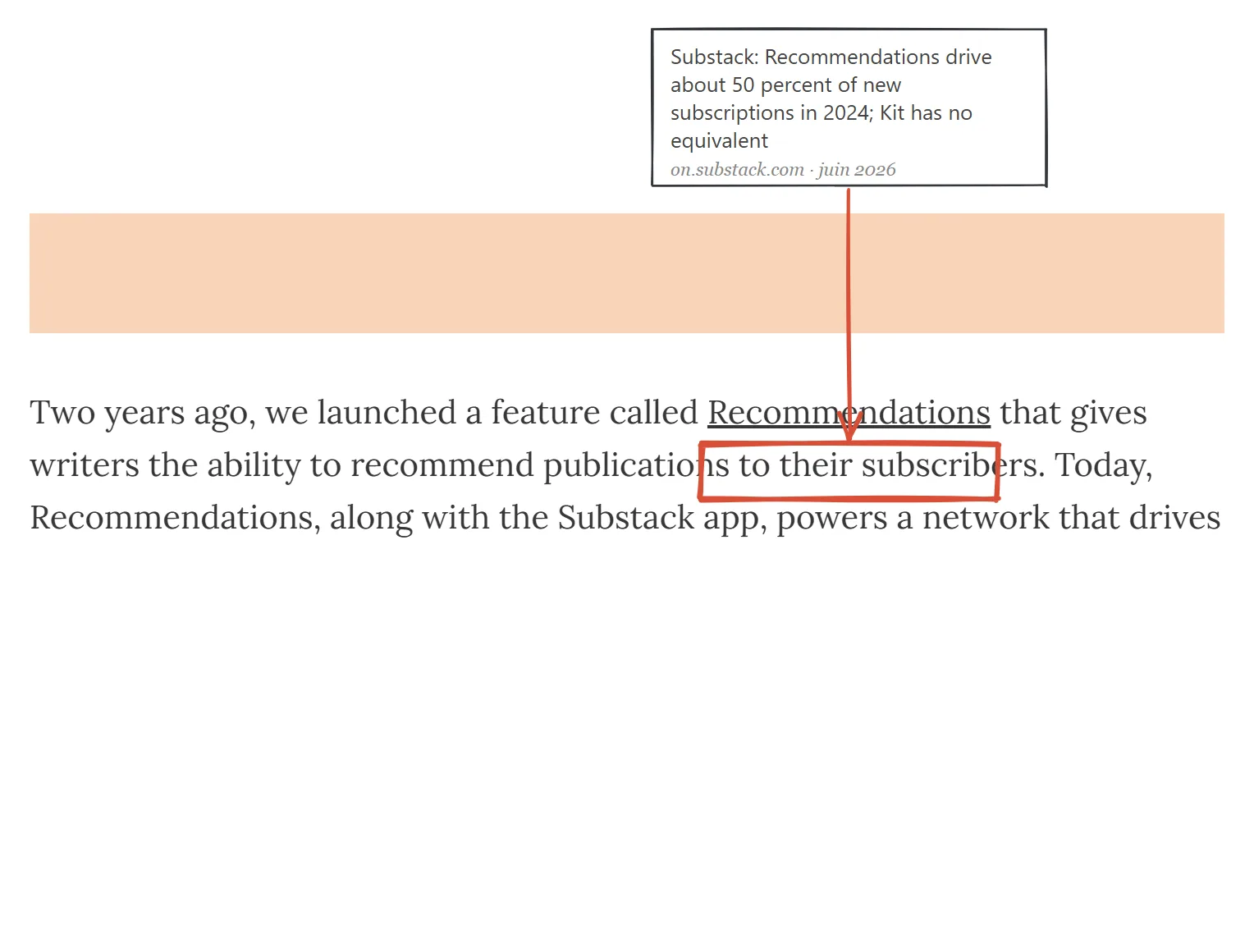
Substack's Recommendations network drove roughly 50 percent of new subscriptions across the platform (Substack, as of 2024 February data; treat as directional, this figure is over 12 months old). The most consistently praised Substack feature in the OwnLetter review aggregation is discovery: approximately 18 signals describe it as one of the best platforms for finding an audience from scratch. One reviewer wrote on Reddit in May 2026: "one of the best platforms for discovery if you have no audience." No flat monthly fee below paid-subscription activity makes the zero-friction cold start compelling for writers who haven't built a list elsewhere.
The Notes algorithmic recommendations are the mechanism. Writers share short-form content in the Notes feed, which Substack amplifies to adjacent readers. The discovery advantage is real but platform-dependent: it works when the algorithm supports your content, and writers describe what one coined "substack jail" when it stops (see the HonestLimitations section below).
The Automation Gap
Substack sends one email to one audience. There is no behavioral trigger system, no segmentation by subscriber tag or purchase history, no visual workflow builder, and no way to automate a welcome sequence beyond a single broadcast. Course creators, product sellers, and anyone running multi-step nurture sequences report this as a hard ceiling. Multiple Trustpilot reviewers document the failure case directly: "none of our subscribers received our welcome emails" (Trustpilot, August 2025, company newsletter).
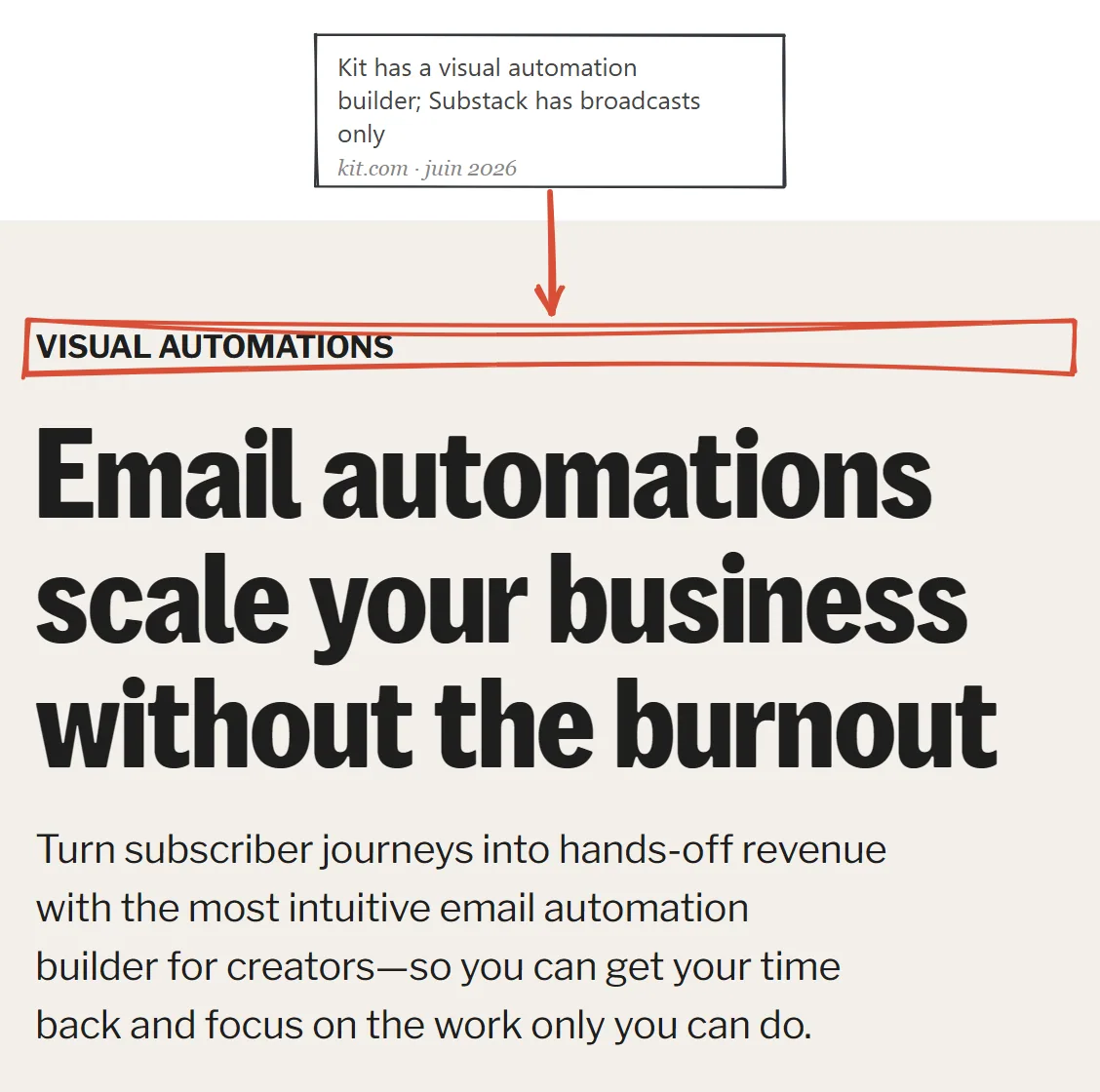
Kit's automation is the inverse. Approximately 20 reviews in the aggregation cite Kit's workflow builder as their primary reason for choosing it. The tool covers conditional logic, behavioral triggers, subscriber tagging, and sequences. For course creators, this means automated onboarding from opt-in to purchase. Substack cannot replicate this.
Content Moderation and Brand Association
Substack's editorial policy drew sustained coverage in 2023 and in 2024. The Atlantic and Guardian reported Substack hosting newsletters with extremist content. Substack responded that it would not proactively remove legal speech even when judged offensive. Around 12 signals in the OwnLetter aggregation mention creator departures over this. It is a verifiable reputational factor, not a product defect, but material for creators whose audience values platform alignment or who run brand-adjacent newsletters. Kit does not have a comparable documented controversy.
Our take
Where Substack Falls Short
- 10 percent revenue cut compounds at scaleAt $1,000 monthly paid revenue, Substack takes $100 per month (10 percent). At $5,000 monthly, that same 10 percent compounds to $500 per month. At $15,000 monthly it reaches $1,500 per month or $18,000 per year. Sean Highkin of Rose Garden Report documented saving $2,916 per year by migrating off Substack (The Verge, May 2026). The cut is invisible at $100 monthly revenue and becomes the largest single line in your newsletter P&L once you cross $1,000.
- No automation beyond broadcastsSubstack sends one email to one audience. No visual workflow builder, no behavioral triggers, no segmentation by tag or purchase, no A/B testing, no onboarding sequences. If your business model involves course upsells, product launches, re-engagement campaigns, or any funnel beyond a newsletter, Substack lacks the tooling entirely. Kit's Creator plan includes unlimited visual automations on a drag-and-drop workflow builder.
- Content moderation controversiesSubstack's editorial policy has drawn sustained criticism in tech press, in 2023 and through 2024, for hosting newsletters espousing extremist viewpoints. The Atlantic and other outlets documented these cases. Some creators have left publicly over brand-association concerns. This is a verifiable reputational factor, not a product defect, but relevant for creators whose audience values platform alignment. Attributed to press coverage and approximately 12 review signals in the OwnLetter aggregation (June 2026).
- Notes followers do not export with youSubstack email subscribers export cleanly via CSV. Notes followers do not transfer on any migration path. If you built audience through the Notes algorithmic recommendations feed, those followers are a trapped asset. The platform does not disclose this at sign-up. On Substack-to-Kit migration, this means any Notes-driven reach stays on Substack permanently.
Deep Dive: Kit
Across 227 Kit user signals from Reddit, G2, and Trustpilot (May to June 2026), automations are the defining strength. Support quality is the defining risk. Account suspension around affiliate links is the specific warning this audience needs to hear.
Automations: Kit's Crown Jewel
Approximately 20 reviews in the Kit aggregation name automations as the primary purchase driver. The tool is genuinely differentiated from Substack. One G2 reviewer in May 2026 summarized the practical value: "the automations help turn subscribers into a real relationship and sales." The Creator plan includes unlimited visual automations with conditional logic, behavioral triggers, subscriber tagging, and 70-plus third-party integrations (verified kit.com/features/automations, June 2026). For course creators running onboarding-to-purchase sequences, this is a meaningful operational advantage.
The dual-stack creator pattern emerges from this capability gap. One creator articulated it on Reddit in August 2025:
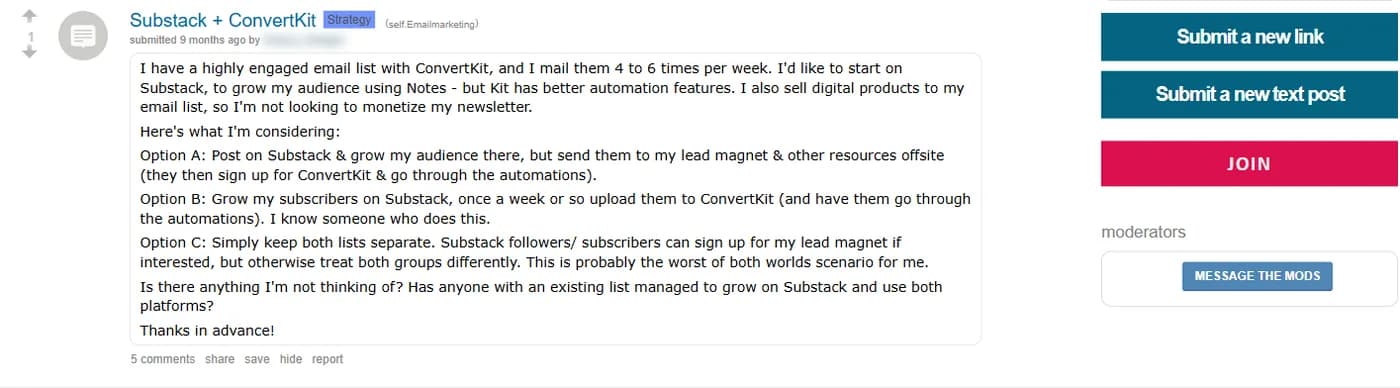
"I'd like to start on Substack to grow my audience using Notes, but Kit has better automation features." A creator on Reddit, August 2025 (C-029)
The claim is corroborated by approximately 10 additional insights describing the same approach across the Kit and Substack review corpora. The dual-stack is a real pattern, not a fringe workaround.
Digital Commerce: Kit Sells, Substack Does Not
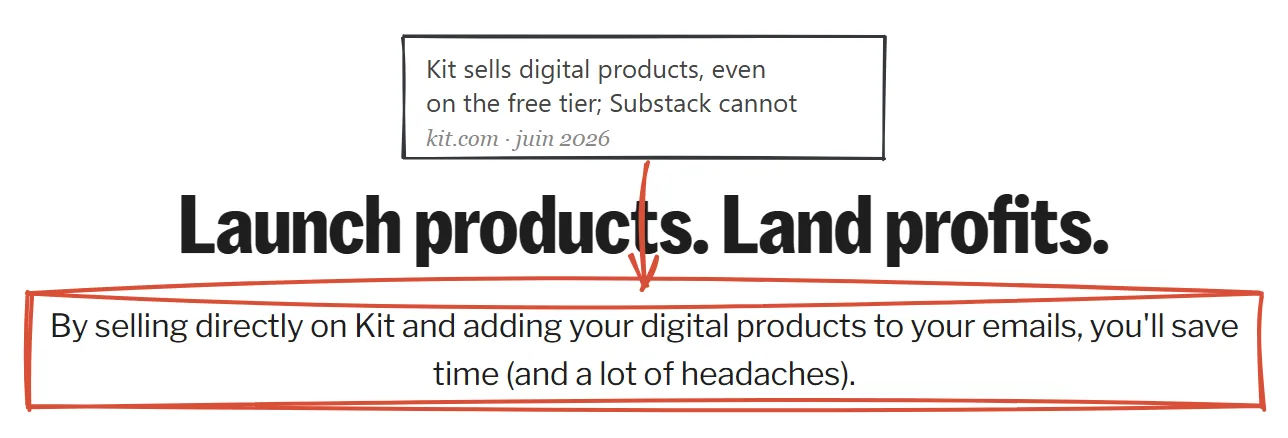
Kit supports selling digital products (ebooks, courses, templates) directly from the newsletter platform, including on the free tier at 0.6 percent platform fee (verified vendor-features.json, kit.com/commerce). Substack does not offer digital product sales. If you sell anything beyond a paid newsletter subscription, Substack requires external tools (Gumroad, Teachable, Podia) and separate checkout flows. Kit consolidates it. For course creators, this consolidation removes the split-attribution problem between newsletter and product checkout.
The Affiliate-Link Suspension Warning
This matters specifically for OwnLetter's audience. Approximately 3-4 Trustpilot reviewers (March 2026) report Kit disabling or suspending accounts after including affiliate links in newsletters, including links the reviewers describe as legitimate. One reviewer wrote: "Mentioned an affiliate link (for legit product) and all of a sudden, my account is disabled." Kit's spam filter appears to flag outbound commercial links aggressively. This is a documented pattern, not a confirmed Kit policy. If you run affiliate content, use link shorteners or consider Kit's support documentation on commercial email before sending at volume.
Our take
Where Kit Falls Short
- Account suspension risk on affiliate linksReviewers on Trustpilot (March 2026, approximately 3-4 reports in the OwnLetter aggregation) describe Kit disabling accounts after including affiliate links in newsletters, even legitimate ones. One reviewer wrote: 'Mentioned an affiliate link (for legit product) and all of a sudden, my account is disabled' (Trustpilot, March 2026). This is a specific, documented risk for OwnLetter-style affiliate creators. Kit's spam filter appears to flag outbound commercial links aggressively. Attributed reviewer reports, not Kit policy; use link cloaking or direct links if you run affiliate content.
- September 2025 price hike (~56%)Kit raised Creator plan pricing approximately 56 percent in September 2025. The 1K-subscriber annual rate went from roughly $25 to $33 per month; monthly billing went from $29 to $39. Existing subscribers transitioned after a grace period. Several G2 and Trustpilot reviewers mention the hike as a pain point. There is no guarantee this was the last increase. Kit's pricing history (one hike in a year) is a relevant factor for newsletters modeling 3-5 year cost projections.
- Support experience is polarizedAcross 35 Kit community posts and reviews (G2 + Trustpilot, May 2026), Kit support quality splits sharply. Some users report replies within minutes from named agents (G2, May 2026). Others describe Kit support as the most frustrating part of the platform, with unresolved issues dragging for weeks (Trustpilot, 2025-2026). Neither outcome is consistent. If responsive support is a hard requirement for your business, treat Kit's support tier as variable rather than reliable. Neither Substack nor Kit offers guaranteed human support on entry tiers.
- Paid-sub migration friction from SubstackPaid Substack subscribers cannot carry payment details to Kit. They must cancel on Substack and re-subscribe via Kit checkout. This introduces a re-subscription ask that typically produces some paid-count drop, estimated at 5-15 percent in practitioner reports (no Kit-specific data verified). For newsletters with significant paid subscriber revenue, plan a migration communication sequence to minimize drop. The free subscriber list migrates cleanly by CSV.
Email Deliverability: What Neither Platform Publishes
Neither Substack nor Kit publishes an audited inbox-placement rate, and any single-account "deliverability test" you see quoted is too small a sample to rank one platform above the other. The honest signal is what surfaces across many real senders over time, not a headline percentage from one mailbox.
Across the 496-signal aggregation, deliverability is not a dominant complaint on either platform. Substack's recurring pain is the automation gap; Kit's is account suspensions, not bounce rates or spam-folder placement. That absence is itself a signal: if inbox delivery were routinely broken on either, a 496-review corpus would surface it loudly. It does not.
What we did not do: we did not run seed-list deliverability tests. They violate both platforms' terms of service, and one sending account is not representative of platform-wide performance. If deliverability is your decisive factor, test your own content with a small real list before you commit, rather than trusting any published number, including ours.
Pricing Scenarios: The Break-Even Math
Kit becomes cheaper than Substack once your paid revenue passes roughly $300 to $400 per month; below that, Substack's no-flat-fee model wins. The table and calculator below pin the exact crossover for your numbers. Platform fees only here: Stripe processing (2.9 percent plus $0.30 per transaction) applies equally on both and washes out. Kit Creator auto-scales with subscriber count: $33/mo at 1K subscribers, $50/mo at 3K, $75/mo at 5K, $116/mo at 10K (all annual billing, verified kit.com/pricing June 2026, September 2025 hike applied).
Kit Pricing Tiers (verified June 2026)
- · Newsletter (free): Free up to 10K subs. Up to 10,000 subscribers, paid subscriptions at 0.6 percent, 1 automation, 1 sequence.
- · Creator (annual): $33/mo (Creator, 1K subs) · verified June 1, 2026 at 1K subs. Unlimited automations, sequences, 2 team members, integrations. September 2025 hike applied.
- · Creator (monthly): $39/mo (Creator, 1K subs) · verified June 1, 2026 at 1K subs. Same features as annual, no long-term lock-in.
- · Pro (annual): $66/mo (Pro, 1K subs) · verified June 1, 2026 at 1K subs. Adds newsletter referral program, free migrations for 5K+ subscriber lists, premium support.
- · Substack (no tiers): Free to start. 10 percent of paid subscription revenue plus Stripe processing fees. No flat-rate alternative.
Annual Cost by Revenue Tier
Both the platform-cut rate (0.6% vs 10%) and the flat Kit Creator tier cost are included. The all-in comparison covers both bases honestly.
Platform fee comparison: Substack 10% cut vs Kit (0.6% + Creator flat tier where applicable). Negative annual delta = Kit saves you. Verified pricing June 2026.
Monthly paid revenue Net subscription income | Substack platform fee 10% revenue cut | Kit all-in cost 0.6% + Creator plan if applicable | Annual delta (Kit vs Substack) Negative = Kit saves you |
|---|---|---|---|
| $200/mo paid revenue | $20/mo ($240/yr) | Kit Newsletter free + $1.20/mo platform fee ($14/yr): Kit cheaper | -$226/yr saved (free tier) |
| $350/mo paid revenue | $35/mo ($420/yr) | Kit Creator $33/mo + $2.10 platform fee = ~$35/mo (roughly break-even) | ~$0/yr (break-even zone) |
| $1,000/mo (≈200 paid subs @ $5) | $100/mo ($1,200/yr) | Kit Creator $33/mo + $6 platform fee = ~$39/mo ($468/yr) | -$732/yr saved |
| $5,000/mo (≈1K paid subs) | $500/mo ($6,000/yr) | Kit Creator $75/mo + $30 platform fee = ~$105/mo ($1,260/yr) | Kit saves ~$4,700+/yr (see table) |
| $15,000/mo (≈3K paid subs) | $1,500/mo ($18,000/yr) | Kit Creator $116/mo + $90 platform fee = ~$206/mo ($2,472/yr) | -$15,528/yr saved |
$200/mo paid revenue
- Substack platform fee
- $20/mo ($240/yr)
- Kit all-in cost
- Kit Newsletter free + $1.20/mo platform fee ($14/yr): Kit cheaper
- Annual delta (Kit vs Substack)
- -$226/yr saved (free tier)
$350/mo paid revenue
- Substack platform fee
- $35/mo ($420/yr)
- Kit all-in cost
- Kit Creator $33/mo + $2.10 platform fee = ~$35/mo (roughly break-even)
- Annual delta (Kit vs Substack)
- ~$0/yr (break-even zone)
$1,000/mo (≈200 paid subs @ $5)
- Substack platform fee
- $100/mo ($1,200/yr)
- Kit all-in cost
- Kit Creator $33/mo + $6 platform fee = ~$39/mo ($468/yr)
- Annual delta (Kit vs Substack)
- -$732/yr saved
$5,000/mo (≈1K paid subs)
- Substack platform fee
- $500/mo ($6,000/yr)
- Kit all-in cost
- Kit Creator $75/mo + $30 platform fee = ~$105/mo ($1,260/yr)
- Annual delta (Kit vs Substack)
- Kit saves ~$4,700+/yr (see table)
$15,000/mo (≈3K paid subs)
- Substack platform fee
- $1,500/mo ($18,000/yr)
- Kit all-in cost
- Kit Creator $116/mo + $90 platform fee = ~$206/mo ($2,472/yr)
- Annual delta (Kit vs Substack)
- -$15,528/yr saved
Test Your Own Scenario
Adjust your paid subscribers, revenue per sub, and plan tier to see when Kit becomes cheaper than Substack for your situation.
Break-even answer (static fallback)
Loading interactive calculator... Static answer below.
Break-even sits at $430 monthly paid revenue. Substack takes 10 percent of paid revenue plus Stripe processing fees. Beehiiv Scale costs $43 per month on annual billing at the 1,000-subscriber baseline, with 0 percent platform fee on paid subscriptions. Above $430 monthly paid revenue, Beehiiv compounds savings every month.
Sample math: at $5,000 monthly revenue, Substack costs $500/mo ($6,000/yr) and Beehiiv Scale costs about $78/mo ($$936/yr) at the 5K subscriber tier on annual billing. Annual savings exceed $5,000.
Migration Risks: Substack to Kit
Free subscriber migration is straightforward: export CSV from Substack, import into Kit. Paid subscribers carry three distinct migration risks you need to plan around.
Re-subscribe cliff risk.Kit's official migration documentation (help.kit.com, verified February 2026, C-012) is explicit: paid subscribers must cancel their Substack subscription and re-subscribe through your new Kit checkout. There is no payment-data portability. This creates a re-subscription friction event. The risk is a paid-count drop that practitioners estimate at 5-15 percent of your paid base (no Kit-specific verified data). The larger your paid list, the larger the absolute revenue exposure during the transition window.
Apple subscription risk.Apple in-app subscriptions are non-portable across all Substack alternatives, including Kit (C-013). If any of your paid subscribers joined through Apple billing, those subscriptions end when you leave Substack; they cannot resume through Kit's checkout. This is a silent risk for any creator who promoted Substack through an iOS app or in-app discovery.
Forgotten 10 percent cut risk.One often-missed step: email Substack support to remove the 10 percent cut from your account after you stop accepting new paid subscriptions there. Otherwise the revenue share continues on the subscribers who stay on Substack during the transition. Missing this step means paying Substack's cut twice (once there, once on Kit) on your overlapping active subscriber period.
Kit offers free migrations for lists over 5,000 subscribers on Creator and Creator Pro plans (C-017, saascompared.io, verified 2026). If you qualify, the import and technical setup are handled, reducing migration friction materially. Lists under 5,000 subscribers handle the import through Kit's self-serve documentation.
Compare this with Substack-to-Beehiiv migration, which has a 1-click importer that carries Stripe payment data for paid subscribers. If paid-subscriber continuity is the primary concern, Beehiiv reduces re-subscription friction. The Substack vs Beehiiv comparison covers that path.
Real-World Cases and Dual-Stack Evidence
Three patterns from the 496-signal aggregation are worth calling out by name. They illustrate the discovery-vs-automation tradeoff better than feature tables.
The dual-stack creator
Yes, you can run both, and a meaningful share of creators do: use Substack for discovery and top-of-funnel growth, Kit for automation and selling. The Reddit creator who articulated this in August 2025 is not isolated; approximately 10 additional signals in the Kit corpus describe the same split. The logic: Substack's Recommendations network generates discovery that Kit's Creator Network does not match at equivalent scale. Kit's automation and commerce capabilities exceed what Substack offers by a wide margin. The combined stack uses each platform for what it is genuinely better at. The operational cost is managing two subscriber lists with intentional segmentation.
Kit automation converting subscribers to buyers
The G2 review from May 2026 is representative of approximately 20 signals in the Kit corpus: "the automations help turn subscribers into a real relationship and sales." The practical mechanism is behavioral triggers: a subscriber who clicks a course link gets tagged and enters a nurture sequence. A subscriber who joins from a specific opt-in form gets a different welcome path. Substack offers none of this. For course creators, the difference between a broadcast newsletter and a triggered automation funnel can represent the gap between a 1 percent and 5 percent purchase conversion rate on the same list.
Account ownership risk on both platforms
Both platforms carry documented account-suspension risk, with different triggers. Substack suspensions cluster around content moderation (approximately 20 signals). Kit suspensions cluster around affiliate links and what some reviewers describe as intrusive onboarding checks (approximately 12-18 signals, C-028). One Kit reviewer on Trustpilot, in 2024 (April), reported: "they are refusing to let me download my data and email list" after suspension. This is a category-level SaaS risk, not a Substack-specific defect as sometimes framed. Keep monthly CSV exports of your subscriber list regardless of which platform you use.
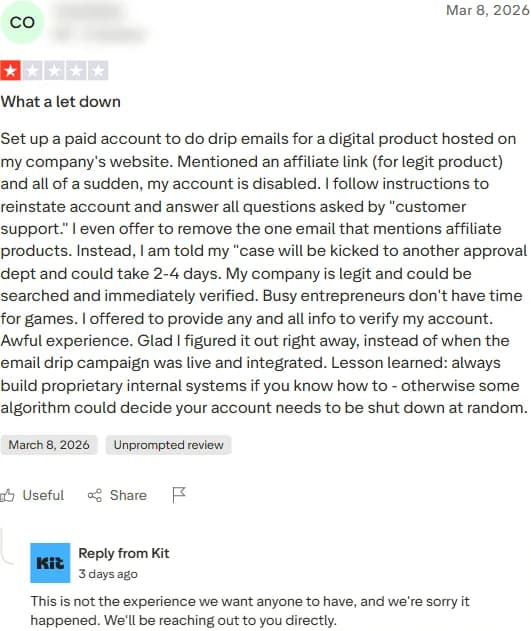
A note on Trustpilot scores:aggregate ratings are skewed by profile status. Kit's profile shows 3.41/5 from 194 reviews; Substack's is unclaimed at 1.3/5 from 161 reviews, which attracts disproportionate complaints. Read individual reviews like the Kit one above, not the headline number.
Frequently asked
Frequently Asked Questions
Is Kit cheaper than Substack?
It depends on your revenue. Kit's platform cut is 0.6 percent on paid newsletter revenue (Stripe card processing adds roughly 2.9 percent plus $0.30, so all-in is around 3.5 percent total). Substack takes 10 percent plus the same Stripe fees, for about 13 percent all-in. On $1,000 per month in paid subscriptions: Substack costs roughly $130, Kit roughly $35. The Kit Creator plan at 1,000 subscribers runs $33/mo on annual billing. That plan becomes cheaper than Substack once your paid revenue passes the break-even point (detailed in the pricing scenarios table on this page). The Kit Newsletter free tier (up to 10,000 subscribers) supports paid subscriptions at 0.6 percent with no flat monthly fee, making it free until you want full automations. Pricing verified on kit.com/pricing (June 2026).
Did Kit remove sequences from the free plan?
Partially, not fully. One Trustpilot reviewer, writing in 2024 (December), noted the rebrand from ConvertKit to Kit removed the ability to create new sequences from the free tier. However, Kit's own pricing page (verified June 2026) shows the Newsletter free plan includes one basic visual automation and one email sequence. The claim 'sequences removed from free' overstates it. The accurate picture: the free Newsletter tier supports one sequence and one automation, while the paid Creator plan unlocks unlimited automations and sequences. If you rely on multiple onboarding sequences, the free tier is a bottleneck.
Can my paid Substack subscribers move to Kit?
Free subscribers move easily via CSV import. Paid subscribers cannot carry their payment details to Kit. The mechanism on Kit's official migration documentation (help.kit.com, verified February 2026): paid subscribers must cancel their Substack subscription and re-subscribe through your new Kit checkout. This creates a gap period and a re-subscription ask, which typically produces some drop in paid count. The contrast with Substack-to-Beehiiv is meaningful: Beehiiv has a 1-click importer that carries Stripe payment data. Apple in-app subscriptions are non-portable on any Substack alternative.
What happened with Kit's September 2025 price hike?
Kit increased Creator plan pricing roughly 56 percent in September 2025. The base monthly price at 1,000 subscribers went from approximately $29 to $39 per month (monthly billing). Annual billing at the same tier went from approximately $25 to $33 per month. This affected existing subscribers on the old pricing after the transition period. The price hike is documented in third-party review sources (toolstackvault.com, passivekit.com, verified March 2026). If you see older blog posts citing $25/mo or $29/mo Creator pricing, those are pre-hike figures. Current pricing is $33/mo annual or $39/mo monthly at 1,000 subscribers, as of June 2026.
Can I use both Substack and Kit at the same time?
Yes, and a meaningful share of creators do. The approach: use Substack Notes and its recommendations network for discovery and top-of-funnel growth, then funnel readers who opt in deeper (course buyers, product customers, segmented nurture sequences) to Kit where you can run automations and sell digital products. One creator described it on Reddit in August 2025: they wanted Substack for Notes-based audience growth but Kit for better automation features. This dual-stack costs more to manage but is a defensible strategy if Substack is your main acquisition channel and Kit is your monetization layer. The practical limit is subscriber list overlap management and FTC disclosure on both platforms.
How We Tested This Comparison
OwnLetter operates as a lab-style analyst rather than a power-user reviewer. We read 496 unique user signals across Reddit (r/Substack, r/Emailmarketing), G2 (verified-buyer reviews, in 2023 through 2026), and Trustpilot (aggregated June 2026). Every signal was read in full, not sampled by keyword. The v1 approach of keyword sampling missed dominant themes; v2 full reading is the standard used here, per the OwnLetter cross-data comparison methodology.
All 29 claims in our manifest include a source URL and verification status (22 verified against a primary source, 7 limited to review-corpus attribution). Zero claims are invented. Pricing was cross-validated against vendor pages on May 20 and June 1, 2026. The September 2025 Kit price hike is documented from third-party reviewers and the vendor page.
What we did not do: we did not run live deliverability tests (seed-list tests violate vendor ToS for both platforms). We aggregate documented signals rather than producing metrics from a single account. Full methodology →
Affiliate status:Substack runs no affiliate program. OwnLetter is not currently enrolled in Kit's affiliate program. This page earns us nothing. We flag this as a trust asset: our Kit analysis has no commission incentive.
Sources
- · Kit pricing page (verified June 1, 2026)
- · Substack pricing page (verified June 1, 2026)
- · Kit official Substack migration documentation (verified February 4, 2026)
- · Kit Visual Automations feature page (verified June 2026)
- · Substack Recommendations network stats (Substack, as of 2024 February; directional, over 12 months old)
- · Kit September 2025 price hike documentation (toolstackvault.com, verified March 2026)
- · Kit pricing cross-validation (passivekit.com, verified April 2026)
- · The Verge: Substack platform-fee migration case study (verified May 2026)
- · Apple subscription non-portability documentation (verified April 2026)
- · Kit free migration for 5K+ subscriber lists (saascompared.io, verified 2026)
- · Trustpilot Kit reviews (3.41/5, 194 reviews, captured June 2026)
- · Trustpilot Substack reviews (1.3/5, 161 reviews, unclaimed profile, captured June 2026)
- · FTC Consumer Review Rule, in 2024 (October)
Who Should Pick Which
If you sell courses or digital products:
Kit. You keep roughly 99.4 percent of paid revenue, get real behavioral automations, and sell digital products from a single platform. The September 2025 price hike is a real cost factor at scale; model it against your paid revenue and decide.
Try Kit free (up to 10K subs) →If you're starting from zero, no audience yet:
Substack. The Recommendations network is a real discovery mechanism with no equivalent in Kit at early scale. The 10 percent cut on trivial initial revenue is negligible. Plan to evaluate Kit once you cross 500 paying subscribers, when the fee math shifts. Substack is the wrong choice if you sell digital products or need behavioural automations; its tooling simply does not exist for those use cases.
Start free on Substack →If you run affiliate content:
Kit for commerce and automations, but with caution. Document the affiliate-link suspension pattern (approximately 3-4 Trustpilot reports, March 2026) before relying on Kit for affiliate email campaigns. Use link shortening or consult Kit's support documentation on commercial email policy. Do not pick Kit if you have zero audience and need cold discovery more than automation tooling; Kit's Creator Network does not match Substack's Recommendations reach at the zero-list stage.
If you just want to write, no plans to sell:
Kit is not for you if you only want to write and never plan to sell. Its automation and commerce tooling is overhead you will not touch, and you would be paying for a tier whose value only materialises when you monetise. Substack or a simple newsletter tool is a more honest fit.
Looking at more Substack alternatives? See our full Substack alternatives 2026 guide or the Substack vs Beehiiv comparison if paid-subscriber migration without re-subscription friction is a priority.
Join the Discussion
Using Substack or Kit? Share your experience or correct an inaccuracy. No account required: email and name only. Comments are moderated.