On this page (13 sections)
Buttondown Review 2026: The Developer-Grade Minimalist

By Arthur Brulard, Founder of OwnLetter. Cross-vendor analyst review across 11 newsletter platforms, aggregating user signals from Reddit, G2, Capterra, Trustpilot, and Hacker News. LinkedIn
Published June 12, 2026 · Updated June 12, 2026 · 18 min read

Free up to 100 subscribers. $9 off your first month on paid (vendor promo). Paid link, at no extra cost to you.
Best for
- Developers (API)
Less ideal for: Podcasters · Ad / sponsor monetizers · SEO / web growth
Derived from our recommendation quiz across creator profiles — not from who pays us.
Hands-On: Writing, Sending and Building on Our Own Account
We set up a real Buttondown account to see the product, not the marketing site. The account is fresh, so the screenshots below show the interface and capability, not a live audience. We do not stage numbers we have not earned. Where a claim needs a real audience, like a measured deliverability rate, we say so and defer it rather than fake it.
The first impression matches the corpus: the editor feels like a writing app, not a marketing console. You write in Markdown and it renders as you type, with a live email preview alongside. That is the part reviewers love. It is also where the trade-off starts, because there is no drag-and-drop block builder underneath the calm.
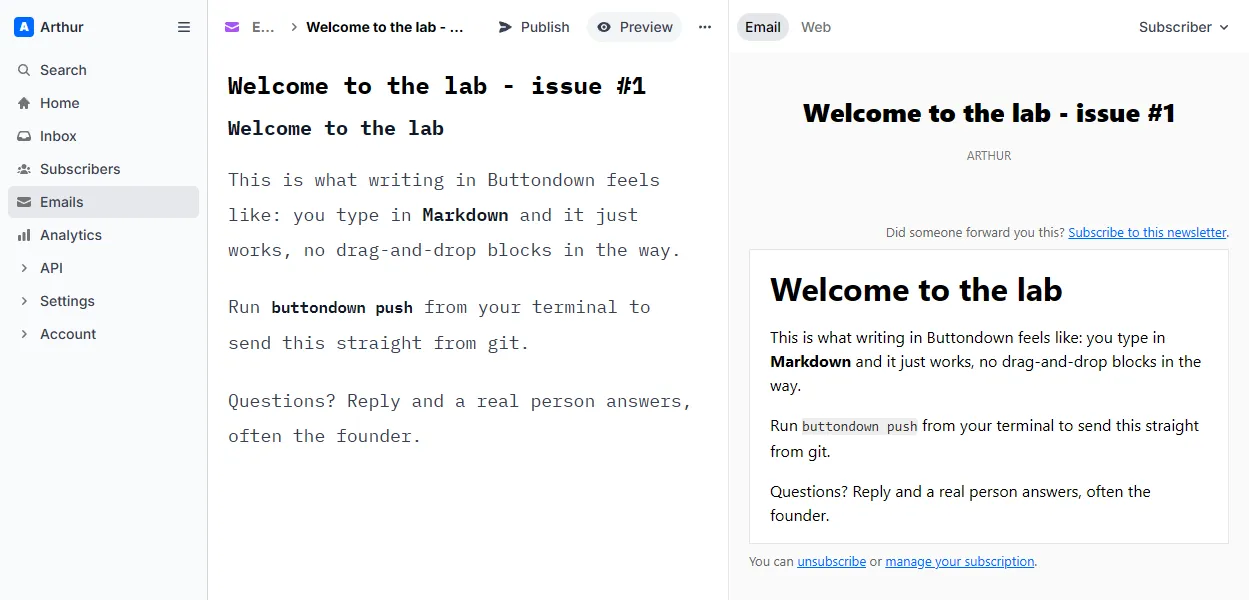
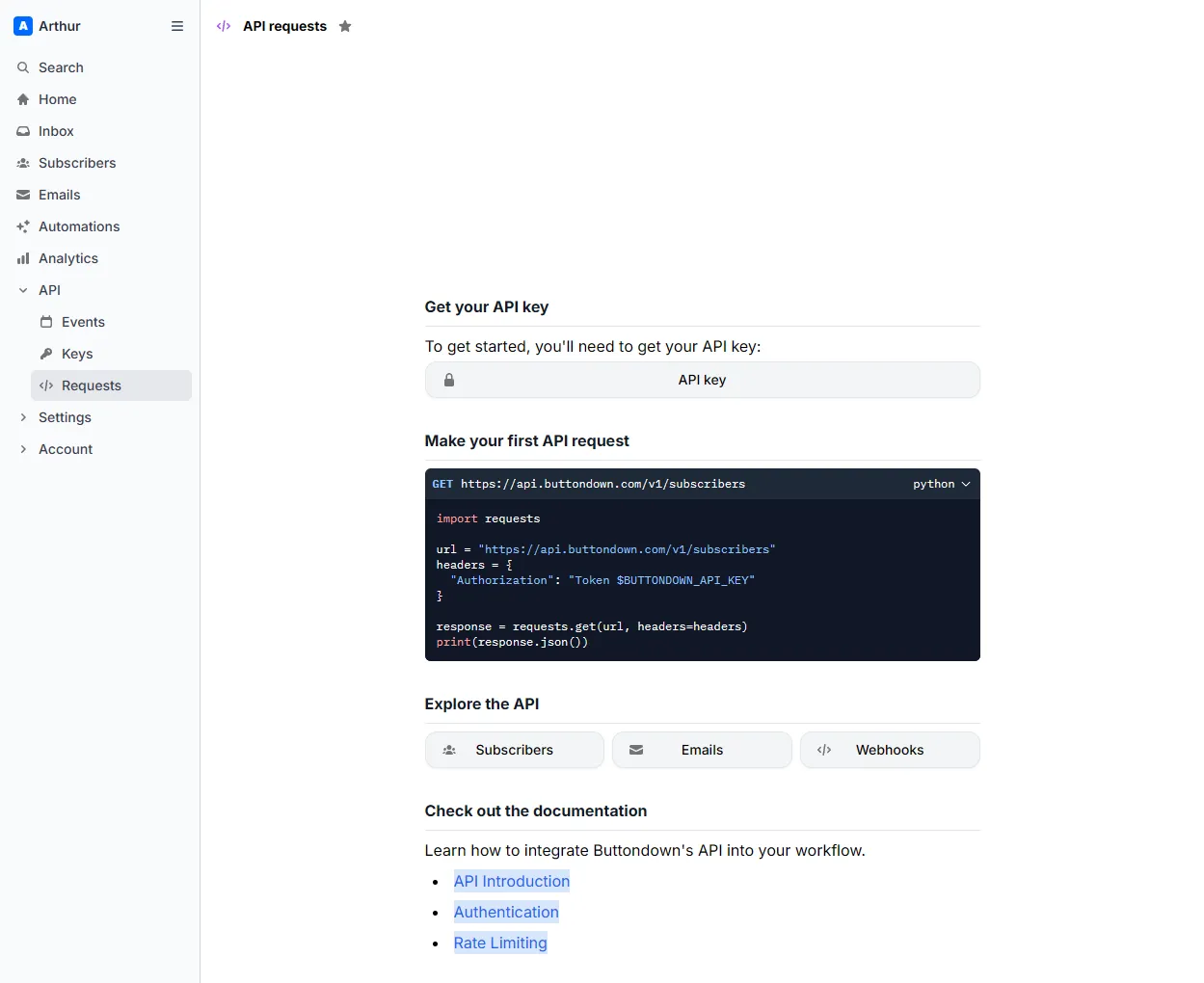
The other half of the product is the developer layer, and Buttondown puts it right in the app. The API console hands you a key, a ready-to-run request and webhooks on the free plan. With the official CLI, this is the stack the developer crowd in the corpus chose Buttondown for.
How we testedVerified June 2026 · 217 reviews aggregated · buttondown tested · hands-on account + 217 posts and reviews read in full + methodology public
What we did: Set up a real Buttondown account and captured the editor, paid-subscriptions setup, automations builder, analytics and API console first-hand (June 2026). Read 217 community posts and reviews in full (Capterra, Reddit, Trustpilot), not sampled by keyword. Cross-validated pricing against buttondown.com/pricing on September 13, 2026, and the feature and trust facts against our eleven-vendor data layers.
What we did NOT do: We did not run a controlled deliverability test (seed-list tests violate ToS and one account is not representative), so we never publish a deliverability rate. Our account has no audience, so we show capability and honest empty states, never staged analytics or earnings.
Refresh cadence: Pricing verified quarterly minimum; the 20-claim manifest carries a source and date per numeric claim (pricing verified September 13, 2026). Full methodology →
Straight from the reviews
What real users say
217reviews read in full
Each site’s average below comes from its own user reviews across Reddit, Trustpilot, Capterra and G2, plus the themes that come up most — the count per site is on each bar. We never invent a quote.
Average score on each review site
 Buttondown
What comes up most often
ButtondownCustomer support qualitytop theme
Responsive, personal, founder-led support is buttondown's single most mentioned strength, cited in roughly 60 reviews as a primary reason customers stay and recommend it.
“Their support is absolutely best in class.”Capterra, 2024-11-11
Ease of use & onboardingtop theme
Buttondown's stripped-down simplicity is its most praised trait, with even self-described non-technical users describing setup and daily use as intuitive and friction-free.
“Buttondown provides exactly what you need without any extra complexity that comes with many tools. It's simple, easy to use, and it works.”Capterra, 2025-04-01
Pricing & value for moneytop theme
Pricing is overwhelmingly praised as fair and transparent, with many reviewers switching from more expensive platforms and cutting costs by 50% or more.
“Price is way more affordable than its big name competitors, and it is way more straightforward to use it as compared to competitors as well.”Capterra, 2024-08-15
Design & customizationcommon
Customization is a split experience: developers appreciate the openness and lack of forced templates, while non-coders find design options limited and the learning curve real.
“Harder to use. Fewer customizations on design and layout. I wish it formed a community like substack and it had space to recommend other newsletter here.”Capterra, 2025-05-20
Email editor & templatescommon
Markdown-first writers love the plaintext editor for keeping emails focused, though some non-developers wish for richer formatting or more ready-made templates.
“I like that i can write campaigns in Markdown and focus on simple emails instead of lots of templates and drag and drop formatting.”Capterra, 2023-11-12
Migration & switchingcommon
Migration into buttondown, most often from Substack, is consistently described as smooth, with hands-on help from the developer easing the transition.
“migration from Substack was easy.”Capterra, 2024-01-02
Analytics & reportingcommon
Analytics are the most consistently cited gap. Reviewers find the reporting too lightweight for tracking growth, and some cannot integrate their own analytics tools.
“It doesn't look like I'm able to use any analytics software. I don't see a way to copy and paste the code.”Capterra, 2025-05-25
Reliability & bugsminor
A minority of users report meaningful reliability issues (outages, UI lag, and emails stuck in draft), though many others describe the platform as dependably stable.
“I think it's a bit clunky, and in the first week alone I experienced 2 major outages which cost me subscribers. So less glitchy would be nice.”Capterra, 2025-03-16
Free plan generosity & changesminor
The free tier is seen as genuinely useful for getting started, though a few reviewers note that practical features like tags are gated behind paid plans.
“Free tier is generous. I recently bumped to the paid tier and felt I was getting excellent value.”Capterra, 2025-01-25
Integrations & APIminor
Developer-focused reviewers single out buttondown's clean API as a decisive reason to choose it, enabling programmatic publishing and bespoke membership integrations.
“The APIs! The support is absolutely top-notch as well. But the fact that I can get the data in and out of the system was why I chose Buttondown.”Capterra, 2024-05-22
Deliverability & sending setupminor
Deliverability is mixed: several reviewers report solid inbox placement, while others describe newsletters landing in spam with no clear path to resolution.
“Deliverability is high. Markdown is great.”Capterra, 2024-01-14
Automation & segmentationminor
A handful of reviewers value basic automations like RSS-to-email and standard sequences, but the feature set is modest and rarely a primary selling point.
“Simple yet powerful features like automation”Capterra, 2023-09-18
Monetization & revenue toolsminor
Paid-subscriber flows exist and offer flexibility like pay-what-you-can tiers, but the workflow is described as cumbersome by the small number of reviewers who use it.
“The paid subscribers flow is a bit tricky and cumbersome, but the developer is extremely helpful.”Capterra, 2023-05-23
Mobile appminor
A few reviewers flag the absence of a native mobile app and intermittent mobile-browser login issues, making it a desktop-only workflow for now.
“There is no app version of the platform”Capterra, 2024-01-07
Data export & lock-inminor
The few reviewers who mention data portability are uniformly reassured: importing from Substack or TinyLetter is described as easy, and owning your data is a stated draw.
“Buttondown makes it easier for me to own my data, and write in markdown.”Capterra, 2023-07-18
Praised · Complaint · Split opinion
Average scores pulled from each site on May 31, 2026. Trustpilot scores are a recent sample, not the lifetime average; Reddit has no star ratings. The full-read count above includes Reddit threads, which carry no star rating, so it runs higher than the per-site rated samples shown here. Themes are summarized from the reviews we read in full. See our methodology.
- Customer support quality: 60 mentions, mostly positive
- Ease of use & onboarding: 58 mentions, mostly positive
- Pricing & value for money: 35 mentions, mostly positive
- Design & customization: 20 mentions, mixed
- Email editor & templates: 18 mentions, mixed
- Migration & switching: 14 mentions, mostly positive
- Analytics & reporting: 10 mentions, mostly critical
- Reliability & bugs: 9 mentions, mixed
- Free plan generosity & changes: 9 mentions, mostly positive
- Integrations & API: 8 mentions, mostly positive
- Deliverability & sending setup: 6 mentions, mixed
- Automation & segmentation: 5 mentions, mostly positive
- Monetization & revenue tools: 4 mentions, mixed
- Mobile app: 3 mentions, mostly critical
- Data export & lock-in: 3 mentions, mostly positive
▲ mostly positive▼ mostly critical◆ mixedTop 12 of 15 themes tracked.
Across 217 Buttondown community posts and reviews we read in full, the single loudest signal is support, and it is unusually personal. GetApp rates Buttondown's customer service 4.9 out of 5, and reviewers name the founder by his first name. One put it memorably:
“the support I get when I reach out. I get an almost immediate response from a real person with a name and I can ask for help as often as I need it...as an 80 year old writer who is not tech savvy, this means a lot to me.”Capterra, April 2024
The second loudest is simplicity: the tool gets out of the way. The honest counterweight, the same corpus, is design and analytics. Buttondown does not compete on graphical emails or rich reporting, and the people who need those say so plainly.
The Developer Layer: Buttondown's Real Moat
This is where Buttondown is genuinely a category of one. In our quality layer its API access scores 1.0, the top of the panel, and the reason is simple: it ships an official command-line tool, the npm package @buttondown/cli. You write in Markdown with YAML frontmatter, version your newsletter in git, and pull or push it from your own machine. No other platform in our eleven-vendor panel, not beehiiv, not Kit, not Substack, has an official CLI.
Underneath it is a REST API that mirrors the app, with eight granular permission scopes per key and HMAC-signed webhooks, free on every plan. Across the corpus, developers say this is exactly why they picked it:
“The APIs! The support is absolutely top-notch as well. But the fact that I can get the data in and out of the system was why I chose Buttondown.”Capterra, May 2024
The one honest gap, for the AI-agent crowd, is that there is no official MCP server yet (beehiiv ships one free), only a community project. And the API moves fast, with twelve breaking changes since launch, so integrators pin a version. But for owning your data and scripting your newsletter, nothing in the category comes close.
Zero Fees, and the Analytics Trade-Off
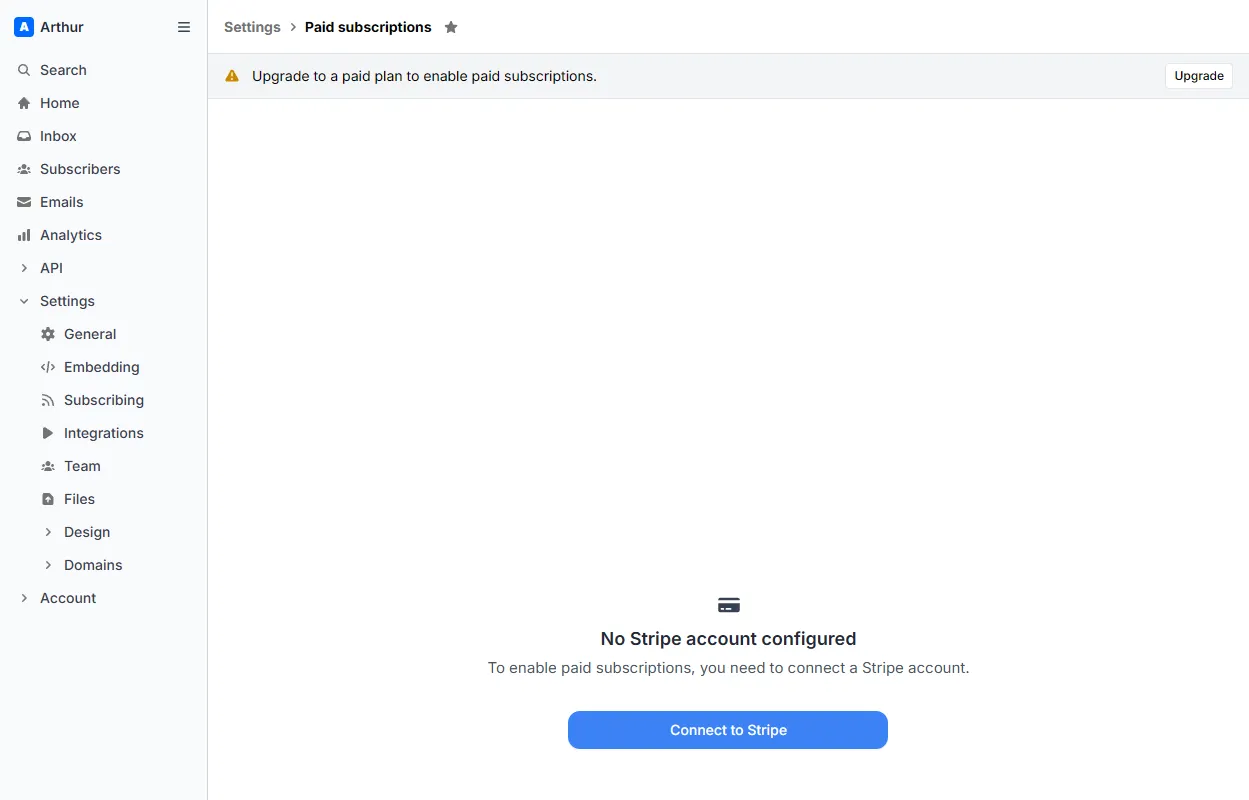
On the money side, Buttondown's stance is clean. It takes a 0 percent platform cut of your paid-subscription revenue and a 0 percent cut of your sponsorship revenue. You keep everything except Stripe's roughly 3 percent processing fee. Against Substack's 10 percent of paid revenue, that is a genuine structural moat, in the platform's own words on its feature page: you keep all of the revenue that you make. The catch is setup. Turning paid subscriptions on needs a paid plan and a connected Stripe account, and the flow is a documented bit of friction.
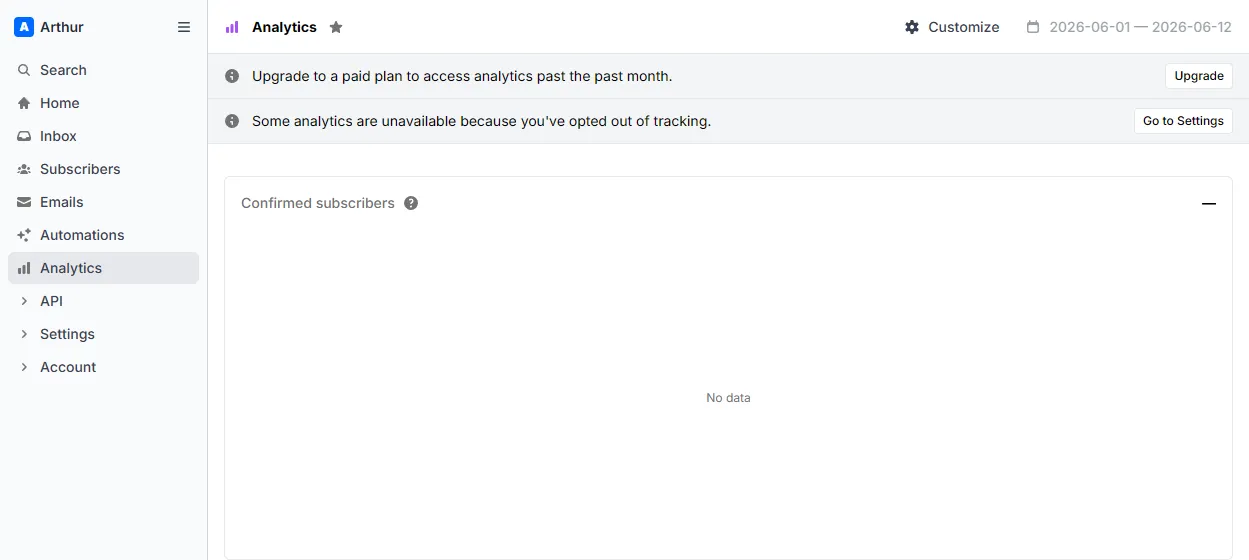
The deliberate weakness is analytics. They are off by default and you cannot inject third-party scripts like Google Analytics, so in our quality layer they score 0.4, against beehiiv's 1.0. The dashboard itself is honest about it: it tells you tracking is opted out, and gates deeper history behind a paid plan. For a privacy-first writer this is a feature. For a data-driven sender it is the deal-breaker, and reviewers who love the product still flag it for others.
Pricing: À-la-Carte, With Fine Print
“Absolutely nothing for your first 100 subscribers.”
Buttondown is free up to 100 active subscribers, and you are billed only on active subscribers, never on unsubscribed or cold contacts. Past 100 the model is unusual: a base that scales by subscriber count, from $9/mo (Paid, 1K subs) · verified June 4, 2026 a month at 1,000 subscribers, plus independent add-ons you switch on one at a time. On annual billing that same base is $7.5/mo (Paid, 1K subs) · verified June 4, 2026 a month, and it rises with your list, reaching $29/mo (Paid, 5K subs) · verified June 4, 2026 a month at 5,000 subscribers.
“I use to pay 2 200 $ CAD per year for a ‘free’ newsletter. I save more than 50 % of that cost with Buttondown.”Capterra, April 2025
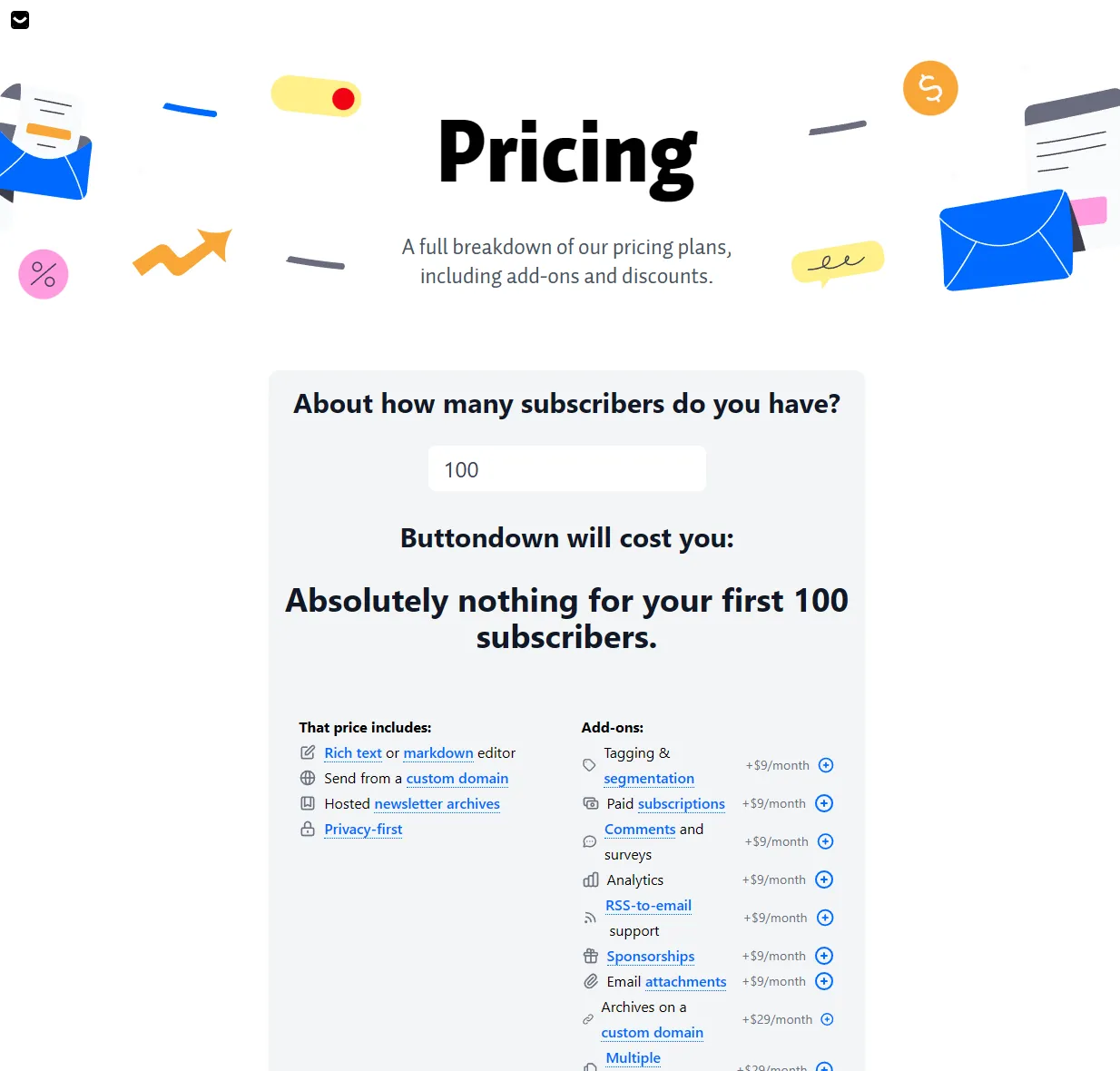
Buttondown plan calculator
Enter your list size to see which Buttondown plan you would be on and what it costs at that size.
Prices for the 1,000-subscriber band, annual billing, verified September 2026. Stripe processing fees apply separately to paid subscriptions.
Pricing verified Jun 4, 2026 · Last change: Apr 20, 2026 (Paywall-expansion: three more features moved behind paid plans)⚠ overdue (101d)
Who Controls Your Audience?
On the question every creator is afraid to ask, Buttondown gives you strong control over the list you build. Three answers decide it.
Can you export your full subscriber list anytime?
Yes. A complete CSV export (email, tags, UTM, IP) works on every plan, including free, and Buttondown will even carry your paid Stripe subscriptions to a competitor without making subscribers re-enter their cards. That portability is the inverse of the lock-in writers leave Substack to escape.source
Who else can use your content?
The terms license only Buttondown's own web assets and stay silent on your newsletters, so there is no IP claim over your content. The flip side of a thin set of terms is that the silence is not an explicit protection either.source
What happens if a platform failure costs you?
The terms set a $0 liability floor: damages for loss of data or profit from business interruption are explicitly excluded. That is worse than Substack's $100 floor on this single clause, the one place Buttondown's otherwise creator-friendly terms fall short.source
The risk in plain languageOwnership is a real strength here, the reason trust scores 8.4. You can leave with everything, and even take your paying subscribers. The asterisks are the $0 liability floor and the single-founder structure. Back up your subscriber CSV every month anyway, which Buttondown makes easy.
See subscriber control across all 11 platforms (11 criteria, side by side).
Our take
Where buttondown Falls Short
- Analytics are deliberately minimal, a documented deal-breakerAnalytics are off by default and you cannot inject third-party scripts. In our quality layer Buttondown's advanced analytics score 0.4, against beehiiv's 1.0, and the corpus is consistent. Even satisfied users flag it: “The analytics are not very intensive. I don't mind that personally, but I could see that being a deal breaker for others.” (Capterra, July 2023). Another was blunter: “It doesn't look like I'm able to use any analytics software. I don't see a way to copy and paste the code.” (Capterra, May 2025).
- No drag-and-drop editor, a wall for non-developersButtondown is Markdown-first. Its “Fancy Mode” is a light rich-text layer, not the block builder you get on Mailchimp or beehiiv, and switching between the two can scramble formatting. One reviewer put it gently: “I wish I could customize the emails a bit better, but it might just be because I am not good at coding.” (Capterra, April 2025). If you want visual, graphical emails without touching markup, this is the wrong tool.
- The free tier is actively shrinkingThe marketing page calls the pricing transparent and stable, but the changelog tells a different story: in a six-week stretch in 2026, Buttondown moved custom domains via API (March 14), then metadata and transactional-email customization (April 15), then a further three features (April 20) behind paid plans. “Three features are moving behind the paywall” is the changelog's own wording. It is a trend worth watching if the free tier is your plan.
- It is a single-founder operation, with a $0 liability floorButtondown is bootstrapped and profitable, an estimated 900,000 dollars in annual revenue (a dated, non-audited figure), but it is effectively run by one person, Justin Duke. Continuity carries a real bus-factor risk a venture-backed rival does not. And the terms set a 0 dollar contractual liability floor: damages for loss of data or profit from business interruption are explicitly excluded, which is worse than Substack's 100 dollar floor on that single clause.
- Hidden constraints: one email a day, weekday-only support, no mobile appThree things the headline never shows. The pricing fine print assumes you send at most one email a day to your whole list; send more and you negotiate a usage-based quote. Support is email-only and weekday-only (about 6am to 6pm ET), so a weekend incident waits: one user documented emails stuck in Draft over a weekend, resolved Monday. And there is no native mobile app, with a couple of Safari login-session glitches reported on phones.
Who should skip Buttondown
Four creators who should look elsewhere
Buttondown is excellent at one thing: being a calm, ownable, developer-grade writing tool. If that is not what you need, its restraint becomes a wall. Four profiles should pick something else.
- Data-driven senders who need rich analytics and third-party tracking: Buttondown's analytics are off by default and score 0.4 in our quality layer. beehiiv leads the panel here.
- Non-technical creators who want drag-and-drop, graphical emails: Buttondown is Markdown-first with no block builder. Mailchimp or beehiiv fit better.
- Anyone counting on the platform for growth: there is no discovery network, no recommendations engine and no ad marketplace. Substack or beehiiv drive organic reach; Buttondown leaves growth entirely to you.
- Course creators who need branched, behavioral automation, or high-frequency senders: automations are linear and add-on-gated, and the base price assumes one email a day. Kit goes deeper on funnels.
Three Alternatives Worth a Look
Not sure Buttondown is the one? These three solve the cases it is weakest at. The deep side-by-side lives on our comparison pages and the recommendation quiz.
 beehiiv
Rich analytics, a native ad network and a growth engine. Best if you want to scale and monetize through the platform, not just around it.
Compare platforms → Kit
KitVisual, branched automations and creator commerce. Best for course creators running behavioral funnels Buttondown cannot.
Compare platforms → Ghost
GhostSelf-hosting, a block-based CMS and 0 percent fees for life. Best if you want a full publication and total platform independence.
Compare platforms →Still weighing it up? Take the 2-minute recommendation quiz for a pick based on your needs, not our commissions. If writing is the whole point for you, the field is ranked writer-first in best newsletter platforms for writers.
Frequently asked
Buttondown FAQ
Is Buttondown worth it in 2026?
For the right person, yes. If you write in Markdown, value owning your data and want a tool that gets out of the way, Buttondown is one of the best-supported newsletter platforms we track, and our engine scores it 6.7 out of 10. If you need rich analytics, a drag-and-drop editor or platform-driven growth, it scores low exactly where you would feel it, and you should look elsewhere.
Does Buttondown take a cut of paid subscriptions?
No. Buttondown takes a 0 percent platform fee on your paid-subscription revenue and a 0 percent cut of your sponsorship revenue. You only pay Stripe's roughly 3 percent processing fee. That is the structural contrast with Substack, which keeps 10 percent of paid revenue. Setting paid subscriptions up needs a paid plan and a connected Stripe account.
Does Buttondown have a free plan?
Yes, free up to 100 active subscribers, and the free plan includes the API, webhooks, a custom sending domain and full data export. You are billed only on active subscribers, never on unsubscribed or cold contacts. Note that the free tier has been shrinking: three features moved behind the paywall in spring 2026.
Can non-developers use Buttondown?
They can, and many do, but expect a learning curve. Buttondown is Markdown-first with no drag-and-drop block builder, so a non-technical writer who wants a visual layout can feel boxed in. The thing that keeps them is the support: the most-cited theme across 217 reviews is fast, personal help, often from the founder himself.
Are Buttondown's analytics any good?
They are deliberately minimal and off by default. You cannot inject third-party scripts like Google Analytics, and the dashboard itself tells you tracking is opted out. That is a privacy feature for writers and an explicit deal-breaker for data-driven senders. Reviewers who love the product still flag the analytics as the thing that could send others away.
Buttondown or Substack?
If you want built-in discovery, a reader network and a zero-setup free start, Substack, and you pay 10 percent of paid revenue for it. If you want to keep 100 percent of your revenue, own your data and write in Markdown, Buttondown, and you grow entirely through your own channels because it has no discovery network. See our comparison pages for the side-by-side.
Is a solo-founder product like Buttondown reliable?
Buttondown is bootstrapped and profitable, with no investors, which is a genuine guard against the venture-driven pivots and price hikes that hit larger rivals. The flip side is a single-founder structure: continuity depends on one person, a category risk no bundled-tier competitor carries. Keep a monthly CSV export, which Buttondown makes easy on every plan.
How We Reviewed Buttondown
OwnLetter reviews as a lab-style analyst, not a power user. We set up a real Buttondown account and captured the product first-hand (June 2026), and we read 217 community posts and reviews in full across Capterra, Reddit and Trustpilot, rather than sampling by keyword. Every factual claim traces to a source with a date in our 20-claim manifest. Pricing was cross-validated against buttondown.com/pricing on September 13, 2026, and the feature and trust facts against our eleven-vendor data layers.
The OwnLetter Score is computed, not hand-set: eight weighted criteria, with weights fixed and published before any vendor was scored, and commission deliberately excluded from the math. We say it plainly because Buttondown pays us: this page earns a commission if you sign up, and it changes nothing in the score. The proof is the 6.7, below beehiiv's 7.4, an affiliate scored honestly where its data lands. Full methodology and weights →
The bottom line
Buttondown gets out of the way so you can write and own it.
The founder-direct support, the 0%-fee revenue and the developer layer are the real reasons to pick it. If you need rich analytics or platform-driven growth, it is the wrong tool, and we said so.
Free up to 100 subscribers · No credit card required
$9 off your first month on paid plans (vendor promo)
Paid link — at no extra cost to you
Used Buttondown? Tell Us
Running a newsletter on Buttondown, or left it? Share your experience or correct an inaccuracy. No account required: email and name only. Comments are moderated.