On this page (16 sections)
Substack vs Ghost 2026: The 10% Tax vs Real Ownership

By Arthur Brulard, Founder of OwnLetter. Cross-vendor analyst review across 11 newsletter platforms, aggregating user signals from Reddit, G2, Capterra, Trustpilot, and Hacker News. LinkedIn
Published June 11, 2026 · Updated June 11, 2026 · 19 min read
Quick verdict
Ghost wins on money and ownership once you earn: a flat plan, 0 percent transaction fees from Publisher ($29/mo annual at 1,000 members), and the only credible exit on this market, an open-source core you can self-host. Past roughly $290/mo in paid revenue, Substack's 10 percent costs more every month. Substack wins the start:zero configuration, zero monthly cost, unlimited free subscribers, and a discovery network Ghost simply does not have. Two caveats define the honest version of this matchup. Ghost's cheapest plan cannot monetize at all, so price it at Publisher. And both hosted products take a perpetual license to your content in their terms; ownership is cleanest only when you self-host. Full math, clauses, and migration mechanics below.
Substack is free to start; Ghost has no free tier. Full pricing math below. Neither link pays us.
Not sure which fits you?
Substack or Ghost — answer a few questions
Which fits you?
Loading the quiz…
How we testedVerified June 2026 · 895 reviews aggregated · Substack + Ghost tested · 35 sourced claims · pricing from our weekly tracker · methodology public
What we did: Read 895 user signals in full (480 Substack + 415 Ghost across Reddit, Trustpilot, G2 and Capterra, aggregated June 2026). Pulled pricing from our weekly automated tracker (verified June 7, 2026). Re-fetched both vendors' primary pages live on June 11, 2026: pricing, terms of service, migration docs, about pages, and the HaveIBeenPwned breach entry. Captured and annotated eight screens as proof. First-hand: we operate a test Substack publication (hands-on log, June 10, 2026); we have not yet run a Ghost trial account.
What we did NOT do: We did not run deliverability seed-list tests (they violate both vendors' terms). We did not test Ghost hands-on yet, so no Ghost claim on this page is presented as first-hand.
Refresh cadence: Pricing re-verified weekly by automation; claims manifest with source URL per numeric claim publicly available. Next full refresh September 2026. (pricing verified June 7, 2026). Full methodology →
 SubstackSubstack
 GhostGhost
The Fee Gap: 10% of Revenue vs a Flat Plan
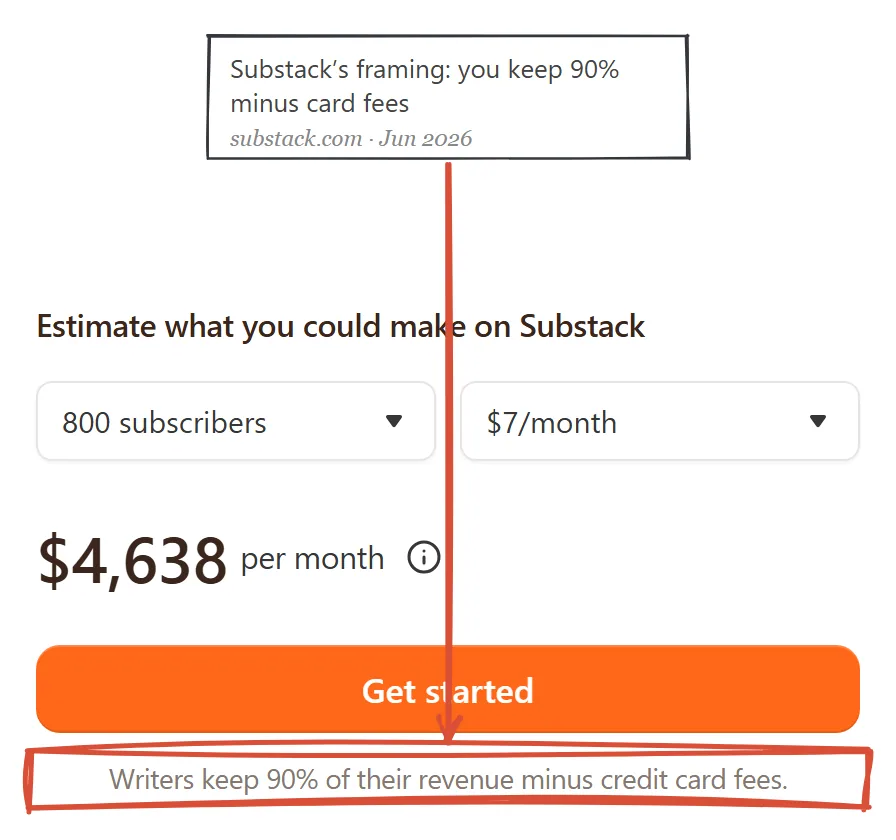
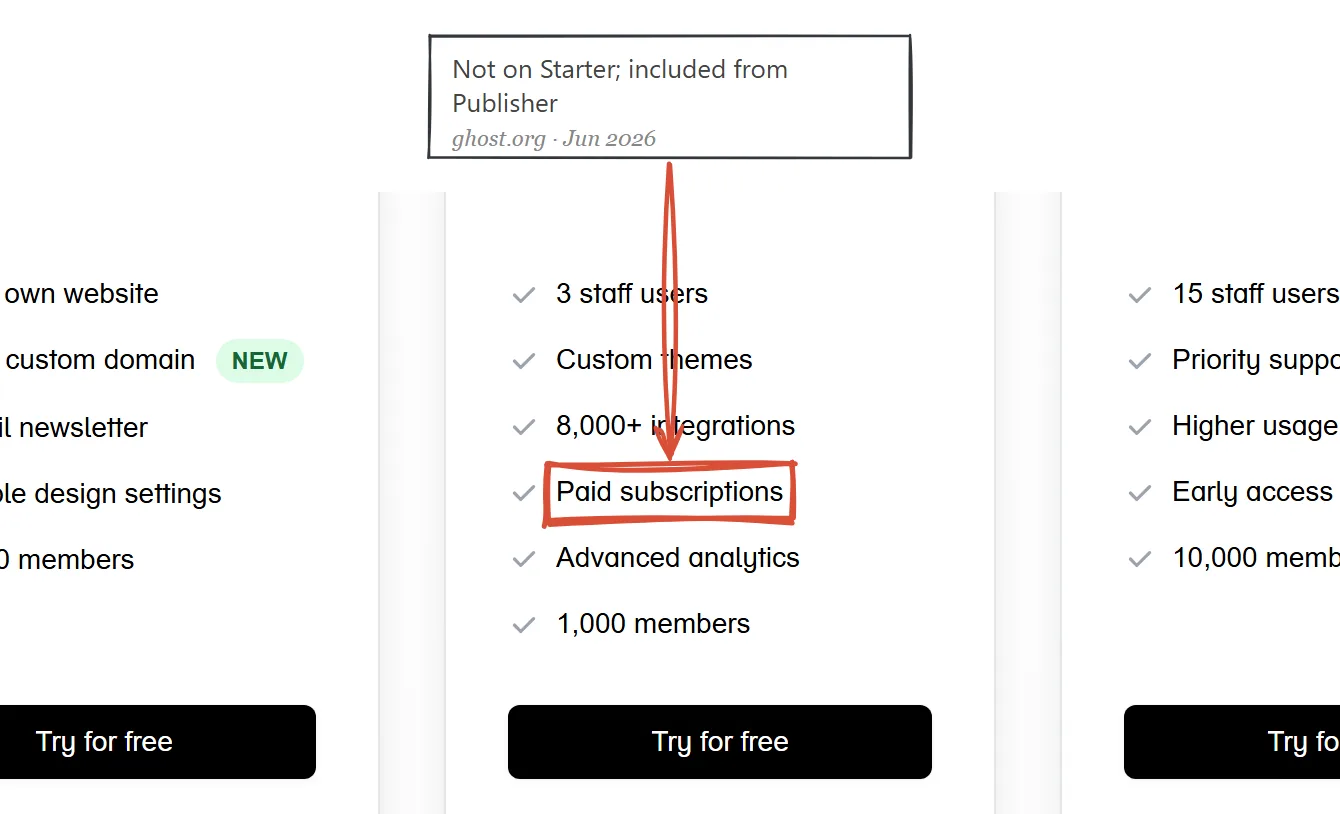
Start with how each platform words its own price. Substack's going-paid page says: "Writers keep 90% of their revenue minus credit card fees." The support center states it the other way around: "From Substack: 10% of each transaction," plus Stripe's 2.9 percent + $0.30 and a 0.7 percent recurring billing fee (both verified June 2026). Ghost's pricing page says "No payment fees" and its plan table shows 0 percent transaction fees on every plan that can monetize. The catch sits one row higher: paid subscriptions only exist from the Publisher plan ($29/moon annual billing at 1,000 members). Ghost's entry Starter plan cannot charge readers at all.
The structural difference matters more than either headline. Substack's cost scales with your revenue; Ghost's scales with your audience size. A Reddit user nailed why Substack's version feels painless in March 2026:
"Substack is the ultimate 'zero-risk' drug. No monthly fees, a clean interface, and a built-in discovery network. It feels free because you aren't getting a bill in your inbox every month." Reddit user (r/Substack source), March 2026 (C-031)
No bill ever arrives, and 10 percent of every transaction leaves anyway. Once paid revenue passes roughly $290/moper month, that invisible cut exceeds Ghost Publisher's entire flat price at the 1,000-member tier. The exact crossover for your list size and revenue is in the calculator further down; the figure here is derived from our weekly pricing tracker, not copied from another blog.
Feature Comparison: Publishing, Monetization, Growth, Control
The split is unusually clean for a head-to-head. Substack brings the network: discovery, recommendations, multi-format publishing (podcast, video, live), and a true free tier. Ghost brings the asset: a full website and CMS, real APIs and webhooks, 0 percent fees, and an open-source core nobody can take away. Neither offers behavioral automation worth the name. The matrix below is data-driven from the OwnLetter feature layer, source-verified against vendor primary documentation (June 2026).
Pick a plan from the ▾ menu under a platform to see what that plan unlocks and its price at your subs count.
| Feature | Substack | Ghost |
|---|---|---|
| Monthly priceat 2.5K subs · monthly | 10% of revenue | $55/mo · Publisher · 2.5K subs |
| 5/6 | 5/6 | |
| 2/5 | 4/5 | |
| 6/9 | 8/9 | |
| 7/9 | 7/9 | |
| 2/4 | 1/4 | |
| 3/5 | 2/5 | |
| 8/10 | 5/10 | |
| 5/5 | 5/5 | |
| Get started | Try free → | Visit → |
✓ Yes · Partial · — No · dotted = unverified · a plan tag (e.g. Scale) = the cheapest plan that unlocks it; pick a plan above each column and ↑ marks features above it. Verified against vendor sources, September 2026.
Straight from the reviews
What real users say
Each site’s average below comes from its own user reviews across Reddit, Trustpilot, Capterra and G2 — the count per site is on each bar. We never invent a quote.
Average score on each review site
SubstackGhostPraised · Complaint · Split opinion
Average scores pulled from each site on May 31, 2026. Trustpilot scores are a recent sample, not the lifetime average; Reddit has no star ratings. Substack isn't listed on Capterra, and on Substack Trustpilot skews toward readers and Reddit toward creators. See our methodology.
Theme by theme: where they agree and differ
| What users say about… | Substack480 reviews read | Ghost415 reviews read |
|---|---|---|
| Ghost leads | ||
| Ghost leads | ||
| Ghost leads | ||
| Ghost leads | ||
| Substack leads | ||
| Substack leads | ||
| See for yourself | Try free → | Visit → |
▲ Praised · ▼ Complaint · ◆ Mixed · top theme / common / minor = how often readers bring it up · ❝ hover any cell for the exact count and a real, sourced quote · · = too few reviews to score. Read in full from Reddit, Trustpilot, G2 and Capterra, June 2026. We never invent a quote.
Review sources:RedditTrustpilotG2Capterra
Deep Dive: Substack
Across 480 Substack community posts and reviews read in full (Reddit, Trustpilot, G2, June 2026), three patterns dominate: the discovery network genuinely works for writers starting from nothing, support is AI-only with no human escalation, and the fee model stays invisible until the month it is not.
Discovery: the moat Ghost does not have
Substack claims that 30 percent or more of paid subscriptions come from within its network (substack.com/about, June 2026; self-reported, no third-party audit). Whatever the true figure, the mechanism is real: Notes, cross-publication recommendations, and leaderboards push your writing to readers who never searched for you. In our corpus, discovery is the second most-mentioned theme (35 mentions, mixed). One Reddit user, May 2026: "it's one of the best newsletter platforms out there for discovery if you have no audience."
The same corpus names the limit honestly:
"The hard truth is most of your early readers will be other writers, not general readers, and breaking out of that circle is genuinely difficult."Reddit user (r/Substack source), June 2026 (C-016)
The network is a real advantage with a saturation curve, not a growth guarantee. Ghost's answer (cross-site recommendations, the Explore directory, ActivityPub federation) is a directory, not an algorithmic feed; Ghost users in our corpus describe signup growth as slow without external channels.
One workflow, many formats, zero config
Substack covers newsletter, podcast (Apple and Spotify RSS), video, and live streams in a single editorial workflow, free, with unlimited subscribers. When we created our own test publication (hands-on, June 10, 2026), onboarding never asked us to pick a plan, and no price appears anywhere in the product; the 10 percent lives only on marketing and support pages. Pledge defaults come pre-wired the moment you connect Stripe. Frictionless is the honest word, and the friction-free design is also how the fee stays out of sight.
Support: the #1 complaint, by volume
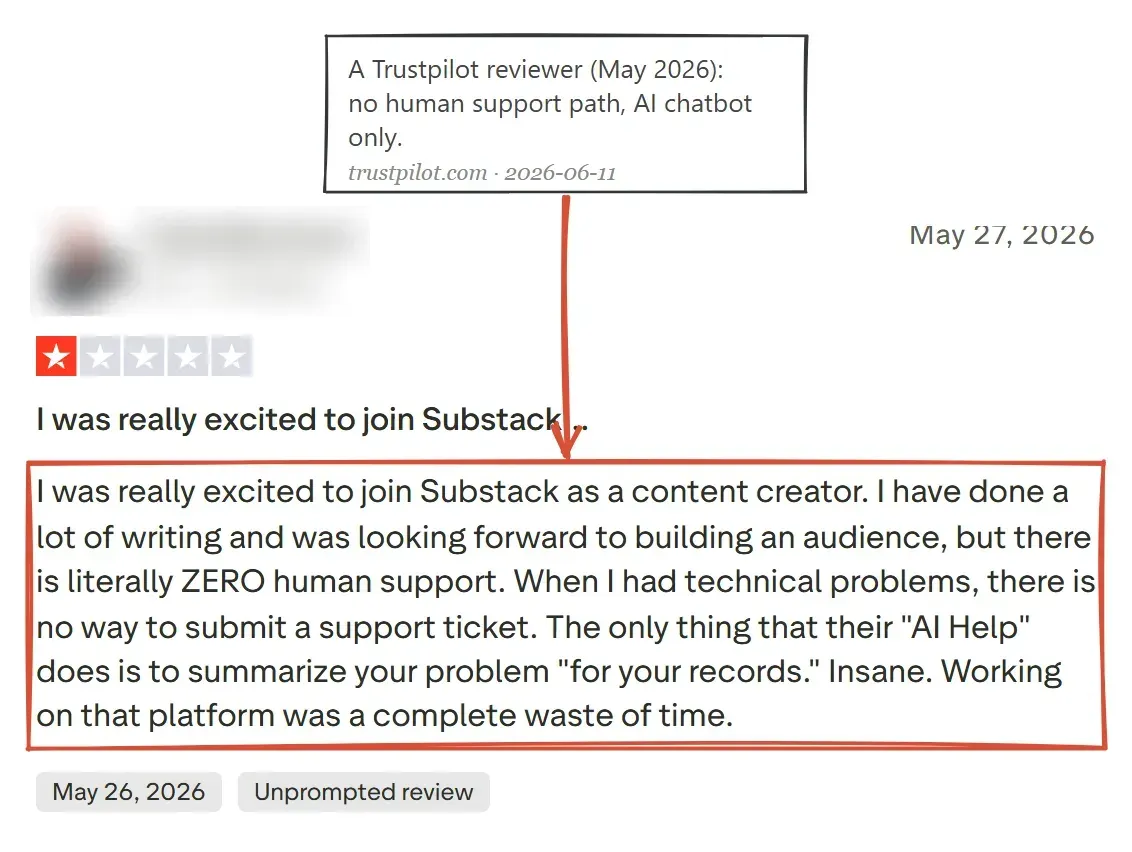
Fifty-eight of 480 signals concern support, almost all negative. The pattern is structural rather than anecdotal: there is no ticket system and no human escalation path, only an AI assistant. Billing disputes (42 mentions, the second one-star driver) mostly come from readers, double-charged or refused refunds after following chatbot instructions. Factor that population into any Trustpilot score you see; it measures reader billing pain more than creator product quality.
Our take
Where Substack Falls Short
- Zero human support, by designSupport is the #1 complaint theme in our 480-review Substack corpus (58 mentions). The pattern is uniform: no support ticket, no human escalation, an AI chatbot that summarizes your problem "for your records" and stops there. One Trustpilot reviewer wrote in May 2026: "there is literally ZERO human support." Several creators cite it as their direct reason for leaving, independent of any product gap. Ghost's support record is mixed rather than absent: praised as fast in several reviews, but a February 2026 backup incident was resolved only after public escalation reached the founder.
- The 10 percent compounds with your successSubstack charges nothing monthly and 10 percent of each paid transaction, plus Stripe's 2.9 percent + $0.30 and a 0.7 percent recurring billing fee (support.substack.com, verified June 2026). At $1,000 per month in paid revenue that is $100 every month. At $15,000 monthly it reaches $1,500 per month. Reddit users describe the all-in cost as closer to 13 to 15 percent of every dollar once processing is counted. The fee is invisible early because no bill ever arrives.
- Automation and segmentation hit a wallA Trustpilot reviewer summarized it in March 2026: "segmentation is basic, automation is almost non-existent, analytics are surface-level." Substack's public help center documents no multi-step sequence feature; drip campaigns are reported in a restricted beta (bestsellers first, October 2025). Tags organize content pages, not audience targeting. If your roadmap includes behavioral funnels, neither platform on this page serves you well, but Substack at least ships welcome emails natively.
- A breach went undetected for monthsIn October 2025 Substack suffered a data breach exposing 663,000 account records (emails, profile data, a subset with phone numbers). It circulated more widely in February 2026, when HaveIBeenPwned indexed it. Passwords and payment data were not exposed. Combined with a terms-of-service stack that includes a perpetual content license, forced arbitration, and a March 2025 case where a locked account's subscriber export became unavailable, the trust picture deserves more scrutiny than its zero-dollar entry price suggests.
Deep Dive: Ghost
Across 415 Ghost community posts and reviews (Reddit, Capterra, G2, Trustpilot, June 2026), the most-praised element is the writing experience, the most structural advantage is the open-source exit, and the most underrated risk is operational: themes, billing surprises, and the real cost of self-hosting.
The editor and the 0%: what users actually praise
Editor and UX lead the corpus at 38 mentions, overwhelmingly positive. One Trustpilot reviewer, January 2026:
"The platform delivers on what it promises: a clean, fast, distraction-free editor focused purely on writing and publishing."Trustpilot reviewer, January 2026 (C-017)
The zero-fee model is the most uniformly positive monetization theme. A Capterra reviewer put it plainly back in 2021: "The best thing about Ghost is that they do not take a portion of your income" (C-032). The model has not changed since: we re-verified the 0 percent transaction fee on ghost.org/pricing in June 2026. One corpus signal makes the stakes concrete: a creator with 17,000 free and 1,100 paid subscribers considering the move because Substack's cut had passed $1,000 per month.
Governance you can verify, not just believe
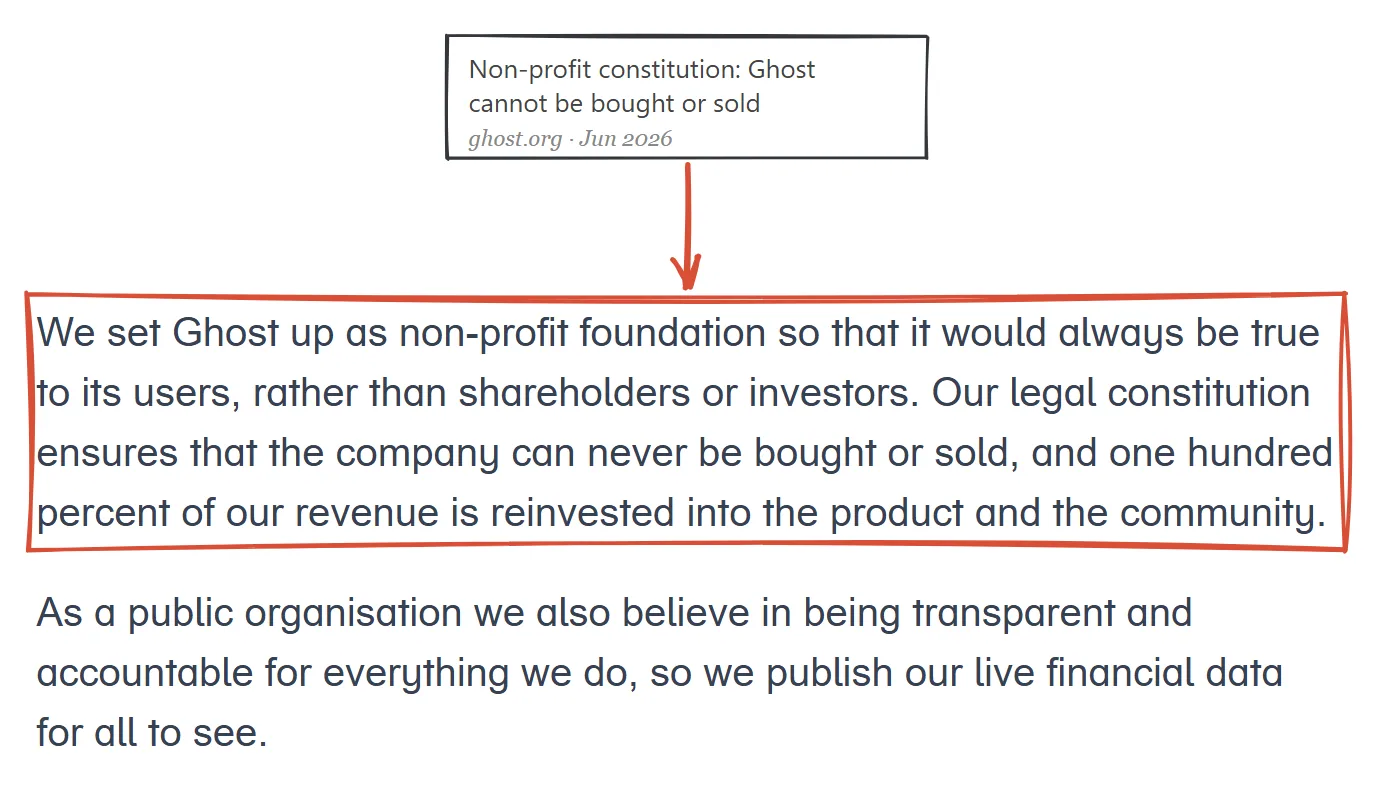
Ghost is a non-profit foundation, founded April 2013, whose constitution states the company "can never be bought or sold," with 100 percent of revenue reinvested. It publishes its metrics live: roughly $10.6M ARR and just over 30,000 active customers as of June 2026 (ghost.org/about). Substack, by contrast, is a VC-backed unicorn (about $1.1B valuation, $190M raised as of July 2025) with no announced profit in over seven years; pressure to raise its take rate is a structural scenario, not a prediction. For a writer choosing a ten-year home, this governance difference is as real as any feature row.
Self-host: the real exit, priced honestly
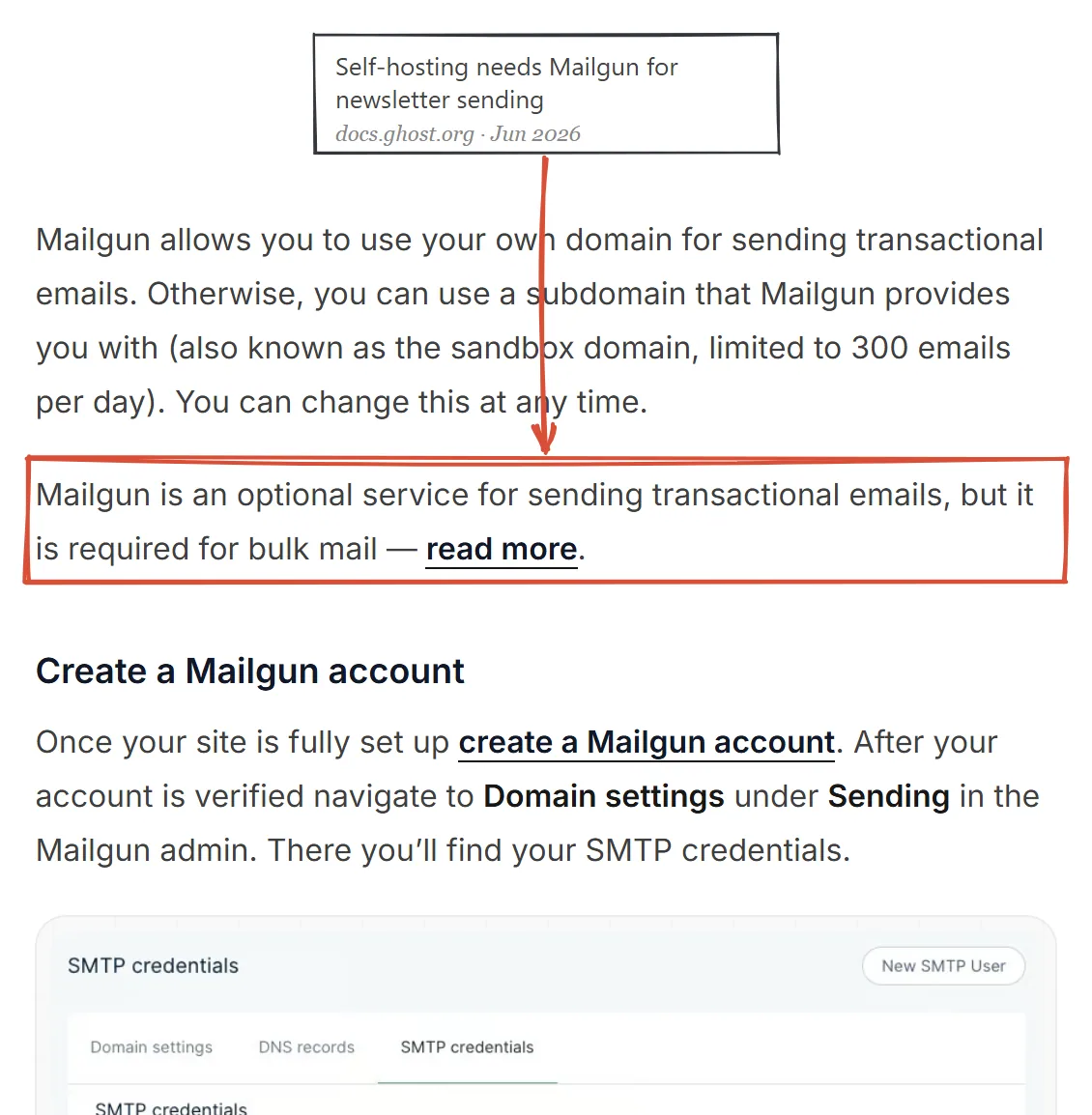
The Ghost software is MIT-licensed. Self-hosting removes deplatforming risk entirely and is the only true ownership path any platform on this site offers. It is not free in operations: Ghost's own docs state Mailgun is "required for bulk mail" (docs.ghost.org/config, June 2026), and one corpus creator calculated a tenfold email-cost jump versus Amazon SES at 600K emails per month. A critical security vulnerability in February 2026 required an emergency patch on self-hosted instances (community-documented). Treat self-host as a second business competency you are acquiring, not a discount.
Our take
Where Ghost Falls Short
- Starter cannot monetize at allGhost's entry plan ($15/mo on annual billing) includes a website, newsletter, and 1,000 members, but no paid subscriptions, no tips, no premium tiers. Monetization starts at Publisher ($29/mo annual at 1,000 members), verified on ghost.org/pricing June 2026. Several comparison articles quote the Starter price as Ghost's cost to replace Substack; for a paid newsletter, that is the wrong number.
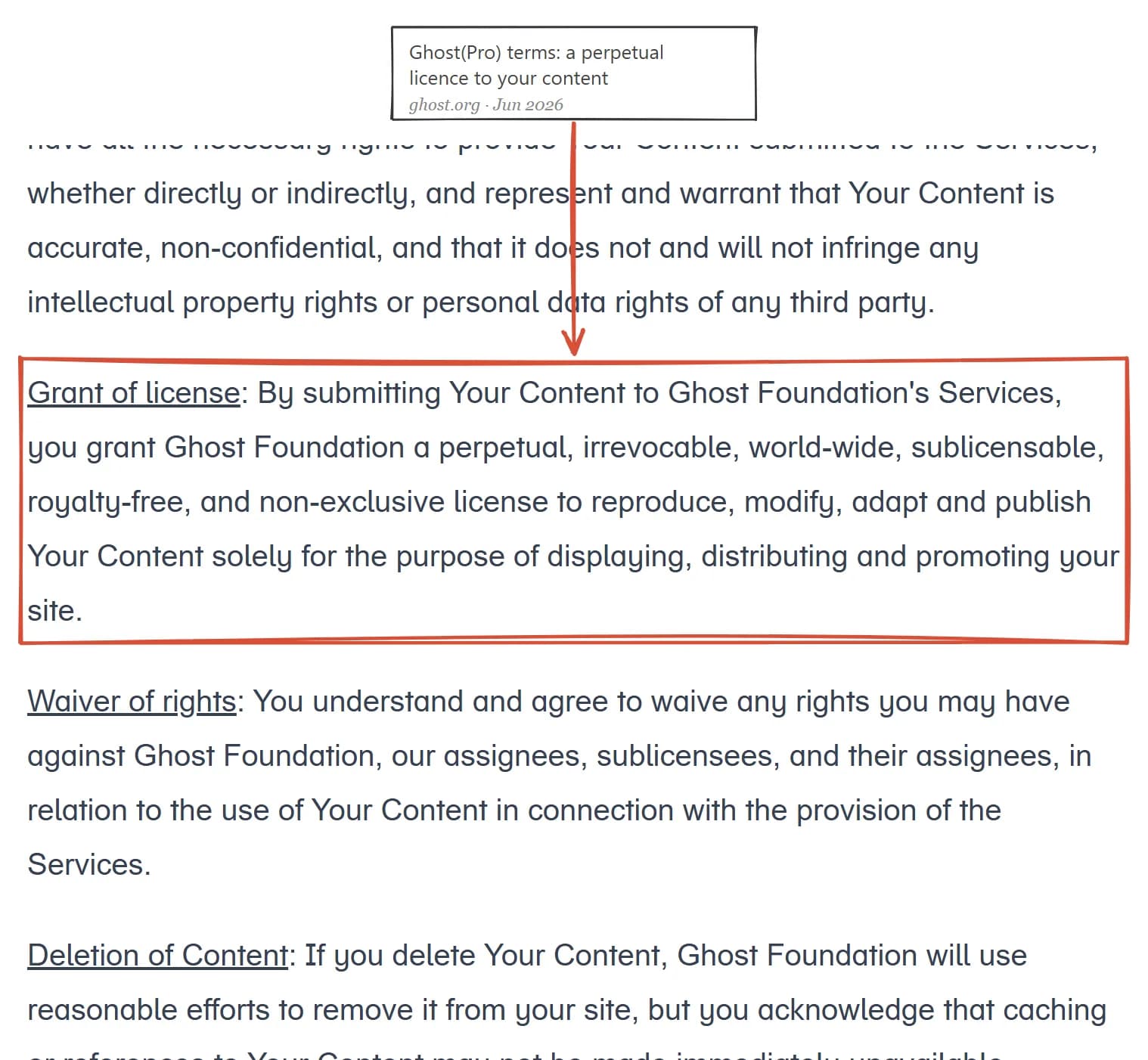
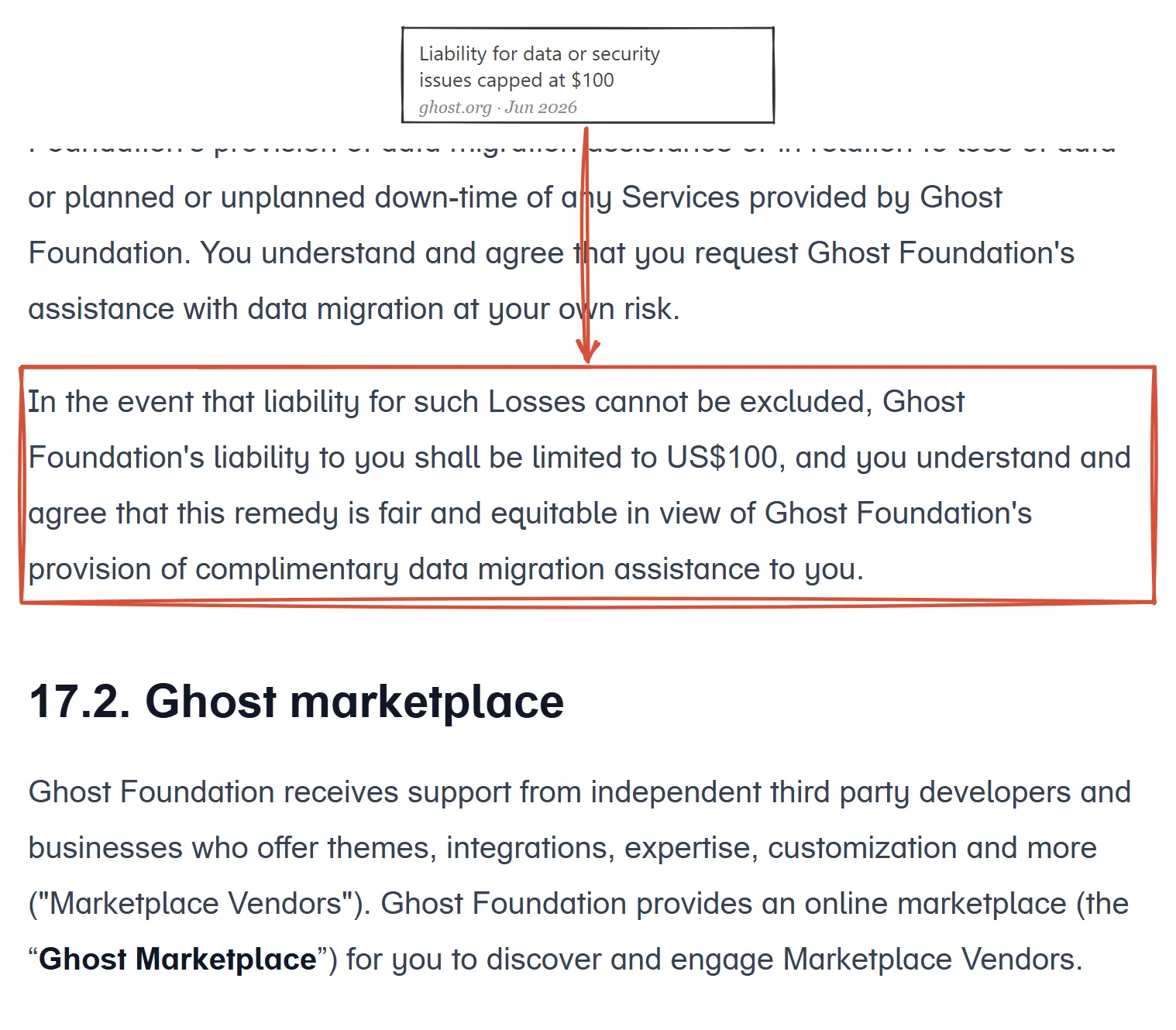
- The ownership pitch has a terms-of-service asteriskSelf-hosting genuinely removes deplatforming risk: the software is MIT-licensed and yours to run. But on Ghost(Pro), the managed product, the terms grant Ghost Foundation a perpetual, irrevocable, royalty-free license to your content (scoped to displaying and promoting your site) and cap liability for data migration and security matters at 100 US dollars (ghost.org/terms, verified June 2026). Disputes route to courts in England and Wales. None of the five top-ranking comparisons we audited mention either clause.
- Self-hosting is free in license, not in operationsGhost's own docs are blunt: Mailgun is "required for bulk mail" on self-hosted installs (docs.ghost.org/config, verified June 2026). One creator in our corpus calculated a tenfold email-cost increase moving a 600K-emails-per-month blog from Amazon SES to Mailgun's pricing. Add server maintenance and security: a critical vulnerability in February 2026 required an emergency patch on self-hosted instances (community-documented). The control is real; so is the operational bill.
- Theme customization frustrates non-developersDesign friction is a recurring theme across 415 Ghost reviews (11 mentions, mixed). One Trustpilot reviewer wrote in July 2025: "The themes are too simple and don't work - the one I paid for didn't work properly." Deep customization means Handlebars templates and CSS. The nuance our corpus adds: a lively third-party theme ecosystem exists but is hard to discover, to the point a community member built a dedicated theme-indexing tool. Budget for a theme or for learning curve, not both zero.
- Analytics stay shallow without third-party toolsNative analytics are limited and the fuller web analytics are gated to Publisher and above. A Reddit user on a paid plan wrote in December 2025: "i dont see any way to check my blog views except Web analytics which is publisher+ plan." Most serious Ghost operators bolt on Plausible, GA, or Tinybird. Substack's analytics are also thin (and iOS open rates are unreliable everywhere), so treat this as a shared weakness with different shapes.
Who Owns Your Audience? Read the Terms, Not the Taglines
This is the matchup where the marketing and the contracts diverge most. Both platforms take a perpetual, irrevocable license to your content in their terms. Substack's applies even after you leave, alongside forced arbitration and a discretionary termination clause; a March 2025 case documented a locked account whose subscriber export became unavailable, and an October 2025 breach (663K accounts, per HaveIBeenPwned) went months before wide disclosure. Ghost(Pro)'s terms grant a perpetual license scoped to displaying and promoting your site, cap liability for data migration and security at 100 US dollars, and route disputes to courts in England and Wales.
The asymmetry that decides this section: Ghost's clauses stop mattering the day you self-host, because the MIT-licensed software is yours to run. Substack offers no equivalent exit. The table below is drawn from our trust-and-risk layer: verbatim terms clauses and documented incidents, with sources on hover.
Trust and risk: Substack vs Ghost
| Platform | Account control | Content license | Liability cap | Vendor longevity | Reliability & incidents | Billing model |
|---|---|---|---|---|---|---|
| Substack | ||||||
| Ghost |
✓ favorable to the creator · ◐ mixed · ✗ unfavorable. Hover or tap a cell for the detail. Compiled June 2026 from public terms, status pages and the pricing data layer. Re-verified quarterly.
Pricing Scenarios: The Break-Even Math
Ghost becomes cheaper than Substack once your paid revenue passes roughly $290/mo per month at the 1,000-member tier; below that, Substack's no-bill model wins. One honest complication the simple version skips: Ghost prices by total members, free plus paid. Substack charges 10 percent of paid revenue and nothing for list size. A large free list with thin paid revenue stays cheaper on Substack longer than the headline break-even suggests, which is why the scenarios below state their assumed list size. Stripe processing applies on both sides and washes out.
Ghost Pricing Tiers (verified June 2026)
- · Starter (annual): $15/mo (Starter, 1K subs) · verified June 7, 2026. Website + newsletter + 1,000 members. No paid subscriptions, no tips: publishing only.
- · Publisher (annual): $29/mo (Publisher, 1K subs) · verified June 7, 2026 at 1K members. Unlocks paid subscriptions at 0% transaction fees, custom themes, advanced analytics, 3 staff users.
- · Publisher (monthly): $35/mo (Publisher, 1K subs) · verified June 7, 2026 at 1K members. Same features, no annual commitment.
- · Business (annual): $199/mo (Business, 1K subs) · verified June 7, 2026. 10K members included, 15 staff, priority support; required once paid subscribers exceed 1,000.
- · Substack (no tiers): Free to start, unlimited subscribers. 10 percent of paid subscription revenue plus Stripe fees. No flat-rate alternative.
Annual Cost by Revenue Tier
Annual platform cost by revenue tier
Monthly paid revenue Assumed list size | Substack platform fee 10% revenue cut | Ghost Publisher (annual) Flat tier by total members | Annual delta Negative = Ghost saves you |
|---|---|---|---|
| $200/mo paid (1K members) | $20/mo ($240/yr) | $29/mo flat: Substack cheaper here | +$108/yr (Ghost costs more) |
| $290/mo paid (1K members) | ~$29/mo equivalent | $29/mo flat | ~$0/yr (break-even zone) |
| $1,000/mo (≈200 paid subs @ $5, 2.5K members) | $100/mo ($1,200/yr) | $46/mo flat | -$648/yr saved |
| $5,000/mo (≈1K paid subs, 10K members) | $500/mo ($6,000/yr) | $88/mo flat | -$4,944/yr saved |
| $15,000/mo (≈3K paid subs, 25K members) | $1,500/mo ($18,000/yr) | $141/mo flat | -$16,308/yr saved |
$200/mo paid (1K members)
- Substack platform fee
- $20/mo ($240/yr)
- Ghost Publisher (annual)
- $29/mo flat: Substack cheaper here
- Annual delta
- +$108/yr (Ghost costs more)
$290/mo paid (1K members)
- Substack platform fee
- ~$29/mo equivalent
- Ghost Publisher (annual)
- $29/mo flat
- Annual delta
- ~$0/yr (break-even zone)
$1,000/mo (≈200 paid subs @ $5, 2.5K members)
- Substack platform fee
- $100/mo ($1,200/yr)
- Ghost Publisher (annual)
- $46/mo flat
- Annual delta
- -$648/yr saved
$5,000/mo (≈1K paid subs, 10K members)
- Substack platform fee
- $500/mo ($6,000/yr)
- Ghost Publisher (annual)
- $88/mo flat
- Annual delta
- -$4,944/yr saved
$15,000/mo (≈3K paid subs, 25K members)
- Substack platform fee
- $1,500/mo ($18,000/yr)
- Ghost Publisher (annual)
- $141/mo flat
- Annual delta
- -$16,308/yr saved
Chart It: Where the Lines Cross
Pricing comparison (static fallback)
Loading interactive chart... Static reference below.
| Monthly paid revenue | Substack (10% cut) | Ghost Publisher (annual) | Flat plan saves |
|---|---|---|---|
| $500/mo | $50/mo | $29/mo (1K subs) | ~$252/yr |
| $5,000/mo | $500/mo | $63/mo (5K subs) | ~$5,244/yr |
| $15,000/mo | $1,500/mo | $88/mo (10K subs) | ~$16,944/yr |
Stripe processing fees apply equally and wash from the comparison. Verified September 2026.
Test Your Own Scenario
Adjust paid subscribers, revenue per subscriber, and list size to find your own crossover point.
Break-even answer (static fallback)
Loading interactive calculator... Static answer below.
Break-even sits at $430 monthly paid revenue. Substack takes 10 percent of paid revenue plus Stripe processing fees. Beehiiv Scale costs $43 per month on annual billing at the 1,000-subscriber baseline, with 0 percent platform fee on paid subscriptions. Above $430 monthly paid revenue, Beehiiv compounds savings every month.
Sample math: at $5,000 monthly revenue, Substack costs $500/mo ($6,000/yr) and Beehiiv Scale costs about $78/mo ($$936/yr) at the 5K subscriber tier on annual billing. Annual savings exceed $5,000.
Migration: No Re-Subscribe Cliff, but the 10% Follows You
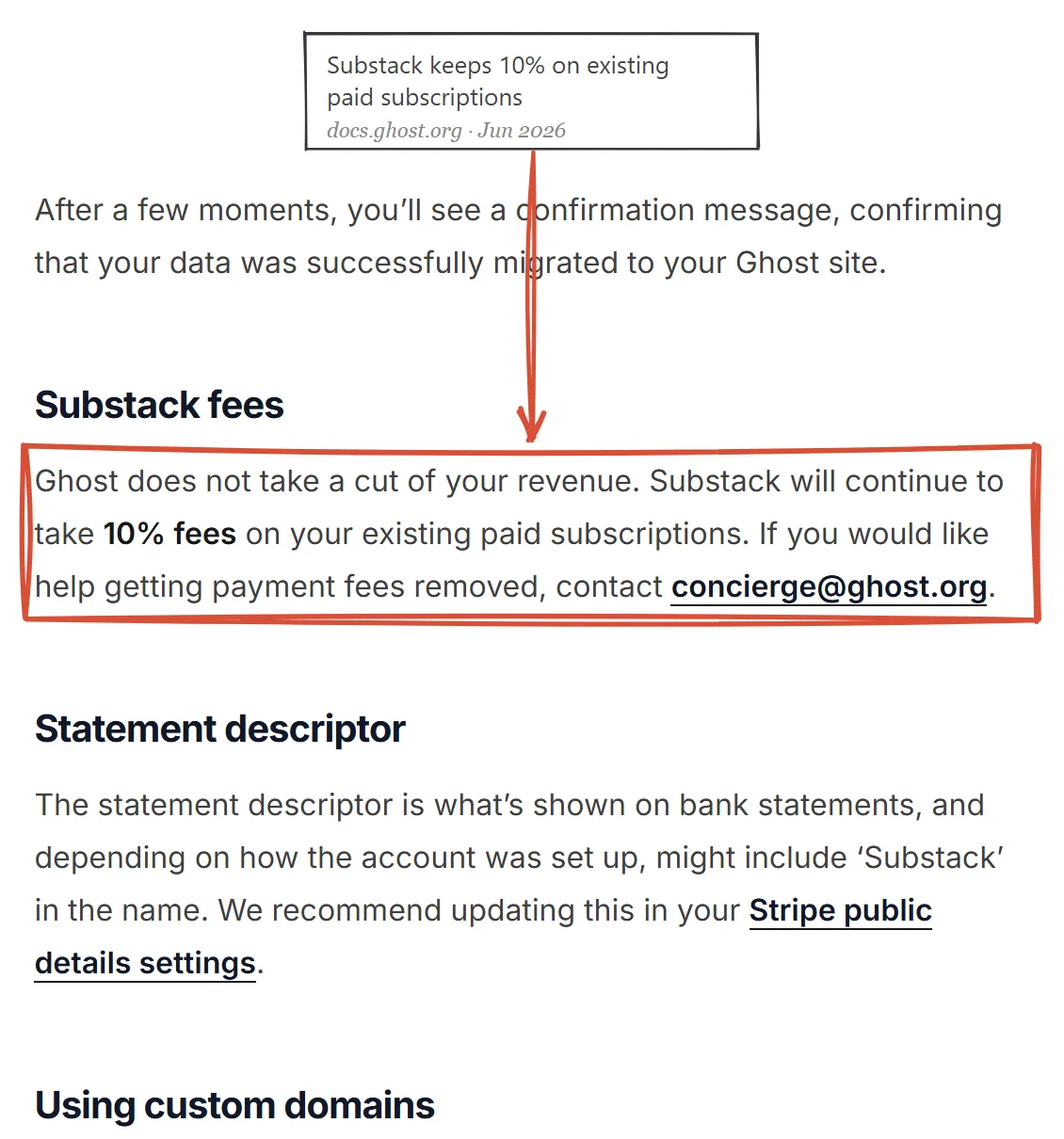
Here is the part every comparison we audited gets wrong or skips. Substack-to-Ghost is the rare migration where paid subscribers do not need to cancel and re-subscribe. Ghost's official migration docs (verified June 2026) have you connect the same Stripe accountthat powers your Substack, then import subscribers by CSV; existing subscriptions keep billing uninterrupted. Compare that with Substack-to-Kit, where payment data cannot move and every paid subscriber faces a re-subscription ask with a typical drop. One top-five competitor page even claims Ghost migrants must "re-enter payment details." Ghost's primary documentation says otherwise.
The trap is what happens to the fee. Quoting Ghost's docs verbatim: "Ghost does not take a cut of your revenue. Substack will continue to take 10% fees on your existing paid subscriptions. If you would like help getting payment fees removed, contact concierge@ghost.org." Until that removal goes through, you pay Ghost's plan andSubstack's 10 percent on every legacy subscription. Two housekeeping steps complete the move: get the fee removed, and update your Stripe statement descriptor, which may still print "Substack" on your readers' bank statements.
What never transfers, on any path: Notes followers, recommendation traffic, and Apple in-app subscriptions. Our corpus also counsels patience on the mechanics; migration is a negative theme on Ghost (six mentions), with one Reddit user describing a Squarespace move that generated mass 404s from trailing slashes. Budget a weekend, not an hour.
Real-World Cases: What the Switch Actually Pays
The Rose Garden Report math
Sean Highkin runs The Rose Garden Report, an NBA publication. The Verge reported in May 2026 that he pays $2,052 per year on Ghost plus the Outpost add-on, against $4,968 per year he was paying on Substack: a $2,916 yearly difference by our arithmetic. His subscriber base, as of that article, had grown 22 percent since the end of 2024. He also told The Verge the early Substack push faded once he stopped being new: "they stopped featuring me and I saw my growth stagnate." One creator's numbers, not a law; the direction matches the fee math above.
Who stays, and why that is rational
The corpus is equally clear about the reverse case. Creators starting from zero describe the network as the reason they earn anything at all, and readers on Substack convert to paid at rates multi-platform creators describe as unusually high: "People on Substack are a lot more inclined to pay" (Reddit, March 2026). A writer below break-even, growing through Notes, gives up real acquisition by leaving and saves little. The honest framing is sequencing, not allegiance: Substack to build, Ghost (or another flat-fee platform) once the 10 percent outgrows a plan price.
Account risk exists on both, with different shapes
Substack suspension reports center on opacity (20 mentions: no rule cited, generic appeal rejections). Ghost's billing thread is smaller but real: five mentions across years, including an unrequested plan change that doubled a customer's bill (reported on Capterra back in 2020) and a partial refund after weeks of unresolved problems (Trustpilot, January 2026). And Ghost Pro's February 2026 backup incident was fixed only after the founder personally intervened. Whoever hosts you, the monthly CSV export habit stands.
Email Deliverability: What Neither Platform Publishes
Neither Substack nor Ghost publishes an audited inbox-placement rate, and we will not invent one. In 895 signals, deliverability is a minor theme on both (8 Substack mentions, 2 Ghost mentions). The Substack reports that exist are specific: open rates dropping under 20 percent after a list migration (one attributed Reddit report, June 2025) and emails landing in Gmail's Promotions tab. Substack runs entirely on shared sending infrastructure, with no custom sending domain or dedicated IP option.
Ghost's situation depends on the path. Ghost(Pro) handles sending for you; self-host puts you on Mailgun with your own domain reputation to manage, which is either control or risk depending on your competence. If deliverability decides your choice, test with your own list and content before committing, and distrust any published percentage, including any you wish we had printed here.
Frequently asked
Frequently Asked Questions
Is Ghost cheaper than Substack?
Above roughly $290/mo in paid subscription revenue, yes. Substack takes 10 percent of each transaction (support.substack.com, verified June 2026) plus Stripe fees. Ghost charges a flat monthly price and 0 percent transaction fees, but paid subscriptions require the Publisher plan ($29/mo on annual billing at 1,000 members, verified ghost.org/pricing June 2026). Below the break-even point Substack is cheaper because it costs nothing until you earn. One caution the simple math hides: Ghost prices by TOTAL members, free and paid combined. A newsletter with 20,000 free readers and modest paid revenue pays Ghost's higher member tiers while Substack still charges only 10 percent of the small paid revenue. Run your own numbers in the calculator on this page.
Do my paid Substack subscribers have to re-subscribe on Ghost?
No, and this surprises people who have read about other migrations. Ghost's official migration documentation (docs.ghost.org, verified June 2026) has you connect the same Stripe account that powers your Substack, then import subscribers by CSV. Existing paid subscriptions keep billing through that shared Stripe account, so there is no cancel-and-resubscribe cliff like the Substack-to-Kit path. The catch is the fee: per the same Ghost documentation, "Substack will continue to take 10% fees on your existing paid subscriptions" until those fees are removed. Ghost's concierge (concierge@ghost.org) helps you request that removal. Apple in-app subscriptions remain non-portable on any migration path.
Why can't I sell subscriptions on Ghost's Starter plan?
Because Starter is publishing-only by design. Ghost's pricing page (verified June 2026) lists paid subscriptions, tips, and premium tiers from the Publisher plan up; the Starter column has no monetization row at all. On Starter ($15/mo annual or $18/mo monthly, up to 1,000 members) you get a website, a newsletter, and simple design settings, but no way to charge readers. If your goal is replacing Substack's paid subscriptions, price Ghost at Publisher ($29/mo annual at 1,000 members), not at the Starter price you may have seen quoted elsewhere.
Does Ghost really give me ownership of my content?
Structurally yes, with one asterisk almost nobody reads. The Ghost software is open source under the MIT license: self-host it and no company can deplatform you or hold your archive. That part of the ownership pitch is real and unique among Substack alternatives. The asterisk applies to Ghost(Pro), the managed hosting most writers actually buy: its terms grant Ghost Foundation a "perpetual, irrevocable, world-wide, sublicensable, royalty-free" license to your content (scoped to displaying and promoting your site) and cap Ghost's liability for data migration and security matters at 100 US dollars (ghost.org/terms, verified June 2026). Substack's terms also include a perpetual content license. On paper, neither hosted product is as clean as the marketing.
Do I lose Substack's discovery network if I move to Ghost?
Yes, and you should price that in. Substack claims 30 percent or more of paid subscriptions come from inside its network (substack.com/about, self-reported, no third-party audit). Notes followers and recommendation traffic do not export; only your email list does. Ghost ships cross-site recommendations, the Ghost Explore directory, and ActivityPub federation, but there is no algorithmic feed pushing your work to readers, and Ghost users in our review corpus describe signup growth as slow without external channels. If Substack's network is your main acquisition source today, leaving it means replacing that growth with SEO, social, or paid channels you control.
How We Built This Comparison
OwnLetter operates as a lab-style analyst, not a power-user reviewer. We read 895 unique user signals in full (480 Substack, 415 Ghost) across Reddit, Trustpilot, G2 and Capterra, aggregated June 2026; no keyword sampling. Pricing comes from our weekly automated tracker (verified June 7, 2026) and is rendered from that data, never typed by hand. On June 11, 2026 we re-fetched both vendors' primary pages live: pricing, terms, migration docs, about pages, Trustpilot aggregates, and the HaveIBeenPwned breach entry.
All 35 claims in our manifest carry a source URL and verification status (29 verified against a primary source, 6 attributed to the review corpus or flagged as derived). Zero claims are invented. First-hand status, stated plainly: we operate a test Substack publication (hands-on log, June 10, 2026); we have not yet run a Ghost trial, so nothing on this page presents Ghost as "tested by us." Full methodology →
Affiliate status: Substack runs no affiliate program. Ghost runs one, but OwnLetter is not enrolled (it is gated behind an audience threshold we have not requested yet). This page earns us nothing, which we flag as a trust asset: the verdict has no commission behind it.
Sources
- · Ghost pricing page (verified June 11, 2026)
- · Substack support: How much does Substack cost? (verified June 11, 2026)
- · Substack going-paid page ("keep 90%" framing) (verified June 11, 2026)
- · Ghost official Substack migration documentation (verified June 11, 2026)
- · Ghost(Pro) terms of service (content license + liability cap) (verified June 11, 2026)
- · Ghost about page (non-profit constitution + live metrics) (verified June 11, 2026)
- · Ghost self-hosting configuration docs (Mailgun requirement) (verified June 11, 2026)
- · HaveIBeenPwned: Substack breach entry (663K accounts, Oct 2025) (verified June 11, 2026)
- · The Verge: "Writers are fleeing the Substack Tax" (Highkin case) (published May 10, 2026)
- · Substack about page (5M paid subscriptions + 30%+ network claims, self-reported) (verified June 11, 2026)
- · Trustpilot Substack reviews (1.3/5, 161 reviews, read live June 11, 2026)
- · Trustpilot Ghost reviews (2.8/5, 15 reviews, read live June 11, 2026; sample too small to weigh)
- · Ghost open-source repository (MIT license) (verified June 2026)
Who Should Pick Which
If you already earn past $290/mo in paid subscriptions:
Ghost, at the Publisher tier. The 10 percent you are paying already exceeds the flat plan, the migration keeps your Stripe billing intact, and the savings compound monthly. Read the terms section first so you know what Ghost(Pro) does and does not promise, and request the legacy fee removal the week you move.
Try Ghost (14-day trial) →If you're starting from zero, no audience yet:
Substack. It costs nothing until you earn, onboarding requires no decisions, and the Recommendations network is real acquisition Ghost cannot match. The 10 percent on early revenue is cheap for what the network returns at that stage. Re-run the math when the cut approaches a Ghost Publisher bill, and export your CSV monthly from day one.
Start free on Substack →If ownership is the actual requirement:
Ghost self-hosted is the only real answer on this page; every hosted product here, Ghost(Pro) included, takes a perpetual content license in its terms. Self-host costs operations: Mailgun for sending, server upkeep, and security patches on your calendar (February 2026 was a live example). If you would not run a server for your business, buy Ghost(Pro) with clear eyes or stay hosted elsewhere.
If you need automations, commerce, or a CRM:
Neither. Substack's sequences live in a restricted beta and Ghost has no behavioral automation at all. That buyer should be comparing Kit and Beehiiv instead; our Substack vs Kit page covers that path honestly.
Looking wider? See the full Substack alternatives 2026 guide or the Substack vs Beehiiv comparison if ad-monetization and growth tooling matter more than ownership.
Join the Discussion
Using Substack or Ghost? Share your experience or correct an inaccuracy. No account required: email and name only. Comments are moderated.